
50x Leverage Contract Trading to Earn Millions of Dollars Daily: Why Do Whales Choose to Open Positions on Hyperliquid?
Original Article Title: The Secret Sauce of Hyperliquid
Original Article Author: @stacy_muur, CuratedCrypt0 Member
Original Article Translation: zhouzhou, BlockBeats
Editor's Note: Why are whales so keen on Hyperliquid, the decentralized derivatives platform known for its up to 50x leverage, zero Gas fees, and on-chain transparent order book, becoming a paradise for high-risk traders? Recently, according to blockbeat flash news, several whales opened high-leverage long and short positions after Trump announced a strategic crypto reserve, netting hundreds of millions of dollars. The platform's low-cost, high-leverage features, coupled with market volatility, have made whales flock to it, making Hyperliquid the new focus of contract trading.
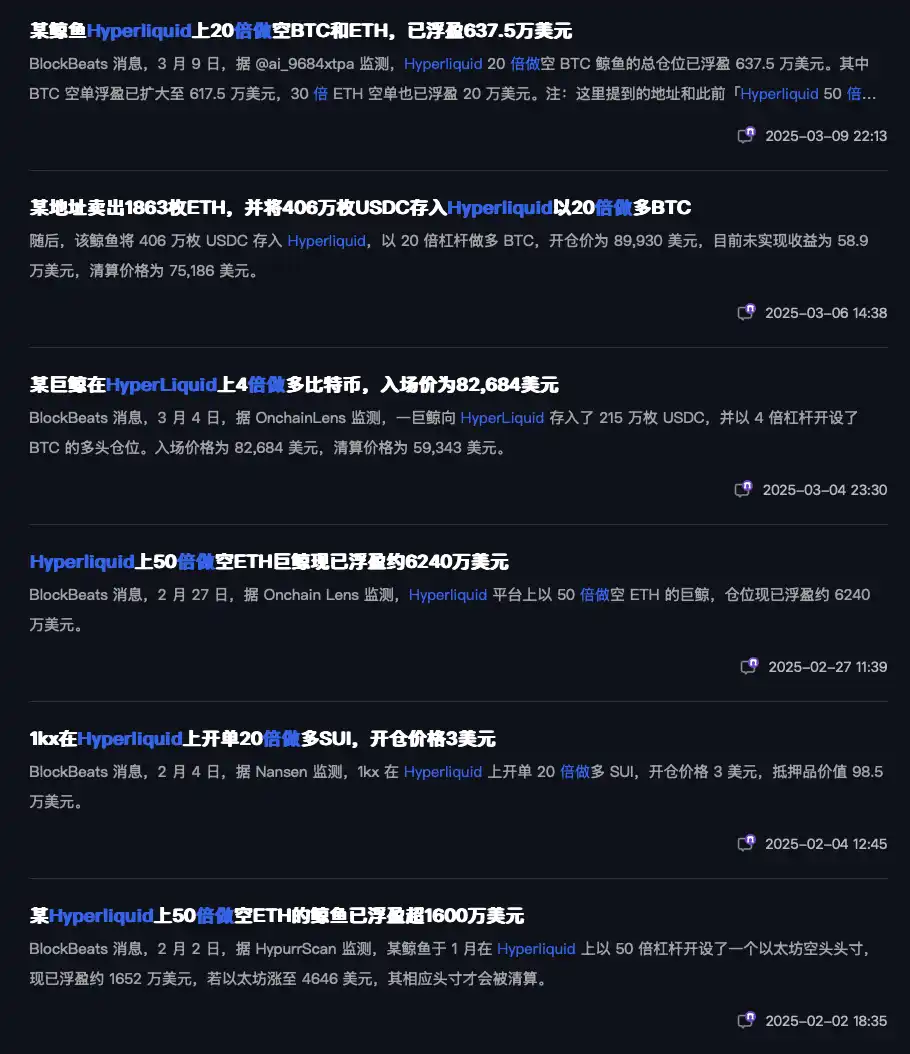
Below is the original article content (slightly reorganized for better readability):
In the history of DeFi derivatives, few protocols have been able to dominate over half of the on-chain perpetual contract market, but Hyperliquid has achieved this. What is its secret?
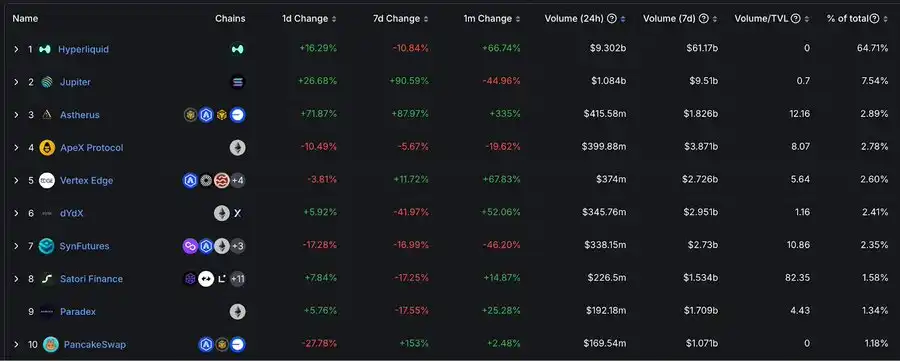
Data shows that in the last 24 hours, the total trading volume of on-chain perpetual contracts was $143.7 billion, with @HyperliquidX accounting for a staggering $93 billion, representing a market share of 64.71%, showcasing Hyperliquid's absolute dominance in the market.
However, most DEXs have struggled to match in these aspects, usually relying on:
· AMM design (leading to high slippage on large orders, e.g., GMX);
· Partial layer 2 solutions (like dYdX v3), which can affect transparency or increase user complexity.
Hyperliquid recognized this issue: if the user experience is poor or liquidity is insufficient, users will not massively migrate on-chain. Therefore, the team is committed to providing "CEX-level speed and liquidity but fully on-chain."
Hyperliquid's success has demonstrated the potential of DEXs when facing giants like Binance. Binance's 24-hour perpetual contract trading volume is $972.2 billion, while the overall DEX trading volume is only $146.37 billion, with Hyperliquid contributing $95.32 billion.
With Hyperliquid, the DEX's trading volume can reach 15% of Binance's; without it, this ratio would drop to 5%, leaving only $51.05 billion. This demonstrates Hyperliquid's driving force for DeFi transactions.
This performance delivers on Hyperliquid's core promise — to provide a CeFi-level trading experience on a fully decentralized Layer-1.
Background and Founding Story
Origin and Team Composition
Hyperliquid was founded by @chameleon_jeff (a Harvard graduate and former Hudson River Trading quantitative trader) and a small engineering team from top-tier institutions such as MIT, Caltech, and others.
They were previously involved in high-frequency trading (HFT) from 2020 to 2022 and shifted to trustless solutions after the FTX collapse. Seeing billions of dollars disappear due to centralized custody, their goal became clear: to build a self-custodial alternative without sacrificing performance. They chose a "no VC, self-funded" approach to ensure long-term alignment with user and trader interests, rather than catering to short-term investor interests.
Why Can CEXs Still Dominate?
Despite major CEX failures like FTX, user trading habits did not immediately shift to DeFi. Many traders still use centralized platforms like Binance, not because they overlook custody risks, but because CEXs always provide:
· Fast and familiar interfaces
· Deep liquidity
· Advanced trading features (stop-loss orders, professional K-line charts, etc.)
· No Gas fees, cross-chain interoperability
· Low barriers and a convenient trading experience
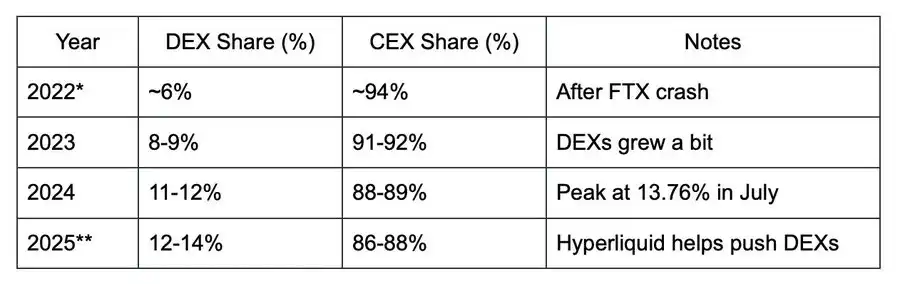
The year 2022 refers to the period after the FTX collapse (November to December). The 2025 data is an estimated value as of March 6. Hyperliquid recognized this shortcoming: if the user experience is poor or liquidity is lacking, users will not migrate to the chain on a large scale. Therefore, the team is dedicated to building "CEX-level speed and liquidity but fully on-chain."
Product Development Prioritizing User Experience from Day One
Let's take a look at Hyperliquid's product matrix:
1. Perpetual Contract DEX
Hyperliquid's core product is its Perpetual Contract DEX, featuring a fully on-chain Central Limit Order Book (CLOB), supporting:
· Up to 50x leverage on BTC, ETH
· Up to 20x leverage on SOL, SUI, kPEPE, XRP
· Up to 3x leverage on small-cap tokens
Hyperliquid is built from the ground up to provide greater composability than competitor layer-two solutions and is specifically designed for high-frequency trading (HFT) needs. Key features include:
· Sub-second trade confirmation
· Processing 100,000 orders per second
· Gas-free or near-zero gas order and cancel experience
These key factors make its user experience on par with CEX.
Advanced Trading Mechanisms
· Atomic Operations: Settlement based on the latest oracle prices supporting atomic settlement and hourly distribution of the funding rate
· Asset Safety Checks: Platform conducts asset security validations at the end of each block
· Order Priority: Prioritizing cancellation over order-only limit orders to protect market makers from malicious liquidity attacks
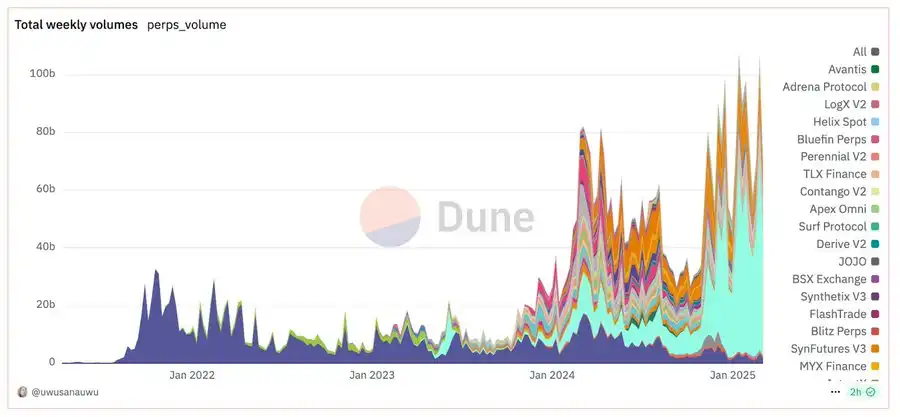
As of last week, Hyperliquid Perps' trading volume reached $665 billion, nearly 7x that of the second-ranking Jupiter ($97 billion), and surpassing the next 14 competitors combined ($336 billion). Hyperliquid accounts for 66% of the total trading volume of the top 15 perpetual exchanges.
2. Spot Exchange
Hyperliquid's spot exchange went live in mid-2024, initially supporting over 20 native assets like HYPE, memecoin, and more.
Compared to Hyperliquid's massive $1.06 trillion perpetual contract market, the spot exchange started smaller but has been growing rapidly. By early 2025, with key upgrades (especially BTC listing), Hyperliquid is gradually becoming a strong contender in on-chain spot trading.
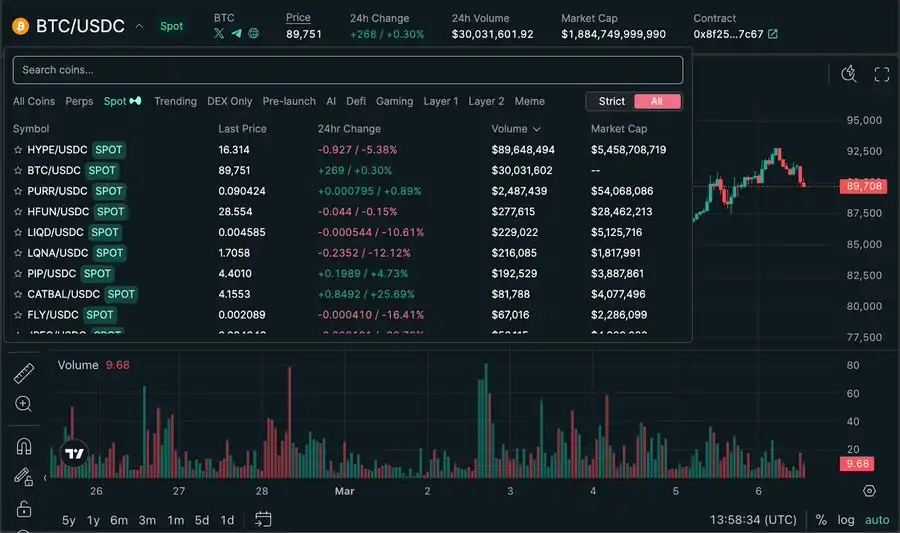
Looking back to mid-2024, Hyperliquid's spot trading was limited to its native token and a few other assets (such as RAGE). This limited asset range deterred many professional traders who preferred mainstream assets like BTC rather than just speculative tokens.
Messari analyst MONK predicted in his report that if Hyperliquid were to add BTC, it would completely change the situation, turning it into a one-stop platform that covers both spot and derivative trading, challenging centralized exchanges. This prediction was quickly validated on February 15, 2025, when the Unit team launched the functionality to directly trade BTC spot on the Hyperliquid order book.
What does this mean?
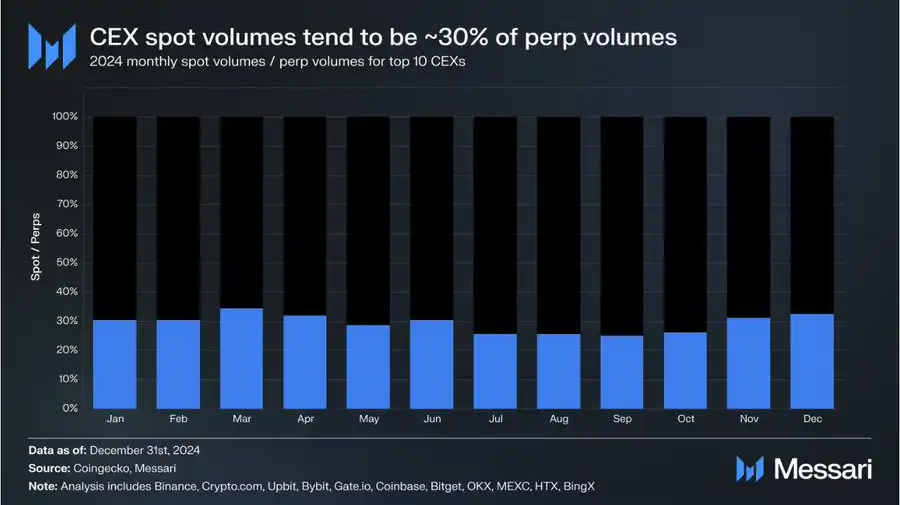
· Surge in Trading Volume: Prior to BTC's listing, Hyperliquid's spot trading volume was only a small fraction of the $630 billion monthly BTC perpetual contract trading volume. Messari estimated that by introducing the right assets, spot trading volume could reach 20%-30% of the perpetual contract trading volume, potentially adding billions of dollars. With BTC spot now live, other DEXs already had $330 billion monthly BTC trading volume, and Hyperliquid is quickly capturing this market share.
· More Assets to Come: Unit's roadmap not only supports BTC but also lays the foundation for the future introduction of ETH, SOL, and even real-world assets. This could position Hyperliquid as a central market for cryptocurrency spot trading.
3. Hyperliquid HLP (Liquidity Pool)
HLP is a liquidity pool where users can deposit funds (mainly USDC) to act as counterparties to traders on the derivatives exchange and receive a share of the trading profits.
· Purpose: To provide passive income opportunities for users who do not want to actively trade, following the "house always wins" model, allowing depositors to benefit from trading activity.
· Key Features:
Funds deposited by users are lent to traders for leverage trading.
Earnings are variable, but by the end of 2024, the annualized return rate had reached 54% at one point.
4. Vaults (Copy Trading)
Hyperliquid offers the Vaults feature, allowing users to allocate funds to professional traders' strategies for automatic trading.
· Purpose: To enable regular users to benefit from top traders' expertise without needing to trade directly themselves.
· Key Features:
Anyone can create a Vault and manage funds, with managers needing to hold at least a 5% position and receiving a 10% profit share.
Users can view different Vault performances, choose investments, and participate in profit sharing.
5. HIP-1 and HIP-2 Token Standards
Hyperliquid has introduced two innovative token standards to enhance its ecosystem:
· HIP-1: Native token protocol allowing users to mint custom tokens on Hyperliquid L1 (e.g., PURR, a meme coin introduced as a proof of concept).
· HIP-2: Liquidity solution providing market-making strategies for HIP-1 minted tokens to ensure liquidity without relying on external platforms like Raydium (unlike Pump.FUN).
Key Features:
· HIP-1 tokens can be directly used for spot and perpetual contract trading on Hyperliquid.
· HIP-2 offers custom market-making by the Hyperliquid team leveraging their quant trading capabilities to provide liquidity support.
Example: PURR features a native ledger, spot order book, built-in oracle, and perpetual contract trading, demonstrating how these standards build a composable trading ecosystem.
Hyperliquid's Technical Core
From perpetual contracts to spot trading, all of Hyperliquid's products are built on its custom blockchain — Hyperliquid Layer1. On February 18, 2025, HyperEVM officially launched on the mainnet.
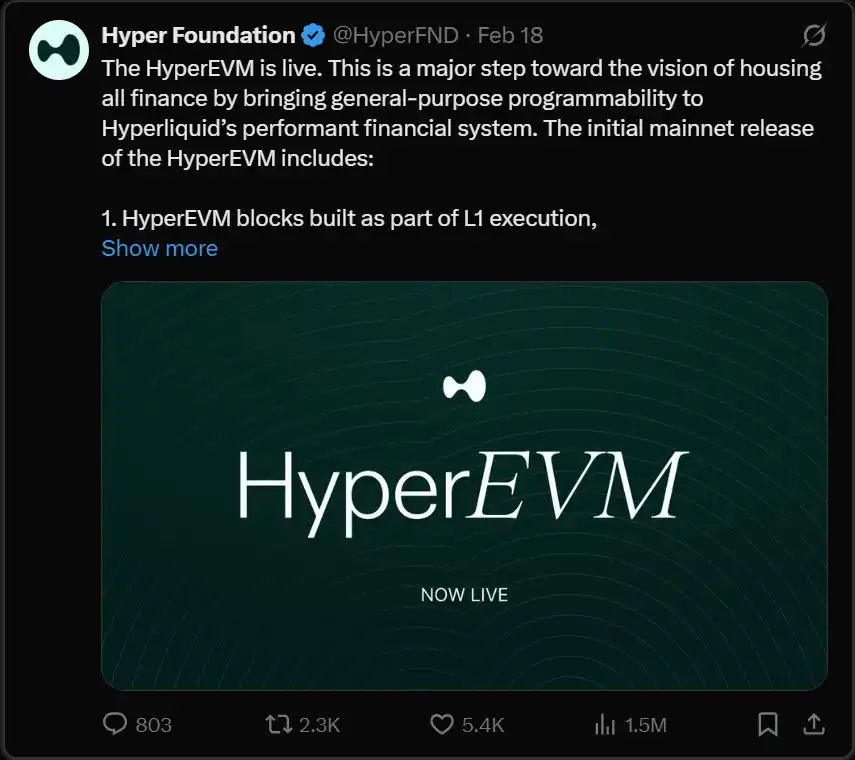
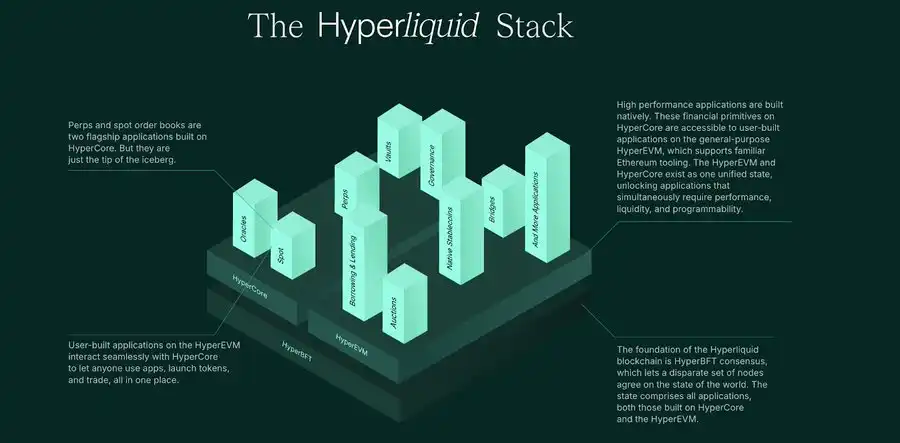
Hyperliquid's blockchain can currently process over 20,000 transactions per second (TPS), supporting a robust ecosystem including perpetual contract trading and the BTC spot market. Based on HyperBFT consensus, its L1 has evolved from an initial professional trading platform to a general-purpose blockchain.
HyperBFT Key Optimization
Significant TPS Increase: Previously limited by Tendermint, supporting only 20,000 transactions per second, the upgrade now can process 200,000 transactions per second.
Faster Processing Speed: The consensus process will not be blocked by execution, transactions can be continuously ordered without waiting for the current block to be executed.
Lower Latency: Confirmation time is faster and more stable, only affected by network latency.
Optimistic Response: Block generation speed depends on the validators' communication efficiency.
HyperEVM: Full Layer-1 Capability
HyperEVM integrates a general EVM network into the Hyperliquid blockchain state, forming a Dual VM Architecture:
Native VM: Optimized for high-performance transactions.
EVM Layer: Supports permissionless third-party development.
With the upgrade of HyperBFT and the introduction of BTC spot trading, Hyperliquid is gradually becoming a more powerful and versatile trading platform.
How Does Hyperliquid Compare to...
Hyperliquid vs. Other DEX
On-chain Fullness vs. Off-chain Partiality
Hyperliquid adopts an on-chain Central Limit Order Book (CLOB), while many DEX competitors (such as dYdX v4) still rely on off-chain partial order books. Hyperliquid's approach ensures verifiability and a transparent matching engine, avoiding dark pool operations and front-running issues.
Dominance in Perpetual Contract Markets
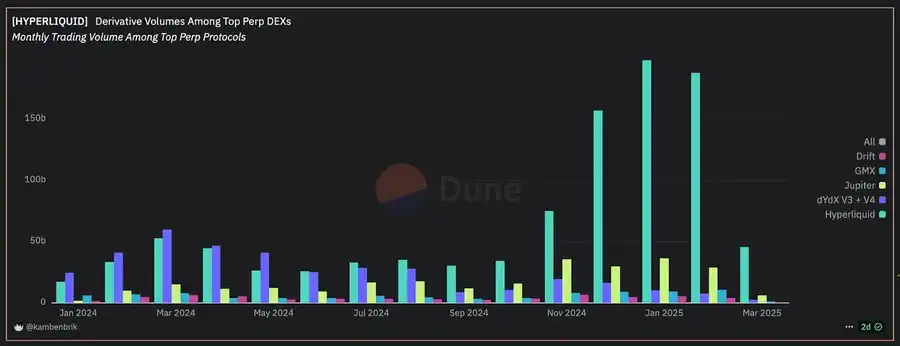
As of February 2024, Hyperliquid has captured 56% of on-chain derivatives DEX trading volume. Since July 2024, its monthly perpetual contract trading volume has surpassed major competitors. In January 2025, Hyperliquid's monthly perpetual trading volume reached $196 billion, while the sum of the other four protocols was only $60 billion.
Performance and Market Maker Priority
Hyperliquid's custom Layer-1 and consensus mechanism (HyperBFT) enable it to achieve sub-second latency and a transaction throughput of around 100,000 trades per second. This is specifically tailored for high-frequency trading. Other DEXs based on general-purpose blockchains need to share block space with many other transactions, making it more challenging to maintain high throughput.
Comparison to CEX
Transaction Volume Discrepancy and Growth Trajectory
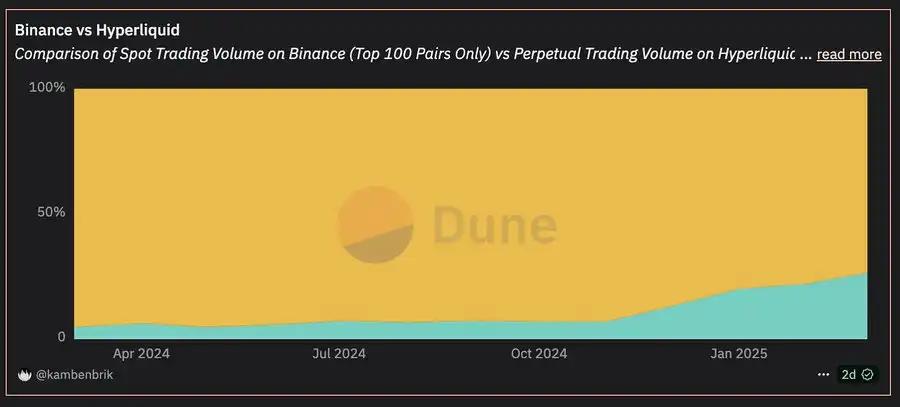
· While Hyperliquid is still smaller than top-tier CEXs like Binance, it has narrowed the gap in certain months, with its transaction volume share exceeding 26% of the displayed total volume by March 2025 (compared to Binance's top 100 spot trading pairs). This comparison highlights how an on-chain high-performance perpetual contract exchange can effectively challenge or even dominate centralized spot markets.
On-Chain Transparency vs. Centralized Control
CEXs usually have proprietary off-chain engines, potentially creating opacity in order routing, fees, or front-running. Hyperliquid's fully on-chain design allows anyone to verify transactions in real-time.
Future Goal: "On-Chain Binance"
Analysts have described the bullish case for Hyperliquid as evolving into an on-chain Binance analogy. It has already offered perpetual contracts and a growing spot market, recently launched spot BTC, and with HyperEVM now live on the mainnet, it is beginning to attract a broader range of DeFi applications.
After becoming a product leader in the DeFi derivatives space, Hyperliquid's rapid success is not only dependent on its performance but also demonstrates its community-first philosophy.
Hyperliquid Community: A Trading Platform Built for Traders
Community-First Token Allocation
· Risk-Free Investor Ownership: Hyperliquid's team conducted development through self-funding, avoiding scenarios where private investors dominate token distribution. This ensures that the tokens are not diluted by large VC stakes, setting it apart from competitors like dYdX (over 50% to investors) or GMX (30% to insiders).
· Generous Airdrop:
Genesis Airdrop (31% of the supply): Distributed to 94,000 early users, with an average of about $45,000 each. This was to reward actual users, not speculators.
Reward Program: An opaque reward mechanism that deters Sybil attacks, favoring loyal users over bots.
76% Community Allocation: Over 3/4 of the $HYPE tokens allocated to the community (airdrops + incentives), ensuring alignment with long-term growth.
Listening to Users
Direct feedback has built a community with shared interests. The team reached out via DMs to traders like @HsakaTrades (500k+ followers) and @burstingbagel, basing Vaults (e.g., Delta-neutral strategies with 20%+ APY) and HLP on feedback. Since 2024, over 50% of feature updates have come from user requests, making traders co-creators, not just users.
· Building Trust Through Reliability
A reliable product can retain users in a skeptical market. Traders initially came for the airdrop but stayed because Hyperliquid offered 1-second deposit times, deep HLP liquidity, and 99.9% uptime, unlike competitors that often suffered downtime.
Hyperliquid wasn't the first DEX to launch perpetual contracts, but by optimizing trade speed (sub-second order execution), liquidity (HLP pools over $5.4B), and user experience (addressing withdrawal delays competitors ignored), it achieved 100,000 daily trades, dispelling doubts that "dYdX or GMX have ended the derivatives market."
Aid Fund
When traders use the Hyperliquid platform, they pay transaction fees, with a portion going to the Aid Fund (AF).
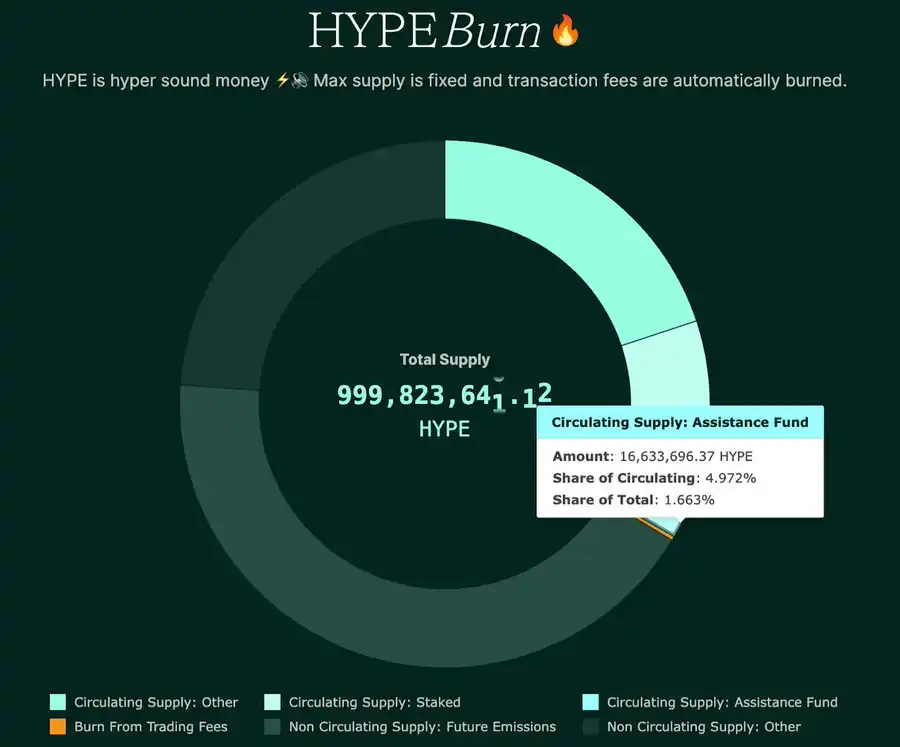
This fund continuously buys HYPE tokens from the market, creating sustained buying pressure. As trading volume increases, more fees flow into the AF, further boosting HYPE demand. To date, AF has accumulated 16.63M HYPE tokens, 4.97% of the circulating supply, valued at approximately $2.6724B. The rapid growth of Hyperliquid is evident, with perpetual trading volume alone reaching $196B in January 2025.
What Does This Mean for End Users
For HYPE holders and traders, this system creates a self-reinforcing value loop. As Hyperliquid trading activity grows (as shown in the diagram below), the purchasing power of the aid fund will also grow, ultimately benefiting long-term token holders.
Self-Reinforcing Loop: More Trades → More Fees → More Buybacks → Token Value Appreciation.
User-Centric Product Design
· Gasless Transactions: Gas fees are incurred only when transactions trigger state mutations (e.g., spot listing or transferring to a new wallet).
· No KYC Required: Register through email or a crypto wallet (such as MetaMask).
· Intuitive Interface: Designed for both beginners and advanced traders, the interface resembles that of centralized exchanges (e.g., Binance).
· Near-Instant Settlement: Sub-second block times support real-time transactions.
· High Throughput: Processes over 200,000 transactions per second, even during peak activity without delays.
· Easy Fund Deposits: Deposit USDC via Arbitrum (future plans to support native multi-chain).
· Gamified Design: Leaderboards and competitive rewards (e.g., airdrops to top traders) foster a highly engaged, active community.
Decentralization Path
While Hyperliquid's L1 initially operated by team-run validators (for performance optimization and rapid iteration), it is gradually moving toward a multi-validator network and a distributed node framework:
· Expanded Validator Set (from 16 to over 100 nodes).
· Read-Only Nodes: Third parties can run nodes to validate the chain's state and block production.
· Long-Term Deployment Strategy: With ecosystem growth, the team plans to introduce stronger staking and validator onboarding mechanisms, progressing toward a trustless model akin to leading proof-of-stake networks.
· Team Incentive Alignment: Because fees currently flow to the protocol treasury and LP providers (not the founding team), the team's future rewards are tied to the upcoming token launch, aligning with long-term chain performance and decentralization goals.
Looking ahead, Hyperliquid is evolving from a specialized perpetual contract DEX into a full-fledged exchange ecosystem. With the addition of BTC spot trading, the launch of HyperEVM on the mainnet, and the expansion of the validator set, its ambition is evident as it aims to become the "on-chain Binance."
It combines CeFi's high performance with DeFi's transparency, already occupying 64.71% of on-chain perpetual contract trading volume, demonstrating how a successful community-driven approach can propel a DEX to challenge even the largest centralized platforms.
What Is the Secret to Hyperliquid's Success?
1. VC-Free, Self-Funded Model: Ensuring users hold the token, reducing private sale pressure, prioritizing the interests of true traders over short-term investors.
2. User-Centric Token Distribution: Generous airdrops (31% of the supply allocated to early users, around 76% overall allocated to the community), a dynamic scoring system to prevent Sybil attacks, and a treasury fund benefiting holders through token buybacks.
3. High-Performance Layer-1 (HyperBFT + HyperEVM): Sub-second confirmations, 100k+ order throughput, and EVM compatibility provide a blend of speed and composability for the future of DeFi expansion.
4. Fully On-Chain CLOB: Transparent order matching and minimal slippage bridge the liquidity gap that typically binds traders to CeFi.
5. Spot and Perpetual Contract One-Stop Service: Seamless access to core markets: newly listed BTC spot and robust perpetual products. Users can manage spot and leverage positions on one platform.
6. Community-Driven Feature Development: Direct feedback loop (user requests for Vault, HLP enhancements, cross-chain bridging) allows traders to engage and shape ongoing improvements.
7. Long-Term Decentralization Vision: Gradual validator set expansion, open read-only nodes, a fee structure with no team profit, ensuring incentive alignment and progressive trustlessness.
By combining technological excellence, community-first incentive mechanisms, and uncompromising user experience, Hyperliquid has outlined a blueprint for DeFi success.
Its "secret" fundamentally lies in the perfect blend of institutional-grade performance and grassroots user engagement—this combination has redefined on-chain trading and paved the way for a broader future of decentralized finance.
You may also like

Token Cannot Compound, Where Is the Real Investment Opportunity?

February 6th Market Key Intelligence, How Much Did You Miss?

China's Central Bank and Eight Other Departments' Latest Regulatory Focus: Key Attention to RWA Tokenized Asset Risk
Foreword: Today, the People's Bank of China's website published the "Notice of the People's Bank of China, National Development and Reform Commission, Ministry of Industry and Information Technology, Ministry of Public Security, State Administration for Market Regulation, China Banking and Insurance Regulatory Commission, China Securities Regulatory Commission, State Administration of Foreign Exchange on Further Preventing and Dealing with Risks Related to Virtual Currency and Others (Yinfa [2026] No. 42)", the latest regulatory requirements from the eight departments including the central bank, which are basically consistent with the regulatory requirements of recent years. The main focus of the regulation is on speculative activities such as virtual currency trading, exchanges, ICOs, overseas platform services, and this time, regulatory oversight of RWA has been added, explicitly prohibiting RWA tokenization, stablecoins (especially those pegged to the RMB). The following is the full text:
To the people's governments of all provinces, autonomous regions, and municipalities directly under the Central Government, the Xinjiang Production and Construction Corps:
Recently, there have been speculative activities related to virtual currency and Real-World Assets (RWA) tokenization, disrupting the economic and financial order and jeopardizing the property security of the people. In order to further prevent and address the risks related to virtual currency and Real-World Assets tokenization, effectively safeguard national security and social stability, in accordance with the "Law of the People's Republic of China on the People's Bank of China," "Law of the People's Republic of China on Commercial Banks," "Securities Law of the People's Republic of China," "Law of the People's Republic of China on Securities Investment Funds," "Law of the People's Republic of China on Futures and Derivatives," "Cybersecurity Law of the People's Republic of China," "Regulations of the People's Republic of China on the Administration of Renminbi," "Regulations on Prevention and Disposal of Illegal Fundraising," "Regulations of the People's Republic of China on Foreign Exchange Administration," "Telecommunications Regulations of the People's Republic of China," and other provisions, after reaching consensus with the Cyberspace Administration of China, the Supreme People's Court, and the Supreme People's Procuratorate, and with the approval of the State Council, the relevant matters are notified as follows:
(I) Virtual currency does not possess the legal status equivalent to fiat currency. Virtual currencies such as Bitcoin, Ether, Tether, etc., have the main characteristics of being issued by non-monetary authorities, using encryption technology and distributed ledger or similar technology, existing in digital form, etc. They do not have legal tender status, should not and cannot be circulated and used as currency in the market.
The business activities related to virtual currency are classified as illegal financial activities. The exchange of fiat currency and virtual currency within the territory, exchange of virtual currencies, acting as a central counterparty in buying and selling virtual currencies, providing information intermediary and pricing services for virtual currency transactions, token issuance financing, and trading of virtual currency-related financial products, etc., fall under illegal financial activities, such as suspected illegal issuance of token vouchers, unauthorized public issuance of securities, illegal operation of securities and futures business, illegal fundraising, etc., are strictly prohibited across the board and resolutely banned in accordance with the law. Overseas entities and individuals are not allowed to provide virtual currency-related services to domestic entities in any form.
A stablecoin pegged to a fiat currency indirectly fulfills some functions of the fiat currency in circulation. Without the consent of relevant authorities in accordance with the law and regulations, any domestic or foreign entity or individual is not allowed to issue a RMB-pegged stablecoin overseas.
(II)Tokenization of Real-World Assets refers to the use of encryption technology and distributed ledger or similar technologies to transform ownership rights, income rights, etc., of assets into tokens (tokens) or other interests or bond certificates with token (token) characteristics, and carry out issuance and trading activities.
Engaging in the tokenization of real-world assets domestically, as well as providing related intermediary, information technology services, etc., which are suspected of illegal issuance of token vouchers, unauthorized public offering of securities, illegal operation of securities and futures business, illegal fundraising, and other illegal financial activities, shall be prohibited; except for relevant business activities carried out with the approval of the competent authorities in accordance with the law and regulations and relying on specific financial infrastructures. Overseas entities and individuals are not allowed to illegally provide services related to the tokenization of real-world assets to domestic entities in any form.
(III) Inter-agency Coordination. The People's Bank of China, together with the National Development and Reform Commission, the Ministry of Industry and Information Technology, the Ministry of Public Security, the State Administration for Market Regulation, the China Banking and Insurance Regulatory Commission, the China Securities Regulatory Commission, the State Administration of Foreign Exchange, and other departments, will improve the work mechanism, strengthen coordination with the Cyberspace Administration of China, the Supreme People's Court, and the Supreme People's Procuratorate, coordinate efforts, and overall guide regions to carry out risk prevention and disposal of virtual currency-related illegal financial activities.
The China Securities Regulatory Commission, together with the National Development and Reform Commission, the Ministry of Industry and Information Technology, the Ministry of Public Security, the People's Bank of China, the State Administration for Market Regulation, the China Banking and Insurance Regulatory Commission, the State Administration of Foreign Exchange, and other departments, will improve the work mechanism, strengthen coordination with the Cyberspace Administration of China, the Supreme People's Court, and the Supreme People's Procuratorate, coordinate efforts, and overall guide regions to carry out risk prevention and disposal of illegal financial activities related to the tokenization of real-world assets.
(IV) Strengthening Local Implementation. The people's governments at the provincial level are overall responsible for the prevention and disposal of risks related to virtual currencies and the tokenization of real-world assets in their respective administrative regions. The specific leading department is the local financial regulatory department, with participation from branches and dispatched institutions of the State Council's financial regulatory department, telecommunications regulators, public security, market supervision, and other departments, in coordination with cyberspace departments, courts, and procuratorates, to improve the normalization of the work mechanism, effectively connect with the relevant work mechanisms of central departments, form a cooperative and coordinated working pattern between central and local governments, effectively prevent and properly handle risks related to virtual currencies and the tokenization of real-world assets, and maintain economic and financial order and social stability.
(5) Enhanced Risk Monitoring. The People's Bank of China, China Securities Regulatory Commission, National Development and Reform Commission, Ministry of Industry and Information Technology, Ministry of Public Security, State Administration of Foreign Exchange, Cyberspace Administration of China, and other departments continue to improve monitoring techniques and system support, enhance cross-departmental data analysis and sharing, establish sound information sharing and cross-validation mechanisms, promptly grasp the risk situation of activities related to virtual currency and real-world asset tokenization. Local governments at all levels give full play to the role of local monitoring and early warning mechanisms. Local financial regulatory authorities, together with branches and agencies of the State Council's financial regulatory authorities, as well as departments of cyberspace and public security, ensure effective connection between online monitoring, offline investigation, and fund tracking, efficiently and accurately identify activities related to virtual currency and real-world asset tokenization, promptly share risk information, improve early warning information dissemination, verification, and rapid response mechanisms.
(6) Strengthened Oversight of Financial Institutions, Intermediaries, and Technology Service Providers. Financial institutions (including non-bank payment institutions) are prohibited from providing account opening, fund transfer, and clearing services for virtual currency-related business activities, issuing and selling financial products related to virtual currency, including virtual currency and related financial products in the scope of collateral, conducting insurance business related to virtual currency, or including virtual currency in the scope of insurance liability. Financial institutions (including non-bank payment institutions) are prohibited from providing custody, clearing, and settlement services for unauthorized real-world asset tokenization-related business and related financial products. Relevant intermediary institutions and information technology service providers are prohibited from providing intermediary, technical, or other services for unauthorized real-world asset tokenization-related businesses and related financial products.
(7) Enhanced Management of Internet Information Content and Access. Internet enterprises are prohibited from providing online business venues, commercial displays, marketing, advertising, or paid traffic diversion services for virtual currency and real-world asset tokenization-related business activities. Upon discovering clues of illegal activities, they should promptly report to relevant departments and provide technical support and assistance for related investigations and inquiries. Based on the clues transferred by the financial regulatory authorities, the cyberspace administration, telecommunications authorities, and public security departments should promptly close and deal with websites, mobile applications (including mini-programs), and public accounts engaged in virtual currency and real-world asset tokenization-related business activities in accordance with the law.
(8) Strengthened Entity Registration and Advertisement Management. Market supervision departments strengthen entity registration and management, and enterprise and individual business registrations must not contain terms such as "virtual currency," "virtual asset," "cryptocurrency," "crypto asset," "stablecoin," "real-world asset tokenization," or "RWA" in their names or business scopes. Market supervision departments, together with financial regulatory authorities, legally enhance the supervision of advertisements related to virtual currency and real-world asset tokenization, promptly investigating and handling relevant illegal advertisements.
(IX) Continued Rectification of Virtual Currency Mining Activities. The National Development and Reform Commission, together with relevant departments, strictly controls virtual currency mining activities, continuously promotes the rectification of virtual currency mining activities. The people's governments of various provinces take overall responsibility for the rectification of "mining" within their respective administrative regions. In accordance with the requirements of the National Development and Reform Commission and other departments in the "Notice on the Rectification of Virtual Currency Mining Activities" (NDRC Energy-saving Building [2021] No. 1283) and the provisions of the "Guidance Catalog for Industrial Structure Adjustment (2024 Edition)," a comprehensive review, investigation, and closure of existing virtual currency mining projects are conducted, new mining projects are strictly prohibited, and mining machine production enterprises are strictly prohibited from providing mining machine sales and other services within the country.
(X) Severe Crackdown on Related Illegal Financial Activities. Upon discovering clues to illegal financial activities related to virtual currency and the tokenization of real-world assets, local financial regulatory authorities, branches of the State Council's financial regulatory authorities, and other relevant departments promptly investigate, determine, and properly handle the issues in accordance with the law, and seriously hold the relevant entities and individuals legally responsible. Those suspected of crimes are transferred to the judicial authorities for processing according to the law.
(XI) Severe Crackdown on Related Illegal and Criminal Activities. The Ministry of Public Security, the People's Bank of China, the State Administration for Market Regulation, the China Banking and Insurance Regulatory Commission, the China Securities Regulatory Commission, as well as judicial and procuratorial organs, in accordance with their respective responsibilities, rigorously crack down on illegal and criminal activities related to virtual currency, the tokenization of real-world assets, such as fraud, money laundering, illegal business operations, pyramid schemes, illegal fundraising, and other illegal and criminal activities carried out under the guise of virtual currency, the tokenization of real-world assets, etc.
(XII) Strengthen Industry Self-discipline. Relevant industry associations should enhance membership management and policy advocacy, based on their own responsibilities, advocate and urge member units to resist illegal financial activities related to virtual currency and the tokenization of real-world assets. Member units that violate regulatory policies and industry self-discipline rules are to be disciplined in accordance with relevant self-regulatory management regulations. By leveraging various industry infrastructure, conduct risk monitoring related to virtual currency, the tokenization of real-world assets, and promptly transfer issue clues to relevant departments.
(XIII) Without the approval of relevant departments in accordance with the law and regulations, domestic entities and foreign entities controlled by them may not issue virtual currency overseas.
(XIV) Domestic entities engaging directly or indirectly in overseas external debt-based tokenization of real-world assets, or conducting asset securitization activities abroad based on domestic ownership rights, income rights, etc. (hereinafter referred to as domestic equity), should be strictly regulated in accordance with the principles of "same business, same risk, same rules." The National Development and Reform Commission, the China Securities Regulatory Commission, the State Administration of Foreign Exchange, and other relevant departments regulate it according to their respective responsibilities. For other forms of overseas real-world asset tokenization activities based on domestic equity by domestic entities, the China Securities Regulatory Commission, together with relevant departments, supervise according to their division of responsibilities. Without the consent and filing of relevant departments, no unit or individual may engage in the above-mentioned business.
(15) Overseas subsidiaries and branches of domestic financial institutions providing Real World Asset Tokenization-related services overseas shall do so legally and prudently. They shall have professional personnel and systems in place to effectively mitigate business risks, strictly implement customer onboarding, suitability management, anti-money laundering requirements, and incorporate them into the domestic financial institutions' compliance and risk management system. Intermediaries and information technology service providers offering Real World Asset Tokenization services abroad based on domestic equity or conducting Real World Asset Tokenization business in the form of overseas debt for domestic entities directly or indirectly venturing abroad must strictly comply with relevant laws and regulations. They should establish and improve relevant compliance and internal control systems in accordance with relevant normative requirements, strengthen business and risk control, and report the business developments to the relevant regulatory authorities for approval or filing.
(16) Strengthen organizational leadership and overall coordination. All departments and regions should attach great importance to the prevention of risks related to virtual currencies and Real World Asset Tokenization, strengthen organizational leadership, clarify work responsibilities, form a long-term effective working mechanism with centralized coordination, local implementation, and shared responsibilities, maintain high pressure, dynamically monitor risks, effectively prevent and mitigate risks in an orderly and efficient manner, legally protect the property security of the people, and make every effort to maintain economic and financial order and social stability.
(17) Widely carry out publicity and education. All departments, regions, and industry associations should make full use of various media and other communication channels to disseminate information through legal and policy interpretation, analysis of typical cases, and education on investment risks, etc. They should promote the illegality and harm of virtual currencies and Real World Asset Tokenization-related businesses and their manifestations, fully alert to potential risks and hidden dangers, and enhance public awareness and identification capabilities for risk prevention.
(18) Engaging in illegal financial activities related to virtual currencies and Real World Asset Tokenization in violation of this notice, as well as providing services for virtual currencies and Real World Asset Tokenization-related businesses, shall be punished in accordance with relevant regulations. If it constitutes a crime, criminal liability shall be pursued according to the law. For domestic entities and individuals who knowingly or should have known that overseas entities illegally provided virtual currency or Real World Asset Tokenization-related services to domestic entities and still assisted them, relevant responsibilities shall be pursued according to the law. If it constitutes a crime, criminal liability shall be pursued according to the law.
(19) If any unit or individual invests in virtual currencies, Real World Asset Tokens, and related financial products against public order and good customs, the relevant civil legal actions shall be invalid, and any resulting losses shall be borne by them. If there are suspicions of disrupting financial order and jeopardizing financial security, the relevant departments shall deal with them according to the law.
This notice shall enter into force upon the date of its issuance. The People's Bank of China and ten other departments' "Notice on Further Preventing and Dealing with the Risks of Virtual Currency Trading Speculation" (Yinfa [2021] No. 237) is hereby repealed.

Former Partner's Perspective on Multicoin: Kyle's Exit, But the Game He Left Behind Just Getting Started
Why Bitcoin Is Falling Now: The Real Reasons Behind BTC's Crash & WEEX's Smart Profit Playbook
Bitcoin's ongoing crash explained: Discover the 5 hidden triggers behind BTC's plunge & how WEEX's Auto Earn and Trade to Earn strategies help traders profit from crypto market volatility.

Wall Street's Hottest Trades See Exodus

Vitalik Discusses Ethereum Scaling Path, Circle Announces Partnership with Polymarket, What's the Overseas Crypto Community Talking About Today?

Believing in the Capital Markets - The Essence and Core Value of Cryptocurrency

Polymarket's 'Weatherman': Predict Temperature, Win Million-Dollar Payout
$15K+ Profits: The 4 AI Trading Secrets WEEX Hackathon Prelim Winners Used to Dominate Volatile Crypto Markets
How WEEX Hackathon's top AI trading strategies made $15K+ in crypto markets: 4 proven rules for ETH/BTC trading, market structure analysis, and risk management in volatile conditions.

A nearly 20% one-day plunge, how long has it been since you last saw a $60,000 Bitcoin?

Raoul Pal: I've seen every single panic, and they are never the end.

Key Market Information Discrepancy on February 6th - A Must-Read! | Alpha Morning Report

2026 Crypto Industry's First Snowfall

The Harsh Reality Behind the $26 Billion Crypto Liquidation: Liquidity Is Killing the Market

Why Is Gold, US Stocks, Bitcoin All Falling?

Key Market Intelligence for February 5th, how much did you miss out on?

Wintermute: By 2026, crypto had gradually become the settlement layer of the Internet economy
Token Cannot Compound, Where Is the Real Investment Opportunity?
February 6th Market Key Intelligence, How Much Did You Miss?
China's Central Bank and Eight Other Departments' Latest Regulatory Focus: Key Attention to RWA Tokenized Asset Risk
Foreword: Today, the People's Bank of China's website published the "Notice of the People's Bank of China, National Development and Reform Commission, Ministry of Industry and Information Technology, Ministry of Public Security, State Administration for Market Regulation, China Banking and Insurance Regulatory Commission, China Securities Regulatory Commission, State Administration of Foreign Exchange on Further Preventing and Dealing with Risks Related to Virtual Currency and Others (Yinfa [2026] No. 42)", the latest regulatory requirements from the eight departments including the central bank, which are basically consistent with the regulatory requirements of recent years. The main focus of the regulation is on speculative activities such as virtual currency trading, exchanges, ICOs, overseas platform services, and this time, regulatory oversight of RWA has been added, explicitly prohibiting RWA tokenization, stablecoins (especially those pegged to the RMB). The following is the full text:
To the people's governments of all provinces, autonomous regions, and municipalities directly under the Central Government, the Xinjiang Production and Construction Corps:
Recently, there have been speculative activities related to virtual currency and Real-World Assets (RWA) tokenization, disrupting the economic and financial order and jeopardizing the property security of the people. In order to further prevent and address the risks related to virtual currency and Real-World Assets tokenization, effectively safeguard national security and social stability, in accordance with the "Law of the People's Republic of China on the People's Bank of China," "Law of the People's Republic of China on Commercial Banks," "Securities Law of the People's Republic of China," "Law of the People's Republic of China on Securities Investment Funds," "Law of the People's Republic of China on Futures and Derivatives," "Cybersecurity Law of the People's Republic of China," "Regulations of the People's Republic of China on the Administration of Renminbi," "Regulations on Prevention and Disposal of Illegal Fundraising," "Regulations of the People's Republic of China on Foreign Exchange Administration," "Telecommunications Regulations of the People's Republic of China," and other provisions, after reaching consensus with the Cyberspace Administration of China, the Supreme People's Court, and the Supreme People's Procuratorate, and with the approval of the State Council, the relevant matters are notified as follows:
(I) Virtual currency does not possess the legal status equivalent to fiat currency. Virtual currencies such as Bitcoin, Ether, Tether, etc., have the main characteristics of being issued by non-monetary authorities, using encryption technology and distributed ledger or similar technology, existing in digital form, etc. They do not have legal tender status, should not and cannot be circulated and used as currency in the market.
The business activities related to virtual currency are classified as illegal financial activities. The exchange of fiat currency and virtual currency within the territory, exchange of virtual currencies, acting as a central counterparty in buying and selling virtual currencies, providing information intermediary and pricing services for virtual currency transactions, token issuance financing, and trading of virtual currency-related financial products, etc., fall under illegal financial activities, such as suspected illegal issuance of token vouchers, unauthorized public issuance of securities, illegal operation of securities and futures business, illegal fundraising, etc., are strictly prohibited across the board and resolutely banned in accordance with the law. Overseas entities and individuals are not allowed to provide virtual currency-related services to domestic entities in any form.
A stablecoin pegged to a fiat currency indirectly fulfills some functions of the fiat currency in circulation. Without the consent of relevant authorities in accordance with the law and regulations, any domestic or foreign entity or individual is not allowed to issue a RMB-pegged stablecoin overseas.
(II)Tokenization of Real-World Assets refers to the use of encryption technology and distributed ledger or similar technologies to transform ownership rights, income rights, etc., of assets into tokens (tokens) or other interests or bond certificates with token (token) characteristics, and carry out issuance and trading activities.
Engaging in the tokenization of real-world assets domestically, as well as providing related intermediary, information technology services, etc., which are suspected of illegal issuance of token vouchers, unauthorized public offering of securities, illegal operation of securities and futures business, illegal fundraising, and other illegal financial activities, shall be prohibited; except for relevant business activities carried out with the approval of the competent authorities in accordance with the law and regulations and relying on specific financial infrastructures. Overseas entities and individuals are not allowed to illegally provide services related to the tokenization of real-world assets to domestic entities in any form.
(III) Inter-agency Coordination. The People's Bank of China, together with the National Development and Reform Commission, the Ministry of Industry and Information Technology, the Ministry of Public Security, the State Administration for Market Regulation, the China Banking and Insurance Regulatory Commission, the China Securities Regulatory Commission, the State Administration of Foreign Exchange, and other departments, will improve the work mechanism, strengthen coordination with the Cyberspace Administration of China, the Supreme People's Court, and the Supreme People's Procuratorate, coordinate efforts, and overall guide regions to carry out risk prevention and disposal of virtual currency-related illegal financial activities.
The China Securities Regulatory Commission, together with the National Development and Reform Commission, the Ministry of Industry and Information Technology, the Ministry of Public Security, the People's Bank of China, the State Administration for Market Regulation, the China Banking and Insurance Regulatory Commission, the State Administration of Foreign Exchange, and other departments, will improve the work mechanism, strengthen coordination with the Cyberspace Administration of China, the Supreme People's Court, and the Supreme People's Procuratorate, coordinate efforts, and overall guide regions to carry out risk prevention and disposal of illegal financial activities related to the tokenization of real-world assets.
(IV) Strengthening Local Implementation. The people's governments at the provincial level are overall responsible for the prevention and disposal of risks related to virtual currencies and the tokenization of real-world assets in their respective administrative regions. The specific leading department is the local financial regulatory department, with participation from branches and dispatched institutions of the State Council's financial regulatory department, telecommunications regulators, public security, market supervision, and other departments, in coordination with cyberspace departments, courts, and procuratorates, to improve the normalization of the work mechanism, effectively connect with the relevant work mechanisms of central departments, form a cooperative and coordinated working pattern between central and local governments, effectively prevent and properly handle risks related to virtual currencies and the tokenization of real-world assets, and maintain economic and financial order and social stability.
(5) Enhanced Risk Monitoring. The People's Bank of China, China Securities Regulatory Commission, National Development and Reform Commission, Ministry of Industry and Information Technology, Ministry of Public Security, State Administration of Foreign Exchange, Cyberspace Administration of China, and other departments continue to improve monitoring techniques and system support, enhance cross-departmental data analysis and sharing, establish sound information sharing and cross-validation mechanisms, promptly grasp the risk situation of activities related to virtual currency and real-world asset tokenization. Local governments at all levels give full play to the role of local monitoring and early warning mechanisms. Local financial regulatory authorities, together with branches and agencies of the State Council's financial regulatory authorities, as well as departments of cyberspace and public security, ensure effective connection between online monitoring, offline investigation, and fund tracking, efficiently and accurately identify activities related to virtual currency and real-world asset tokenization, promptly share risk information, improve early warning information dissemination, verification, and rapid response mechanisms.
(6) Strengthened Oversight of Financial Institutions, Intermediaries, and Technology Service Providers. Financial institutions (including non-bank payment institutions) are prohibited from providing account opening, fund transfer, and clearing services for virtual currency-related business activities, issuing and selling financial products related to virtual currency, including virtual currency and related financial products in the scope of collateral, conducting insurance business related to virtual currency, or including virtual currency in the scope of insurance liability. Financial institutions (including non-bank payment institutions) are prohibited from providing custody, clearing, and settlement services for unauthorized real-world asset tokenization-related business and related financial products. Relevant intermediary institutions and information technology service providers are prohibited from providing intermediary, technical, or other services for unauthorized real-world asset tokenization-related businesses and related financial products.
(7) Enhanced Management of Internet Information Content and Access. Internet enterprises are prohibited from providing online business venues, commercial displays, marketing, advertising, or paid traffic diversion services for virtual currency and real-world asset tokenization-related business activities. Upon discovering clues of illegal activities, they should promptly report to relevant departments and provide technical support and assistance for related investigations and inquiries. Based on the clues transferred by the financial regulatory authorities, the cyberspace administration, telecommunications authorities, and public security departments should promptly close and deal with websites, mobile applications (including mini-programs), and public accounts engaged in virtual currency and real-world asset tokenization-related business activities in accordance with the law.
(8) Strengthened Entity Registration and Advertisement Management. Market supervision departments strengthen entity registration and management, and enterprise and individual business registrations must not contain terms such as "virtual currency," "virtual asset," "cryptocurrency," "crypto asset," "stablecoin," "real-world asset tokenization," or "RWA" in their names or business scopes. Market supervision departments, together with financial regulatory authorities, legally enhance the supervision of advertisements related to virtual currency and real-world asset tokenization, promptly investigating and handling relevant illegal advertisements.
(IX) Continued Rectification of Virtual Currency Mining Activities. The National Development and Reform Commission, together with relevant departments, strictly controls virtual currency mining activities, continuously promotes the rectification of virtual currency mining activities. The people's governments of various provinces take overall responsibility for the rectification of "mining" within their respective administrative regions. In accordance with the requirements of the National Development and Reform Commission and other departments in the "Notice on the Rectification of Virtual Currency Mining Activities" (NDRC Energy-saving Building [2021] No. 1283) and the provisions of the "Guidance Catalog for Industrial Structure Adjustment (2024 Edition)," a comprehensive review, investigation, and closure of existing virtual currency mining projects are conducted, new mining projects are strictly prohibited, and mining machine production enterprises are strictly prohibited from providing mining machine sales and other services within the country.
(X) Severe Crackdown on Related Illegal Financial Activities. Upon discovering clues to illegal financial activities related to virtual currency and the tokenization of real-world assets, local financial regulatory authorities, branches of the State Council's financial regulatory authorities, and other relevant departments promptly investigate, determine, and properly handle the issues in accordance with the law, and seriously hold the relevant entities and individuals legally responsible. Those suspected of crimes are transferred to the judicial authorities for processing according to the law.
(XI) Severe Crackdown on Related Illegal and Criminal Activities. The Ministry of Public Security, the People's Bank of China, the State Administration for Market Regulation, the China Banking and Insurance Regulatory Commission, the China Securities Regulatory Commission, as well as judicial and procuratorial organs, in accordance with their respective responsibilities, rigorously crack down on illegal and criminal activities related to virtual currency, the tokenization of real-world assets, such as fraud, money laundering, illegal business operations, pyramid schemes, illegal fundraising, and other illegal and criminal activities carried out under the guise of virtual currency, the tokenization of real-world assets, etc.
(XII) Strengthen Industry Self-discipline. Relevant industry associations should enhance membership management and policy advocacy, based on their own responsibilities, advocate and urge member units to resist illegal financial activities related to virtual currency and the tokenization of real-world assets. Member units that violate regulatory policies and industry self-discipline rules are to be disciplined in accordance with relevant self-regulatory management regulations. By leveraging various industry infrastructure, conduct risk monitoring related to virtual currency, the tokenization of real-world assets, and promptly transfer issue clues to relevant departments.
(XIII) Without the approval of relevant departments in accordance with the law and regulations, domestic entities and foreign entities controlled by them may not issue virtual currency overseas.
(XIV) Domestic entities engaging directly or indirectly in overseas external debt-based tokenization of real-world assets, or conducting asset securitization activities abroad based on domestic ownership rights, income rights, etc. (hereinafter referred to as domestic equity), should be strictly regulated in accordance with the principles of "same business, same risk, same rules." The National Development and Reform Commission, the China Securities Regulatory Commission, the State Administration of Foreign Exchange, and other relevant departments regulate it according to their respective responsibilities. For other forms of overseas real-world asset tokenization activities based on domestic equity by domestic entities, the China Securities Regulatory Commission, together with relevant departments, supervise according to their division of responsibilities. Without the consent and filing of relevant departments, no unit or individual may engage in the above-mentioned business.
(15) Overseas subsidiaries and branches of domestic financial institutions providing Real World Asset Tokenization-related services overseas shall do so legally and prudently. They shall have professional personnel and systems in place to effectively mitigate business risks, strictly implement customer onboarding, suitability management, anti-money laundering requirements, and incorporate them into the domestic financial institutions' compliance and risk management system. Intermediaries and information technology service providers offering Real World Asset Tokenization services abroad based on domestic equity or conducting Real World Asset Tokenization business in the form of overseas debt for domestic entities directly or indirectly venturing abroad must strictly comply with relevant laws and regulations. They should establish and improve relevant compliance and internal control systems in accordance with relevant normative requirements, strengthen business and risk control, and report the business developments to the relevant regulatory authorities for approval or filing.
(16) Strengthen organizational leadership and overall coordination. All departments and regions should attach great importance to the prevention of risks related to virtual currencies and Real World Asset Tokenization, strengthen organizational leadership, clarify work responsibilities, form a long-term effective working mechanism with centralized coordination, local implementation, and shared responsibilities, maintain high pressure, dynamically monitor risks, effectively prevent and mitigate risks in an orderly and efficient manner, legally protect the property security of the people, and make every effort to maintain economic and financial order and social stability.
(17) Widely carry out publicity and education. All departments, regions, and industry associations should make full use of various media and other communication channels to disseminate information through legal and policy interpretation, analysis of typical cases, and education on investment risks, etc. They should promote the illegality and harm of virtual currencies and Real World Asset Tokenization-related businesses and their manifestations, fully alert to potential risks and hidden dangers, and enhance public awareness and identification capabilities for risk prevention.
(18) Engaging in illegal financial activities related to virtual currencies and Real World Asset Tokenization in violation of this notice, as well as providing services for virtual currencies and Real World Asset Tokenization-related businesses, shall be punished in accordance with relevant regulations. If it constitutes a crime, criminal liability shall be pursued according to the law. For domestic entities and individuals who knowingly or should have known that overseas entities illegally provided virtual currency or Real World Asset Tokenization-related services to domestic entities and still assisted them, relevant responsibilities shall be pursued according to the law. If it constitutes a crime, criminal liability shall be pursued according to the law.
(19) If any unit or individual invests in virtual currencies, Real World Asset Tokens, and related financial products against public order and good customs, the relevant civil legal actions shall be invalid, and any resulting losses shall be borne by them. If there are suspicions of disrupting financial order and jeopardizing financial security, the relevant departments shall deal with them according to the law.
This notice shall enter into force upon the date of its issuance. The People's Bank of China and ten other departments' "Notice on Further Preventing and Dealing with the Risks of Virtual Currency Trading Speculation" (Yinfa [2021] No. 237) is hereby repealed.
Former Partner's Perspective on Multicoin: Kyle's Exit, But the Game He Left Behind Just Getting Started
Why Bitcoin Is Falling Now: The Real Reasons Behind BTC's Crash & WEEX's Smart Profit Playbook
Bitcoin's ongoing crash explained: Discover the 5 hidden triggers behind BTC's plunge & how WEEX's Auto Earn and Trade to Earn strategies help traders profit from crypto market volatility.