
80% is Hype? Six Major Red Flags to See Stable's True Intent



Editor's Note: Recently, Stable completed two significant rounds of presale events in a short period of time. The initial allocation of 8.25 billion USD was quickly sold out, and the second round saw qualified subscriptions surpassing 11 billion USD, attracting high industry attention.
However, behind the impressive data, there are also backgrounds that need to be clarified. The project is driven by key figures from Tether, with USDT as the native asset forming a strong peg. The presale allocation is highly concentrated among early institutions and insiders. Moreover, from the enactment of the "GENIUS Act" to the accelerated project development, the timing between the two is overly tight.
This article attempts to present a more complete picture beyond the hype, addressing what infrastructure problems it is solving, who benefited in the early stages, where the risks lie, and why this issuance is worth careful scrutiny beyond the surface.
The following is the translation of the original text.
TL;DR: Overview
Stable project swept the field with a TVL of 8.25 billion USD in the first phase, completing the raise in just 20 minutes, and has recently launched the public testnet. However, behind this frenzy, there are some uncomfortable issues: risks brought by the high concentration of stablecoins, insider positioning in advance, and whether this project is actually solving payment issues or just creating a new batch of "bagholders." Below is an attempt at an honest interpretation:
What is the project?
A Layer 1 based on USDT as the native asset, backed by Tether insiders—but who is really benefiting?
Key Data:
Raised 28 million USD in seed funding, presale size of 8.25 billion USD (snatched up in 20 minutes—was it too fast?); the public testnet is live, but the mainnet is still weeks away from launch, and early insiders are already preparing to exit.
Core Narrative:
Stablecoins need a new payment rail, but the current design of Stable is more favorable to those who got in early, putting retail investors at a clear "disadvantageous" position.
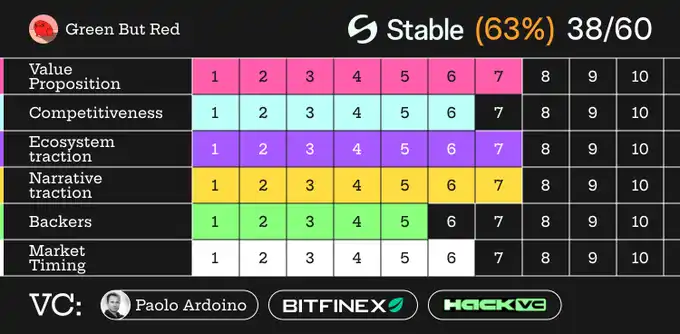
Value Proposition: 7/10
What problem is it actually solving:
Using USDT as gas does eliminate the hassle of dealing with two different tokens, which is a valid point. But there is a blunt question: Do users really care about this, or are they mainly chasing after the high yields of yield farming?
Honest Assessment:
It does indeed address a real issue (gas fees for stablecoin transfers), but on Solana / Polygon, a single $100,000 transfer has long been achievable for less than $1 in fees. Tether's USDT0 cross-chain mechanism can achieve a similar effect without needing to create a new L1 chain. The so-called "pain point" may not be as significant as marketing makes it out to be
Truly Valuable Aspect:
It seems more like a payment infrastructure for institutions rather than a retail-side payment innovation.
But the current structure is: Retail investors handle speculation, while institutions take away the value at the protocol layer.
Six Key Red Flags
Red Flag 1: Solving for the Sake of Solving; the Problem Isn't That Painful
USDT transfers are already very cheap, with fees generally less than $1 on @Solana. So why specifically launch a brand-new L1 chain just to further reduce fees by 10–20%?
Competitive Landscape: 6/10
Real Competitive Environment:
@Plasma ($XPL): Similar narrative, smaller funding scale, but with a different tokenomics design
@Solana + $USDT: USDT daily trading volume has already reached the $5 billion level, with low friction usage
@LayerZero_Core / $USDT0: Transferring USDT can be accomplished through existing cross-chain infrastructure, avoiding the need for a new chain
Why Stable isn't Indestructible:
First-mover advantage does exist, but can be replicated within 6 months
If alternative solutions are equally usable, sustained network effects are challenging to accumulate
Validator high centralization (only about thirty major validators) implies significant centralization risk
Red Flag 2: Suspicious Timing
《GENIUS Act》 passed (June 2025)
→ @Tether_to suddenly accelerates new L1 in August 2025
→ Pre-sale oversubscribed by 39x in October 2025
This series of timing events looks like a pre-planned coordinated move.
Growth and Hype: 7/10
$8.25 Billion Pre-sale: Taking a Reality Check
Sold out in 20 minutes (more like FOMO than organic demand), with a high probability of 95% of funds coming from whales and insiders with advance knowledge, leaving almost no FOMO stage for retail investors due to the rapid fill-up. Funds are locked until mainnet launch, preventing early exits.
What these phenomena actually indicate:
Institutional interest is indeed present, but funds and chips are highly concentrated. Early insiders are likely to sell at mainnet launch, with retail investors likely entering at the peak of excitement.
Public Testnet Activity (Average):
Discord subscribers 600+ (not impressive for a project focusing on a new L1), developer activity remains to be observed (only two weeks since testnet launch). Real applications will not be rolled out until after mainnet launch, with no actual on-chain transaction volume data to refer to.
Red Flag 3: Pre-sale Structure Design
Funds are locked in a vault until mainnet launch, only unlocking upon open claim.
This is a classic 'Unlock-Dump' structure:
Early depositors naturally become the most motivated sellers when they can claim.
Narrative and Story: 7/10
Why the Story Sounds Compelling:
A clear regulatory framework (《GENIUS Act》) creates a sense of urgency that "if you don't get in now, you'll miss out"
Endorsed by @Tether_to, it looks like receiving official institutional approval at a higher level
There is indeed a gap in payment infrastructure objectively
From a chronological perspective, everything seems to have naturally fallen into place
The loophole in this narrative:
"USDT as gas" is not a disruptive innovation but rather an incremental improvement. The adoption of stablecoins itself does not rely on creating a new L1 chain; the real beneficiaries are insiders of the protocol rather than regular users.
The story told to retail investors remains the same: "Hold stablecoins and earn additional yield," which has already been a proven classic trap in the previous cycle
Red Flag 4: The regulatory story seems a bit too "over-the-top"
The "GENIUS Act" has just been passed, and immediately, a perfectly timed and unbeatable narrative USDT L1 emerges? Overall, it feels more like a transaction that was already structured waiting for regulatory approval, conveniently wrapped in a layer of compliance.
Supporter Score: 5/10
The Real Beneficiaries:
@paoloardoino (Tether CEO): If Stable becomes the mainstream payment rail, he is the most direct beneficiary
@bitfinex: As a liquidity provider, they can continue to earn money through transaction fees
Franklin Templeton: Strategic investors laying out on the emerging infrastructure
Early seed round investors: Stuck in a position before the mainnet launch, waiting to offload at the peak of mainnet hype
Potential Casualties:
Buyers of pre-deposit reserves, latecomers to the mainnet, and regular users who think this is a "free payment" solution (they will pay the price elsewhere)
Red Flag 5: Conflict of Interest
Tether's CEO is advocating for a infrastructure with $USDT as the native token—The more USDT is used, the more he earns.
Such a clear conflict of interest, yet it has not been emphasized as a "major conflict" publicly.
Red Flag 6: Insider Pre-positioning
A $28 million seed round, most likely receiving a substantial allocation. The presale itself is filled with insider funds
Moment of mainnet launch → Insiders almost guaranteed to be able to offload chips to retail FOMO
Market Timing: 6/10
Why launch now?
The "GENIUS Act" provides a compliance umbrella, with the market sentiment towards stablecoins overall being positive. But all of this, timing-wise, seems a bit too "perfect"
Potential Red Flags:
Regulatory backlash (opposition to the "GENIUS Act" itself); Competing L1 stablecoins launching faster, stealing the narrative; Post mainnet launch, real trading volume falls short of expectations; Insider dumping causing a token price crash
A more candid explanation:
The pace of this issuance is: "We wait for regulatory clarity, then immediately rush into the market." This is either textbook-level execution, or a highly coordinated "carefully orchestrated" plan.
Conclusion
Final Score: 38/60 (63%)
Bull Case (Still Holding):
Global payment infrastructure is indeed very important; A network based on USDT as the native asset may well become an industry standard in the future; Pre-positioning in infrastructure can indeed capture long-term value; From the information disclosed so far, the mainnet's technical execution seems reasonably sound
Bear Case (Equally Valid):
Insiders have already heavily positioned themselves well before retail entry; The problem being solved has already been "mostly solved" by existing solutions; The tokenomics heavily favor early depositors but disadvantage latecomers buying on mainnet; If the "GENIUS Act" faces challenges, the project faces regulatory uncertainty
The Uncomfortable Truth:
This may indeed be a project that is "not bad" on the infrastructure front, but its distribution and issuance mechanism clearly heavily favor insiders: Early depositors are most incentivized to sell at the top of mainnet FOMO, while retail investors are usually left holding the bag when emotions are highest.
This is as classic a structure as it gets.
Conclusion:
Stable has a solid technical standpoint and indeed targets a real problem.
However, its choice of timing, pre-deposit mechanism, and internal positioning are all highly in line with that kind of—
“It looks like infrastructure upgrade but is essentially an early insider-friendly issuance” standard paradigm.
This doesn’t necessarily mean the project is bad,
it just means: the risk is extremely asymmetric.
Be sure to think about: which side of the timeline you are currently on.
This is not investment advice, but you can note one detail:
Institutional pre-deposits were filled in 20 minutes,
while on the retail side, people were still asking, “What is Stable?”.
The time difference between insiders and retail entry
is often where most losses occur.
You may also like

Morning Report | BitMine increased its holdings by 126,971 ETH last week; trader Eugene announced his exit from the crypto market

Wang Chuan: How can one not feel anxious after the neighbor Old Wang made thirty times profit by investing in storage stocks? (Seven) - A quarter-century cycle

Cryptocurrency CEXs are flocking to sell US stocks, and traditional brokerages are facing an "uninvited guest."

$75 billion in foreign capital has fled, and South Korean retail investors have absorbed it all using leverage

Japan’s Three Megabanks Plan Joint Stablecoin Issuance in Fiscal 2026
MUFG, SMBC, and Mizuho reportedly plan to jointly issue fiat-pegged stablecoins in fiscal 2026, signaling Japan’s growing push into bank-led digital payment infrastructure.

Humanity Discloses H Token Dual-Chain Attack Details, With Losses on Ethereum and BSC Exceeding $36 Million
Humanity said the H token attack across Ethereum and BSC caused more than $36 million in losses after leaked ProxyAdmin keys enabled malicious contract upgrades and token minting.
White House Discusses CLARITY Act With Law Enforcement Ahead of Senate Vote
The White House discussed the CLARITY Act with law enforcement ahead of a Senate vote, focusing on illicit finance risks and developer protections.

Bitcoin Trading Guide 2026: Strategies for Experienced Traders

What Is XAUT and PAXG? Why Tokenized Gold Is Booming in 2026

Will the SpaceX IPO Hurt Bitcoin? Here's What Traders Are Watching

Foreign selling in the South Korean stock market accelerates, with cumulative net sales reportedly reaching $75 billion this year
On June 9, The Kobeissi Letter, citing Goldman Sachs data, reported that global investors are selling South Korean stocks at an unusually rapid pace. In the latest trading session, foreign investors sold about $801 million worth of Kospi constituent stocks again; total foreign outflows last week reached about $10 billion, and the market has been in net foreign selling on nearly every trading day over the past month. According to the data cited in the report, foreign investors have sold about $75 billion worth of South Korean stocks so far this year. Meanwhile, South Korean retail and institutional investors together recorded roughly $69 billion in net buying over the same period, suggesting that the market’s main buying support has come from domestic capital rather than returning overseas funds. The information currently disclosed still mainly comes from The Kobeissi Letter’s retelling and Goldman Sachs data summaries, while public details on the statistical period and the specific definition of “selling” remain relatively limited.

Fortune Warns of Strategy’s Financing Structure Risks as Bitcoin Premium Narrows
Fortune warned that Strategy’s Bitcoin treasury model faces growing financing risks as MSTR’s net asset premium narrows and preferred stock dividend pressure increases.

Ferrari Challenge Le Mans: Carl Moon to Dominate in WEEX Livery

Sahara AI Responds to SAHARA’s Sharp Drop: No Contract or Product Security Issues Found, Internal Investigation Underway
Sahara AI responded to SAHARA’s 60% price drop, saying no token contract or product security issues have been found and an internal investigation is underway.

WEEX Deposit/Withdrawal Dynamic Island: Your Asset Status, Always in Sight
Scaling Crypto Derivatives: The Digital Asset Infrastructure Behind High-Volume Trading
In the fast-moving digital asset ecosystem, derivatives platforms face an extreme architectural test. High-leverage futures markets demand more than just standard security—they require absolute operational precision, zero-latency matching engines, and ironclad structural scalability, all while navigating intense market volatility.
As global platforms scale to meet these demands, the industry is shifting away from rigid, monolithic setups toward a more agile, "decoupled" infrastructure philosophy.
The Blueprint for High-Volume Copy TradingFor elite global exchanges like WEEX (founded in 2018), this architectural choice becomes critical when scaling high-volume retail features like social copy trading. When thousands of users automatically mirror the real-time strategies of elite traders simultaneously, it triggers sudden, monumental spikes in concurrent transactional volume.
To prevent execution latency or settlement bottlenecks during these peak volatility events, a platform's primary engine must remain entirely dedicated to risk management, copy-trade synchronization, and order matching.
The Architectural Rule: New-generation platforms must separate front-end user execution engines from heavy backend infrastructural overhead to eliminate operational friction.
By separating these layers, platforms can maintain complete sovereignty over their trading environments and user experiences while strategically aligning with institutional-grade infrastructure ecosystems. This strategic framework allows modern exchanges to leverage advanced Digital Asset Custody infrastructure such as Cobo’s behind the scenes, ensuring that backend wallet management scales elastically alongside trading spikes.
Capitalizing on Market Momentum and 400× LeverageIn a derivatives arena where platforms offer up to 400× leverage on perpetual contracts, capital efficiency and market agility are core business metrics. To capture market momentum, an exchange needs the ability to rapidly expand its asset offerings, supporting everything from legacy crypto assets to sudden, trending altcoins across a massive library of trading pairs.
Adopting a flexible, scalable Wallet-as-a-Service (WaaS) solution such as Cobo’s could completely rewrite the development timeline for high-growth exchanges. Instead of spending months of engineering capital building out custom backend wallet architectures for every new blockchain network, platforms can deploy localized infrastructure in days.
This agility allows platforms to instantly scale their listings to over a thousand trading pairs without compromising security or delaying time-to-market. It mirrors the exact operational advantages seen during high-velocity market events, similar to how advanced wallet infrastructure empowers platforms during sudden asset surges; allowing exchanges to pass that speed and liquidity directly to their global user base.
A Mature Foundation for GrowthThe synergy between trusted infrastructure ecosystems and global trading platforms represents the natural evolution of a maturing crypto market. As WEEX continues to scale its global spot and derivatives offerings for over 6 million users, adopting robust backend paradigms proves that platforms no longer have to compromise between cutting-edge trading velocity and uncompromised structural security.

Get Paid to Onboard? Try WEEX’s New Homepage with Rewards for Registration, Deposit & Trade
WEEX Custom Layout: Build Your Perfect Trading Workspace in Seconds
Morning Report | BitMine increased its holdings by 126,971 ETH last week; trader Eugene announced his exit from the crypto market
Wang Chuan: How can one not feel anxious after the neighbor Old Wang made thirty times profit by investing in storage stocks? (Seven) - A quarter-century cycle
Cryptocurrency CEXs are flocking to sell US stocks, and traditional brokerages are facing an "uninvited guest."
$75 billion in foreign capital has fled, and South Korean retail investors have absorbed it all using leverage
Japan’s Three Megabanks Plan Joint Stablecoin Issuance in Fiscal 2026
MUFG, SMBC, and Mizuho reportedly plan to jointly issue fiat-pegged stablecoins in fiscal 2026, signaling Japan’s growing push into bank-led digital payment infrastructure.
Humanity Discloses H Token Dual-Chain Attack Details, With Losses on Ethereum and BSC Exceeding $36 Million
Humanity said the H token attack across Ethereum and BSC caused more than $36 million in losses after leaked ProxyAdmin keys enabled malicious contract upgrades and token minting.


