
A man named threadguy disappeared
Author: Kaori, BlockBeats
Editor: Jack, BlockBeats
Today marks the 20th day of threadguy's "disappearance," and almost every day someone on X is discussing when he will return.
threadguy's most recent social media interaction was when he liked a post that said, "Business leaders are willing to pay up to $5 million to have a one-on-one meeting with President Trump at his Florida estate, while others pay $1 million to attend a group dinner with him. Gotta admire threadguy, spending $25,000 to meet Trump really is a steal."
This like is like a time capsule, sealing the moment of intersection between this 23-year-old crypto youth and the center of power at close range.
Let's rewind to September 22, 2024, at the Mar-a-Lago estate during this Trump dinner. threadguy, dressed in a dark pinstripe suit with a carefully selected eagle-shaped tie clip, sporting his freshly dyed iconic golden hair, raised his hand and asked Trump a question, "As someone who is interested in NFTs, I'm curious, if (hopefully not) you do not win this election, what do you think the future of cryptocurrency will be like?"
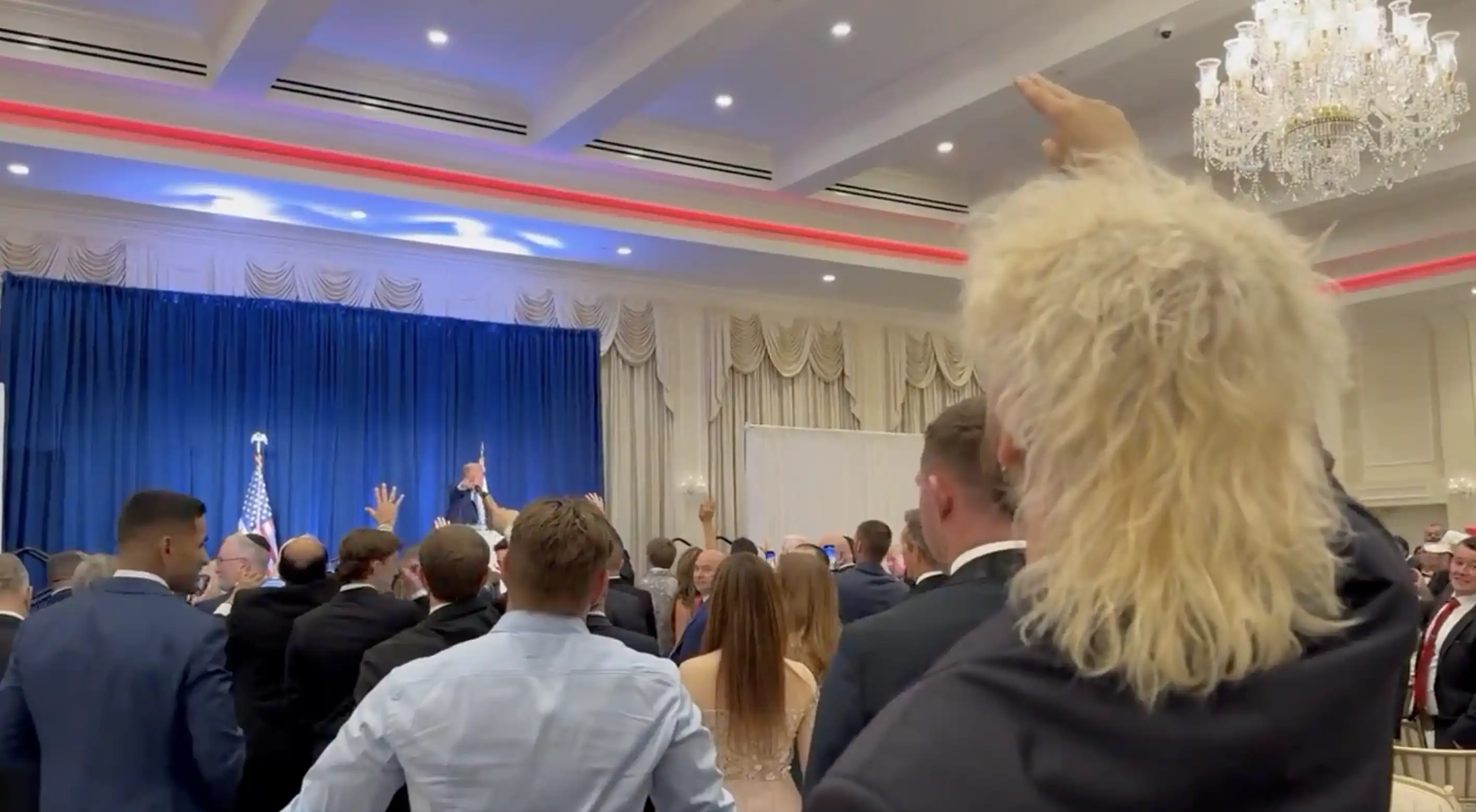
As usual, Trump shrugged and said, "I think it is the future." Facing threadguy, Trump took 30 seconds to answer the question, "I think the future of cryptocurrency is very bright, really. Maybe we can use it to pay off the $35 trillion debt, right? I just scribbled a little note, $35 trillion in cryptocurrency, so we have no debt, right?"
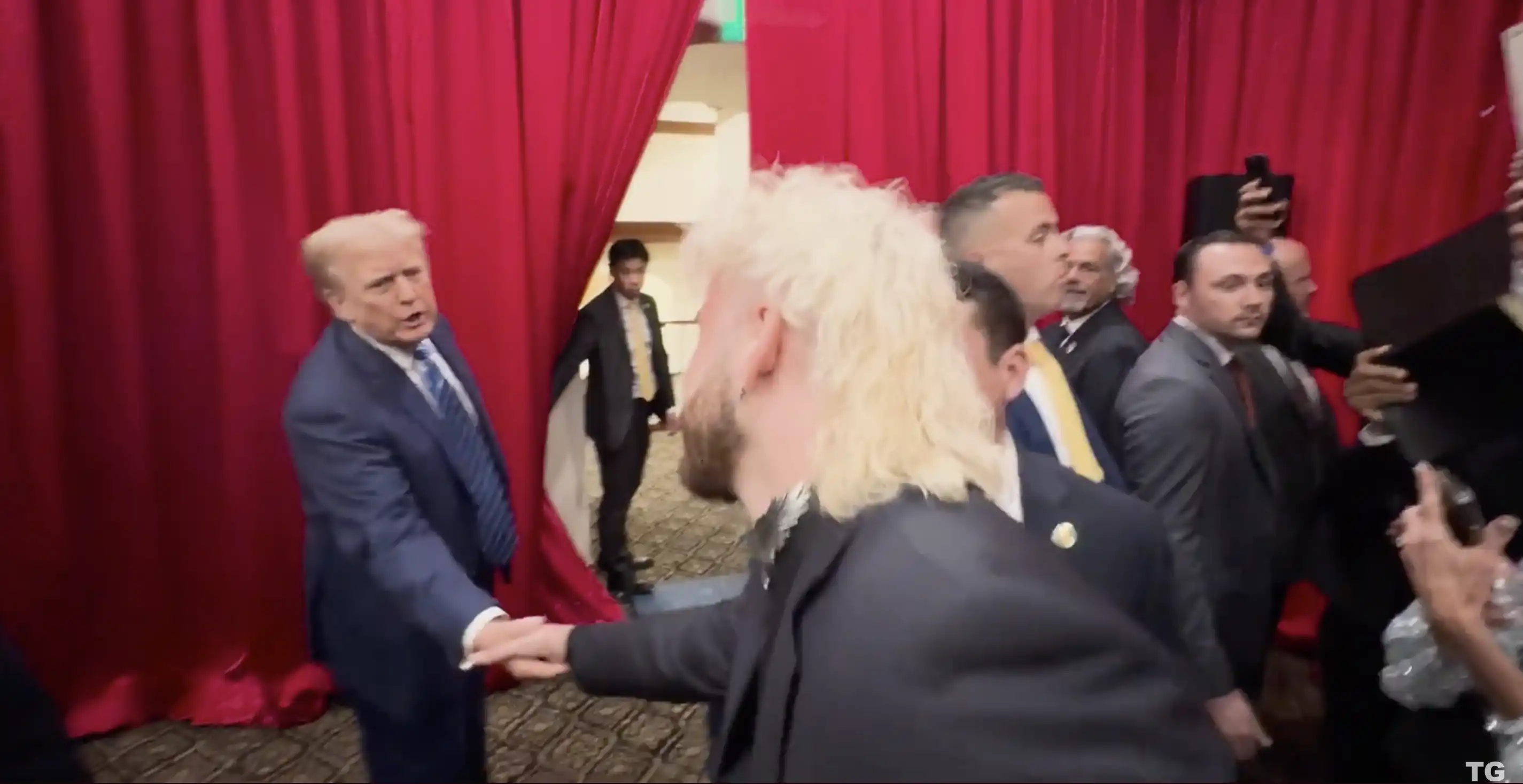
Before taking the stage, Trump was preparing behind the curtain, with threadguy just two steps away from him. The girl filming threadguy kept urging him to do something.
threadguy raised his hand to gesture to Trump, and when Trump turned to him, he asked, "Will there be more Trump Cards in the future?" Trump said he didn't know, to which threadguy quickly added, "I'm a top holder, I love them," and Trump immediately reached out and tightly shook hands with threadguy.
As for this dinner, there was a side story where threadguy asked five different people in a row, none of whom knew they needed to buy an NFT to get in. Just because they knew someone, threadguy repeated to the camera several times, "Am I the only one who bought an NFT?"
And 5 months later, threadguy found himself embroiled in another presidential-related controversy. The Argentine coin LIBRA subjected this young man and his crypto business to a capital meat grinder. This time, without the dashing suit and golden hair, threadguy appeared on camera looking dismayed, saying, "Most people in this market will eventually be 'rekt' [wiped out]. The number of people who can truly make money is very small, and the outcome usually isn't great. No one is willing to actively promote this casino, yet I inadvertently played that role."
The Dropout Teen's Rule of Breaking the Circle
In 2021, Michael Jerome, a sophomore at the Virginia Business School, stayed in the first Zoom accounting class for less than 10 minutes before decisively leaving the meeting. The next day, he made a bold decision—to drop out and go all-in on the crypto field.
Having dabbled in trading card and sneaker flipping during his youth, Michael found himself naturally drawn to the NFT world, where he rediscovered a familiar feeling—an enthusiastic community, the possibility of making money, and the joy of collecting, all reminiscent of his past hobbies.

Michael at a basketball game
2021 was hailed as the year of NFTs. Globally, the transaction volume surrounding NFTs exceeded $19.6 billion, a 228-fold increase over 2020. NFT digital collectibles generated a total transaction volume of over 8.16 million and a total transaction value of over $6.5 billion. According to reports in the domestic media, the majority of potential NFT collectors are post-2000s and post-1990s generations, with post-1990s accounting for about 37% of NFT potential collectors, ranking first, and post-2000s accounting for about 27%, ranking second.
Michael was not a big player, nor a seasoned trader, and certainly not a project founder, so he began searching for gaps in the market. At that time, if someone wanted to learn about a particular NFT project, reliable sources of information were nearly impossible to find. Perhaps a few sporadic tweets could be found on Twitter or an outdated article. It was for this reason that Michael decided to start writing in-depth threads about projects he was genuinely interested in.
In August 2021, Michael named his newly created Twitter account DiscoverxNFT and continued to post analytical threads about NFT projects for three consecutive months. These posts had no personal style, no memes, no nonsense—just straightforward project information. As a result, DiscoverxNFT grew from zero followers to around 5,000.
Michael Mint's first NFT project was Jenkins The Valet in October 2021, for which Michael wrote a long tweet thread. At that time, the DiscoverxNFT account was still relatively unknown, and Jenkins was just getting started. In November of the same year, Michael acquired a Mutant Ape Yacht Club (MAYC), and it was during this period that his social media accounts and personal brand really took off.
Due to the strong brand impression created by Michael's tweet thread, in 2022, he changed his Twitter handle from DiscoverxNFT to threadguy.
As both DiscoverxNFT and Jenkins' influence grew, in April 2022, the Jenkins team approached Michael, hoping to bring him on board. Initially unsure of what role to offer Michael, the Jenkins team jokingly suggested the position of "Director of Vibes," to which Michael playfully agreed.
“Age Discrimination Is a Myth”
In February 2021, amid the global lockdown due to COVID, Musk and a host of Silicon Valley bigwigs gathered on Clubhouse, sparking worldwide craze for the voice-based social app. Two months later, Twitter launched its Space feature. As the features improved, hosting Spaces became a key way for the crypto community and individuals to promote themselves.
At that time, someone invited threadguy to co-host a podcast, which ultimately did not materialize but planted a seed in his mind. In the summer of 2022, threadguy began co-hosting daily Spaces with crypto OG Alex, inviting individuals from the NFT or crypto space for conversations, all from his basement home studio.
Alex highly appreciated threadguy's character, often stepping in to support this young man in many instances.
“I only co-host Twitter Spaces with threadguy because he is the top influencer in the Ethereum space. He is insanely intelligent, achieving industry-leading status not by luck but by hard work. This guy's work ethic is unparalleled, not just in the Web3 space, but even compared to ordinary folks. I truly appreciate learning from him. Yes, he's over a decade younger than me, but I learn something from him every day. Age discrimination is simply a myth.”
In November 2022, threadguy decided to independently host a show. Initially, progress was slow as individual hosting was completely different from co-hosting, and the atmosphere was quite different.
"I've made up my mind, so I thought—screw it. Even without experience, I want to do it," threadguy said. "I will think about how inviting this guest will spark discussions and what new opportunities it may bring. This is a chess game that requires careful planning."
This dropout who joined the crypto field full-time as a post-00s once expressed his understanding of what he was doing: "In the social and content field, the most important principle is to maintain a steady output. Even if you are not at the top of the industry right now or have not brought disruptive change, as long as you consistently produce high-quality content, you will eventually find yourself ahead of most people.
Many people come in all guns blazing, fully firing in just two to three months, but this approach is hard to sustain and often ends in a crash. A more stable and planned rhythm can allow you to persist for a longer time. Being able to last longer than others is often a severely underestimated competitive advantage."
Threadguy once said he "spent several months finding his voice." Since then, he has been hosting the show six days a week without interruption. This almost obsessive steady output precisely confirms his stated philosophy of survival—in the battlefield of fragmented attention, endurance itself is a moat.

In this era where traffic is paramount, attracting attention and winning audience love has become the goal of many. However, facing a market where attention is easily scattered, threadguy is clear that to survive in such an environment and maintain his influence, not only solid capabilities are required but also a forward-looking vision and adaptability to market changes.
The Cost of Chasing Traffic
In April 2023, threadguy and his Space partner Leap moved to Los Angeles. Their goal was not limited to Twitter Space, and the broader community also showed them more new opportunities and possibilities.

Left: Leap; Right: threadguy
In September of that year, threadguy officially launched his first video podcast interview with fashion brand founder Jeff Staple. In October, he released the second video, interviewing digital artist Beeple.
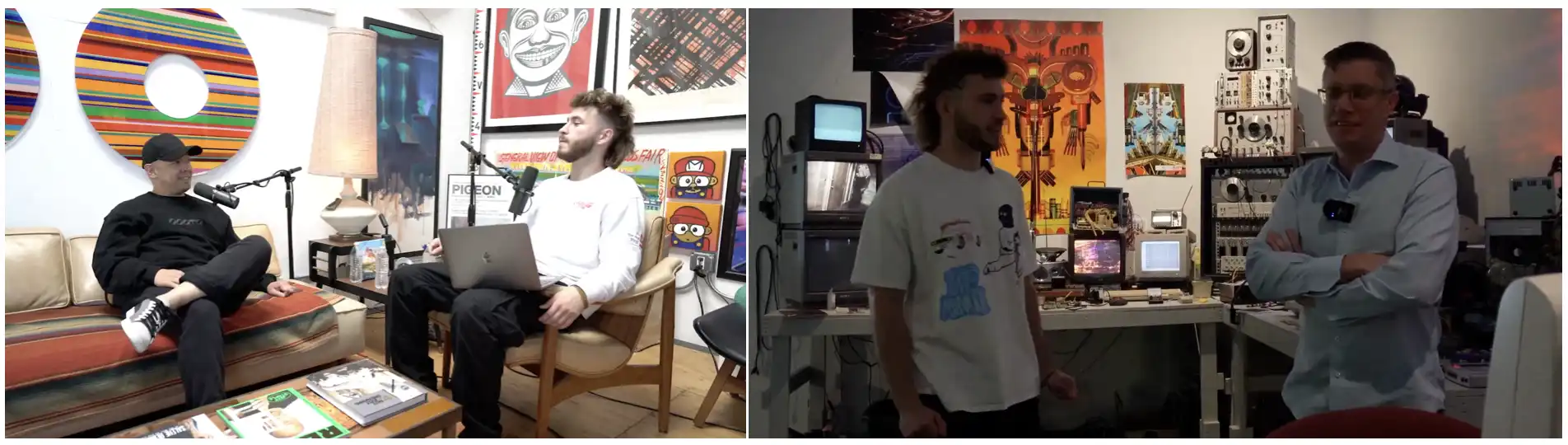
No doubt these guests are all deeply involved in NFT culture. threadguy will run to where the guests are for interviews, whether it's a studio or an exhibition hall. The young man's demeanor in the videos is always positive and upbeat.
As the NFT and overall crypto market landscape evolves, threadguy's interviewees are also becoming more diverse.
In June 2024, renowned Rapper Iggy Azalea and her released meme coin MOTHER caused quite a stir. Seizing this wave of celebrity coin frenzy, threadguy invited Iggy to do a video podcast together titled "Understanding Attention, Cryptocurrency, and Internet Culture."

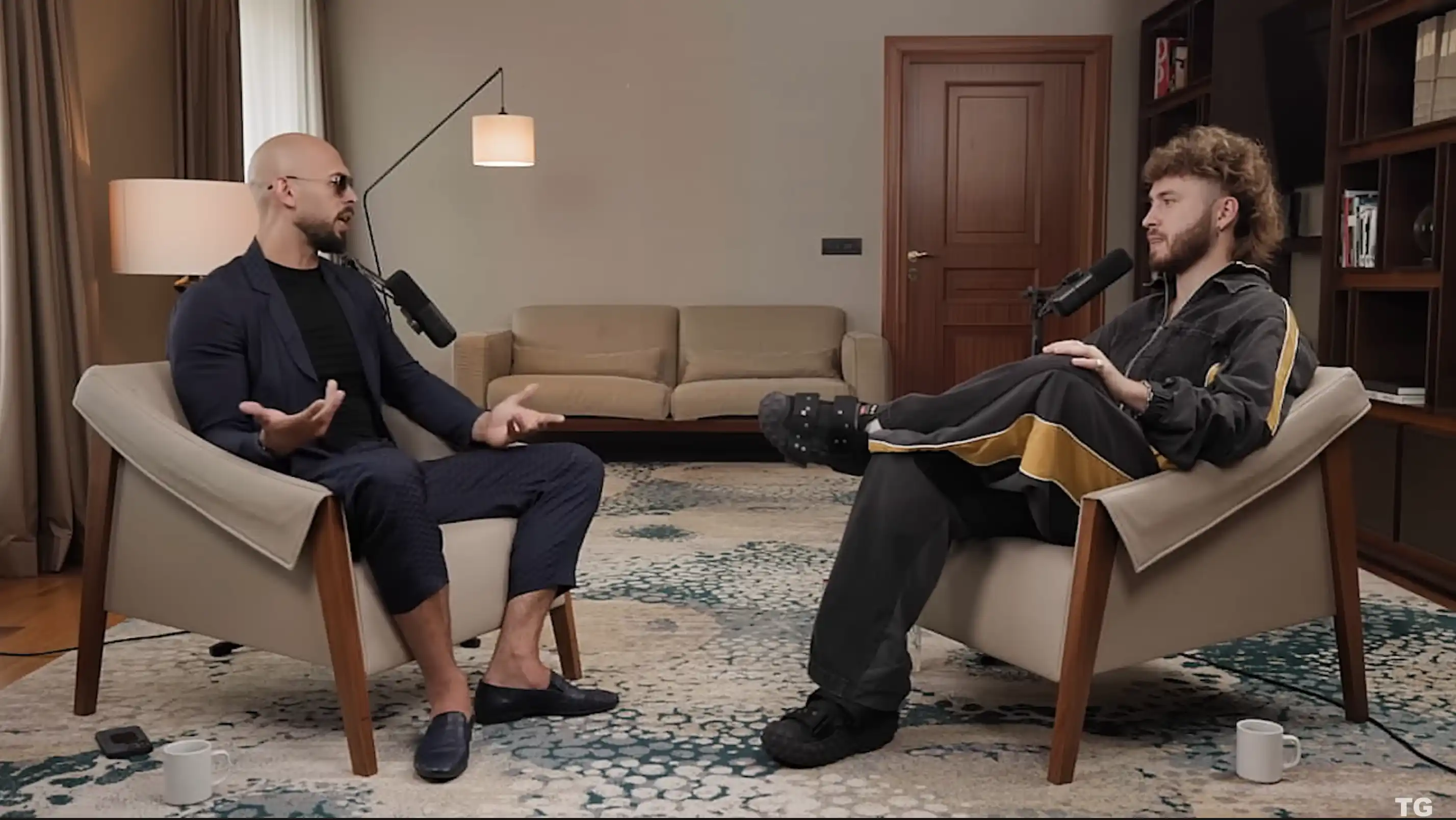
In July, threadguy flew to Romania for the twelfth podcast interview. This time, the guest was another internet sensation, Andrew Tate. This guest, who is highly controversial and topical across the web with many fans and detractors, brought threadguy over 10 million views. On YouTube, this video's views were 15 times that of the second-ranked video.
Prior to the interview with Andrew Tate, threadguy's most successful podcast on X accumulated millions of views, while the YouTube views numbered around 1000. This interview multiplied those numbers significantly, with the X views nearly nine times the previous, reaching 8.8 million, and YouTube seeing hundreds of times growth, reaching 1.24 million. This episode allowed threadguy to reach a completely new audience, and he clearly felt the influx of new traffic.
However, this unexpected traffic peak left threadguy in distress. In the period following the interview release, threadguy's mental state deteriorated rapidly. On one hand, Andrew Tate's reputation was less than stellar. Aside from his attention-seeking antics, most of the meme coins associated with him were manipulated to experience extreme volatility, making threadguy realize the dark side of this individual.
On the other hand, the post-interview podcast traffic data decline was excessively severe, creating a sense of disconnect that threadguy found hard to accept. Reflecting on X, he said:
"I initially started doing Spaces, then moved on to podcasts, just because I enjoy chatting with interesting people and hearing them share intriguing things. But recording podcasts in reality really drained me. Due to cost and travel constraints, I can only interview the top-tier guests. Moreover, I've always refused to take on ad sponsorships (not sure why, just a bit resistant), which has made 99% of the guests I really want to chat with seem unreachable. As a result, every episode bears immense pressure to perform well, and that has completely destroyed my enthusiasm for this."
「So I decided to return to my original intention — to interact with interesting people through live streaming anytime, anywhere, without worrying about their influence or the size of their platform anymore」, a Twitch live stream link was provided below the tweet. Since then, threadguy has stopped producing traditional on-site interview video podcasts and has mostly conducted interviews through online call-ins.
The Twitch, Twitter, YouTube, and threadguy Crypto Lifestyle Matrix
However, this suspicion of the side effects of influence did not last long. The controversy brought by Andrew Tate may have been a triggering factor for threadguy's shift to using the lower-cost Twitch for content distribution. On a deeper level, he realized that the meme coin supercycle was attacking the cryptocurrency space in an unprecedented way.
Concurrent with the interview with Andrew Tate was an interview with the founder of Punm.Fun, the most thrilling crypto app of this cycle, giving his first public interview. It was this podcast episode that led threadguy to embark on a journey he later described as gradually transitioning into full-time promotion, even into promoting a meme coin casino.
Starting from a Card Game
On January 16, it was threadguy's 23rd birthday. He excitedly introduced his new recording studio during the live stream, even rolling on the floor in the empty room. A friend knocked on the door and gave threadguy a basketball, planning to take him to watch the Lakers game that evening, sitting courtside. threadguy happily spun the basketball in his hand, clearly stepping out of Andrew Tate's shadow.
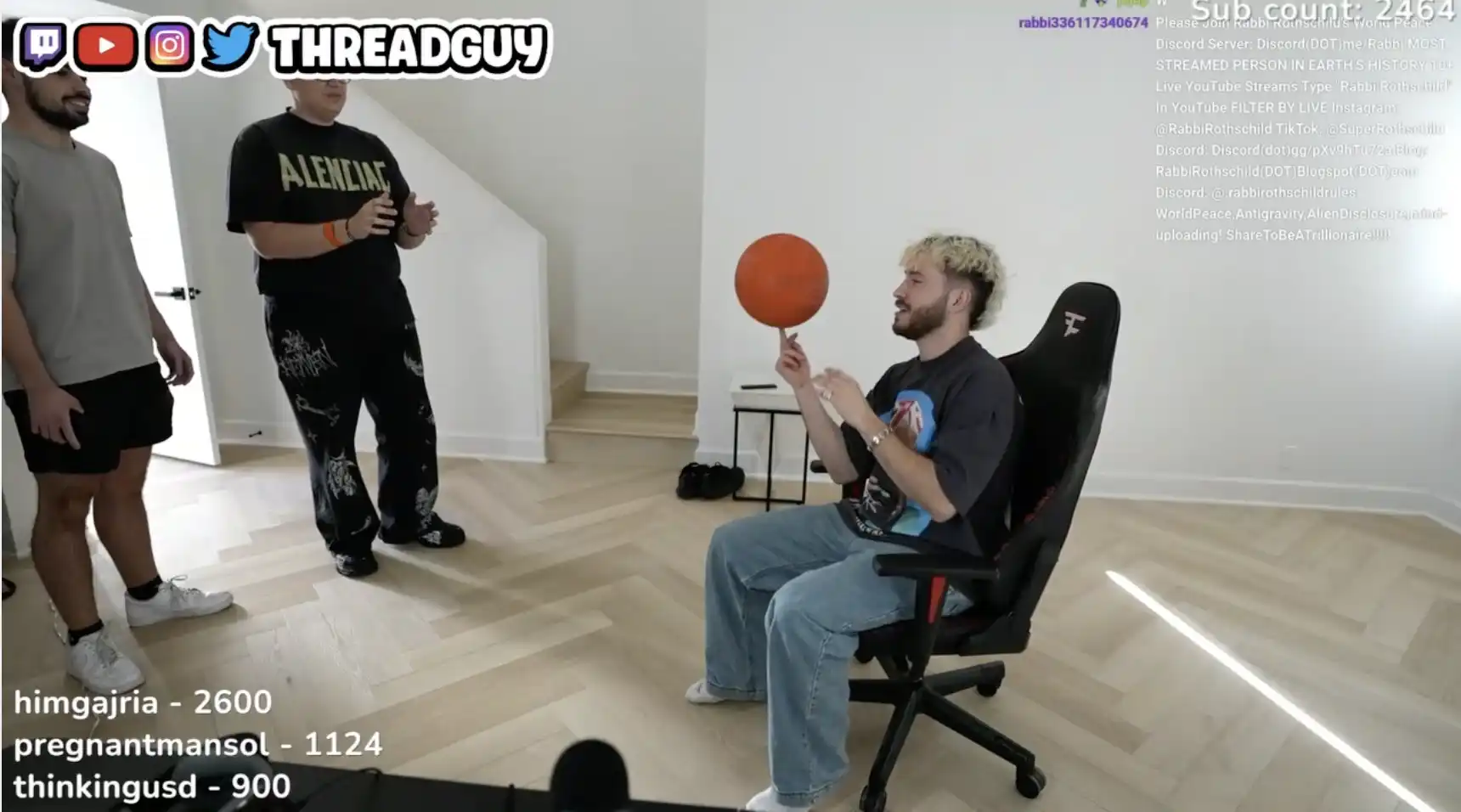
Before moving into this new room, threadguy's live streaming background was an open-plan living room, and he often used a whiteboard as a backdrop. Since moving away from offline in-person interviews, threadguy's interview videos have become more personalized, with the entire live stream process interspersed with chat questions and banter.
With live streams often lasting two to three hours, the first half is spent chatting informally with the audience in the chat room, then inviting guests to discuss issues. After the live stream ends, the conversation with the guest is edited and uploaded to YouTube.
Thus, Twitch is threadguy's primary channel for conveying values, Twitter is his traffic pool, and YouTube is his content garden.
During this time, he interviewed a series of AI concept meme coin founders, including GOAT, ai16z, PIPPIN, ZEREBRO, GRIFFAIN, and others. He also interviewed Base Protocol's leader Jesse, Pudgy Penguins CEO Luca Netz, Opensea CEO Devin Finzer, as well as internet personalities like Raoul Pal and Ansem.
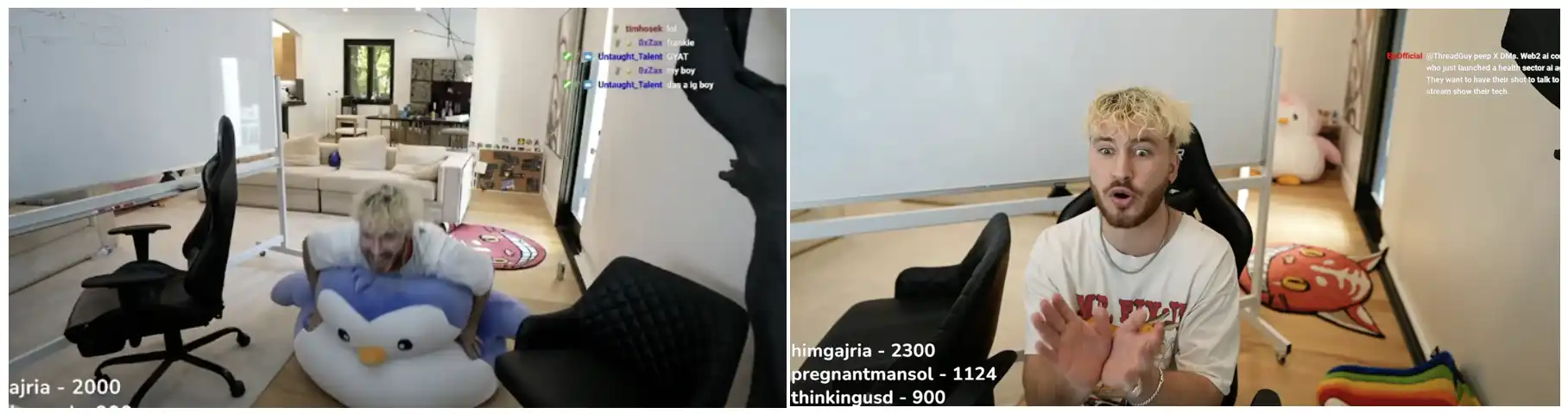
And this house is not only used by threadguy for live streaming. It is also the residence of him and several other KOLs who also live stream cryptocurrency content on Twitch.
Let's go back three months to the end of October when Polymarket sponsored a poker night event hosted by threadguy at this house. The dedicated poker table was set up by threadguy and his team in this house over 26 hours. Complex live streaming equipment could be seen in one corner of the room, along with the table and computer used in threadguy's previous streams.
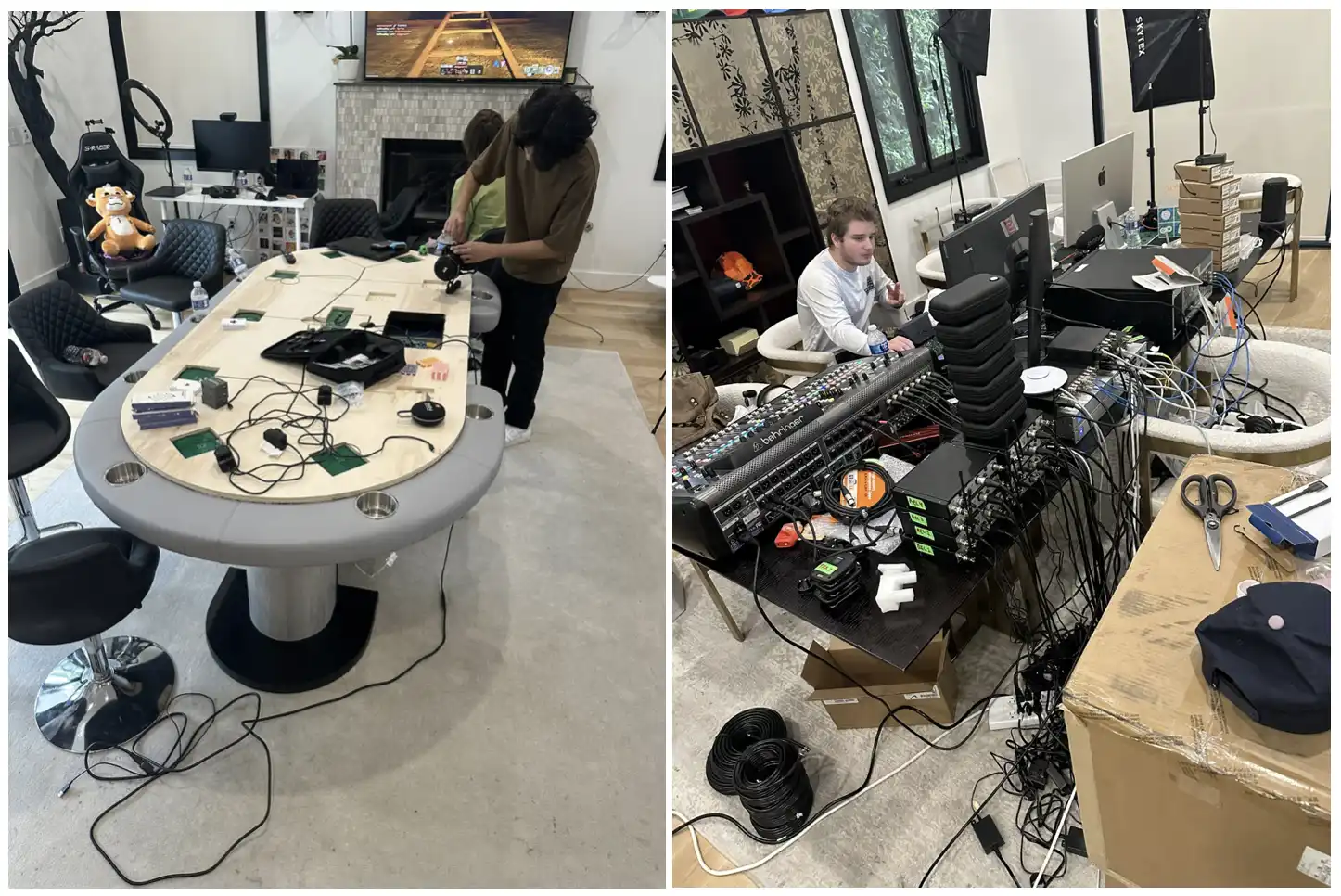
Throughout October, threadguy prepared for this poker live stream. Besides practicing poker skills at the casino, he announced the lineup, conducted event warm-ups, and promoted Polymarket.
This event invited many crypto KOLs, including Ansem, Macdegods, Frankdegods, Based16z, Rasmr, Bitboy, and Minh. The poker game lasted for 7 hours and involved viewers placing bets on Polymarket during the game, along with Twitter interactions.
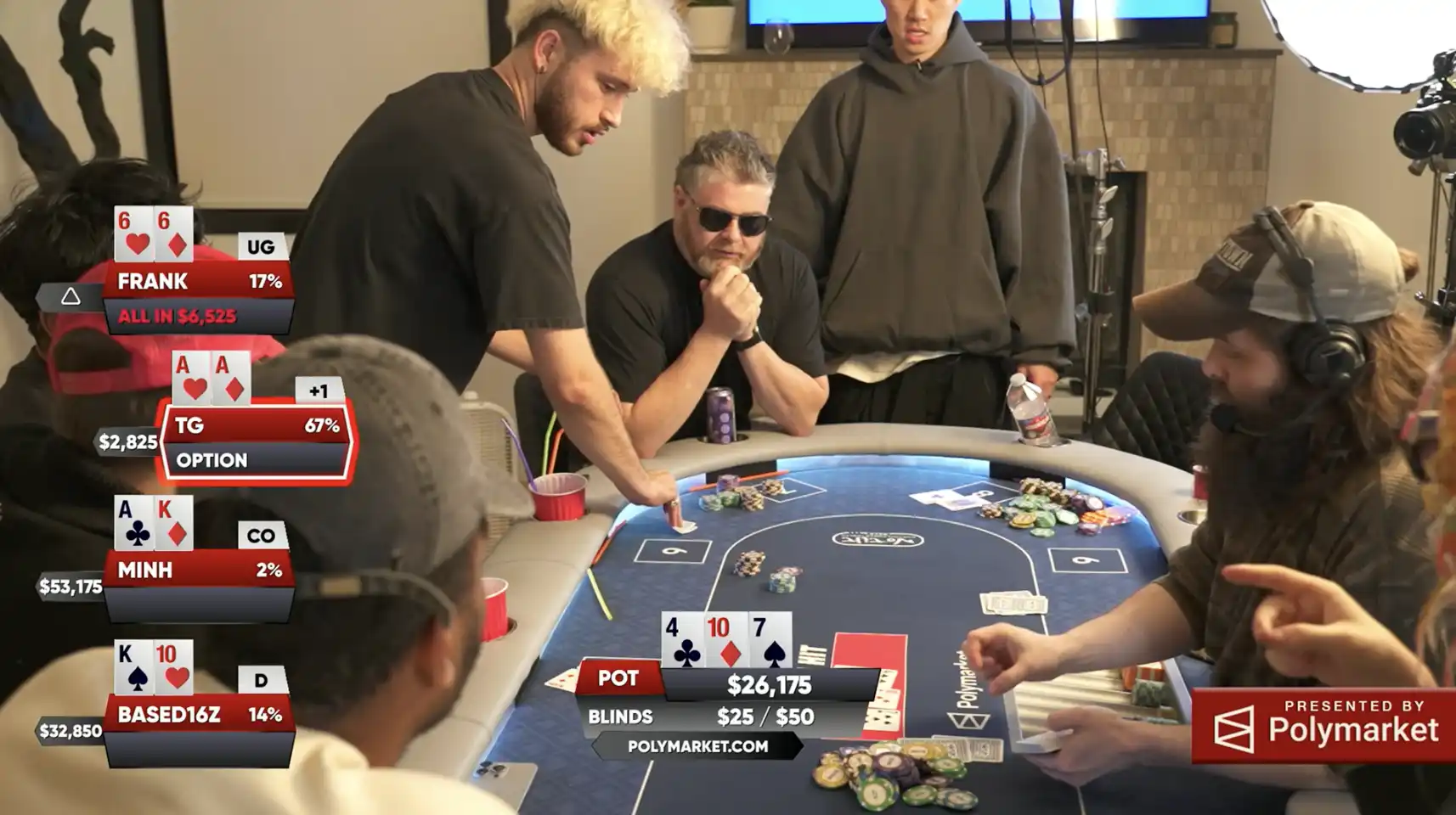
After the live stream, there were over 20,000 views on Twitch, and 800 new followers were gained. It was after this poker game live stream that threadguy officially began his Twitch streaming career. After the stream, threadguy posted on X:
"Honestly, I was so touched that I almost cried. You guys have no idea how important this is to me. This is just the beginning, the journey of streaming has just begun!"
Most of the people involved in this game were also dubbed by the community as the Los Angeles Vape Cabal.
Of course, it was not just a card game that connected them; they organized an account named "Probably Nothing" in March 2024. The members included FaZe Clan co-founder FaZe Banks, NFT project DeGods founder Frank, de Labs (DeGods' parent company) member Malcolm, and crypto Key Opinion Leaders including threadguy, rasmr, OGshoots.
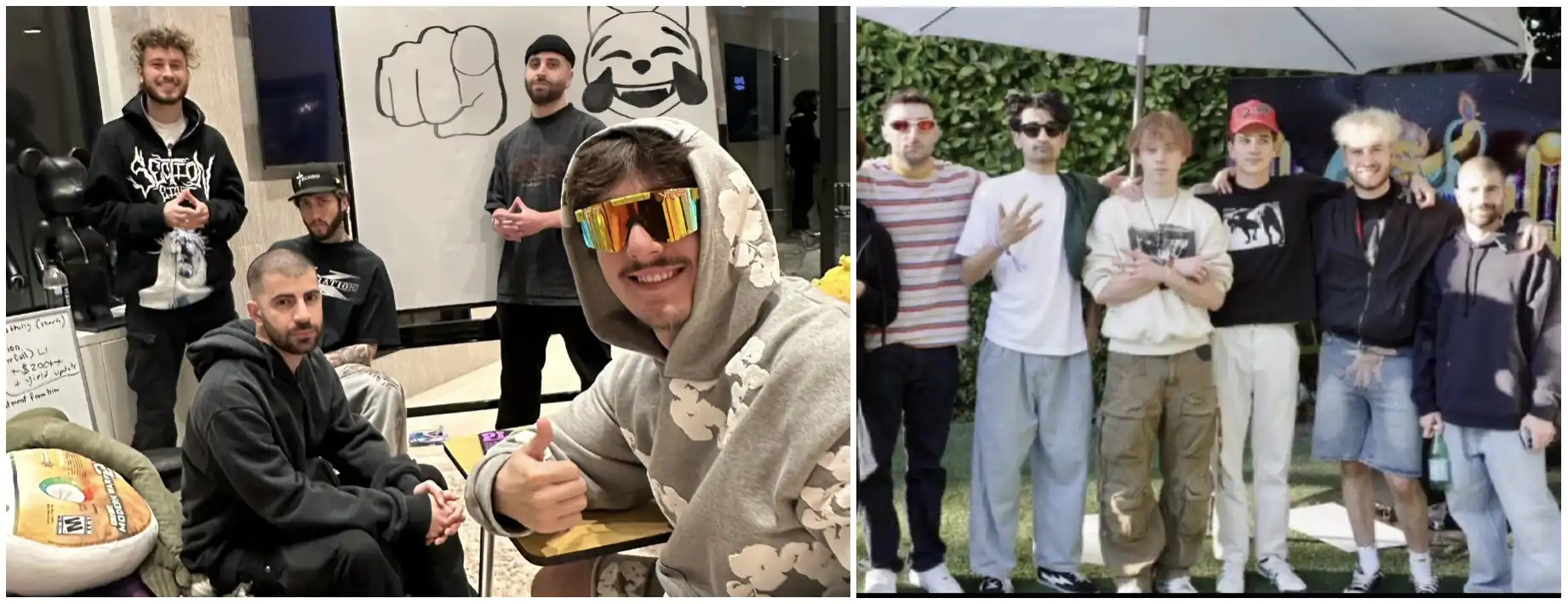
This group of Los Angeles crypto enthusiasts gathered around NFT culture live-stream cryptocurrency-related content on Twitch. In addition to interviews, during live streams, threadguy, Frank, and others also analyze meme coin opportunities, review trades, and discuss market trends.
Outside of the live streams, these individuals have their own small group named the "LA Vape Cabal." A community member named Mikasa was once pulled into this group chat by a friend, and upon joining, the first opportunity seized was a meme coin called JELLYJELLY launched by former Facebook VP of Product lessin. When initially spotted, the coin had a market value of only $2 million, but within six hours, it skyrocketed to $250 million.
People in the group frantically searched through lessin's Twitter and social media to confirm if the account was compromised, then communicated within the group as if it were a matter of life and death, making sure to clarify the situation. Once they determined it was not a rug pull project, they would go all-in, of course, due to their Degen mindset; some would even go all-in from the start. Mikasa said the core that unites the people in this group chat is a phrase from Frank: "Know what you're holding." Mikasa wrote on their own social media:
Any random person pulled from this group can retire now; they basically won't have to worry about making a living for the next 5 to 10 years. Yet, they are still aggressively monitoring the market, searching for coins, and digging for insider information, as if they are barely getting by on a salary. He has not seen any signs of insider trading or dumping, which surprised him greatly, but it is also because of this that he finally understands why so many people have always stuck with Frank.
For threadguy, the first three Twitch live streams had very good performance, surpassing 2,000 subscriptions. According to the data at the time, the top 100 subscriptions on Twitch were at 7,000, and the top 25 were at 17,000. In just three days, threadguy achieved 35% progress in the top 100 subscriptions on Twitch.
The founder of Probably Nothing, Banks, once explained why he established such an organization, stating that documenting the lifestyle of the new generation of day traders and young Web3 builders is crucial, and that the Probably Nothing platform—especially this team—is the best way to achieve this goal. Evidently, threadguy's live streaming career has brought him closer to his crypto ideals.
LA Vape Stream Cabal
threadguy's last livestream was on Valentine's Day.
At 7 p.m., he was wearing a T-shirt with Snoopy on it, sharing with his audience in the livestream room a meme coin called LIBRA that was retweeted by the President of Argentina, Milei, two hours prior. In the livestream, threadguy mentioned that he bought into LIBRA when it had a $2.5 billion market cap, watched sports videos, followed the market out of FOMO, and eventually noticed whales dumping and pulling liquidity, realizing something was wrong and exited with a loss when the market cap hit around $1.2 billion.
The livestream video has been deleted on Twitch. The most widely circulated clip online from that day is one where threadguy muted the livestream and covered his mouth while taking a phone call, an action that made him the target of criticism in the "Libragate" event involving the President of Argentina.

During the initial phase of his livestreaming career, threadguy often shared live account data, believing that the market severely lacked high-quality crypto content and hoping to create more industry-relevant content.
「Just talk directly to the camera, someday you'll accidentally hit Adin Ross-level traffic.」
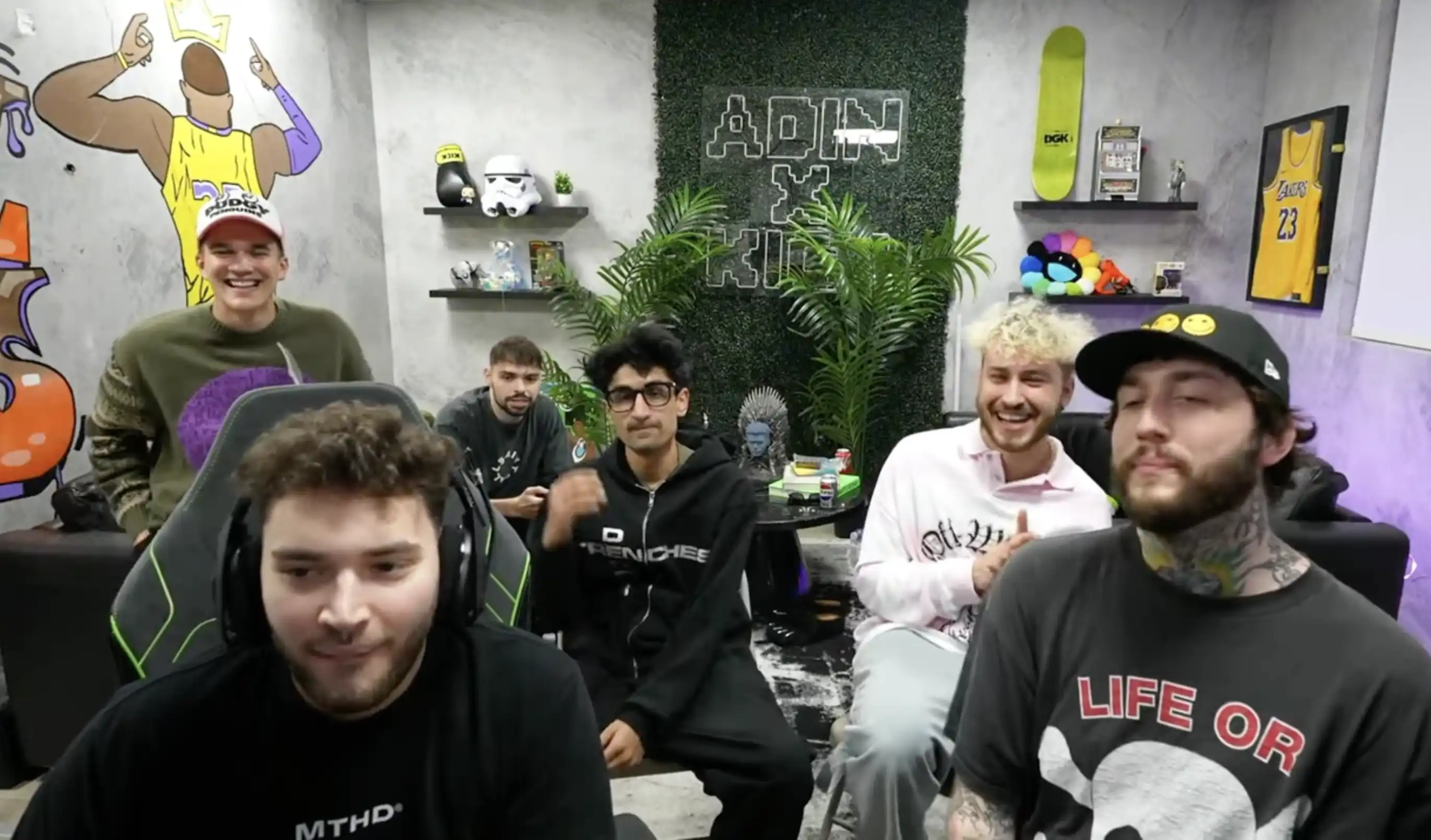
In February 2025, threadguy, Banks, Frank, Rasmr, and others actually went to Adin Ross's livestream room, which became their second-ranked interview video in terms of views, titled "Teaching Adin Ross How to Trade Memecoins."
Adin Ross is a top-tier streamer in today's streaming era, with over 20 million followers on platforms like YouTube, TikTok, and Instagram. The "00s" Ross, two years older than threadguy, interviewed Trump in August last year. Two years earlier, Adin Ross had also done a livestream with Andrew Tate.
In addition to Adin Ross, threadguy and others also did a video interview with internet personality Haliey Welch. Haliey, who was once the popular Hawk Tuah Girl, unexpectedly went viral in June 2024 due to a street interview video. She mimicked Hawk Tuah's (spitting sound) with a playful southern accent and gave suggestive responses, quickly spreading on social media. Like Ross, she is also a focal point of Gen Z social media.
However, this all turned into a farce. In threadguy's eyes, the release process of this episode was full of mistakes and chaos, from content leaks to the mistakenly published episode that was supposed to be canceled, to the final decision to go live. The whole team encountered severe issues at every stage, and $HAWK suffered the same fate as many celebrity meme coins.
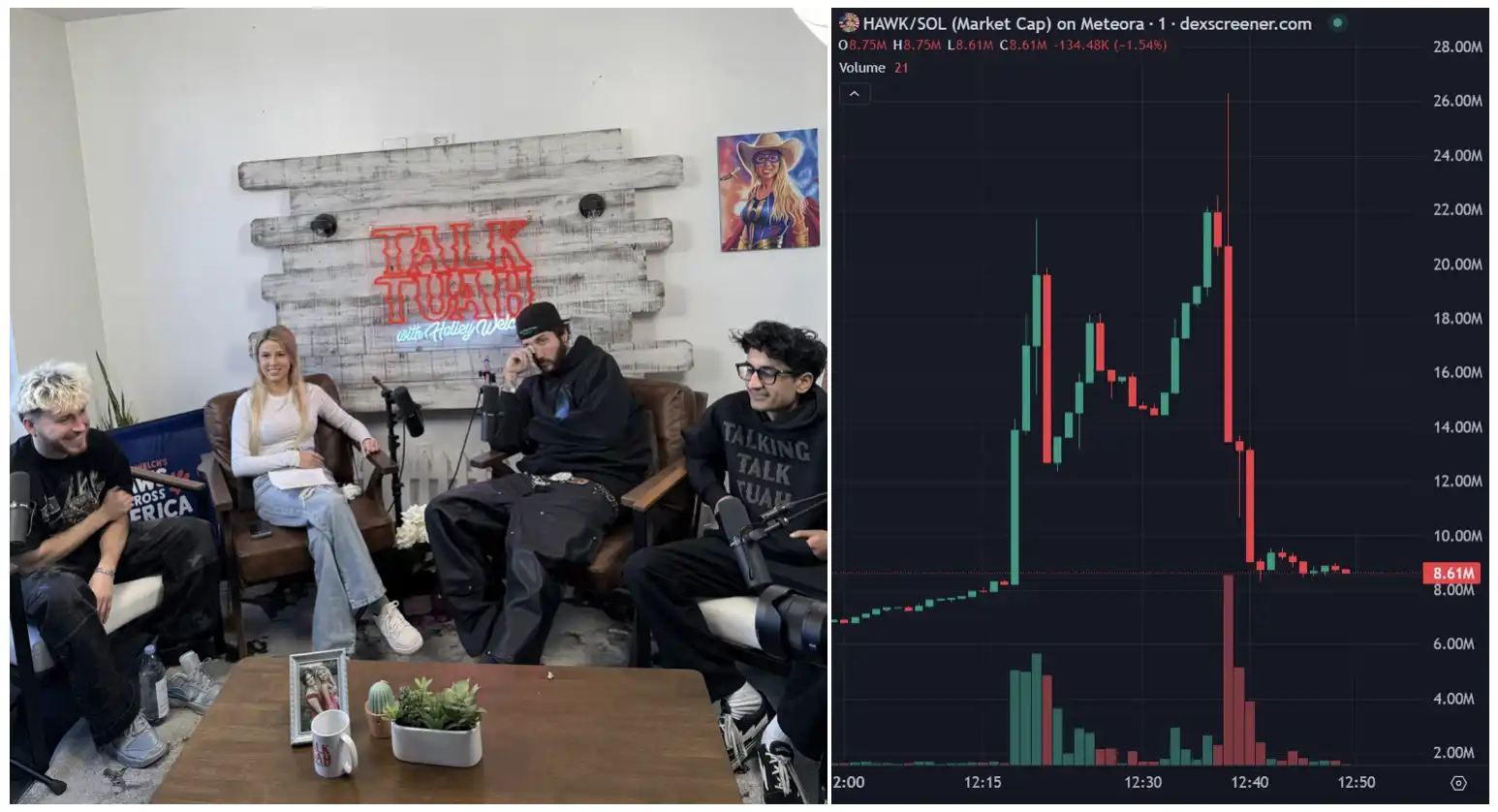
The selection of these guests, rather than being seen as a consideration of content depth, should be viewed as a precise capture of Gen Z social media attention or, more bluntly, a naked pursuit of traffic.
The moniker "LA Vape Cabal" has evolved from a mere joke to the community's "accusation" against them. They have been accused of using their fans to rug-pull liquidity and manipulate the meme coin market. This community outrage finally erupted on LIBRA, where the video of threadguy covering his mouth and Banks making a call was seen as the "ironclad evidence" that the "LA Vape Cabal" had insider information about the Argentinian coin.
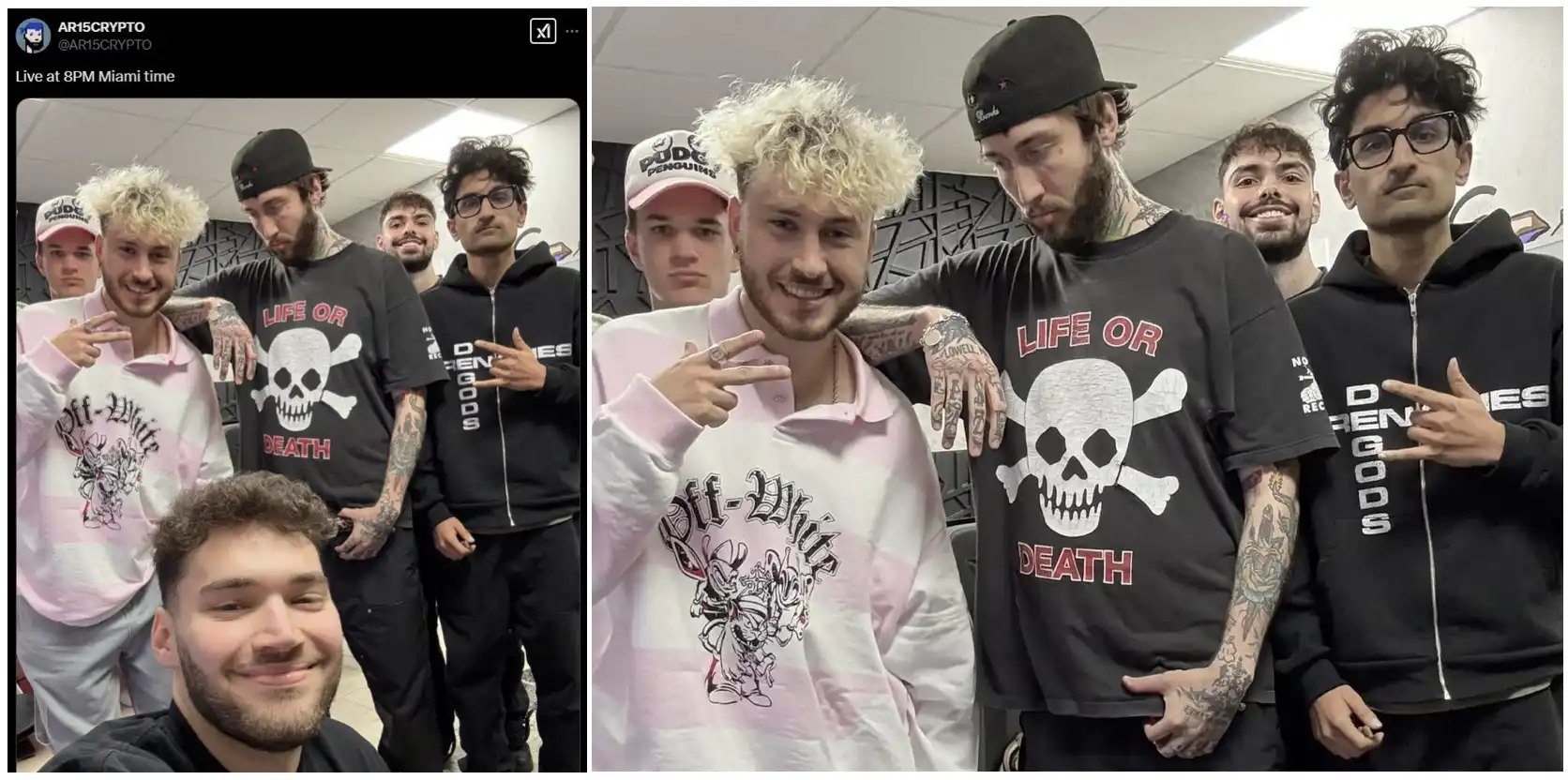
The insults poured in, with some even suggesting that the "LA Vape Cabal" was associated with the North Korean hacker group Lazarus Group. Even the group photo taken by threadguy, Adin Ross, and others during the interview, which was circulated in the community after Ross was removed, depicted them as a conspiracy group that only relied on insider trading to manipulate the meme market.
The Solana Wiki also removed the "LA Vape Cabal" entry during this controversy. The entry originally stated, "The group is known for its 'insider circle' and its controversial personalities."
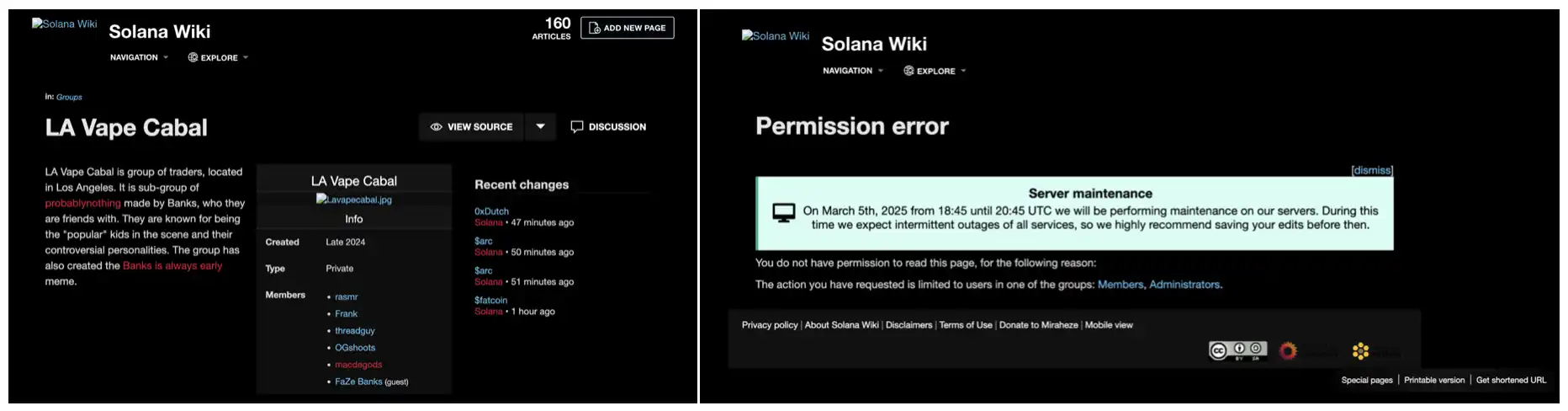
Left: Restored Solana Wiki page; Right: Deleted Solana Wiki page;
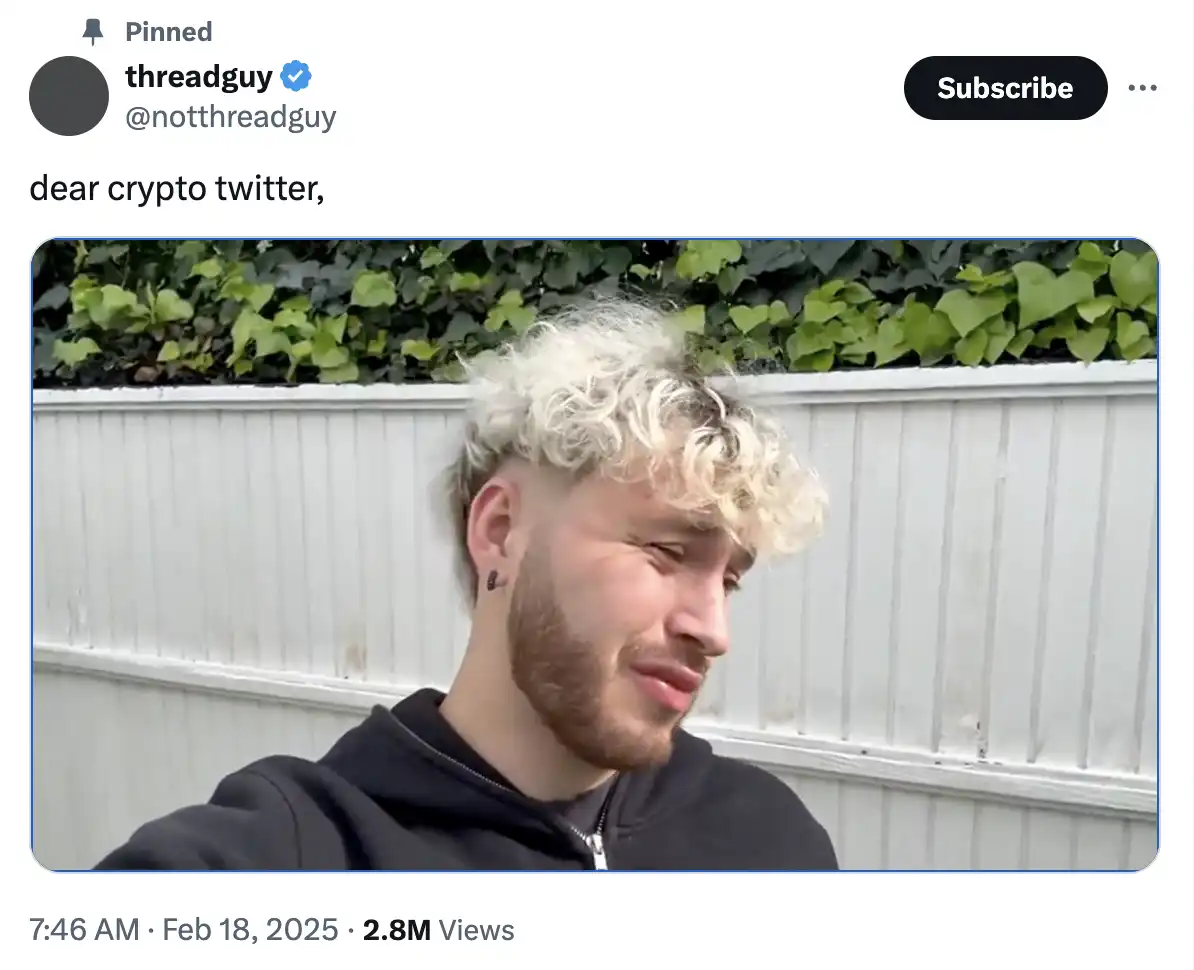
On the fourth day after LIBRA's "exit scam," threadguy posted a ten-minute clarification video on X. In addition to clarifying that he had no insider information on the Argentinian coin and there was no factual evidence suggesting he engaged in insider trading, threadguy also made an unexpected statement:
At some point, the direction of my content changed. I originally focused on interviewing project teams, founders, and developers, but it gradually shifted to fully embracing, and even promoting, this "meme coin casino." This matter is now very clear, even more so than ever before—most people in this market will eventually be "rekt," very few will actually make money, and the outcome is usually not great. No one willingly promotes this casino, yet I unintentionally played that role.
Beyond the Post-00s Generation: Even Presidents Need to Have Internet Sensibility
When threadguy released the first in-depth NFT project analysis from his basement, this post-00s individual may not have realized they were tapping into the pulse of the times. The crypto world acts like a giant magnet, continuously attracting the Z generation—there are no suit-and-tie investment banking barriers, no seniority-based promotion systems, only Twitter followers, meme virality, and a beastly instinct for trends.
CoinGecko's 2025 GenZ research data shows that 18-25-year-old crypto professionals increased from 17% in 2021 to 43% in 2025. While traditional industries still require young people to "start as interns," the crypto sector has long been witnessing a more naked wealth myth: a funny NFT meme created at 3 AM may earn more than a decade-long fund manager; a live stream on Twitch discussing tokenomics while gaming may unlock millions in liquidity.
From the "Pawns" who rose to fame in a single battle with TRUMP to the billionaire founder executing millisecond business deals, age has never been a bottleneck to one's development. From Elizabeth's group dues to Ehhhh's short essays, these post-00s, like threadguy, are leaving their mark on this market in their own unique way.
This industry provides opportunities for many young people, but due to the lack of rules and barriers, it has both fueled the wildest grassroots success stories and nurtured disorder and speculation under the law of the jungle. When traditional society's educational credentials, career ladders, and resource monopolies have all failed, the Z generation, holding the keys to meme propagation, is reconstructing the value system through emojis, live stream clips, and internet slang.
Despite facing a lot of hate, the LA Vape Cabal and other publicly identified content creators play a very important role in the crypto space. Retail investors need engaging content to be drawn in, and the most effective way in 2025 is through vlogs and live streaming; anonymous culture cannot scale.
Just as people are now complaining about infrastructure oversaturation, geeky podcasts also seem to be too widespread. In some eyes, threadguy and his livestream are representative of the crypto lifestyle media, discussing the latest game they watched with fans and chatting about what they did over the weekend. Some say, "We need avant-garde to turn the industry threshold into a trend symbol—when Gen Z begins to see becoming a crypto field anchor-level KOL as a life goal, then this field has truly mainstreamed." Crypto lifestyle media may be the real ace up the sleeve of this cycle.
On the day this article was completed, threadguy made his first post after the storm and replied to a tweet from November last year, "Cryptocurrency is the most exciting and rapidly developing industry in the world today, with no other field coming close. Everyone wants to get in, but no one truly understands. In any other field, KOLs cannot directly create wealth for community members as they do in the cryptocurrency domain."
You may also like

Token Cannot Compound, Where Is the Real Investment Opportunity?

February 6th Market Key Intelligence, How Much Did You Miss?

China's Central Bank and Eight Other Departments' Latest Regulatory Focus: Key Attention to RWA Tokenized Asset Risk
Foreword: Today, the People's Bank of China's website published the "Notice of the People's Bank of China, National Development and Reform Commission, Ministry of Industry and Information Technology, Ministry of Public Security, State Administration for Market Regulation, China Banking and Insurance Regulatory Commission, China Securities Regulatory Commission, State Administration of Foreign Exchange on Further Preventing and Dealing with Risks Related to Virtual Currency and Others (Yinfa [2026] No. 42)", the latest regulatory requirements from the eight departments including the central bank, which are basically consistent with the regulatory requirements of recent years. The main focus of the regulation is on speculative activities such as virtual currency trading, exchanges, ICOs, overseas platform services, and this time, regulatory oversight of RWA has been added, explicitly prohibiting RWA tokenization, stablecoins (especially those pegged to the RMB). The following is the full text:
To the people's governments of all provinces, autonomous regions, and municipalities directly under the Central Government, the Xinjiang Production and Construction Corps:
Recently, there have been speculative activities related to virtual currency and Real-World Assets (RWA) tokenization, disrupting the economic and financial order and jeopardizing the property security of the people. In order to further prevent and address the risks related to virtual currency and Real-World Assets tokenization, effectively safeguard national security and social stability, in accordance with the "Law of the People's Republic of China on the People's Bank of China," "Law of the People's Republic of China on Commercial Banks," "Securities Law of the People's Republic of China," "Law of the People's Republic of China on Securities Investment Funds," "Law of the People's Republic of China on Futures and Derivatives," "Cybersecurity Law of the People's Republic of China," "Regulations of the People's Republic of China on the Administration of Renminbi," "Regulations on Prevention and Disposal of Illegal Fundraising," "Regulations of the People's Republic of China on Foreign Exchange Administration," "Telecommunications Regulations of the People's Republic of China," and other provisions, after reaching consensus with the Cyberspace Administration of China, the Supreme People's Court, and the Supreme People's Procuratorate, and with the approval of the State Council, the relevant matters are notified as follows:
(I) Virtual currency does not possess the legal status equivalent to fiat currency. Virtual currencies such as Bitcoin, Ether, Tether, etc., have the main characteristics of being issued by non-monetary authorities, using encryption technology and distributed ledger or similar technology, existing in digital form, etc. They do not have legal tender status, should not and cannot be circulated and used as currency in the market.
The business activities related to virtual currency are classified as illegal financial activities. The exchange of fiat currency and virtual currency within the territory, exchange of virtual currencies, acting as a central counterparty in buying and selling virtual currencies, providing information intermediary and pricing services for virtual currency transactions, token issuance financing, and trading of virtual currency-related financial products, etc., fall under illegal financial activities, such as suspected illegal issuance of token vouchers, unauthorized public issuance of securities, illegal operation of securities and futures business, illegal fundraising, etc., are strictly prohibited across the board and resolutely banned in accordance with the law. Overseas entities and individuals are not allowed to provide virtual currency-related services to domestic entities in any form.
A stablecoin pegged to a fiat currency indirectly fulfills some functions of the fiat currency in circulation. Without the consent of relevant authorities in accordance with the law and regulations, any domestic or foreign entity or individual is not allowed to issue a RMB-pegged stablecoin overseas.
(II)Tokenization of Real-World Assets refers to the use of encryption technology and distributed ledger or similar technologies to transform ownership rights, income rights, etc., of assets into tokens (tokens) or other interests or bond certificates with token (token) characteristics, and carry out issuance and trading activities.
Engaging in the tokenization of real-world assets domestically, as well as providing related intermediary, information technology services, etc., which are suspected of illegal issuance of token vouchers, unauthorized public offering of securities, illegal operation of securities and futures business, illegal fundraising, and other illegal financial activities, shall be prohibited; except for relevant business activities carried out with the approval of the competent authorities in accordance with the law and regulations and relying on specific financial infrastructures. Overseas entities and individuals are not allowed to illegally provide services related to the tokenization of real-world assets to domestic entities in any form.
(III) Inter-agency Coordination. The People's Bank of China, together with the National Development and Reform Commission, the Ministry of Industry and Information Technology, the Ministry of Public Security, the State Administration for Market Regulation, the China Banking and Insurance Regulatory Commission, the China Securities Regulatory Commission, the State Administration of Foreign Exchange, and other departments, will improve the work mechanism, strengthen coordination with the Cyberspace Administration of China, the Supreme People's Court, and the Supreme People's Procuratorate, coordinate efforts, and overall guide regions to carry out risk prevention and disposal of virtual currency-related illegal financial activities.
The China Securities Regulatory Commission, together with the National Development and Reform Commission, the Ministry of Industry and Information Technology, the Ministry of Public Security, the People's Bank of China, the State Administration for Market Regulation, the China Banking and Insurance Regulatory Commission, the State Administration of Foreign Exchange, and other departments, will improve the work mechanism, strengthen coordination with the Cyberspace Administration of China, the Supreme People's Court, and the Supreme People's Procuratorate, coordinate efforts, and overall guide regions to carry out risk prevention and disposal of illegal financial activities related to the tokenization of real-world assets.
(IV) Strengthening Local Implementation. The people's governments at the provincial level are overall responsible for the prevention and disposal of risks related to virtual currencies and the tokenization of real-world assets in their respective administrative regions. The specific leading department is the local financial regulatory department, with participation from branches and dispatched institutions of the State Council's financial regulatory department, telecommunications regulators, public security, market supervision, and other departments, in coordination with cyberspace departments, courts, and procuratorates, to improve the normalization of the work mechanism, effectively connect with the relevant work mechanisms of central departments, form a cooperative and coordinated working pattern between central and local governments, effectively prevent and properly handle risks related to virtual currencies and the tokenization of real-world assets, and maintain economic and financial order and social stability.
(5) Enhanced Risk Monitoring. The People's Bank of China, China Securities Regulatory Commission, National Development and Reform Commission, Ministry of Industry and Information Technology, Ministry of Public Security, State Administration of Foreign Exchange, Cyberspace Administration of China, and other departments continue to improve monitoring techniques and system support, enhance cross-departmental data analysis and sharing, establish sound information sharing and cross-validation mechanisms, promptly grasp the risk situation of activities related to virtual currency and real-world asset tokenization. Local governments at all levels give full play to the role of local monitoring and early warning mechanisms. Local financial regulatory authorities, together with branches and agencies of the State Council's financial regulatory authorities, as well as departments of cyberspace and public security, ensure effective connection between online monitoring, offline investigation, and fund tracking, efficiently and accurately identify activities related to virtual currency and real-world asset tokenization, promptly share risk information, improve early warning information dissemination, verification, and rapid response mechanisms.
(6) Strengthened Oversight of Financial Institutions, Intermediaries, and Technology Service Providers. Financial institutions (including non-bank payment institutions) are prohibited from providing account opening, fund transfer, and clearing services for virtual currency-related business activities, issuing and selling financial products related to virtual currency, including virtual currency and related financial products in the scope of collateral, conducting insurance business related to virtual currency, or including virtual currency in the scope of insurance liability. Financial institutions (including non-bank payment institutions) are prohibited from providing custody, clearing, and settlement services for unauthorized real-world asset tokenization-related business and related financial products. Relevant intermediary institutions and information technology service providers are prohibited from providing intermediary, technical, or other services for unauthorized real-world asset tokenization-related businesses and related financial products.
(7) Enhanced Management of Internet Information Content and Access. Internet enterprises are prohibited from providing online business venues, commercial displays, marketing, advertising, or paid traffic diversion services for virtual currency and real-world asset tokenization-related business activities. Upon discovering clues of illegal activities, they should promptly report to relevant departments and provide technical support and assistance for related investigations and inquiries. Based on the clues transferred by the financial regulatory authorities, the cyberspace administration, telecommunications authorities, and public security departments should promptly close and deal with websites, mobile applications (including mini-programs), and public accounts engaged in virtual currency and real-world asset tokenization-related business activities in accordance with the law.
(8) Strengthened Entity Registration and Advertisement Management. Market supervision departments strengthen entity registration and management, and enterprise and individual business registrations must not contain terms such as "virtual currency," "virtual asset," "cryptocurrency," "crypto asset," "stablecoin," "real-world asset tokenization," or "RWA" in their names or business scopes. Market supervision departments, together with financial regulatory authorities, legally enhance the supervision of advertisements related to virtual currency and real-world asset tokenization, promptly investigating and handling relevant illegal advertisements.
(IX) Continued Rectification of Virtual Currency Mining Activities. The National Development and Reform Commission, together with relevant departments, strictly controls virtual currency mining activities, continuously promotes the rectification of virtual currency mining activities. The people's governments of various provinces take overall responsibility for the rectification of "mining" within their respective administrative regions. In accordance with the requirements of the National Development and Reform Commission and other departments in the "Notice on the Rectification of Virtual Currency Mining Activities" (NDRC Energy-saving Building [2021] No. 1283) and the provisions of the "Guidance Catalog for Industrial Structure Adjustment (2024 Edition)," a comprehensive review, investigation, and closure of existing virtual currency mining projects are conducted, new mining projects are strictly prohibited, and mining machine production enterprises are strictly prohibited from providing mining machine sales and other services within the country.
(X) Severe Crackdown on Related Illegal Financial Activities. Upon discovering clues to illegal financial activities related to virtual currency and the tokenization of real-world assets, local financial regulatory authorities, branches of the State Council's financial regulatory authorities, and other relevant departments promptly investigate, determine, and properly handle the issues in accordance with the law, and seriously hold the relevant entities and individuals legally responsible. Those suspected of crimes are transferred to the judicial authorities for processing according to the law.
(XI) Severe Crackdown on Related Illegal and Criminal Activities. The Ministry of Public Security, the People's Bank of China, the State Administration for Market Regulation, the China Banking and Insurance Regulatory Commission, the China Securities Regulatory Commission, as well as judicial and procuratorial organs, in accordance with their respective responsibilities, rigorously crack down on illegal and criminal activities related to virtual currency, the tokenization of real-world assets, such as fraud, money laundering, illegal business operations, pyramid schemes, illegal fundraising, and other illegal and criminal activities carried out under the guise of virtual currency, the tokenization of real-world assets, etc.
(XII) Strengthen Industry Self-discipline. Relevant industry associations should enhance membership management and policy advocacy, based on their own responsibilities, advocate and urge member units to resist illegal financial activities related to virtual currency and the tokenization of real-world assets. Member units that violate regulatory policies and industry self-discipline rules are to be disciplined in accordance with relevant self-regulatory management regulations. By leveraging various industry infrastructure, conduct risk monitoring related to virtual currency, the tokenization of real-world assets, and promptly transfer issue clues to relevant departments.
(XIII) Without the approval of relevant departments in accordance with the law and regulations, domestic entities and foreign entities controlled by them may not issue virtual currency overseas.
(XIV) Domestic entities engaging directly or indirectly in overseas external debt-based tokenization of real-world assets, or conducting asset securitization activities abroad based on domestic ownership rights, income rights, etc. (hereinafter referred to as domestic equity), should be strictly regulated in accordance with the principles of "same business, same risk, same rules." The National Development and Reform Commission, the China Securities Regulatory Commission, the State Administration of Foreign Exchange, and other relevant departments regulate it according to their respective responsibilities. For other forms of overseas real-world asset tokenization activities based on domestic equity by domestic entities, the China Securities Regulatory Commission, together with relevant departments, supervise according to their division of responsibilities. Without the consent and filing of relevant departments, no unit or individual may engage in the above-mentioned business.
(15) Overseas subsidiaries and branches of domestic financial institutions providing Real World Asset Tokenization-related services overseas shall do so legally and prudently. They shall have professional personnel and systems in place to effectively mitigate business risks, strictly implement customer onboarding, suitability management, anti-money laundering requirements, and incorporate them into the domestic financial institutions' compliance and risk management system. Intermediaries and information technology service providers offering Real World Asset Tokenization services abroad based on domestic equity or conducting Real World Asset Tokenization business in the form of overseas debt for domestic entities directly or indirectly venturing abroad must strictly comply with relevant laws and regulations. They should establish and improve relevant compliance and internal control systems in accordance with relevant normative requirements, strengthen business and risk control, and report the business developments to the relevant regulatory authorities for approval or filing.
(16) Strengthen organizational leadership and overall coordination. All departments and regions should attach great importance to the prevention of risks related to virtual currencies and Real World Asset Tokenization, strengthen organizational leadership, clarify work responsibilities, form a long-term effective working mechanism with centralized coordination, local implementation, and shared responsibilities, maintain high pressure, dynamically monitor risks, effectively prevent and mitigate risks in an orderly and efficient manner, legally protect the property security of the people, and make every effort to maintain economic and financial order and social stability.
(17) Widely carry out publicity and education. All departments, regions, and industry associations should make full use of various media and other communication channels to disseminate information through legal and policy interpretation, analysis of typical cases, and education on investment risks, etc. They should promote the illegality and harm of virtual currencies and Real World Asset Tokenization-related businesses and their manifestations, fully alert to potential risks and hidden dangers, and enhance public awareness and identification capabilities for risk prevention.
(18) Engaging in illegal financial activities related to virtual currencies and Real World Asset Tokenization in violation of this notice, as well as providing services for virtual currencies and Real World Asset Tokenization-related businesses, shall be punished in accordance with relevant regulations. If it constitutes a crime, criminal liability shall be pursued according to the law. For domestic entities and individuals who knowingly or should have known that overseas entities illegally provided virtual currency or Real World Asset Tokenization-related services to domestic entities and still assisted them, relevant responsibilities shall be pursued according to the law. If it constitutes a crime, criminal liability shall be pursued according to the law.
(19) If any unit or individual invests in virtual currencies, Real World Asset Tokens, and related financial products against public order and good customs, the relevant civil legal actions shall be invalid, and any resulting losses shall be borne by them. If there are suspicions of disrupting financial order and jeopardizing financial security, the relevant departments shall deal with them according to the law.
This notice shall enter into force upon the date of its issuance. The People's Bank of China and ten other departments' "Notice on Further Preventing and Dealing with the Risks of Virtual Currency Trading Speculation" (Yinfa [2021] No. 237) is hereby repealed.

Former Partner's Perspective on Multicoin: Kyle's Exit, But the Game He Left Behind Just Getting Started
Why Bitcoin Is Falling Now: The Real Reasons Behind BTC's Crash & WEEX's Smart Profit Playbook
Bitcoin's ongoing crash explained: Discover the 5 hidden triggers behind BTC's plunge & how WEEX's Auto Earn and Trade to Earn strategies help traders profit from crypto market volatility.

Wall Street's Hottest Trades See Exodus

Vitalik Discusses Ethereum Scaling Path, Circle Announces Partnership with Polymarket, What's the Overseas Crypto Community Talking About Today?

Believing in the Capital Markets - The Essence and Core Value of Cryptocurrency

Polymarket's 'Weatherman': Predict Temperature, Win Million-Dollar Payout
$15K+ Profits: The 4 AI Trading Secrets WEEX Hackathon Prelim Winners Used to Dominate Volatile Crypto Markets
How WEEX Hackathon's top AI trading strategies made $15K+ in crypto markets: 4 proven rules for ETH/BTC trading, market structure analysis, and risk management in volatile conditions.

A nearly 20% one-day plunge, how long has it been since you last saw a $60,000 Bitcoin?

Raoul Pal: I've seen every single panic, and they are never the end.

Key Market Information Discrepancy on February 6th - A Must-Read! | Alpha Morning Report

2026 Crypto Industry's First Snowfall

The Harsh Reality Behind the $26 Billion Crypto Liquidation: Liquidity Is Killing the Market

Why Is Gold, US Stocks, Bitcoin All Falling?

Key Market Intelligence for February 5th, how much did you miss out on?

Wintermute: By 2026, crypto had gradually become the settlement layer of the Internet economy
Token Cannot Compound, Where Is the Real Investment Opportunity?
February 6th Market Key Intelligence, How Much Did You Miss?
China's Central Bank and Eight Other Departments' Latest Regulatory Focus: Key Attention to RWA Tokenized Asset Risk
Foreword: Today, the People's Bank of China's website published the "Notice of the People's Bank of China, National Development and Reform Commission, Ministry of Industry and Information Technology, Ministry of Public Security, State Administration for Market Regulation, China Banking and Insurance Regulatory Commission, China Securities Regulatory Commission, State Administration of Foreign Exchange on Further Preventing and Dealing with Risks Related to Virtual Currency and Others (Yinfa [2026] No. 42)", the latest regulatory requirements from the eight departments including the central bank, which are basically consistent with the regulatory requirements of recent years. The main focus of the regulation is on speculative activities such as virtual currency trading, exchanges, ICOs, overseas platform services, and this time, regulatory oversight of RWA has been added, explicitly prohibiting RWA tokenization, stablecoins (especially those pegged to the RMB). The following is the full text:
To the people's governments of all provinces, autonomous regions, and municipalities directly under the Central Government, the Xinjiang Production and Construction Corps:
Recently, there have been speculative activities related to virtual currency and Real-World Assets (RWA) tokenization, disrupting the economic and financial order and jeopardizing the property security of the people. In order to further prevent and address the risks related to virtual currency and Real-World Assets tokenization, effectively safeguard national security and social stability, in accordance with the "Law of the People's Republic of China on the People's Bank of China," "Law of the People's Republic of China on Commercial Banks," "Securities Law of the People's Republic of China," "Law of the People's Republic of China on Securities Investment Funds," "Law of the People's Republic of China on Futures and Derivatives," "Cybersecurity Law of the People's Republic of China," "Regulations of the People's Republic of China on the Administration of Renminbi," "Regulations on Prevention and Disposal of Illegal Fundraising," "Regulations of the People's Republic of China on Foreign Exchange Administration," "Telecommunications Regulations of the People's Republic of China," and other provisions, after reaching consensus with the Cyberspace Administration of China, the Supreme People's Court, and the Supreme People's Procuratorate, and with the approval of the State Council, the relevant matters are notified as follows:
(I) Virtual currency does not possess the legal status equivalent to fiat currency. Virtual currencies such as Bitcoin, Ether, Tether, etc., have the main characteristics of being issued by non-monetary authorities, using encryption technology and distributed ledger or similar technology, existing in digital form, etc. They do not have legal tender status, should not and cannot be circulated and used as currency in the market.
The business activities related to virtual currency are classified as illegal financial activities. The exchange of fiat currency and virtual currency within the territory, exchange of virtual currencies, acting as a central counterparty in buying and selling virtual currencies, providing information intermediary and pricing services for virtual currency transactions, token issuance financing, and trading of virtual currency-related financial products, etc., fall under illegal financial activities, such as suspected illegal issuance of token vouchers, unauthorized public issuance of securities, illegal operation of securities and futures business, illegal fundraising, etc., are strictly prohibited across the board and resolutely banned in accordance with the law. Overseas entities and individuals are not allowed to provide virtual currency-related services to domestic entities in any form.
A stablecoin pegged to a fiat currency indirectly fulfills some functions of the fiat currency in circulation. Without the consent of relevant authorities in accordance with the law and regulations, any domestic or foreign entity or individual is not allowed to issue a RMB-pegged stablecoin overseas.
(II)Tokenization of Real-World Assets refers to the use of encryption technology and distributed ledger or similar technologies to transform ownership rights, income rights, etc., of assets into tokens (tokens) or other interests or bond certificates with token (token) characteristics, and carry out issuance and trading activities.
Engaging in the tokenization of real-world assets domestically, as well as providing related intermediary, information technology services, etc., which are suspected of illegal issuance of token vouchers, unauthorized public offering of securities, illegal operation of securities and futures business, illegal fundraising, and other illegal financial activities, shall be prohibited; except for relevant business activities carried out with the approval of the competent authorities in accordance with the law and regulations and relying on specific financial infrastructures. Overseas entities and individuals are not allowed to illegally provide services related to the tokenization of real-world assets to domestic entities in any form.
(III) Inter-agency Coordination. The People's Bank of China, together with the National Development and Reform Commission, the Ministry of Industry and Information Technology, the Ministry of Public Security, the State Administration for Market Regulation, the China Banking and Insurance Regulatory Commission, the China Securities Regulatory Commission, the State Administration of Foreign Exchange, and other departments, will improve the work mechanism, strengthen coordination with the Cyberspace Administration of China, the Supreme People's Court, and the Supreme People's Procuratorate, coordinate efforts, and overall guide regions to carry out risk prevention and disposal of virtual currency-related illegal financial activities.
The China Securities Regulatory Commission, together with the National Development and Reform Commission, the Ministry of Industry and Information Technology, the Ministry of Public Security, the People's Bank of China, the State Administration for Market Regulation, the China Banking and Insurance Regulatory Commission, the State Administration of Foreign Exchange, and other departments, will improve the work mechanism, strengthen coordination with the Cyberspace Administration of China, the Supreme People's Court, and the Supreme People's Procuratorate, coordinate efforts, and overall guide regions to carry out risk prevention and disposal of illegal financial activities related to the tokenization of real-world assets.
(IV) Strengthening Local Implementation. The people's governments at the provincial level are overall responsible for the prevention and disposal of risks related to virtual currencies and the tokenization of real-world assets in their respective administrative regions. The specific leading department is the local financial regulatory department, with participation from branches and dispatched institutions of the State Council's financial regulatory department, telecommunications regulators, public security, market supervision, and other departments, in coordination with cyberspace departments, courts, and procuratorates, to improve the normalization of the work mechanism, effectively connect with the relevant work mechanisms of central departments, form a cooperative and coordinated working pattern between central and local governments, effectively prevent and properly handle risks related to virtual currencies and the tokenization of real-world assets, and maintain economic and financial order and social stability.
(5) Enhanced Risk Monitoring. The People's Bank of China, China Securities Regulatory Commission, National Development and Reform Commission, Ministry of Industry and Information Technology, Ministry of Public Security, State Administration of Foreign Exchange, Cyberspace Administration of China, and other departments continue to improve monitoring techniques and system support, enhance cross-departmental data analysis and sharing, establish sound information sharing and cross-validation mechanisms, promptly grasp the risk situation of activities related to virtual currency and real-world asset tokenization. Local governments at all levels give full play to the role of local monitoring and early warning mechanisms. Local financial regulatory authorities, together with branches and agencies of the State Council's financial regulatory authorities, as well as departments of cyberspace and public security, ensure effective connection between online monitoring, offline investigation, and fund tracking, efficiently and accurately identify activities related to virtual currency and real-world asset tokenization, promptly share risk information, improve early warning information dissemination, verification, and rapid response mechanisms.
(6) Strengthened Oversight of Financial Institutions, Intermediaries, and Technology Service Providers. Financial institutions (including non-bank payment institutions) are prohibited from providing account opening, fund transfer, and clearing services for virtual currency-related business activities, issuing and selling financial products related to virtual currency, including virtual currency and related financial products in the scope of collateral, conducting insurance business related to virtual currency, or including virtual currency in the scope of insurance liability. Financial institutions (including non-bank payment institutions) are prohibited from providing custody, clearing, and settlement services for unauthorized real-world asset tokenization-related business and related financial products. Relevant intermediary institutions and information technology service providers are prohibited from providing intermediary, technical, or other services for unauthorized real-world asset tokenization-related businesses and related financial products.
(7) Enhanced Management of Internet Information Content and Access. Internet enterprises are prohibited from providing online business venues, commercial displays, marketing, advertising, or paid traffic diversion services for virtual currency and real-world asset tokenization-related business activities. Upon discovering clues of illegal activities, they should promptly report to relevant departments and provide technical support and assistance for related investigations and inquiries. Based on the clues transferred by the financial regulatory authorities, the cyberspace administration, telecommunications authorities, and public security departments should promptly close and deal with websites, mobile applications (including mini-programs), and public accounts engaged in virtual currency and real-world asset tokenization-related business activities in accordance with the law.
(8) Strengthened Entity Registration and Advertisement Management. Market supervision departments strengthen entity registration and management, and enterprise and individual business registrations must not contain terms such as "virtual currency," "virtual asset," "cryptocurrency," "crypto asset," "stablecoin," "real-world asset tokenization," or "RWA" in their names or business scopes. Market supervision departments, together with financial regulatory authorities, legally enhance the supervision of advertisements related to virtual currency and real-world asset tokenization, promptly investigating and handling relevant illegal advertisements.
(IX) Continued Rectification of Virtual Currency Mining Activities. The National Development and Reform Commission, together with relevant departments, strictly controls virtual currency mining activities, continuously promotes the rectification of virtual currency mining activities. The people's governments of various provinces take overall responsibility for the rectification of "mining" within their respective administrative regions. In accordance with the requirements of the National Development and Reform Commission and other departments in the "Notice on the Rectification of Virtual Currency Mining Activities" (NDRC Energy-saving Building [2021] No. 1283) and the provisions of the "Guidance Catalog for Industrial Structure Adjustment (2024 Edition)," a comprehensive review, investigation, and closure of existing virtual currency mining projects are conducted, new mining projects are strictly prohibited, and mining machine production enterprises are strictly prohibited from providing mining machine sales and other services within the country.
(X) Severe Crackdown on Related Illegal Financial Activities. Upon discovering clues to illegal financial activities related to virtual currency and the tokenization of real-world assets, local financial regulatory authorities, branches of the State Council's financial regulatory authorities, and other relevant departments promptly investigate, determine, and properly handle the issues in accordance with the law, and seriously hold the relevant entities and individuals legally responsible. Those suspected of crimes are transferred to the judicial authorities for processing according to the law.
(XI) Severe Crackdown on Related Illegal and Criminal Activities. The Ministry of Public Security, the People's Bank of China, the State Administration for Market Regulation, the China Banking and Insurance Regulatory Commission, the China Securities Regulatory Commission, as well as judicial and procuratorial organs, in accordance with their respective responsibilities, rigorously crack down on illegal and criminal activities related to virtual currency, the tokenization of real-world assets, such as fraud, money laundering, illegal business operations, pyramid schemes, illegal fundraising, and other illegal and criminal activities carried out under the guise of virtual currency, the tokenization of real-world assets, etc.
(XII) Strengthen Industry Self-discipline. Relevant industry associations should enhance membership management and policy advocacy, based on their own responsibilities, advocate and urge member units to resist illegal financial activities related to virtual currency and the tokenization of real-world assets. Member units that violate regulatory policies and industry self-discipline rules are to be disciplined in accordance with relevant self-regulatory management regulations. By leveraging various industry infrastructure, conduct risk monitoring related to virtual currency, the tokenization of real-world assets, and promptly transfer issue clues to relevant departments.
(XIII) Without the approval of relevant departments in accordance with the law and regulations, domestic entities and foreign entities controlled by them may not issue virtual currency overseas.
(XIV) Domestic entities engaging directly or indirectly in overseas external debt-based tokenization of real-world assets, or conducting asset securitization activities abroad based on domestic ownership rights, income rights, etc. (hereinafter referred to as domestic equity), should be strictly regulated in accordance with the principles of "same business, same risk, same rules." The National Development and Reform Commission, the China Securities Regulatory Commission, the State Administration of Foreign Exchange, and other relevant departments regulate it according to their respective responsibilities. For other forms of overseas real-world asset tokenization activities based on domestic equity by domestic entities, the China Securities Regulatory Commission, together with relevant departments, supervise according to their division of responsibilities. Without the consent and filing of relevant departments, no unit or individual may engage in the above-mentioned business.
(15) Overseas subsidiaries and branches of domestic financial institutions providing Real World Asset Tokenization-related services overseas shall do so legally and prudently. They shall have professional personnel and systems in place to effectively mitigate business risks, strictly implement customer onboarding, suitability management, anti-money laundering requirements, and incorporate them into the domestic financial institutions' compliance and risk management system. Intermediaries and information technology service providers offering Real World Asset Tokenization services abroad based on domestic equity or conducting Real World Asset Tokenization business in the form of overseas debt for domestic entities directly or indirectly venturing abroad must strictly comply with relevant laws and regulations. They should establish and improve relevant compliance and internal control systems in accordance with relevant normative requirements, strengthen business and risk control, and report the business developments to the relevant regulatory authorities for approval or filing.
(16) Strengthen organizational leadership and overall coordination. All departments and regions should attach great importance to the prevention of risks related to virtual currencies and Real World Asset Tokenization, strengthen organizational leadership, clarify work responsibilities, form a long-term effective working mechanism with centralized coordination, local implementation, and shared responsibilities, maintain high pressure, dynamically monitor risks, effectively prevent and mitigate risks in an orderly and efficient manner, legally protect the property security of the people, and make every effort to maintain economic and financial order and social stability.
(17) Widely carry out publicity and education. All departments, regions, and industry associations should make full use of various media and other communication channels to disseminate information through legal and policy interpretation, analysis of typical cases, and education on investment risks, etc. They should promote the illegality and harm of virtual currencies and Real World Asset Tokenization-related businesses and their manifestations, fully alert to potential risks and hidden dangers, and enhance public awareness and identification capabilities for risk prevention.
(18) Engaging in illegal financial activities related to virtual currencies and Real World Asset Tokenization in violation of this notice, as well as providing services for virtual currencies and Real World Asset Tokenization-related businesses, shall be punished in accordance with relevant regulations. If it constitutes a crime, criminal liability shall be pursued according to the law. For domestic entities and individuals who knowingly or should have known that overseas entities illegally provided virtual currency or Real World Asset Tokenization-related services to domestic entities and still assisted them, relevant responsibilities shall be pursued according to the law. If it constitutes a crime, criminal liability shall be pursued according to the law.
(19) If any unit or individual invests in virtual currencies, Real World Asset Tokens, and related financial products against public order and good customs, the relevant civil legal actions shall be invalid, and any resulting losses shall be borne by them. If there are suspicions of disrupting financial order and jeopardizing financial security, the relevant departments shall deal with them according to the law.
This notice shall enter into force upon the date of its issuance. The People's Bank of China and ten other departments' "Notice on Further Preventing and Dealing with the Risks of Virtual Currency Trading Speculation" (Yinfa [2021] No. 237) is hereby repealed.
Former Partner's Perspective on Multicoin: Kyle's Exit, But the Game He Left Behind Just Getting Started
Why Bitcoin Is Falling Now: The Real Reasons Behind BTC's Crash & WEEX's Smart Profit Playbook
Bitcoin's ongoing crash explained: Discover the 5 hidden triggers behind BTC's plunge & how WEEX's Auto Earn and Trade to Earn strategies help traders profit from crypto market volatility.