
 Buy Crypto
- Markets
 Futures
- Spot
- Copy Trade
- Earn
- More
Americans are saying that the cost of living has become so high that it's unaffordable, and the reason is the $700 billion AI investment.

On April 1st, St. Louis Fed economists Miguel Faria-e-Castro and Serdar Ozkan published a blog post with a restrained title but a glaring conclusion: AI optimism itself is an inflationary force. Not because electricity prices have gone up, not because of chip shortages, but because everyone believes AI will make the future better—this belief is prompting them to spend more now.
On the same day, Fortune revealed an experiment by Deutsche Bank: they had three AI models assess the "Impact of AI on Inflation." The conclusion was that even AI itself believes it is driving up prices.

Posts on social media about skyrocketing U.S. prices are abundant
These two incidents together point to a somewhat uncomfortable cycle: the more investment in AI, the higher the inflation, the more distant the rate cuts, the higher the cost of financing—but investment continues to accelerate.
The Unstoppable Arms Race
Let's first look at the money. According to corporate financial reports, the combined capital expenditures of Amazon, Microsoft, Google, and Meta for 2023 are approximately $152 billion. By 2024, this figure jumps to $251 billion, a 65% increase. By the end of 2025, it totals $416 billion, another 66% increase.
The company guidance for 2026 is even more aggressive. As per Wolf Street's compilation, Amazon's guidance is $200 billion, Google's is $1.75 to $1.85 billion, Microsoft's is $1.45 to $1.5 billion, and Meta's is $1.35 billion. The combined total of these four companies is around $663 billion. If Oracle's $42 billion is included, the total approaches $700 billion.

In four years, the capital expenditures of these four companies have quadrupled. This growth rate is unprecedented in U.S. corporate history. According to Fortune, this scale already exceeds Sweden's GDP for a full year.
A Data Center Using as Much Electricity as an Entire State
Most of this money is flowing into data centers. The biggest bottleneck for data centers is not land but electricity. According to EIA data, Vermont consumes approximately 5,364 gigawatt-hours of electricity per year, equivalent to an average load of 0.61 gigawatts. Rhode Island is slightly higher, at around 0.83 gigawatts.
Now take a look at what data centers are up to. According to company announcements, OpenAI's Stargate project, in partnership with Oracle and SoftBank, has a total planned power capacity of 10 gigawatts, equivalent to the entire electricity usage of 16 Vermonts. Meta plans 5 gigawatts at its Hyperion campus in Louisiana, with an investment of $27 billion. Musk's xAI in Tennessee's Colossus has expanded to 2 gigawatts, reportedly deploying 555,000 NVIDIA GPUs at a cost of around $18 billion, as reported by Introl. Amazon and Anthropic's Project Rainier in Indiana is planning for 2.2 gigawatts.
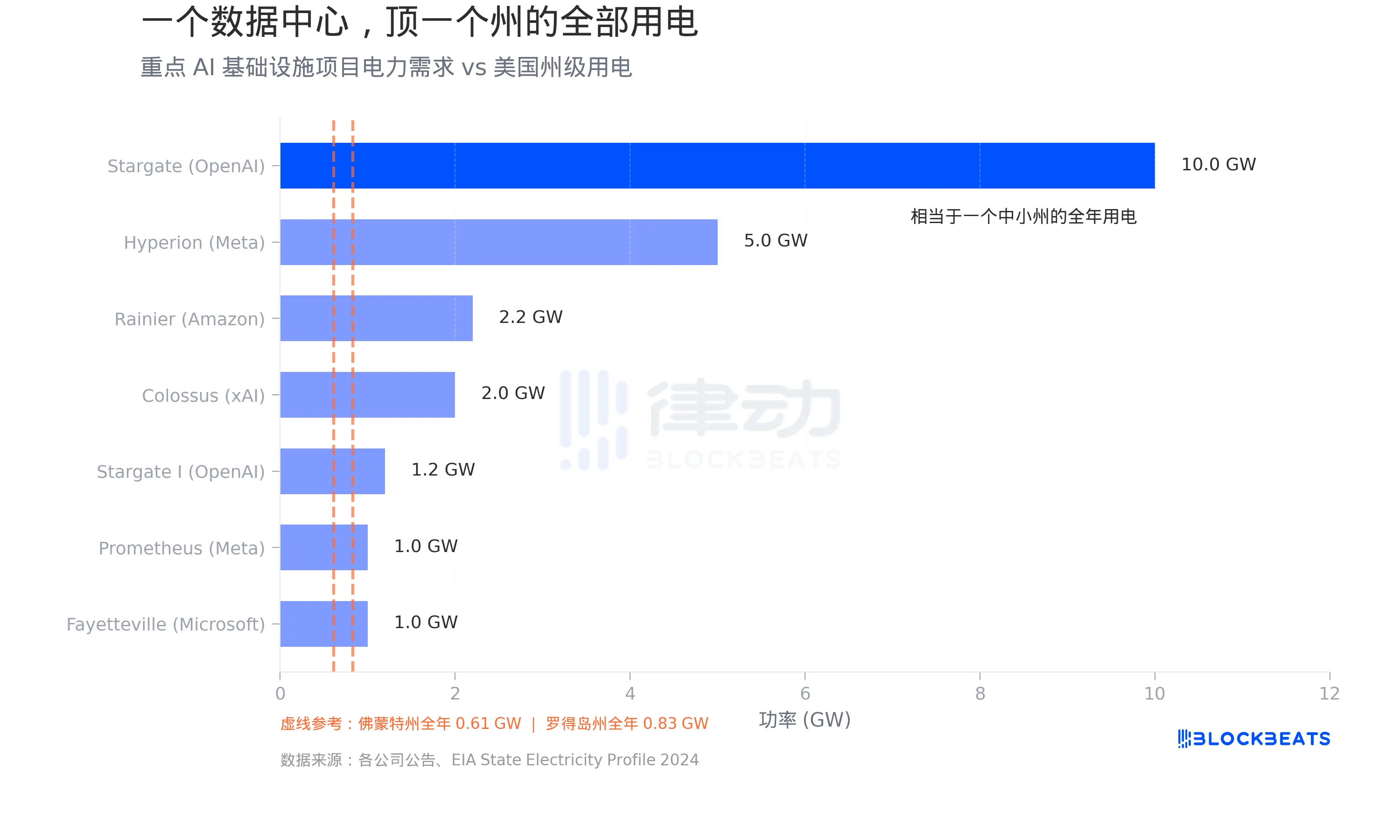
According to S&P Global data, U.S. data centers consumed a total of 183 terawatt-hours of electricity in 2024, accounting for over 4% of the national electricity usage. By 2030, this number is expected to triple.
These power demands are not a long-term story in the making; they are already squeezing the existing grids. According to a CBRE report, the North American data center vacancy rate dropped from 3.3% in the first half of 2023 to 1.6% in the first half of 2025, the lowest on record. According to Cushman & Wakefield data, the vacancy rate saw a slight increase to 3.5% in the second half of 2025, but only because a significant amount of new capacity came online — the absolute level remains historically low, and meaningful supply relief is unlikely to materialize before 2030.
Even AI Itself Says It's Fueling Inflation
These investments are driving demand, raising electricity prices, exacerbating chip shortages, and also revealing a more insidious inflation channel.
According to a Fortune report on April 1, a team led by Deutsche Bank's Chief U.S. Economist Matthew Luzzetti conducted an experiment: they had Deutsche Bank's in-house model dbLumina, Anthropic's Claude, and OpenAI's ChatGPT-5.2 separately assess the "probability of AI driving inflation in the next year."
Results: dbLumina gave 40%, Claude gave 25%, and ChatGPT-5.2 gave 20%. The three models were consistent in their assessment of the "probability of AI significantly lowering inflation": only 5%.
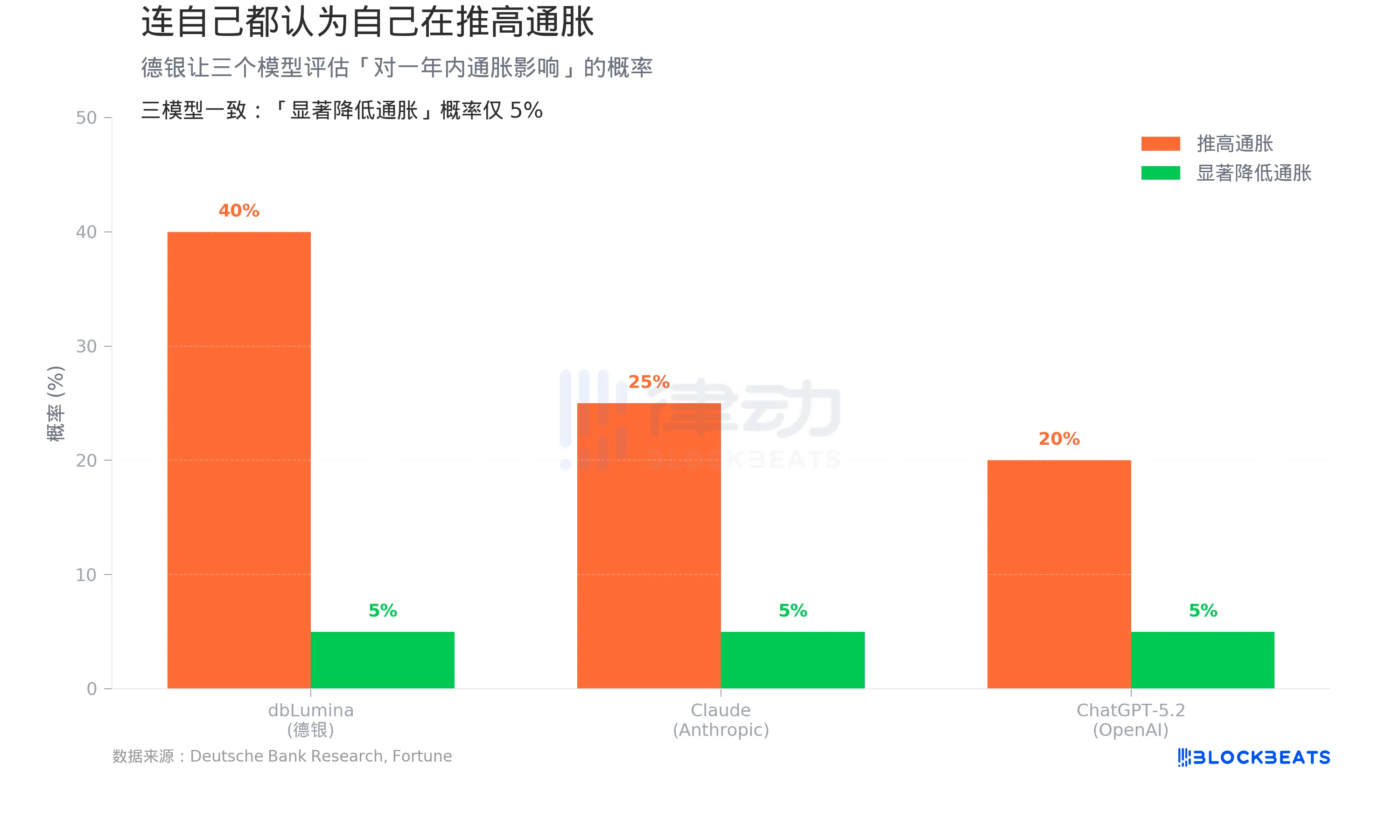
The highly consistent inflationary driver referenced by three models: data centers scaling up, semiconductor demand soaring, power consumption of AI workloads rapidly growing — all demand-driven price pressures.
This stands in stark contrast to the consensus among Wall Street investors. The Deutsche Bank team wrote in a research report: "Will AI become a major deflationary force? Not even AI thinks so."
Over a five-year horizon, the models have indeed shifted towards more deflation potential. However, the probability of "AI triggering large-scale deflation" is still squeezed in the tail risk range.
Optimism Itself Is Inflationary
A paper from the St. Louis Fed provides a theoretical framework to make sense of it all.
Faria-e-Castro and Ozkan use a standard macroeconomic model, defining the AI investment frenzy as a "news shock." According to the Fed post, the logic of the model is: when households see AI described as a revolutionary technology, they anticipate future income increases and increase consumption in advance. Businesses expect productivity gains and ramp up investment. The two effects combine, rapidly outstripping supply with demand. The paper states: "These forces jointly produce a surge of demand-driven inflation — a core feature of the early stages of a news shock."
The model presents two paths. If AI does deliver a productivity leap, short-term inflation will be absorbed by long-term output growth, setting the economy on a virtuous cycle. But if productivity fails to materialize — described in the paper as "sustained low growth and stubbornly high inflation," that is stagflation.
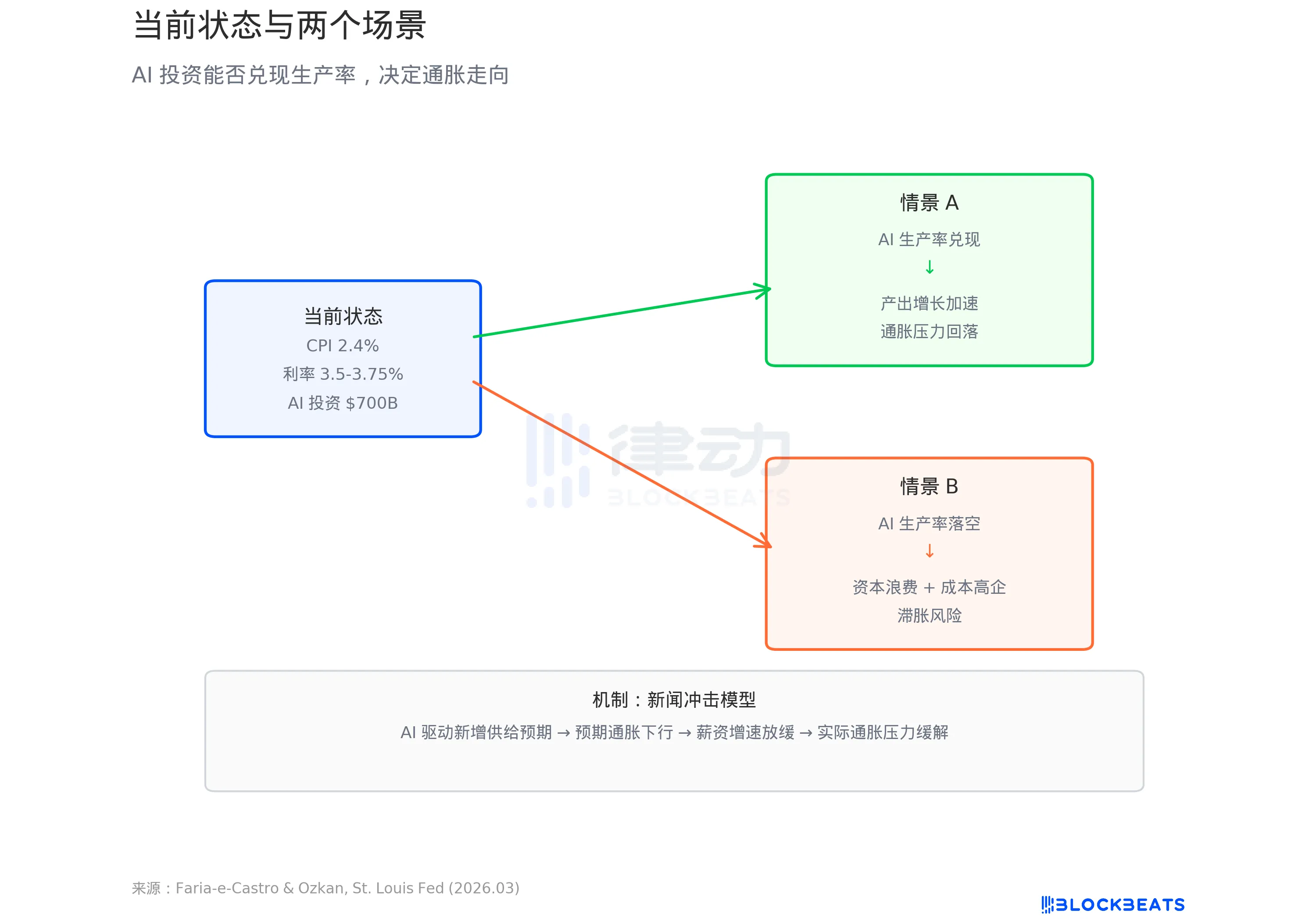
According to the Fed post-cited data, the annualized growth rate of total factor productivity (TFP) in the U.S. since the release of ChatGPT is 1.11%, below the historical average of 1.23%. So far, AI has not made its mark on productivity data.
Meanwhile, according to BLS data, the U.S. CPI in February 2026 was 2.4% year over year, core CPI at 2.5%, both still below the Fed's 2% target. The Fed's March dot plot shows a median year-end rate forecast of 3.4%, pointing to just one rate cut this year.
$700 billion is pouring into AI infrastructure. Whether this money is the cause of inflation or the prelude to a productivity revolution depends on a question that no one has been able to answer yet: Will the models running in these data centers actually make the economy more efficient?
You may also like

The New Yorker in-depth investigation interpretation: Why do OpenAI insiders consider Altman untrustworthy?
Two Divided Worlds: Insights from the New York Digital Asset Summit, the Most Institutionalized Blockchain Conference

Top Ten Reveals of CZ's New Book: Advance Knowledge of "94", the Inside Story of Huobi's Change of Ownership Made Public for the First Time

Ceasefire Overnight Erases War Premium, Three Fault Lines Only One Sealed | Rewire News Morning Brief

Robinhood Secures 'Trump Account': Enabling Millions of Newborns to Access the Stock Market

Afraid to Open the Pandora's Box? Anthropic's Most Powerful Model Ever Dares Not Be Disclosed

US-Iran Ceasefire: A Temporary Pause or Prelude to Renewed Conflict? Market Outlook for Oil, Gold, and Bitcoin
April 8, 2026 – A temporary ceasefire between the U.S. and Iran has provided some immediate relief to the global markets, but the fundamental question remains: Will the cessation of hostilities hold, or is this merely a brief reprieve before a resumption of conflict? As the situation unfolds, market observers are closely monitoring how key assets like oil, gold, and Bitcoin will react in the coming weeks. This article explores whether the ceasefire is a sign of lasting peace, assesses the short-term market implications, and delves into the evolving role of Bitcoin in the global financial landscape.

WEEX Market Update: U.S.-Iran Ceasefire Sparks Bitcoin Price Surge
April 8, 2026 – In a significant shift in global geopolitics, U.S. President Donald Trump has announced a temporary two-week ceasefire with Iran, resulting in a notable market reaction across various asset classes. This development comes after discussions between Trump, Pakistani Prime Minister Shahbaz Sharif, and Army Chief General Asim Munir. The announcement is already reverberating through markets, particularly in oil, gold, and cryptocurrencies.
Morning Report | South Korean financial institutions pilot stablecoin payments for foreign users; Morgan Stanley Bitcoin ETF is about to be listed; CME plans to launch AVAX and SUI futures contracts

EigenCloud Founder: AI and Cryptocurrency are Creating the Next Trillion-Dollar Asset Class
From Panic to Pumps: How Bitcoin Traders Are Playing the 2-Week US-Iran Ceasefire
For most people, the two-week US-Iran ceasefire is about geopolitics, oil prices, and whether World War III gets postponed. But for crypto traders glued to their screens late Sunday night, it was something else entirely: the clearest risk-on signal in months.

US-Iran Ceasefire Triggers Oil Plunge, Bitcoin Surge, and Gold Rally
Despite the sharp rally, caution is warranted. The $70,000–$72,000 zone has historically been strong resistance. The ceasefire is only temporary (two weeks), and any breakdown in negotiations could trigger a sell-off toward the $62,000–$65,000 support zone. For now, Bitcoin needs to close decisively above $72,500 to confirm a true breakout; failure to do so within 48–72 hours could lead to a swift retracement.

OpenAI has no "New Deal," a blueprint for AI that refuses to pay.

Wall Street Flash Mob Run? Mega-Cap Stock Plunge, Goldman's Great Escape, Illustrated Guide to Private Credit Crisis

OpenAI Feud: Power, Trust, and the Uncontrollable Boundaries of AGI
「AI Doomsday Cult」 Sends Operatives into the Strait of Hormuz: What Did They Find?
Everyone is waiting for the war to end, but is the oil price signaling a prolonged conflict?


 App
App