
America's First State-Backed Stablecoin FRNT: Can It Save Wyoming Amid Energy Slump?

 Prefer us on Google


Original Title: "Homeland of Brokeback Mountain, Issuing a New American Dream"
Original Author: Bootly, by Bitpush News
On the map of the United States, Wyoming is often an overlooked "Western Asset."
Mention it, and most people's first reaction is to the Old Faithful geyser in Yellowstone National Park, or the perpetually snow-capped peak of the Grand Tetons.
It is the least populous state in America, with fewer than 600,000 people living on nearly 97,800 square miles of land—this number is even less than a suburb town in Shanghai.
In the memory of literature and imagery, it is the cruel wilderness described by Annie Proulx, the unforgiving mountains of a cowboy's life in "Brokeback Mountain," and the bloodstained frontier trapped in a blizzard in Quentin Tarantino's "The Hateful Eight."
It is a land of contradictions: extremely conservative, it is the reddest state in America, where the Republican Party has held a monopoly for forty years, with over 70% of voters casting their ballots for Trump in the 2024 U.S. Presidential Election. Yet it has also been at the forefront of its time, becoming the first "Equality State" to grant women the right to vote as early as 1869.
But Wyoming is by no means a financial desert. Every midsummer, the most influential group of people in the world gathers here: in the serene resort town of Jackson Hole, Wyoming, the annual Global Central Bankers Conference hosted by the Kansas City Federal Reserve is held. From Greenspan (the thirteenth Chairman of the Federal Reserve) to Powell, every key turning point in global monetary policy has been set on this mountain-surrounded meadow.
It is this proud and distinctive "Western Spirit" that has once again brought Wyoming into the public eye in early 2026.
On January 7th local time, the state officially announced the launch of the $FRNT stablecoin, first issued on the Solana blockchain and supporting six EVM-compatible chains. This is the world's first U.S. dollar stablecoin endorsed by "state government credit."
Mine Seekers: The Resurrection of Energy Transition
Wyoming's radicalism stems from a deep-seated fiscal anxiety: the "underground wealth" that has sustained this land for centuries is running dry.
As the energy heart that supplies 40% of America's coal, this place once created a "tax haven" myth through a mining severance tax: residents did not pay personal income tax, and businesses were exempt from income tax.
One of the key reasons was the continuous export of resources from the Powder River Basin, allowing this sparsely populated state to generate astonishing wealth: its per capita GDP has long ranked in the top ten in the U.S., even rivaling New York and California in years of energy boom.
This prosperity once gave Wyoming the confidence to refuse levying personal income tax, corporate income tax, and estate tax. However, this was a fragile prosperity built on heavy industry.
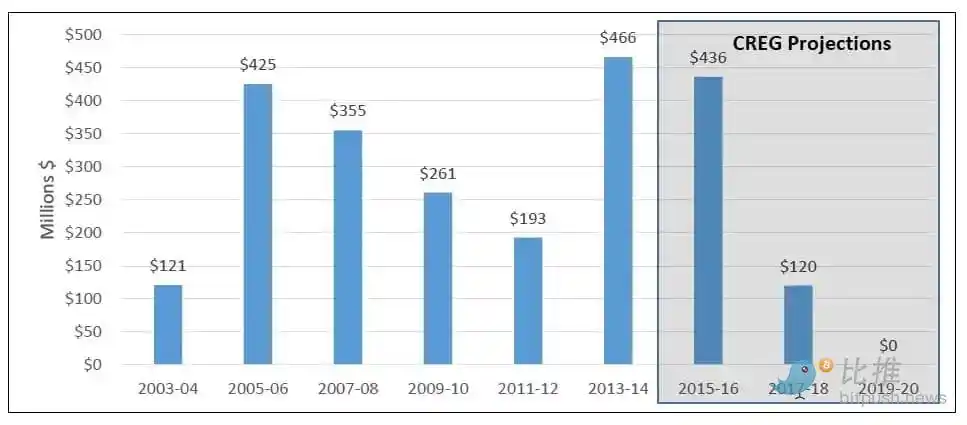
Image Source: University of Wyoming Center for Energy Economics and Public Policy
Starting in 2011, Wyoming's cornerstone industry embarked on a decade-long "avalanche":
Relentless market substitution: The rise of low-cost shale gas and renewable energy dealt a heavy blow to coal in terms of electricity generation costs.
Tightening environmental constraints: The advancement of U.S. federal carbon emission regulations (such as the Clean Power Plan) led to the mass closure of coal-fired power plants across the country.
A precipitous fiscal gap: According to official CREG data cited by Wyoming Public Media, the state's coal severance tax plummeted from $290 million in 2011 to $170 million in 2022. By 2025, the state's coal production is expected to drop to its second-lowest historical point, only half of the peak in 2008. And the "Coal Lease Bonuses," which were once a significant source of school infrastructure funding, have even been reduced to zero.
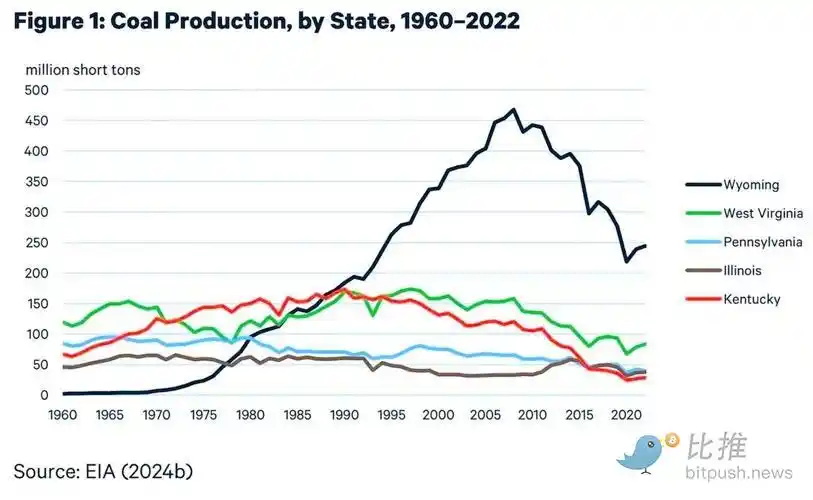
"If we don't shake things up, we'll become the next West Virginia" — a traditional mining region in the U.S. that, after the decline of the coal industry, became one of the poorest states in America. This raw pain has prompted even the most conservative cowboy politicians in the area to develop a sense of urgency.
They realized that since they couldn't change the trend of energy transition, they had to leverage Wyoming's most core asset — extremely business-friendly legislation.
In fact, Wyoming's innovation gene has a precedent. In 1977, it was the first in the U.S. to invent the LLC (Limited Liability Company), the most popular business entity to this day.
Starting in 2018, to save itself, this most "red" conservative state was forced to embark on a long journey of institutional innovation in the crypto world.
In 2019, Wyoming passed House Bill 74 (HB 74), establishing a new type of financial entity: the SPDI license (Special Purpose Depository Institution). This is not a traditional bank, but an institution that "does not engage in loan-making, only custody and settlement."
In September 2020, the crypto exchange Kraken became the first recipient of an SPDI license in the U.S., establishing Kraken Bank. This marked the first time that crypto assets had received "bank" status under state law.
In 2021, the state became the first to pass the "DAO Bill," allowing code-based organizations to register as legal LLC entities.
As for the newly launched $FRNT, according to the Wyoming Stablecoin Committee (WST) plan, the $FRNT stablecoin is overcollateralized by 102% with U.S. Treasuries and cash.
The reserve management is handled by investment giant Franklin Templeton, which oversees around $1.6 trillion in assets, with custody provided by its affiliate Fiduciary Trust Company International. The core business logic is as follows: the state government absorbs dollars, buys U.S. debt, and the interest income generated is directly allocated to the "School Foundation Fund" to support local public education.
Stablecoin: Who Will Benefit?
Wyoming's leap actually signifies the stablecoin race entering the second half: from private companies' "credit game" to the government level "public good."
In the past, discussions about stablecoins revolved around the compliance risks of Tether or Circle; but in the Wyoming narrative, stablecoins want to return to their essence—a highly efficient, low-cost payment channel (settlement fees are usually below $0.01) and are beginning to exhibit public financial attributes.
However, this "digital highway" has encountered intangible barriers in the real world.

In Jackson Hole, Wyoming, the rent for an ordinary two-bedroom apartment has reached $4,000, 25% higher than Los Angeles. Despite having one of the highest GDP per capita figures in the U.S., about 10% of residents still face food shortages. For blue-collar workers who rush to catch the commuter bus every morning, relying on two or three jobs to make ends meet, "stablecoin" seems more like a distant technological concept.
This division is not accidental but intricately designed and maintained. A state official admitted to prospect.org that through land acquisition and zoning thresholds, the landscape here has been shaped to look like "invisible poverty."
Writer Annie Proulx once depicted the harshness of Wyoming's land, a harshness that has now been folded by technology and capital into two layers of impenetrable realities.
On one side, there is a tax-evading utopia for the wealthy nestled in the mountains and forests; on the other side is the ordinary American propping it all up but with nowhere to call home—their lives quietly folded in both reality and online narratives.
As I browse discussions about Wyoming on Reddit, the locals' complaints are abundant:
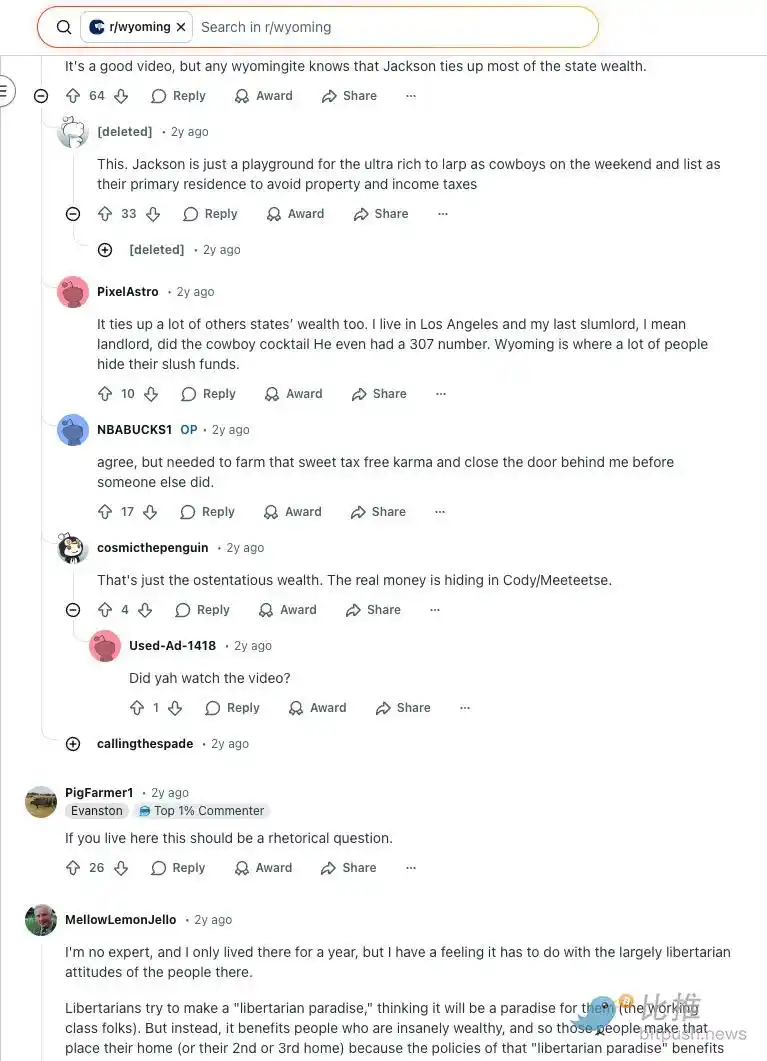
"Jackson is simply a playground for the super-rich to play cowboy on the weekends, listing it as their main residence to avoid property and income taxes."
"The people here are libertarians trying to create a 'libertarian paradise,' thinking it would be their (working-class's) paradise. But in reality, it benefits the oil-rich who make it their home (or second, third home) because the policies of the 'libertarian paradise,' such as less regulation, taxes, etc., favor them."
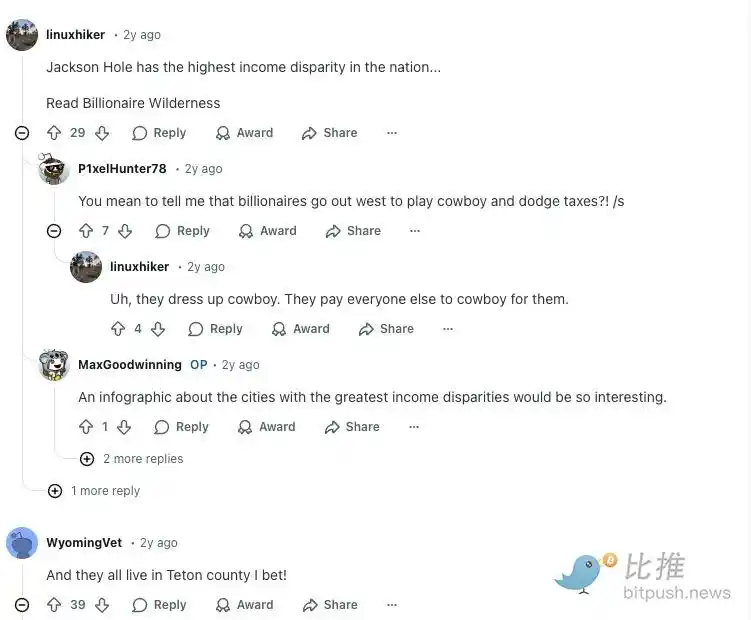
In such a divide, the state government is attempting to build a digital-age financial sovereignty on the ruins of the coal industry, using laws and stablecoins. Data shows that Wyoming now surpasses Delaware, becoming a new institutional haven in the U.S., with 348 limited liability companies per thousand adults.
But can this rush of digital gains to the "Cowboy State" truly mend the rifts in this land?
References:
<1> Consensus Revenue Estimating Group (2025.10)
<2> CNBC: Wyoming is pushing crypto payments and trying to beat the Fed to a digital dollar
<3> The American Prospect: Down and Out on the Crypto Frontier
<4> wyofile: Clean Power Plan may cut Wyo coal revenue 31-63 percent
Disclaimer: This content is provided for general branding and informational purposes only and doesn't constitute financial, investment, legal, or tax advice. Any events, rewards, online events, or related information mentioned herein should not be considered a recommendation, solicitation, or invitation to purchase, sell, trade, or otherwise deal in any crypto assets or to use any services. Crypto assets are highly volatile and may result in loss. WEEX services and online events may not be available in all regions and are subject to applicable laws, regulations, and eligibility requirements. You are responsible for ensuring that your use of WEEX services complies with local laws and for carefully assessing the risks before participating in any crypto-related activities.
You may also like

Home Robot NEO Grows "Dexterous Hands": How Do Hands Become the API to the Physical World?

What is SCEX? The Cryptocurrency Exchange for Vietnam's Market by Sacombank

Major Update for ChatGPT: Cross-Platform Functionality, One-Click Website Creation, and Lower Costs

BTC Challenges 64,000 After Breaking 63,000, Market Trading 'Manageable Risks'

As the Bubble Bursts, Who Dominates Attention in the AI Era? A 2026 Guide to Influential AI KOLs in China and the UK

Old Money in Crypto Shifts: Paradigm Raises $1.2 Billion, Half Bet on AI and Robotics

Bitdeer unveils $36M Nevada factory to shake up Bitcoin mining

Perplexity Fine-Tuned a Chinese AI Model to Match Claude Opus 4.8 at One-Third the Cost

Bank of Korea defends bank-first stablecoin plan amid bill deadlock
JPMorgan says bitcoin's main risk isn't Strategy, but blockchain adoption that doesn't benefit public chains and tokens
Fear & Greed Index Today: What Extreme Fear Means for Crypto, Stocks and Gold
Labour MPs Push to Make UK Crypto Donation Ban Permanent

Supreme Court ruling expanding Trump's authority over federal agencies raises questions for SEC, CFTC as crypto rulemaking advances

'Bottom building in progress': Analysts say bitcoin holder capitulation signals late-stage bear market

A Comprehensive Analysis: Starting from 1996, Who is Laying the Foundation for the Next Generation of Capital Markets
Luke Dashjr, the Biggest Anti-Spammer of Bitcoin, Inscribed Phrases on the Network in 2011

Whales bought 270,000 BTC while ETFs bled $7 billion. One side is wrong

The crypto IPO class of 2025-26 is down as much as 89%. Autopsy of a listing boom
Robinhood Chain Mining Guide: A Comprehensive Tutorial from Cross-Chain to Memecoin
BitGo CEO says single-digit percentages of bitcoin's supply are 'probably right' for large holders amid Strategy's sale

Beyond Private Keys: How to Safeguard the Security Boundaries of Web3 from Wallets, L2 to Supply Chains?

Vanguard Enters the Market, Opening a New Crypto Gateway for 50 Million Traditional Investors

Why the OUSD Alliance of 150 Companies Still Cannot Shake USDT and USDC?
Citigroup Analysis: Is There Still 47% Upside for Nvidia? Can Rubin and CPO Deliver?

WEEX API Fast Connect: Turn Every Sign-In Into a Live Trader in Under 10 Seconds
WEEX API Fast Connect is a one-click OAuth authorization system that lets your users link their WEEX account without ever touching an API key. Frictionless onboarding, faster conversions, higher retention — built for WEEX Broker partners.
Bitcoin's dwindling exchange reserves don't pack the same bullish punch anymore

From Le Mans to the Rollercoaster: Carl Moon Takes On Portimão
Crypto world renowned KOL and racing driver Carl Moon, backed by WEEX, heads to the Ferrari Challenge Portugal round at the Algarve International Circuit, July 16–19, fresh off a podium finish at Le Mans. Here's why this race is one to watch.
Fast execution. Split-second accuracy. Security that never blinks. That's WEEX — and that's exactly how Carl races.

The Downfall of a Public Company: A $1.46 Billion Bet on WLFI, $540 Million Went to the Trump Family
Dragonfly Partner: BTC is Intergenerational Wealth, Optimistic About ETH and SOL
Goldman Sachs Calls to Go Long on Chinese AI: $4 Trillion Market Value Behind, Global Funds Only Allocated 1.2%
Home Robot NEO Grows "Dexterous Hands": How Do Hands Become the API to the Physical World?
What is SCEX? The Cryptocurrency Exchange for Vietnam's Market by Sacombank
Major Update for ChatGPT: Cross-Platform Functionality, One-Click Website Creation, and Lower Costs
BTC Challenges 64,000 After Breaking 63,000, Market Trading 'Manageable Risks'
As the Bubble Bursts, Who Dominates Attention in the AI Era? A 2026 Guide to Influential AI KOLs in China and the UK
Old Money in Crypto Shifts: Paradigm Raises $1.2 Billion, Half Bet on AI and Robotics

Contents
Latest articles





Latest coin listings on WEEX


