Analysis and Opinion: Will the Crypto Market Still Be Bullish in 2025?

By: blockbeats|2025/03/11 15:15:03
0
Share
copy
Original Title: Still Bullish? Or are we in the "Wealth Destruction" Phase Now?
Original Author: Michael Nadeau, Founder of The DeFi Report
Original Translation: Deep Tide TechFlow

Hello readers, last week we conducted some polls on X and LinkedIn, and many of you expressed interest in seeing more data/analysis about the current cycle.

Therefore, the focus of our discussion this week will be answering these questions: Is there still a bull market for cryptocurrencies in 2025? Why are there many bullish factors now, but I still feel pessimistic? How should we dialectically think about the state of the cycle?

Let's go!

Bearish Viewpoint

Before diving into on-chain data analysis, I'd like to share some qualitative analysis of how we view the cryptocurrency cycle.

Early Bull Market Phase

Roughly from January 2023 to October 2023.

This was the period when the market rebounded from the FTX crash. It was a very quiet time (low trading volume, almost silent crypto Twitter). Then the market started to rise again.

Bitcoin's price surged from around $16,500 to $33,000.

However, no one called this phase a bull market. In the "early bull market" phase, most market participants were still in a wait-and-see mode.

Wealth Creation Phase

Roughly from November 2023 to March 2024.

During this phase, we saw significant price surges and notable wealth creation effects. For example, SOL rose from $20 to $200. Jito's airdrop (December 2023) created amazing wealth effects within the Solana ecosystem and repriced Solana's DeFi projects (such as Pyth, Marinade, Raydium, Orca, etc.). The VC market also peaked during this phase.

The Bitcoin price surged from $33,000 to $72,000. Ethereum rose from $1,500 to $3,600.

Bonk's market cap increased from $90 million to $24 billion (26x). WIF's market cap rose from $60 million to $4.5 billion (75x). This phase also planted the seeds for a larger-scale "Memecoin Season."

However, despite this, this period was still relatively "quiet." Your "normie" friends may not have started asking you about cryptocurrency yet.

Wealth Distribution Phase

Roughly spanning from March 2024 to January 2025.

This phase is the "Peak Attention" phase. We often see "WAGMI" (We're All Gonna Make It), fast rotations, new hotspots (though short-lived), and blind investments that pay off. Celebrities and other "crypto tourists" often enter the market during this phase. This phase may see sensational news such as "Tesla buying Bitcoin" or "Bitcoin Strategic Reserve."

Why?

Because new investors enter the market due to this news. They fear they are "missing out on the party."

This is the second wave of "Memecoin Season," evolving into the "AI agent season." In this phase, the market turns a blind eye to many blatantly questionable behaviors. No one wants to point out the issues because everyone is making money.

And then we arrive at the current state.

Wealth Destruction Phase

We believe we entered this phase shortly after Trump took office.

This is the period the market immediately enters after experiencing a top sell-off. The catalysts of the bull market have become a thing of the past. Positive-looking news triggers bearish price actions.

In the current market environment, political actions regarding "Bitcoin Strategic Reserve" have not impacted the market — a crucial signal. In this phase, market rebounds often face critical resistance levels and ultimately fail (as we saw last week with the market's response to Trump's tweet about crypto reserves).

In the "Wealth Destruction" phase, we pay additional attention to some signals:

· Settlement and "panic" events, which disrupt the market but have not yet led to a full sobering-up of the market — we saw a similar situation in DeepSeek AI's panic and tariff uncertainty.

· Investors still hold on to "illusions." Today, we see a lot of discussions about the US dollar's decline and global M2 (broad money) growth (which will be detailed later in the report).

· "Speculators" entering the market. More people are DMing us to "check out their project," more ads are circulating in the market, well-funded projects at major conferences engaging in senseless spending, and more PvP. Moreover, the entire industry is emitting a more "dirty" atmosphere. As the "wealth destruction" period unfolds, bad actors start to show their true colors.

At this stage, hidden issues gradually surface — usually post-settlement. The last cycle started with Terra Luna, which then led to the blow-up of Three Arrows Capital. This was followed by the bankruptcies of BlockFi, Celsius, FTX, among others, ultimately resulting in Genesis's closure and CoinDesk's sale.

Currently, we have not yet seen any blow-up events. The blow-up phenomenon in this cycle should decrease — simply because the number of CeFi companies has decreased, meaning that when the market officially bottoms out, the low point may be higher.

Where will the blow-up come from?

No one knows, but I think there are some "suspects" worth monitoring:

· Exchanges: Pay attention to hidden leverage and/or potential fraudulent behavior in some overseas "B and C grade" exchanges.

· Stablecoins: We are monitoring Ethena/USDe — currently its circulating stablecoin value is close to $5.5 billion. It maintains its peg through cash and futures arbitrage (holding spot, shorting futures) to earn yield — this pattern was a major source of leverage in the last cycle (through Grayscale). Ethena's reliance on centralized exchanges adds extra counterparty risk. Additionally, MakerDAO also has some of its reserves invested in USDe, further increasing the systemic risk in DeFi.

· Protocols: Beware of frequent hacking attempts and potential liquidation cascades triggered by cryptographic asset collateral on platforms like Aave — which still has over $110 billion in active loans (although down from a peak of $150 billion).

· Strategy: We believe that Strategy has excelled in prudent debt management, with the majority of its debt being long-term unsecured debt or convertible bonds (BTC holdings will not trigger additional margin calls). Furthermore, in the last cycle, they were able to withstand a 75% price drop in BTC. However, having said that, if the BTC price experiences a significant decline, it may force Saylor to sell a large amount of BTC at the worst possible time.

The optimal re-entry point into the market is towards the end of the wealth destruction phase. We believe this moment has not yet arrived.

Bearish Data

Decentralized Exchange (DEX) Trading Volume

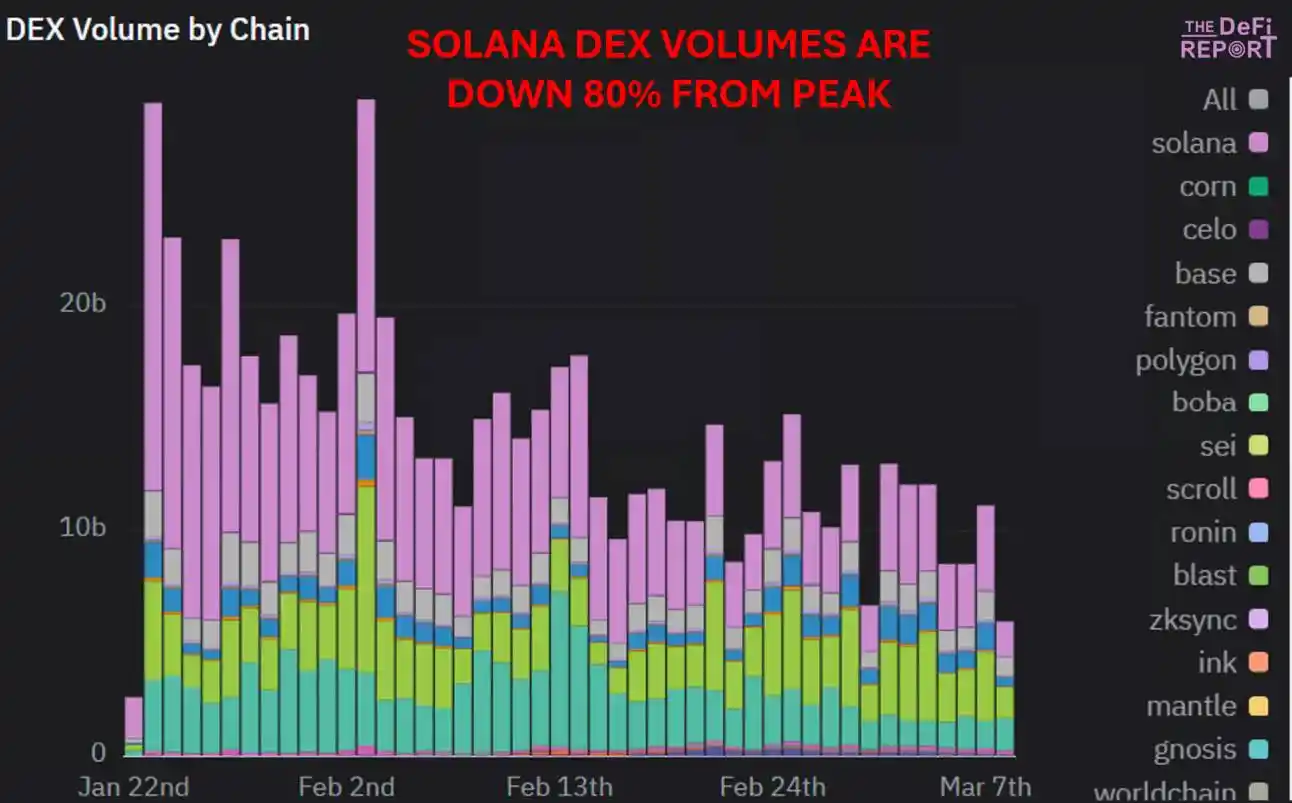
The trading volume on Solana's decentralized exchanges has dropped by 80% compared to the peak reached after Trump launched his Memecoin. At the same time, the number of active individual traders has also decreased by over 50%. This indicates to us that speculative fervor in the market is waning.

Analysis and Opinion: Will the Crypto Market Still Be Bullish in 2025?


Data: The DeFi Report, Dune

Token Issuance

The number of tokens issued on Solana has decreased by 72% compared to the peak. However, the chain still sees over 20,000 tokens being created daily.
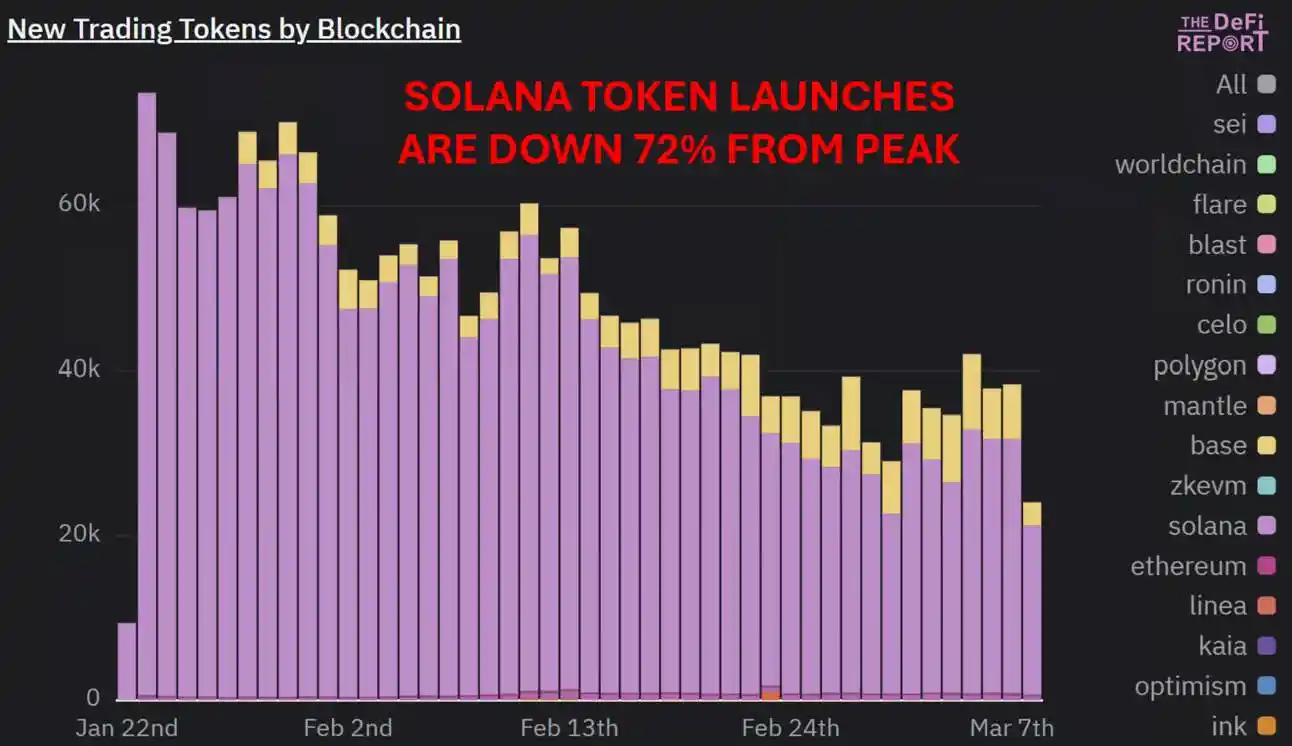
Data: The DeFi Report, Dune

BTC Long-Term Holder MVRV Ratio
Data: Glassnode

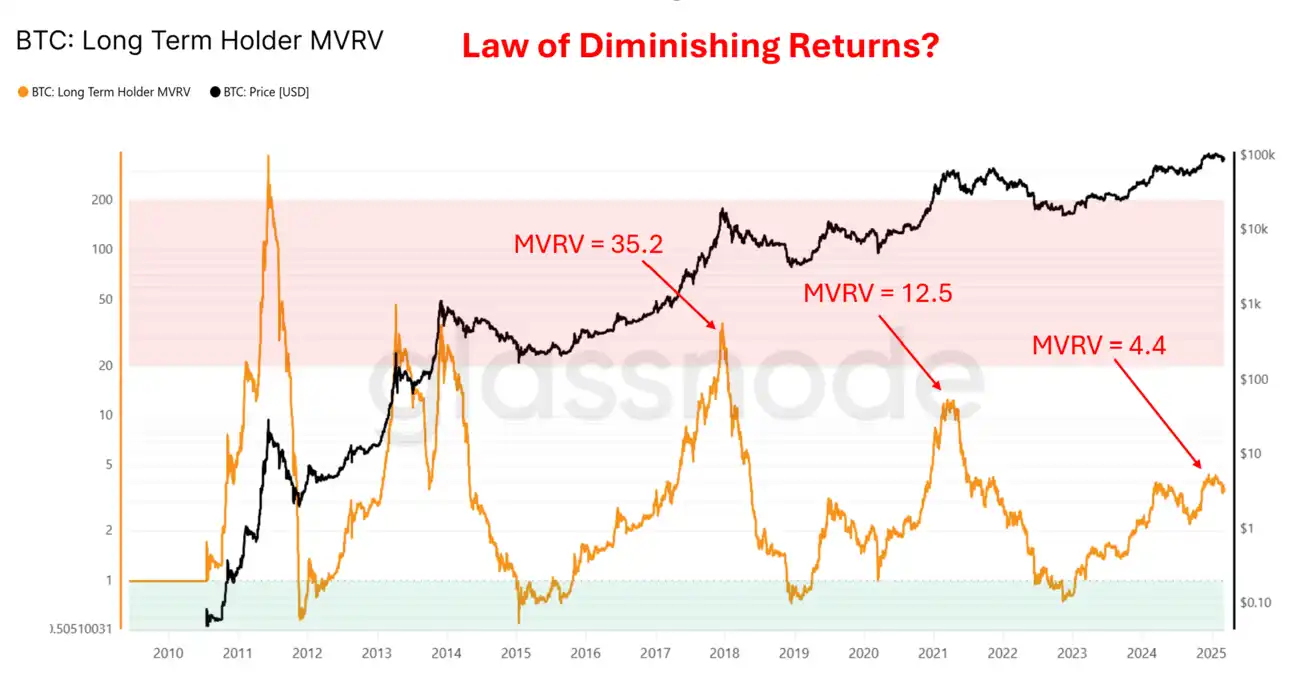
Bitcoin's long-term holder MVRV (Bitcoin's "smart money") peaked at 4.4 in December of last year. This is only 35% of the 2021 cycle peak of 12.5, which itself is 35% of the 2017 cycle peak.

Bitcoin rose approximately 80x from low to high during the 2017 cycle, around 20x during the 2021 cycle, and about 6.6x in the current cycle.

The realized price of Bitcoin (i.e., the average cost basis of all circulating Bitcoins) peaked at $5,403 during the 2017 cycle, which was 15.1 times higher than the peak of the 2013 cycle; peaked at $24,530 during the 2021 cycle, which was 4.5 times higher than the 2017 cycle peak. And today's realized price is $43,240, 1.7 times the peak of the 2021 cycle.

Conclusion

· From each of the above data points, it can be observed that the peak values of different cycles exhibit symmetrical diminishing returns. These data clearly demonstrate the existence of the diminishing returns law.

· Bitcoin is now a $1.7 trillion asset. However bullish the news may be, investors should not expect to see sustainable parabolic growth as in the past—too much capital would be required at this point to drive the asset higher.

· When Bitcoin loses momentum, the rest of the tokens in the market will also suffer.

· The speculative frenzy around Solana is waning. Considering that 61% of DEX volume so far this year involved meme coins and that in the past 30 days, less than 1% of Solana users contributed over 95% of gas fees. This is worrying as it indicates that a small part of Solana's users (the "whales") are preying on other users (the "minnows"). Therefore, if the "minnows" tire of losses and opt to exit temporarily (which we believe they are), we might see the fundamentals of Solana deteriorate rapidly.
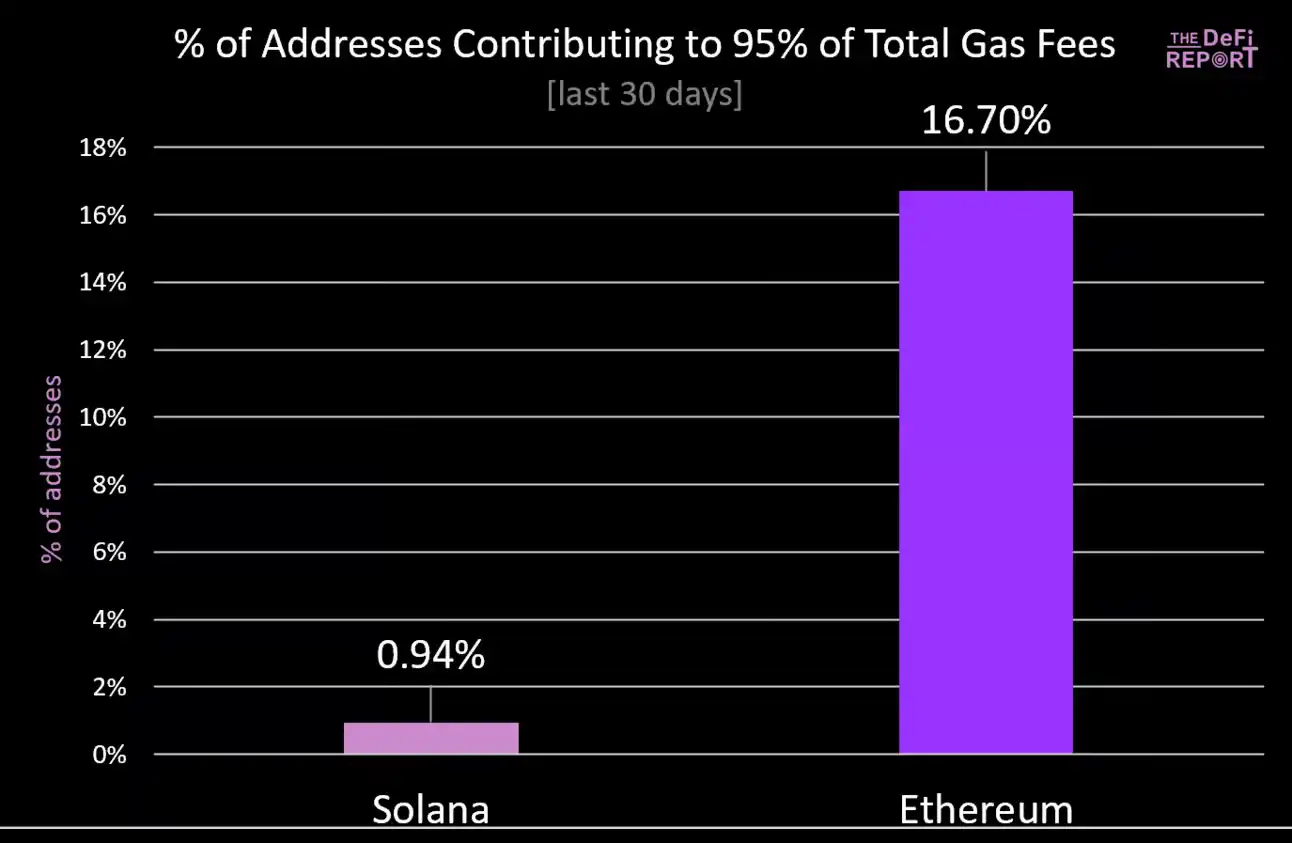
Data: The DeFi Report, Dune (base + priority fees + Jito tips on Solana)

· Bitcoin's long-term holders have realized profits twice in the past year. Their realized price (i.e., cost basis) is currently around $25,000. On the other hand, short-term holders who bought at the peak now have an average cost basis of $92,000, putting them at a loss. We believe that as the market realizes that Bitcoin's top is likely in at $109,000, these short-term holders might continue to sell at lower peaks.
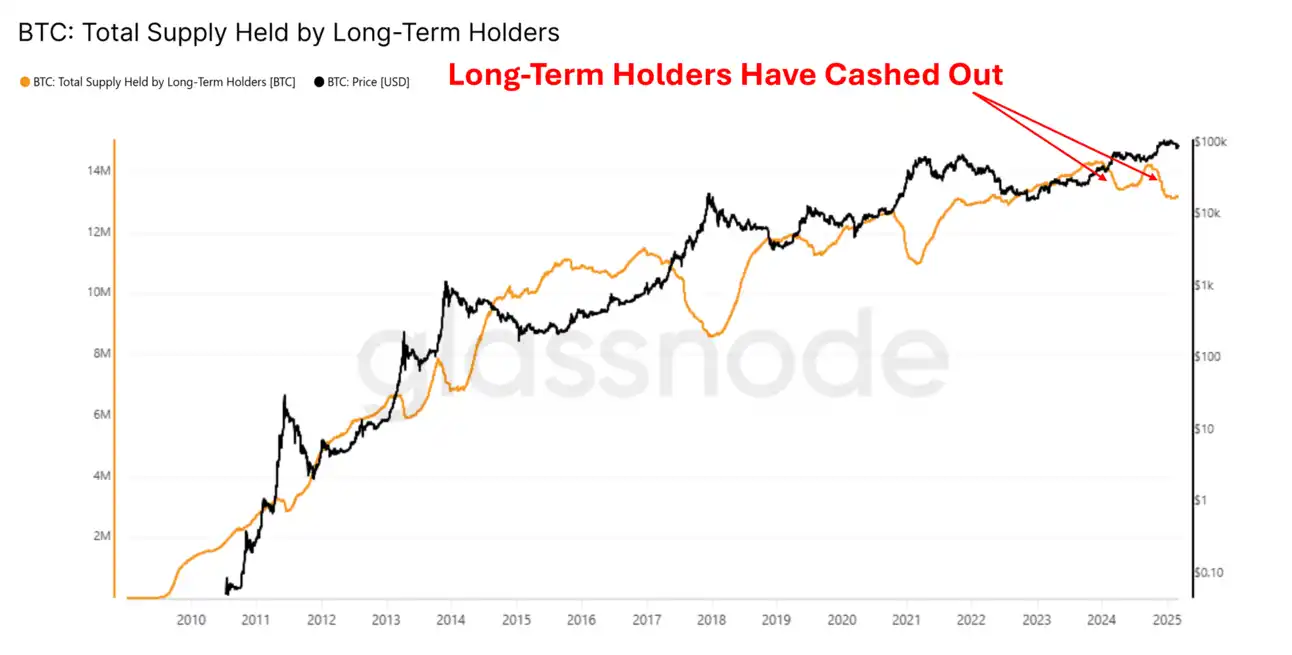
Data: Glassnode

When all information is laid out like this, we believe it is undeniable that the "typical" cycle has completed, and this is not the so-called "law" at play.

In our view, the best way to process this information is to acknowledge reality and assign a probability to the possibility that the cycle has already peaked. We believe this probability clearly exceeds 50%.

After completing the fundamental analysis, we will attempt to identify any flaws in our argument and stress-test our viewpoint.

Let's get started.

Bullish Viewpoints

I still see significant opposition to bearish views in the market, and bulls are not likely to lay down their arms easily.

This raises a question: Does the bullish viewpoint further prove that we have entered the "wealth destruction phase"? Or are we too bearish and overlooking the possibility of another rally?

In this section, we will go over some observed "bullish viewpoints."

Global M2/Liquidity
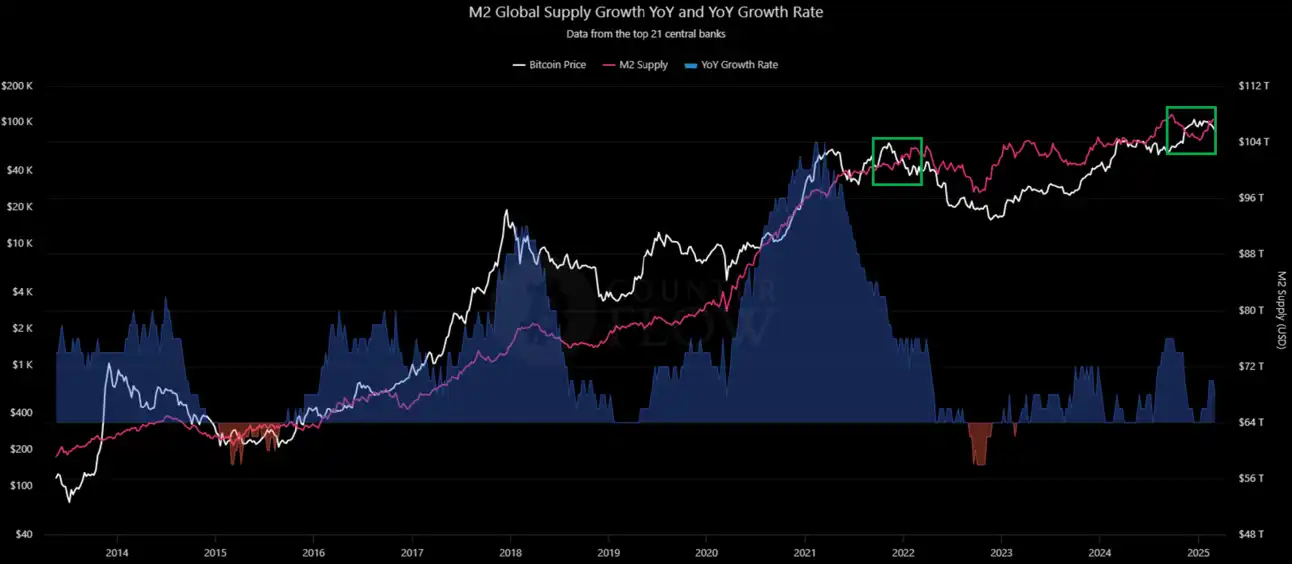
Data: Bitcoin Counter Flow

The green box on the right shows: When global M2 starts to rise, BTC is falling. Some have pointed this out and mentioned the correlation between BTC and M2, as well as the 2 to 3 month lagging reaction of BTC to M2 changes.

However, the green box on the left shows: A similar dynamic occurred at the end of the last cycle: as M2 was rising, BTC was falling. In fact, M2 did not peak until early April 2022—5 months later than BTC's peak.

Since mid-January, global M2 has grown by 1.87%, mainly due to central banks shifting from tightening to easing policies.

These are favorable liquidity conditions.

However, we also need to consider the following questions:

1. What is driving M2 growth? We believe this is mainly coming from the decline in the US dollar (down 4% since February 28!), leading to an increase in foreign currency priced in USD, thereby driving global M2 growth. Additionally, the reverse repo facility has recently been drained, and China is also stimulating its economy through loose policies.

2. Will This Trend Continue? We believe the U.S. dollar will continue to decline as investors move funds overseas, but the pace of decline in the coming weeks may not be as rapid as recently experienced. We expect China to continue implementing loose monetary policies against the backdrop of a weakening dollar. However, the Federal Reserve may not take immediate easing measures as they have stated that reserves are still "ample." Additionally, we believe the Federal Reserve remains concerned about inflation.

3. How Are Current Liquidity Conditions Compared to Last Year? We believe that current liquidity conditions should be seen as headwinds compared to last year. Remember, the key is the rate of change, not just nominal growth. We strongly believe that the Federal Reserve and the Treasury Department drove the markets last year through "shadow liquidity," namely "not-QE, QE," and "not Yield Curve Control, Yield Curve Control," to aid the reelection of Biden/Harris. According to Michael Howell of Cross Border Capital, the unwinding of these policies has had a significant impact on the rate of change.
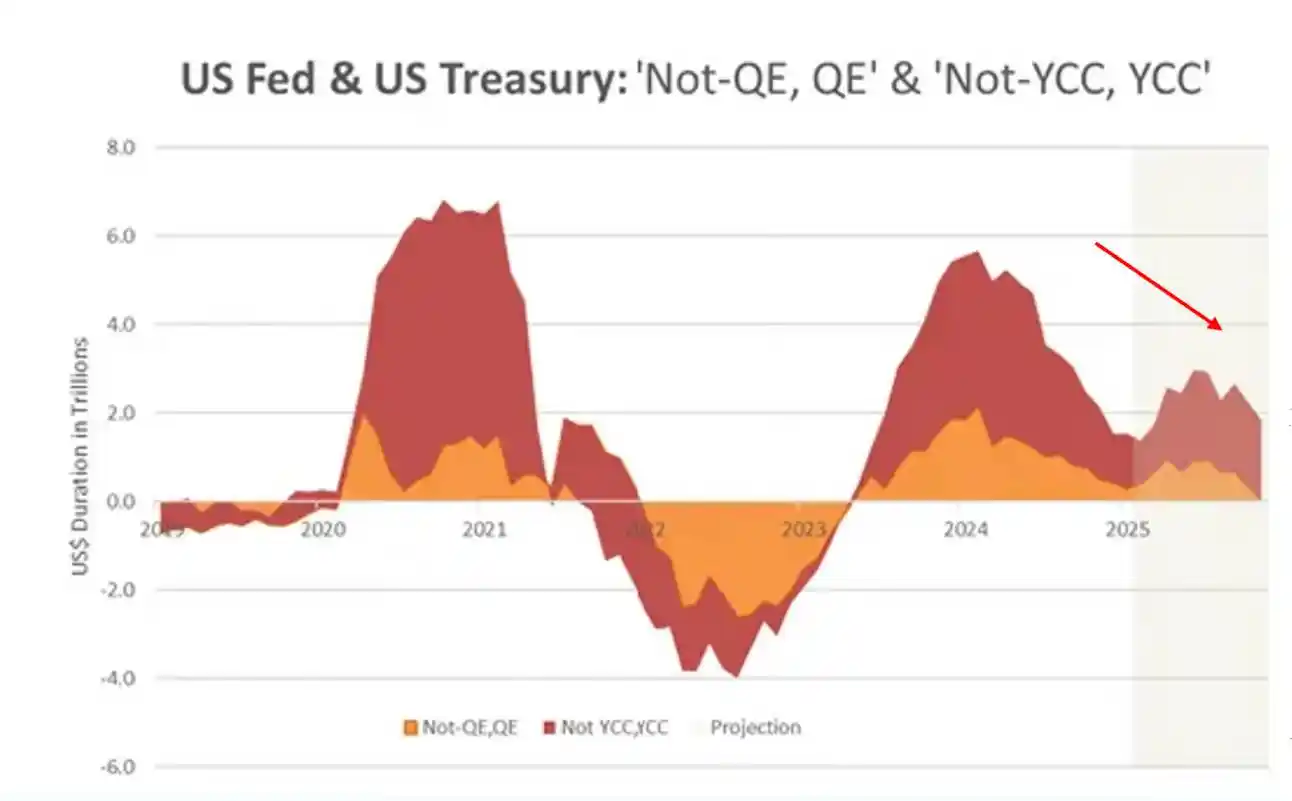
Data: Cross Border Capital

It is estimated that the above-mentioned "secret stimulus" added $5.7 trillion to the U.S. markets at the beginning of 24. This was achieved by exhausting reverse repos + pre-issuing new bonds in the bills.

Finally, we believe investors should closely watch Treasury Secretary Bessent's comments in a CNBC interview last week: "The market and the economy are addicted. We have become reliant on this government spending. It's going to require a detox. It's going to require a detox."

Business Cycle/ISM

As we have previously pointed out, ISM data indicates the start of a new business cycle. We have also noted strong data on capital expenditure (Capex) purchases and small business confidence. We believe this data is real but also clearly shows growth is slowing down. The data we observed last month may have been distorted by some manufacturers engaging in "pre-tariff buying" ahead of expected tariffs. Since then, we have seen some softness in the service sector and new order data, with the February manufacturing PMI reading at 50.3, down from January's 50.9.

Strategic Bitcoin Reserve

Until last Friday, we still saw natives of the crypto space holding out hope for discussions regarding strategic cryptocurrency/bitcoin reserves—despite the market ignoring such news multiple times over the past 6 weeks.

I believe we can now collectively agree this has been a "buy the rumor, sell the news" event.

The Flaw of "Cyclical Thinking"?

We should also acknowledge that the current "cycle" has behaved differently than past cycles. For example:

· BTC hit an all-time high for the first time before a halving.

· This cycle has been shorter, with just a two-year bull run.

· The "altcoin season" has behaved very differently, with bitcoin's dominance steadily rising since early 2023.

· Bitcoin is now fully integrated into the financial system and has the backing of the US government.

If there is a flaw in "cyclical thinking," then perhaps we have not peaked yet. Instead, we might just be in a pause/adjustment/consolidation phase before the next leg up, rather than entering a year-long bear market where prices could drop 75%-80% as seen in the past.

We believe the cycle is evolving. However, we still anticipate that a bear market may take 9 to 12 months to fully unfold.

Conclusion
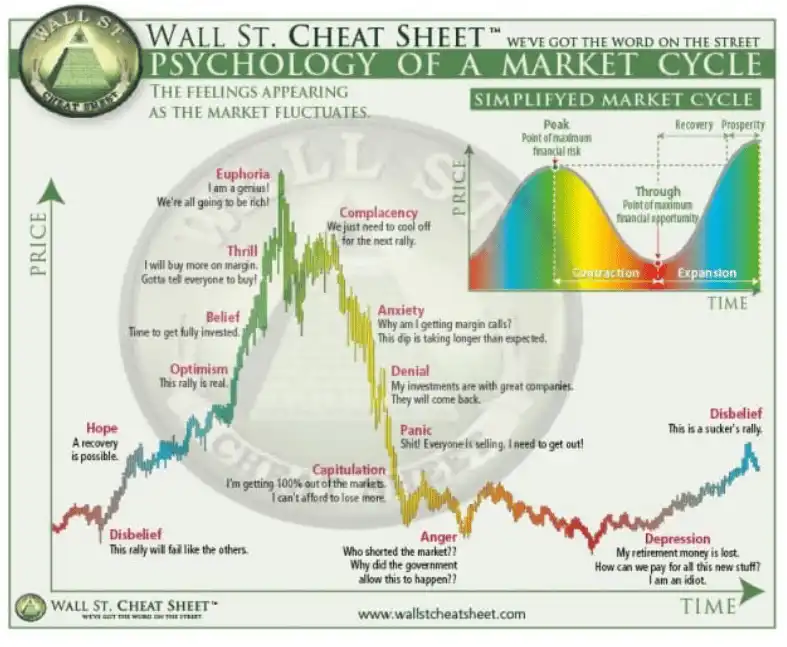
To summarize our view:

1. We believe we are currently in the "complacency" stage as shown in the chart above.

2. All the bullish catalysts identifiable years ago have now played out.

3. The economy may be heading towards a recession. We believe the Trump administration's stance is very clear. They are essentially telling us that the economy needs a "detox." We should believe their stance. This is very similar to Powell's statement early in 2022 about "pain coming." Our current thinking is that cryptocurrency is the canary in the coal mine. Traditional financial markets will slowly decline/oscillate in response.

4. Given the market sentiment is extremely bearish, we may see a short-term bounce to the low $90K range for BTC. However, we believe this bounce will face intense selling pressure—potentially squashing any hope of a recovery to the bull market structure.

5. As always, we remain open to the possibility of being wrong. Our analysis is based on the information we currently have. As new information emerges, we will update our views.

What would make us bullish again? We will be watching for the following:

1. Reversal of fiscal tightening/Efforts from the Department of Government Efficiency (DOGE).

2. Significant rate cuts/Quantitative Easing (QE) from the Federal Reserve.

3. Massive influx of global liquidity driven by the Federal Reserve (not just China).

4. Major correction/capitulation selling in the S&P 500/Nasdaq.

One concern we have is that the bearish view is becoming consensual. This is worrisome to us. Yet, for now, we must weigh all other factors—because signs are abundant that a cycle top is in, and a bear market is nigh.

Of course, there are many reasons to be bullish over the long term.

Cryptocurrency has truly entered its "inflection" period. It is now finally time to rebuild the financial system on a public blockchain.

Not to mention, we love bear markets. As the tide recedes, the noise from past cycles is easier to strip away, leaving the true signals—which will prepare us for the next bull run.

This is the time for us to do all our best work, and for us to create the most value for our readers.

Original Article Link

You may also like

Token Cannot Compound, Where Is the Real Investment Opportunity?

The next chapter in the crypto industry will undoubtedly be written by Crypto-empowered Stocks.

February 6th Market Key Intelligence, How Much Did You Miss?

1. On-chain Flows: $508.2M USD inflow to Ethereum today; $390.8M USD outflow from Arbitrum 2. Biggest Gainers/Losers: $HBTC, $AIO 3. Top News: Current Bitcoin weekly RSI oversold signal comparable to June 2022

China's Central Bank and Eight Other Departments' Latest Regulatory Focus: Key Attention to RWA Tokenized Asset Risk


Foreword: Today, the People's Bank of China's website published the "Notice of the People's Bank of China, National Development and Reform Commission, Ministry of Industry and Information Technology, Ministry of Public Security, State Administration for Market Regulation, China Banking and Insurance Regulatory Commission, China Securities Regulatory Commission, State Administration of Foreign Exchange on Further Preventing and Dealing with Risks Related to Virtual Currency and Others (Yinfa [2026] No. 42)", the latest regulatory requirements from the eight departments including the central bank, which are basically consistent with the regulatory requirements of recent years. The main focus of the regulation is on speculative activities such as virtual currency trading, exchanges, ICOs, overseas platform services, and this time, regulatory oversight of RWA has been added, explicitly prohibiting RWA tokenization, stablecoins (especially those pegged to the RMB). The following is the full text:


To the people's governments of all provinces, autonomous regions, and municipalities directly under the Central Government, the Xinjiang Production and Construction Corps:


  Recently, there have been speculative activities related to virtual currency and Real-World Assets (RWA) tokenization, disrupting the economic and financial order and jeopardizing the property security of the people. In order to further prevent and address the risks related to virtual currency and Real-World Assets tokenization, effectively safeguard national security and social stability, in accordance with the "Law of the People's Republic of China on the People's Bank of China," "Law of the People's Republic of China on Commercial Banks," "Securities Law of the People's Republic of China," "Law of the People's Republic of China on Securities Investment Funds," "Law of the People's Republic of China on Futures and Derivatives," "Cybersecurity Law of the People's Republic of China," "Regulations of the People's Republic of China on the Administration of Renminbi," "Regulations on Prevention and Disposal of Illegal Fundraising," "Regulations of the People's Republic of China on Foreign Exchange Administration," "Telecommunications Regulations of the People's Republic of China," and other provisions, after reaching consensus with the Cyberspace Administration of China, the Supreme People's Court, and the Supreme People's Procuratorate, and with the approval of the State Council, the relevant matters are notified as follows:


  I. Clarify the essential attributes of virtual currency, Real-World Assets tokenization, and related business activities


  (I) Virtual currency does not possess the legal status equivalent to fiat currency. Virtual currencies such as Bitcoin, Ether, Tether, etc., have the main characteristics of being issued by non-monetary authorities, using encryption technology and distributed ledger or similar technology, existing in digital form, etc. They do not have legal tender status, should not and cannot be circulated and used as currency in the market.


  The business activities related to virtual currency are classified as illegal financial activities. The exchange of fiat currency and virtual currency within the territory, exchange of virtual currencies, acting as a central counterparty in buying and selling virtual currencies, providing information intermediary and pricing services for virtual currency transactions, token issuance financing, and trading of virtual currency-related financial products, etc., fall under illegal financial activities, such as suspected illegal issuance of token vouchers, unauthorized public issuance of securities, illegal operation of securities and futures business, illegal fundraising, etc., are strictly prohibited across the board and resolutely banned in accordance with the law. Overseas entities and individuals are not allowed to provide virtual currency-related services to domestic entities in any form.


  A stablecoin pegged to a fiat currency indirectly fulfills some functions of the fiat currency in circulation. Without the consent of relevant authorities in accordance with the law and regulations, any domestic or foreign entity or individual is not allowed to issue a RMB-pegged stablecoin overseas.


(II)Tokenization of Real-World Assets refers to the use of encryption technology and distributed ledger or similar technologies to transform ownership rights, income rights, etc., of assets into tokens (tokens) or other interests or bond certificates with token (token) characteristics, and carry out issuance and trading activities.


  Engaging in the tokenization of real-world assets domestically, as well as providing related intermediary, information technology services, etc., which are suspected of illegal issuance of token vouchers, unauthorized public offering of securities, illegal operation of securities and futures business, illegal fundraising, and other illegal financial activities, shall be prohibited; except for relevant business activities carried out with the approval of the competent authorities in accordance with the law and regulations and relying on specific financial infrastructures. Overseas entities and individuals are not allowed to illegally provide services related to the tokenization of real-world assets to domestic entities in any form.


  II. Sound Work Mechanism


  (III) Inter-agency Coordination. The People's Bank of China, together with the National Development and Reform Commission, the Ministry of Industry and Information Technology, the Ministry of Public Security, the State Administration for Market Regulation, the China Banking and Insurance Regulatory Commission, the China Securities Regulatory Commission, the State Administration of Foreign Exchange, and other departments, will improve the work mechanism, strengthen coordination with the Cyberspace Administration of China, the Supreme People's Court, and the Supreme People's Procuratorate, coordinate efforts, and overall guide regions to carry out risk prevention and disposal of virtual currency-related illegal financial activities.


  The China Securities Regulatory Commission, together with the National Development and Reform Commission, the Ministry of Industry and Information Technology, the Ministry of Public Security, the People's Bank of China, the State Administration for Market Regulation, the China Banking and Insurance Regulatory Commission, the State Administration of Foreign Exchange, and other departments, will improve the work mechanism, strengthen coordination with the Cyberspace Administration of China, the Supreme People's Court, and the Supreme People's Procuratorate, coordinate efforts, and overall guide regions to carry out risk prevention and disposal of illegal financial activities related to the tokenization of real-world assets.


  (IV) Strengthening Local Implementation. The people's governments at the provincial level are overall responsible for the prevention and disposal of risks related to virtual currencies and the tokenization of real-world assets in their respective administrative regions. The specific leading department is the local financial regulatory department, with participation from branches and dispatched institutions of the State Council's financial regulatory department, telecommunications regulators, public security, market supervision, and other departments, in coordination with cyberspace departments, courts, and procuratorates, to improve the normalization of the work mechanism, effectively connect with the relevant work mechanisms of central departments, form a cooperative and coordinated working pattern between central and local governments, effectively prevent and properly handle risks related to virtual currencies and the tokenization of real-world assets, and maintain economic and financial order and social stability.


  III. Strengthened Risk Monitoring, Prevention, and Disposal


  (5) Enhanced Risk Monitoring. The People's Bank of China, China Securities Regulatory Commission, National Development and Reform Commission, Ministry of Industry and Information Technology, Ministry of Public Security, State Administration of Foreign Exchange, Cyberspace Administration of China, and other departments continue to improve monitoring techniques and system support, enhance cross-departmental data analysis and sharing, establish sound information sharing and cross-validation mechanisms, promptly grasp the risk situation of activities related to virtual currency and real-world asset tokenization. Local governments at all levels give full play to the role of local monitoring and early warning mechanisms. Local financial regulatory authorities, together with branches and agencies of the State Council's financial regulatory authorities, as well as departments of cyberspace and public security, ensure effective connection between online monitoring, offline investigation, and fund tracking, efficiently and accurately identify activities related to virtual currency and real-world asset tokenization, promptly share risk information, improve early warning information dissemination, verification, and rapid response mechanisms.


  (6) Strengthened Oversight of Financial Institutions, Intermediaries, and Technology Service Providers. Financial institutions (including non-bank payment institutions) are prohibited from providing account opening, fund transfer, and clearing services for virtual currency-related business activities, issuing and selling financial products related to virtual currency, including virtual currency and related financial products in the scope of collateral, conducting insurance business related to virtual currency, or including virtual currency in the scope of insurance liability. Financial institutions (including non-bank payment institutions) are prohibited from providing custody, clearing, and settlement services for unauthorized real-world asset tokenization-related business and related financial products. Relevant intermediary institutions and information technology service providers are prohibited from providing intermediary, technical, or other services for unauthorized real-world asset tokenization-related businesses and related financial products.


  (7) Enhanced Management of Internet Information Content and Access. Internet enterprises are prohibited from providing online business venues, commercial displays, marketing, advertising, or paid traffic diversion services for virtual currency and real-world asset tokenization-related business activities. Upon discovering clues of illegal activities, they should promptly report to relevant departments and provide technical support and assistance for related investigations and inquiries. Based on the clues transferred by the financial regulatory authorities, the cyberspace administration, telecommunications authorities, and public security departments should promptly close and deal with websites, mobile applications (including mini-programs), and public accounts engaged in virtual currency and real-world asset tokenization-related business activities in accordance with the law.


  (8) Strengthened Entity Registration and Advertisement Management. Market supervision departments strengthen entity registration and management, and enterprise and individual business registrations must not contain terms such as "virtual currency," "virtual asset," "cryptocurrency," "crypto asset," "stablecoin," "real-world asset tokenization," or "RWA" in their names or business scopes. Market supervision departments, together with financial regulatory authorities, legally enhance the supervision of advertisements related to virtual currency and real-world asset tokenization, promptly investigating and handling relevant illegal advertisements.


  (IX) Continued Rectification of Virtual Currency Mining Activities. The National Development and Reform Commission, together with relevant departments, strictly controls virtual currency mining activities, continuously promotes the rectification of virtual currency mining activities. The people's governments of various provinces take overall responsibility for the rectification of "mining" within their respective administrative regions. In accordance with the requirements of the National Development and Reform Commission and other departments in the "Notice on the Rectification of Virtual Currency Mining Activities" (NDRC Energy-saving Building [2021] No. 1283) and the provisions of the "Guidance Catalog for Industrial Structure Adjustment (2024 Edition)," a comprehensive review, investigation, and closure of existing virtual currency mining projects are conducted, new mining projects are strictly prohibited, and mining machine production enterprises are strictly prohibited from providing mining machine sales and other services within the country.


  (X) Severe Crackdown on Related Illegal Financial Activities. Upon discovering clues to illegal financial activities related to virtual currency and the tokenization of real-world assets, local financial regulatory authorities, branches of the State Council's financial regulatory authorities, and other relevant departments promptly investigate, determine, and properly handle the issues in accordance with the law, and seriously hold the relevant entities and individuals legally responsible. Those suspected of crimes are transferred to the judicial authorities for processing according to the law.


 (XI) Severe Crackdown on Related Illegal and Criminal Activities. The Ministry of Public Security, the People's Bank of China, the State Administration for Market Regulation, the China Banking and Insurance Regulatory Commission, the China Securities Regulatory Commission, as well as judicial and procuratorial organs, in accordance with their respective responsibilities, rigorously crack down on illegal and criminal activities related to virtual currency, the tokenization of real-world assets, such as fraud, money laundering, illegal business operations, pyramid schemes, illegal fundraising, and other illegal and criminal activities carried out under the guise of virtual currency, the tokenization of real-world assets, etc.


  (XII) Strengthen Industry Self-discipline. Relevant industry associations should enhance membership management and policy advocacy, based on their own responsibilities, advocate and urge member units to resist illegal financial activities related to virtual currency and the tokenization of real-world assets. Member units that violate regulatory policies and industry self-discipline rules are to be disciplined in accordance with relevant self-regulatory management regulations. By leveraging various industry infrastructure, conduct risk monitoring related to virtual currency, the tokenization of real-world assets, and promptly transfer issue clues to relevant departments.


  IV. Strict Supervision of Domestic Entities Engaging in Overseas Business Activities


(XIII) Without the approval of relevant departments in accordance with the law and regulations, domestic entities and foreign entities controlled by them may not issue virtual currency overseas.


  (XIV) Domestic entities engaging directly or indirectly in overseas external debt-based tokenization of real-world assets, or conducting asset securitization activities abroad based on domestic ownership rights, income rights, etc. (hereinafter referred to as domestic equity), should be strictly regulated in accordance with the principles of "same business, same risk, same rules." The National Development and Reform Commission, the China Securities Regulatory Commission, the State Administration of Foreign Exchange, and other relevant departments regulate it according to their respective responsibilities. For other forms of overseas real-world asset tokenization activities based on domestic equity by domestic entities, the China Securities Regulatory Commission, together with relevant departments, supervise according to their division of responsibilities. Without the consent and filing of relevant departments, no unit or individual may engage in the above-mentioned business.


  (15) Overseas subsidiaries and branches of domestic financial institutions providing Real World Asset Tokenization-related services overseas shall do so legally and prudently. They shall have professional personnel and systems in place to effectively mitigate business risks, strictly implement customer onboarding, suitability management, anti-money laundering requirements, and incorporate them into the domestic financial institutions' compliance and risk management system. Intermediaries and information technology service providers offering Real World Asset Tokenization services abroad based on domestic equity or conducting Real World Asset Tokenization business in the form of overseas debt for domestic entities directly or indirectly venturing abroad must strictly comply with relevant laws and regulations. They should establish and improve relevant compliance and internal control systems in accordance with relevant normative requirements, strengthen business and risk control, and report the business developments to the relevant regulatory authorities for approval or filing.


  V. Strengthen Organizational Implementation


  (16) Strengthen organizational leadership and overall coordination. All departments and regions should attach great importance to the prevention of risks related to virtual currencies and Real World Asset Tokenization, strengthen organizational leadership, clarify work responsibilities, form a long-term effective working mechanism with centralized coordination, local implementation, and shared responsibilities, maintain high pressure, dynamically monitor risks, effectively prevent and mitigate risks in an orderly and efficient manner, legally protect the property security of the people, and make every effort to maintain economic and financial order and social stability.


  (17) Widely carry out publicity and education. All departments, regions, and industry associations should make full use of various media and other communication channels to disseminate information through legal and policy interpretation, analysis of typical cases, and education on investment risks, etc. They should promote the illegality and harm of virtual currencies and Real World Asset Tokenization-related businesses and their manifestations, fully alert to potential risks and hidden dangers, and enhance public awareness and identification capabilities for risk prevention.


  VI. Legal Responsibility


  (18) Engaging in illegal financial activities related to virtual currencies and Real World Asset Tokenization in violation of this notice, as well as providing services for virtual currencies and Real World Asset Tokenization-related businesses, shall be punished in accordance with relevant regulations. If it constitutes a crime, criminal liability shall be pursued according to the law. For domestic entities and individuals who knowingly or should have known that overseas entities illegally provided virtual currency or Real World Asset Tokenization-related services to domestic entities and still assisted them, relevant responsibilities shall be pursued according to the law. If it constitutes a crime, criminal liability shall be pursued according to the law.


  (19) If any unit or individual invests in virtual currencies, Real World Asset Tokens, and related financial products against public order and good customs, the relevant civil legal actions shall be invalid, and any resulting losses shall be borne by them. If there are suspicions of disrupting financial order and jeopardizing financial security, the relevant departments shall deal with them according to the law.


  This notice shall enter into force upon the date of its issuance. The People's Bank of China and ten other departments' "Notice on Further Preventing and Dealing with the Risks of Virtual Currency Trading Speculation" (Yinfa [2021] No. 237) is hereby repealed.


Former Partner's Perspective on Multicoin: Kyle's Exit, But the Game He Left Behind Just Getting Started

Kyle knew his game, so he decided to focus on playing the game he was good at and interested in.

Why Bitcoin Is Falling Now: The Real Reasons Behind BTC's Crash & WEEX's Smart Profit Playbook

Bitcoin's ongoing crash explained: Discover the 5 hidden triggers behind BTC's plunge & how WEEX's Auto Earn and Trade to Earn strategies help traders profit from crypto market volatility.

Wall Street's Hottest Trades See Exodus

This time there is no single triggering factor, but rather market anxiety about asset valuation, with many already skeptical of these valuations being too high, leading to investors choosing to retreat almost simultaneously.

Popular coins

Latest Crypto News

Read more