ETHDenver2025 Flash Essay Collection: The Market Isn't as Bleak as It Seems

By: blockbeats|2025/03/04 13:45:04
0
Share
copy

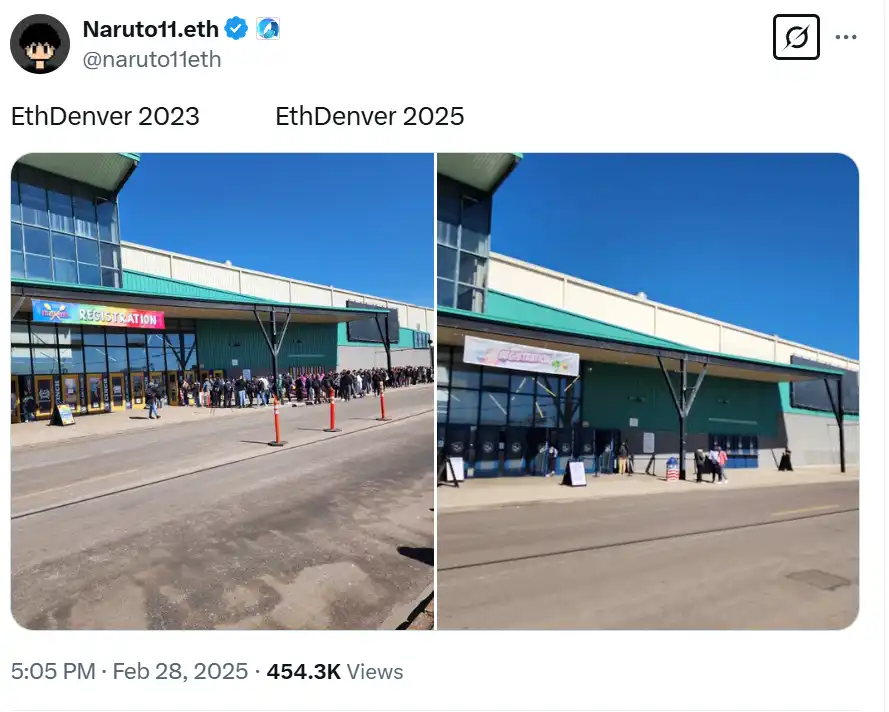
From February 27 to March 2, ETHDenver 2025 took place at the National Western Complex in Denver, Colorado, USA. The conference coincided with continued volatility in the crypto market, with Ethereum's price on a downward trend and overall market sentiment remaining subdued. Looking at the live pictures shared by attendees, this year's ETHDenver seems noticeably quieter compared to the bustling crowds of previous years.

ETHDenver2025 Flash Essay Collection: The Market Isn't as Bleak as It Seems

Nevertheless, ETHDenver still had a strong presence of genuine builders, with even higher density of core industry participants than in previous years. Compared to past focus on Layer 2 and Restaking, this year's discussions were more diverse, covering multiple areas including AI, modular blockchains, stablecoins, RWA, among others. Although a unified industry narrative was lacking, this may indicate a return to focusing on technology's essence rather than being solely driven by a single hot topic.

BlockBeats has selected three insights from investors and crypto researchers at the conference, covering market sentiment, technical trends, investment directions, and more. The full articles are reposted below:

Mason Nystrom (Pantera Investor)

Original Article Translation: Felix, PANews

ETH Denver Conference Takeaways

The Market Doesn't Look as Bad as It Seems

The sentiment on Crypto Twitter (CT) appears quite pessimistic, but it's not very representative. Memecoin speculators are feeling frustrated, and the overall investor consensus is bearish in the short term. This is not financial advice, and investors can also be wrong.

However, everyone should be able to recognize the current situation: a positive regulatory environment, growth of legitimate stablecoins, more RWAs and TradFi moving to the chain. In the long run, people are still very excited and optimistic about the market landscape.

However, the next catalyst remains unknown. Keep moving forward.

What Are People Building? What Are Investors Seeing?

AI—Many builders are still excited about AI's impact, with various Agentic and DeFAI projects. There is a lot of market "noise," making it difficult to find quality projects.

DePIN / Robotics—Related to AI but distinct enough. Many companies are building hardware or data collection networks for robotics, and DePIN seems to capture this narrative. Energy DePIN has also been of interest, presenting opportunities for new typical DePIN projects to emerge.

DeFi—still building a myriad of DeFi applications. More types of lending protocols, new stablecoins, Uni Hooks, more DeFi interfaces. PayFi and DeFAI also have some overlap in certain aspects.

zkTLS (Note: a novel technology combining zero-knowledge proofs and Transport Layer Security protocol)—has provided a real-world use case, but the focus now is on rollout and commercialization rather than the actual technical implementation.

Stablecoins—though discussed less on CT, every investor is watching and investing in this space, largely equity trading hence the lesser focus. Many companies will build upon the stablecoin market opportunity.

Three Dragons: Bitcoin, Ethereum, and Solana

Bitcoin: Many Bitcoin L2s are about to go live, all vying for Bitcoin deposits. Bitcoin's yield will continue to rise. Bitcoin lending will see improvements. Bitcoin is no longer a "pet rock."

Ethereum: Setting aside price sentiment, many builders continue to work on Ethereum. Optimism remains for a high-throughput ETH chain. Base remains fundamental. FlashBlocksTM is about to launch, heavily promoted at conferences. Unichain is overlooked by many. More chains are on the way.

Solana: Despite it being ETHDenver, there are still many Solana events, founders, and small gatherings. Despite the memecoin market correction, many are still excited about Solana. The DePIN narrative continues to evolve on Solana. More SVMs are rolling out, implying the need for interoperability "ducks" between SVM chains.

Regarding Venture Capital

For many investors, project investments at the seed pre and seed stage feel slow to return. The expected valuations of projects in the public markets are high, leading some funds to opt for a wait-and-see approach without investing. Most investments are concentrated in liquidity and Series A funding. Additionally, the Series B funding market seems better than six months ago. Please note, this analysis is purely based on market sentiment and hearsay, lacking data support.

Issuance of some tokens has not performed well in the recent market correction, with valuation mindsets readjusting. Like a clock, those who once prioritized trends and narratives are now driving projects to improve revenue and costs. Establishing trust is more important than ever.

Original Article Link

kiwi (OKX Ventures Researcher)


【ETH Denver 2025 On-Site Observation】

1. Attended ETHDenver2025.

This year saw fewer attendees, but the quality was higher.

Although the number of participants was lower, the true builder density significantly increased, with the filtering cost much lower than Token2049 and events in Hong Kong. Many top researchers delved into hardcore content, with the Stanford Blockchain Association bringing solid ZK and cryptography research. Proval showcased many hardcore zk projects. However, some criticized that the academic elites seemed to be working in isolation. Hopefully, there will be outputs more closely aligned with the market in the end.

2. Project Quality?

Overall, it was mediocre. If we compare these projects to January last year, many of them would have been worth investing in or even oversubscribed; however, looking at it now, there aren't many narrative highlights. Timing and the market are indeed crucial, as the same project can have completely different values at different times.

3. Evolution of Topics:

Two years ago at ETH Denver, the focus was on Layer2, last year it was Restaking, and this year, it was expected to be about AI but surprisingly diversified. The top three hot topics were: Modularity+L2+ZK, compliant asset stablecoins, and AI BTC. Following them were DeSci, SUI, Solana, Story, and others. There was no single hot topic, which might actually be a good thing.

4. Many overvalued old projects are still striving for the last round of funding (RiscZero, PINAI, etc.) as the market has changed.

On the other hand, Story and Corn organized numerous events, and the Bitcoin ecosystem's BOB is also very active (TGE coming soon?). Even in a downturn, there are still projects working hard to create momentum.

5. Various Funds Showcasing Their Strengths:

1kx and Symbolic held multi-day events, while Hashed, Paradigm, and Dragonfly hosted single-day workshops.


During a conversation with a major fund, it was discovered that they are not in a hurry to exit investments; instead, they are using large investments to maintain the project's FDV and preserve the fund's MOIC, considering how high the management fees are. As many ten-year funds are compared to several five- to six-year Asian funds, long-term building may have a higher tolerance?

6. This cycle is clearly regulation-driven.

Stablecoins and the on-chain yield of traditional assets have become mainstream, with large asset management companies supporting blockchain projects, and an increasing number of projects focusing on the integration of traditional finance and DeFi. Unfortunately, the participation of Asian investors is relatively low. Compliance is key, but it also sets a high barrier.

7. Had a three-and-a-half-hour chat with Alliance DAO founder, Wang Qiao, and gained a lot.

The third-phase fund has invested in over 100 projects, and the ownership stake has increased from 5% to the current 9%. Interestingly, he is not chasing exits but aims to build useful consumer-grade applications. He even provides ideas to incubators for implementation and has recently invested in several purely AI projects.

8. The project PumpFun, backed by Alliance DAO, has shown impressive performance. Although daily revenue has dropped from a peak of 5-6 million to 2 million, the annualized return still reaches 500 million US dollars!

They guided PumpFun to develop a DEX a year ago and will be venturing into perpetual swaps in the future. After all, isn't perp option prediction meme all about a group of people?

9. Summary:

ETHDenver acts as a market thermometer—it appears to be cooling down on the surface, but the core remains hot.

With fewer attendees, quality has improved; there is no unified narrative, but research and development remain solid, investments are cautious, yet long-term strategies are clear. This may be the value of a bear market—filtering out true builders and allowing technology to break through in silence.

10. Perhaps this is what Web3 is:

After the hype subsides, real innovation begins to emerge; at the trough of disappointment, the next wave of prosperity is already brewing.

"True revolution is not noisy but silent."


We may be in the calm before the storm, and after the storm, spring will be even more brilliant?

Original Article Link

Anthurine (Crypto KOL)


Insights from ETHDenver 2025

Background: Four-time ETHDenver attendee, three-time conference sponsor

First time writing a long post, please be gentle

1 Scale and Atmosphere Changes


Before the pandemic, ETHDenver was just a small gathering. However, after a three-year hiatus due to the pandemic, it has become the largest conference in the Ethereum ecosystem in terms of attendance, second only to Devcon. Especially the first edition after the pandemic was impressive—everyone arrived early, and the pre-conference week was full of peripheral activities, almost all of which required advance registration and approval for entry. This kind of scene is very rare in industry conferences, given that most events want as many people as possible. I remember the zkday at that time, with over 1000 people on-site simultaneously, which was very spectacular. In 2024, the number of attendees decreased, but high-quality events still attracted hundreds of people at the same time, with the only event requiring queuing for entry being Berachain's event. This year, the number of peripheral activities has significantly decreased, and apart from evening social events, daytime activities have very few attendees, and events with over 100 people in attendance are considered successful.

2 Evolution of Topic Hotness

2023 was the year of ZK, given the broad range of topics under ZK, which remained diverse and widespread. In addition to ZK, topics such as Chain, DeFi, GameFi, NFTs, etc., also attracted considerable attention. In 2024, the enthusiasm for ZK decreased, and the focus shifted to areas such as Restaking, Data Availability, Layer2, AI, and Account Abstraction. However, this year, apart from AI, particularly AI Agents, there doesn't seem to be any other fresh topics. Unlike other conferences, ETHDenver has a lower proportion of social activities, with more focus on hardcore technical lectures. However, this year, due to the lack of attractive topics, not only were there fewer attendees, but those willing to seriously listen to the lectures were also few, with many events having only a handful of people in the audience. The meme content of this edition is very low, even lower than last year, both in terms of special events and panels. Personally, I am not against memes, but if the industry only has memes without anything else, it definitely cannot last long.

3 Diminished Presence of VCs

In previous years, many VCs would host peripheral events, but this year the presence of VCs has significantly decreased. Although they still send representatives to attend, VCs that used to generously sponsor and host events as they did in the past two years are now seldom seen.

4 Booth Changes


The number of booths this year is on par with previous years, mainly because the sponsorship plan was already set in stone in Q2-Q3 of last year. However, the vast majority of booths are related to infrastructure projects, with very few pure DApp projects, and the Web3 games that were popular in previous years are almost non-existent. However, this year, many booths featured robots and robotic dogs for the first time. I found the most interesting booth design to be @Polygon set up to look like a storage room. The cutest was the kitten plushie from @ZircuitL2.

5 Decreased Peripheral Attraction

The peripheral activities of EthDenver have always been the most creative and engaging in my opinion, bar none. It is also the only event where I am willing to bring back a bunch of souvenirs. This year, the peripheral surprises have decreased significantly, especially in terms of hats. In the previous two years, I couldn't resist participating in a hat contest, so this year we intentionally prepared hats as souvenirs, but the competition was too weak, and 75% of them were given out by the first morning.

6 Decrease in Developer Presence

In previous years, what impressed me most about ETHDenver was the large number of developers. Rarely did I encounter a newbie who knew nothing about blockchain and Ethereum among the people visiting our booth. Over 30% were developers (maybe because our booth was infrastructure-related, so we interacted more with programmers). Everyone would ask high-quality technical questions. However, this year, the number of developers visiting our booth halved, and there were more BD and marketing personnel from other projects (such as node service providers, auditing companies, traffic platforms, etc.).

7 Mismanagement of Venue Arrangement for Talks

This year, the talk stage was moved from the exhibition area to another building (in the same area as the hackathon), which was a terrible arrangement. The crowd was mainly concentrated in the exhibition area. In previous years, everyone could freely switch between exploring the exhibition and attending talks, taking a break from wandering around to listen to interesting speeches. However, this year, the talk venue was hard to find and far away, resulting in an average audience of only a few people per talk, significantly diminishing the sponsorship effect.

8 Practical Tips for Denver

Although the trough made people feel lost, it is comforting to see that there are still many builders willing to stay in this industry. Many of the exhibiting projects are also long-term believers. After all, this industry needs some long-term mindset individuals. Lastly, here are some practical tips: In Denver, it is recommended to use Lyft instead of Uber for transportation. For the same route, a $10 trip under normal circumstances can skyrocket to $50 with Uber during peak hours, while Lyft costs around $20, although it also increases its prices, it is not as outrageous. Also, Chinese food in Denver is expensive and not very tasty, but surprisingly, Thai food is good, especially Aloy Modern Thai, which is worth a try.

Original Post Link

You may also like

Token Cannot Compound, Where Is the Real Investment Opportunity?

The next chapter in the crypto industry will undoubtedly be written by Crypto-empowered Stocks.

February 6th Market Key Intelligence, How Much Did You Miss?

1. On-chain Flows: $508.2M USD inflow to Ethereum today; $390.8M USD outflow from Arbitrum 2. Biggest Gainers/Losers: $HBTC, $AIO 3. Top News: Current Bitcoin weekly RSI oversold signal comparable to June 2022

China's Central Bank and Eight Other Departments' Latest Regulatory Focus: Key Attention to RWA Tokenized Asset Risk


Foreword: Today, the People's Bank of China's website published the "Notice of the People's Bank of China, National Development and Reform Commission, Ministry of Industry and Information Technology, Ministry of Public Security, State Administration for Market Regulation, China Banking and Insurance Regulatory Commission, China Securities Regulatory Commission, State Administration of Foreign Exchange on Further Preventing and Dealing with Risks Related to Virtual Currency and Others (Yinfa [2026] No. 42)", the latest regulatory requirements from the eight departments including the central bank, which are basically consistent with the regulatory requirements of recent years. The main focus of the regulation is on speculative activities such as virtual currency trading, exchanges, ICOs, overseas platform services, and this time, regulatory oversight of RWA has been added, explicitly prohibiting RWA tokenization, stablecoins (especially those pegged to the RMB). The following is the full text:


To the people's governments of all provinces, autonomous regions, and municipalities directly under the Central Government, the Xinjiang Production and Construction Corps:


  Recently, there have been speculative activities related to virtual currency and Real-World Assets (RWA) tokenization, disrupting the economic and financial order and jeopardizing the property security of the people. In order to further prevent and address the risks related to virtual currency and Real-World Assets tokenization, effectively safeguard national security and social stability, in accordance with the "Law of the People's Republic of China on the People's Bank of China," "Law of the People's Republic of China on Commercial Banks," "Securities Law of the People's Republic of China," "Law of the People's Republic of China on Securities Investment Funds," "Law of the People's Republic of China on Futures and Derivatives," "Cybersecurity Law of the People's Republic of China," "Regulations of the People's Republic of China on the Administration of Renminbi," "Regulations on Prevention and Disposal of Illegal Fundraising," "Regulations of the People's Republic of China on Foreign Exchange Administration," "Telecommunications Regulations of the People's Republic of China," and other provisions, after reaching consensus with the Cyberspace Administration of China, the Supreme People's Court, and the Supreme People's Procuratorate, and with the approval of the State Council, the relevant matters are notified as follows:


  I. Clarify the essential attributes of virtual currency, Real-World Assets tokenization, and related business activities


  (I) Virtual currency does not possess the legal status equivalent to fiat currency. Virtual currencies such as Bitcoin, Ether, Tether, etc., have the main characteristics of being issued by non-monetary authorities, using encryption technology and distributed ledger or similar technology, existing in digital form, etc. They do not have legal tender status, should not and cannot be circulated and used as currency in the market.


  The business activities related to virtual currency are classified as illegal financial activities. The exchange of fiat currency and virtual currency within the territory, exchange of virtual currencies, acting as a central counterparty in buying and selling virtual currencies, providing information intermediary and pricing services for virtual currency transactions, token issuance financing, and trading of virtual currency-related financial products, etc., fall under illegal financial activities, such as suspected illegal issuance of token vouchers, unauthorized public issuance of securities, illegal operation of securities and futures business, illegal fundraising, etc., are strictly prohibited across the board and resolutely banned in accordance with the law. Overseas entities and individuals are not allowed to provide virtual currency-related services to domestic entities in any form.


  A stablecoin pegged to a fiat currency indirectly fulfills some functions of the fiat currency in circulation. Without the consent of relevant authorities in accordance with the law and regulations, any domestic or foreign entity or individual is not allowed to issue a RMB-pegged stablecoin overseas.


(II)Tokenization of Real-World Assets refers to the use of encryption technology and distributed ledger or similar technologies to transform ownership rights, income rights, etc., of assets into tokens (tokens) or other interests or bond certificates with token (token) characteristics, and carry out issuance and trading activities.


  Engaging in the tokenization of real-world assets domestically, as well as providing related intermediary, information technology services, etc., which are suspected of illegal issuance of token vouchers, unauthorized public offering of securities, illegal operation of securities and futures business, illegal fundraising, and other illegal financial activities, shall be prohibited; except for relevant business activities carried out with the approval of the competent authorities in accordance with the law and regulations and relying on specific financial infrastructures. Overseas entities and individuals are not allowed to illegally provide services related to the tokenization of real-world assets to domestic entities in any form.


  II. Sound Work Mechanism


  (III) Inter-agency Coordination. The People's Bank of China, together with the National Development and Reform Commission, the Ministry of Industry and Information Technology, the Ministry of Public Security, the State Administration for Market Regulation, the China Banking and Insurance Regulatory Commission, the China Securities Regulatory Commission, the State Administration of Foreign Exchange, and other departments, will improve the work mechanism, strengthen coordination with the Cyberspace Administration of China, the Supreme People's Court, and the Supreme People's Procuratorate, coordinate efforts, and overall guide regions to carry out risk prevention and disposal of virtual currency-related illegal financial activities.


  The China Securities Regulatory Commission, together with the National Development and Reform Commission, the Ministry of Industry and Information Technology, the Ministry of Public Security, the People's Bank of China, the State Administration for Market Regulation, the China Banking and Insurance Regulatory Commission, the State Administration of Foreign Exchange, and other departments, will improve the work mechanism, strengthen coordination with the Cyberspace Administration of China, the Supreme People's Court, and the Supreme People's Procuratorate, coordinate efforts, and overall guide regions to carry out risk prevention and disposal of illegal financial activities related to the tokenization of real-world assets.


  (IV) Strengthening Local Implementation. The people's governments at the provincial level are overall responsible for the prevention and disposal of risks related to virtual currencies and the tokenization of real-world assets in their respective administrative regions. The specific leading department is the local financial regulatory department, with participation from branches and dispatched institutions of the State Council's financial regulatory department, telecommunications regulators, public security, market supervision, and other departments, in coordination with cyberspace departments, courts, and procuratorates, to improve the normalization of the work mechanism, effectively connect with the relevant work mechanisms of central departments, form a cooperative and coordinated working pattern between central and local governments, effectively prevent and properly handle risks related to virtual currencies and the tokenization of real-world assets, and maintain economic and financial order and social stability.


  III. Strengthened Risk Monitoring, Prevention, and Disposal


  (5) Enhanced Risk Monitoring. The People's Bank of China, China Securities Regulatory Commission, National Development and Reform Commission, Ministry of Industry and Information Technology, Ministry of Public Security, State Administration of Foreign Exchange, Cyberspace Administration of China, and other departments continue to improve monitoring techniques and system support, enhance cross-departmental data analysis and sharing, establish sound information sharing and cross-validation mechanisms, promptly grasp the risk situation of activities related to virtual currency and real-world asset tokenization. Local governments at all levels give full play to the role of local monitoring and early warning mechanisms. Local financial regulatory authorities, together with branches and agencies of the State Council's financial regulatory authorities, as well as departments of cyberspace and public security, ensure effective connection between online monitoring, offline investigation, and fund tracking, efficiently and accurately identify activities related to virtual currency and real-world asset tokenization, promptly share risk information, improve early warning information dissemination, verification, and rapid response mechanisms.


  (6) Strengthened Oversight of Financial Institutions, Intermediaries, and Technology Service Providers. Financial institutions (including non-bank payment institutions) are prohibited from providing account opening, fund transfer, and clearing services for virtual currency-related business activities, issuing and selling financial products related to virtual currency, including virtual currency and related financial products in the scope of collateral, conducting insurance business related to virtual currency, or including virtual currency in the scope of insurance liability. Financial institutions (including non-bank payment institutions) are prohibited from providing custody, clearing, and settlement services for unauthorized real-world asset tokenization-related business and related financial products. Relevant intermediary institutions and information technology service providers are prohibited from providing intermediary, technical, or other services for unauthorized real-world asset tokenization-related businesses and related financial products.


  (7) Enhanced Management of Internet Information Content and Access. Internet enterprises are prohibited from providing online business venues, commercial displays, marketing, advertising, or paid traffic diversion services for virtual currency and real-world asset tokenization-related business activities. Upon discovering clues of illegal activities, they should promptly report to relevant departments and provide technical support and assistance for related investigations and inquiries. Based on the clues transferred by the financial regulatory authorities, the cyberspace administration, telecommunications authorities, and public security departments should promptly close and deal with websites, mobile applications (including mini-programs), and public accounts engaged in virtual currency and real-world asset tokenization-related business activities in accordance with the law.


  (8) Strengthened Entity Registration and Advertisement Management. Market supervision departments strengthen entity registration and management, and enterprise and individual business registrations must not contain terms such as "virtual currency," "virtual asset," "cryptocurrency," "crypto asset," "stablecoin," "real-world asset tokenization," or "RWA" in their names or business scopes. Market supervision departments, together with financial regulatory authorities, legally enhance the supervision of advertisements related to virtual currency and real-world asset tokenization, promptly investigating and handling relevant illegal advertisements.


  (IX) Continued Rectification of Virtual Currency Mining Activities. The National Development and Reform Commission, together with relevant departments, strictly controls virtual currency mining activities, continuously promotes the rectification of virtual currency mining activities. The people's governments of various provinces take overall responsibility for the rectification of "mining" within their respective administrative regions. In accordance with the requirements of the National Development and Reform Commission and other departments in the "Notice on the Rectification of Virtual Currency Mining Activities" (NDRC Energy-saving Building [2021] No. 1283) and the provisions of the "Guidance Catalog for Industrial Structure Adjustment (2024 Edition)," a comprehensive review, investigation, and closure of existing virtual currency mining projects are conducted, new mining projects are strictly prohibited, and mining machine production enterprises are strictly prohibited from providing mining machine sales and other services within the country.


  (X) Severe Crackdown on Related Illegal Financial Activities. Upon discovering clues to illegal financial activities related to virtual currency and the tokenization of real-world assets, local financial regulatory authorities, branches of the State Council's financial regulatory authorities, and other relevant departments promptly investigate, determine, and properly handle the issues in accordance with the law, and seriously hold the relevant entities and individuals legally responsible. Those suspected of crimes are transferred to the judicial authorities for processing according to the law.


 (XI) Severe Crackdown on Related Illegal and Criminal Activities. The Ministry of Public Security, the People's Bank of China, the State Administration for Market Regulation, the China Banking and Insurance Regulatory Commission, the China Securities Regulatory Commission, as well as judicial and procuratorial organs, in accordance with their respective responsibilities, rigorously crack down on illegal and criminal activities related to virtual currency, the tokenization of real-world assets, such as fraud, money laundering, illegal business operations, pyramid schemes, illegal fundraising, and other illegal and criminal activities carried out under the guise of virtual currency, the tokenization of real-world assets, etc.


  (XII) Strengthen Industry Self-discipline. Relevant industry associations should enhance membership management and policy advocacy, based on their own responsibilities, advocate and urge member units to resist illegal financial activities related to virtual currency and the tokenization of real-world assets. Member units that violate regulatory policies and industry self-discipline rules are to be disciplined in accordance with relevant self-regulatory management regulations. By leveraging various industry infrastructure, conduct risk monitoring related to virtual currency, the tokenization of real-world assets, and promptly transfer issue clues to relevant departments.


  IV. Strict Supervision of Domestic Entities Engaging in Overseas Business Activities


(XIII) Without the approval of relevant departments in accordance with the law and regulations, domestic entities and foreign entities controlled by them may not issue virtual currency overseas.


  (XIV) Domestic entities engaging directly or indirectly in overseas external debt-based tokenization of real-world assets, or conducting asset securitization activities abroad based on domestic ownership rights, income rights, etc. (hereinafter referred to as domestic equity), should be strictly regulated in accordance with the principles of "same business, same risk, same rules." The National Development and Reform Commission, the China Securities Regulatory Commission, the State Administration of Foreign Exchange, and other relevant departments regulate it according to their respective responsibilities. For other forms of overseas real-world asset tokenization activities based on domestic equity by domestic entities, the China Securities Regulatory Commission, together with relevant departments, supervise according to their division of responsibilities. Without the consent and filing of relevant departments, no unit or individual may engage in the above-mentioned business.


  (15) Overseas subsidiaries and branches of domestic financial institutions providing Real World Asset Tokenization-related services overseas shall do so legally and prudently. They shall have professional personnel and systems in place to effectively mitigate business risks, strictly implement customer onboarding, suitability management, anti-money laundering requirements, and incorporate them into the domestic financial institutions' compliance and risk management system. Intermediaries and information technology service providers offering Real World Asset Tokenization services abroad based on domestic equity or conducting Real World Asset Tokenization business in the form of overseas debt for domestic entities directly or indirectly venturing abroad must strictly comply with relevant laws and regulations. They should establish and improve relevant compliance and internal control systems in accordance with relevant normative requirements, strengthen business and risk control, and report the business developments to the relevant regulatory authorities for approval or filing.


  V. Strengthen Organizational Implementation


  (16) Strengthen organizational leadership and overall coordination. All departments and regions should attach great importance to the prevention of risks related to virtual currencies and Real World Asset Tokenization, strengthen organizational leadership, clarify work responsibilities, form a long-term effective working mechanism with centralized coordination, local implementation, and shared responsibilities, maintain high pressure, dynamically monitor risks, effectively prevent and mitigate risks in an orderly and efficient manner, legally protect the property security of the people, and make every effort to maintain economic and financial order and social stability.


  (17) Widely carry out publicity and education. All departments, regions, and industry associations should make full use of various media and other communication channels to disseminate information through legal and policy interpretation, analysis of typical cases, and education on investment risks, etc. They should promote the illegality and harm of virtual currencies and Real World Asset Tokenization-related businesses and their manifestations, fully alert to potential risks and hidden dangers, and enhance public awareness and identification capabilities for risk prevention.


  VI. Legal Responsibility


  (18) Engaging in illegal financial activities related to virtual currencies and Real World Asset Tokenization in violation of this notice, as well as providing services for virtual currencies and Real World Asset Tokenization-related businesses, shall be punished in accordance with relevant regulations. If it constitutes a crime, criminal liability shall be pursued according to the law. For domestic entities and individuals who knowingly or should have known that overseas entities illegally provided virtual currency or Real World Asset Tokenization-related services to domestic entities and still assisted them, relevant responsibilities shall be pursued according to the law. If it constitutes a crime, criminal liability shall be pursued according to the law.


  (19) If any unit or individual invests in virtual currencies, Real World Asset Tokens, and related financial products against public order and good customs, the relevant civil legal actions shall be invalid, and any resulting losses shall be borne by them. If there are suspicions of disrupting financial order and jeopardizing financial security, the relevant departments shall deal with them according to the law.


  This notice shall enter into force upon the date of its issuance. The People's Bank of China and ten other departments' "Notice on Further Preventing and Dealing with the Risks of Virtual Currency Trading Speculation" (Yinfa [2021] No. 237) is hereby repealed.


Former Partner's Perspective on Multicoin: Kyle's Exit, But the Game He Left Behind Just Getting Started

Kyle knew his game, so he decided to focus on playing the game he was good at and interested in.

Why Bitcoin Is Falling Now: The Real Reasons Behind BTC's Crash & WEEX's Smart Profit Playbook

Bitcoin's ongoing crash explained: Discover the 5 hidden triggers behind BTC's plunge & how WEEX's Auto Earn and Trade to Earn strategies help traders profit from crypto market volatility.

Wall Street's Hottest Trades See Exodus

This time there is no single triggering factor, but rather market anxiety about asset valuation, with many already skeptical of these valuations being too high, leading to investors choosing to retreat almost simultaneously.

Popular coins

Latest Crypto News

Read more