
What Is OpenClaw? How AI Agents Could Change Crypto Exchange Trading


Over the past few months, OpenClaw has taken the tech and crypto communities by storm. This open‑source AI agent has seen explosive growth, racking up over 250,000 stars on GitHub in less than four months — a pace that rivals some of the most popular software projects in history. Developers and enthusiasts around the world are experimenting with its ability to perform tasks autonomously, from controlling apps and browsers to executing complex workflows. Its sudden popularity has sparked conversations about the future of AI agents and how they might reshape digital productivity and even financial operations.
This article aims to explain, in simple and practical terms, what OpenClaw is, why it’s become so popular, and how it could interact with crypto exchanges. Our goal is to give WEEX users a clear understanding of the opportunities and risks of AI-powered trading, so you can stay informed, trade smarter, and safely explore the evolving world of AI-assisted crypto strategies.
What Is OpenClaw? Why This AI Agent Is Going Viral on GitHub
OpenClaw is an open‑source autonomous AI agent — a smart digital assistant that can do more than chat, enabling users to autonomously manage tasks, interact with apps, and control software on their behalf. Originally released as Clawdbot in late 2025 and later renamed OpenClaw, it rapidly became one of the most talked‑about projects in the AI world because of how quickly developers adopted it.
In just a few months after its launch, OpenClaw’s repository amassed an astonishing number of stars on GitHub — growing from zero to over 250,000 stars in under four months, surpassing well‑established projects like React and Linux in community attention. This viral growth reflects both intense developer interest and real‑world experimentation with agentic AI — enough to spark global discussions around its potential and its risks.
How OpenClaw Works: From AI Assistant to Autonomous Agent
Unlike traditional AI assistants that simply respond to prompts, OpenClaw is designed to act. It belongs to a new generation of “executable AI agents” that can connect to applications via APIs, control browsers, read and write files, run scripts, and complete multi-step workflows autonomously. In practical terms, OpenClaw doesn’t just suggest what you should do — it can do it for you. If connected to a crypto exchange account, it could place trades, adjust positions, rebalance strategies, or execute pre-defined workflows automatically. This marks a key shift from earlier AI tools that mainly generated text or analysis. OpenClaw operates more like a digital operator sitting at the keyboard, capable of interacting directly with software systems rather than merely offering guidance.
How OpenClaw Can Connect to Crypto Exchanges Through APIs
OpenClaw could integrate with crypto exchanges primarily through APIs — the same technical gateways that power trading bots today, but with far greater flexibility and intelligence. By linking to an exchange account via API keys, OpenClaw could read market data, monitor positions, place orders, adjust leverage, or rebalance portfolios automatically based on predefined strategies or real-time analysis. This could mean transforming static trading bots into adaptive AI-driven operators that respond dynamically to volatility, liquidity shifts, or on-chain signals. Beyond direct execution, OpenClaw could also serve as an intelligent assistant embedded within exchange interfaces — analyzing ETF flows, tracking whale wallets, summarizing funding rates, and generating strategy suggestions while users retain final control. In this model, the exchange becomes the execution infrastructure, and OpenClaw becomes the intelligent decision layer sitting on top of it.
Recent real-world cases show that OpenClaw is beginning to move from experimentation into practical crypto applications. The most notable example is the integration announced by Crypto.com, which introduced an “Agent Key” mechanism allowing users to connect OpenClaw to their exchange accounts with controlled API permissions. This setup enables AI-assisted trade execution while applying safeguards such as scoped access and risk limits. In addition, third-party platforms are building OpenClaw-based trading dashboards that connect to major exchanges like Binance and OKX, allowing users to deploy AI trading workflows with monitoring and permission controls.
Beyond centralized exchanges, OpenClaw is also being applied in on-chain environments. Community-built wallet “skills” allow agents to check balances, execute token swaps, and transfer assets across networks such as Ethereum and Solana. These developments suggest that AI agents are gradually evolving from simple research assistants into cross-platform financial operators capable of interacting with both CEX and DeFi infrastructure — though adoption remains early and heavily dependent on security design.
Risks of Using AI Agents for Crypto Trading
While OpenClaw offers powerful automation capabilities, its integration with crypto exchanges introduces significant risks.
- First is security risk: because OpenClaw can execute actions (not just generate suggestions), a compromised agent, leaked API key, or malicious plugin could directly place trades, transfer funds, or manipulate positions. Unlike traditional trading bots with fixed logic, an AI agent can dynamically interpret instructions — which makes it more flexible, but also more vulnerable to prompt injection or unexpected behavior.
- Second is operational risk: if an AI strategy misinterprets market signals during extreme volatility, it could trigger rapid losses at scale.
- Third is regulatory and compliance risk: autonomous high-frequency trading, cross-market arbitrage, or behavior resembling market manipulation could attract scrutiny from regulators.
- Finally, there is reputational risk — if users widely adopt AI agents through an exchange and suffer major losses due to automation errors, the platform may face public backlash even if users opted in voluntarily.
In short, the more execution power an AI agent has, the stronger the exchange’s risk controls must be.
The Future of AI Agents in Crypto Exchanges
Looking ahead, the integration between OpenClaw and crypto exchanges could gradually reshape how trading platforms operate. Instead of being just places where users manually click “buy” or “sell,” exchanges may evolve into AI-friendly execution infrastructure — systems optimized for autonomous agents to analyze, decide, and act in real time. We could see the emergence of dedicated “agent accounts” with tiered permissions, built-in risk limits, and behavior monitoring designed specifically for AI-driven strategies. API stability, latency performance, and AI-compatible risk engines may become just as important as liquidity and trading fees.
In a more advanced stage, exchanges might launch AI strategy marketplaces, where verified OpenClaw-based trading agents can be published, audited, subscribed to, and performance-tracked transparently. Hybrid models could also emerge, where AI agents simultaneously monitor centralized exchange order books and decentralized liquidity pools, executing cross-platform strategies automatically. However, this future will depend heavily on security architecture and regulatory clarity. If implemented responsibly, OpenClaw could help exchanges move from traditional trading platforms to intelligent financial operating systems — where humans set goals, and AI handles structured execution under controlled boundaries.
How WEEX Users Can Safely Use AI Trading Agents
For WEEX users exploring OpenClaw or similar AI agents, keep it simple:
- Start cautiously: Automation doesn’t remove risk — it can amplify it. If you experiment, use small amounts, enable only necessary API permissions (no withdrawals), and limit trading scope. Never grant more access than required.
- Use it as a tool, not a substitute: AI can monitor markets and execute rules efficiently, but it doesn’t truly understand risk. Set clear stop conditions, loss limits, and shutdown rules before enabling automation. Review activity regularly.
- Prioritize security: Protect API keys, avoid unverified plugins, and don’t allow unnecessary access to sensitive files. Many risks come from compromised environments, not the model itself.
AI trading tools are still evolving — stay informed, disciplined, and security-conscious.
*Disclaimer: This content is provided for informational and educational purposes only and does not constitute investment advice, trading advice, or a recommendation of any digital asset or strategy. Digital asset trading and the use of automated tools involve significant risk and may result in the loss of capital. Readers should make independent decisions based on their own risk tolerance and assume full responsibility for any actions taken. WEEX is not liable for any direct or indirect losses arising from the use of third-party tools or the information provided herein.
About WEEX
Founded in 2018, WEEX has developed into a global crypto exchange with over 6.2 million users across more than 150 countries. The platform emphasizes security, liquidity, and usability, providing over 1,200 spot trading pairs and offering up to 400x leverage in crypto futures trading. In addition to the traditional spot and derivatives markets, WEEX is expanding rapidly in the AI era — delivering real-time AI news, empowering users with AI trading tools, and exploring innovative trade-to-earn models that make intelligent trading more accessible to everyone. Its 1,000 BTC Protection Fund further strengthens asset safety and transparency, while features such as copy trading and advanced trading tools allow users to follow professional traders and experience a more efficient, intelligent trading journey.
Follow WEEX on social media
X: @WEEX_Official
Instagram: @WEEX Exchange
Tiktok: @weex_global
Youtube: @WEEX_Official
Discord: WEEX Community
Telegram: WeexGlobal Group
You may also like

AI Crypto Trading in 2026: How AI Agents Use Stablecoins for Capital Management and Settlement
Learn how AI agents use stablecoins for crypto trading in 2026 — managing capital, settling transactions, and operating across exchanges and DeFi protocols.

AI Trading's Ultimate Test: Empower Your AI Strategy with Tencent Cloud to Win $1.88M & a Bentley
AI traders! Win $1.88M & a Bentley by crushing WEEX's live-market challenge. Tencent Cloud powers your AI Trading bot - can it survive the Feb 9 finals?

How a Risk-Controlled AI Crypto Trading Bot Protects Capital in Real Markets
Ritmex demonstrates how disciplined risk control and structured signals can make an AI crypto trading bot more stable and reliable on WEEX, highlighting the importance of combining execution discipline with scalable AI trading systems.

How a Structured AI Crypto Trading Bot Won at the WEEX Hackathon
Crypto_Trade shows how structured inputs and controlled adaptability can build a more stable and reliable AI crypto trading bot within the WEEX AI Trading Hackathon, highlighting a practical path toward scalable AI trading systems.

How a Fully Automated AI Trading Bot Won at WEEX Hackathon (From 0 to AI Agent)
Nick’s journey on WEEX shows that successful AI Trading isn’t just about strategy ideas—but about structured AI agents, disciplined execution, and continuous adaptation in real market conditions.

Best AI Crypto Trading Bot? Inside the AI Trading System That Ranked Top 3 on WEEX
Discover the best AI crypto trading bot on WEEX. Learn how AI trading works, how to trade automatically, and why this system stands out among top AI trading apps.

OpenClaw and AI Bots: From AI Trading to BTC Liquidations in the Crypto Gold Rush
AI crypto trading bots like OpenClaw and AI trading apps are reshaping digital markets. From BTC liquidations to crypto bubble charts, automated trading is expanding alongside free crypto airdrops, affiliate programs, LALIGA partnerships, and tokenized gold markets.

From Human Strategy to AI Trading Bot: How Shadow Trading AI Won 2nd Place in the WEEX Hackathon
Ivan’s Shadow Trading AI secured second place in the WEEX AI Trading Hackathon, demonstrating how AI trading systems built on real market expertise can perform under live market conditions.

Who Will Control AI? Why Decentralized AI May Be the Only Alternative to Government and Big Tech
AI has become critical infrastructure, and governments and corporations are competing to control it. Centralized development and regulation are entrenching existing power structures. The Web3 community is building a decentralized alternative — distributed compute, token incentives, and community governance — before that window closes.

WEEX AI Hackathon: How Did This AI Trading Winner Succeed?
A self-taught AI trading enthusiast achieved top-10 results at the WEEX AI Hackathon. Learn about the mindset, AI tools, and lessons behind this impressive performance.

Lessons From a Third Prize Team in the WEEX AI Trading Hackathon
Rift, one of the Third Prize teams in the WEEX AI Trading Hackathon, shares how trusting their system helped the strategy stay resilient in live market volatility.

Champion Crowned at WEEX AI Hackathon: Revealing Strategy That Won $600K
A trader with only 6 months of AI trading experience won $600,000 at the WEEX AI Hackathon. Discover the strategy, tools, and lessons behind this breakthrough victory.

4 AI Trading Strategy Lessons from WEEX Hackathon Finalist
Finalist Bambi shares how AI tools helped turn real trading experience into an automated strategy, why survival-first risk control shaped the system’s design, and how the approach will evolve ahead of WEEX AI Trading Hackathon Season 2.

What Is OpenClaw? How The AI Agent Could Automate Crypto Trading Through APIs
OpenClaw is a rapidly growing AI agent on GitHub that can automate tasks and even execute crypto trades through exchange APIs. Learn how OpenClaw works, how it connects to exchanges, and the risks traders should understand before using AI trading agents.

WEEX AI Hackathon Champions Crowned, Revealing Future of AI Trading
The first-ever WEEX AI Hackathon has concluded, with 10 winners emerging from over 200 global teams. Beyond its $1.8 million prize pool, the event marked a milestone—proving that the future of AI trading belongs to accessible, AI-powered innovation.

Lessons From a Top 10 AI Trading Strategy in the WEEX AI Hackathon
A Top 10 finalist in the WEEX AI Hackathon shares how a market-neutral AI trading system competed against high-leverage strategies in live crypto markets.

From 27th to 4th: The AI Trading "Survivor Strategy" Behind a WEEX Hackathon Comeback
After a logic failure dropped him to 27th place, ClubW_9Kid rebuilt his AI trading framework and finished 4th in the WEEX AI Hackathon. In this interview, he explains the lessons behind disciplined AI execution, risk control, and why survival beats complexity in algorithmic trading.
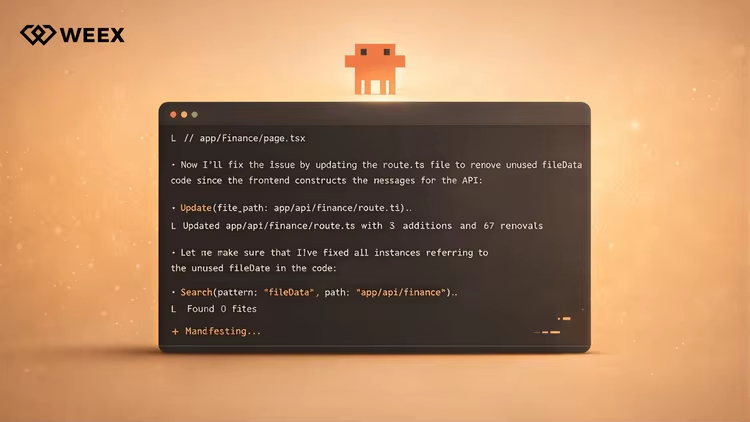
What Is Vibe Coding? How AI Is Changing Web3 & Crypto Development
What is vibe coding? Learn how AI coding tools are lowering the barrier to Web3 development and enabling anyone to build crypto applications.
AI Crypto Trading in 2026: How AI Agents Use Stablecoins for Capital Management and Settlement
Learn how AI agents use stablecoins for crypto trading in 2026 — managing capital, settling transactions, and operating across exchanges and DeFi protocols.
AI Trading's Ultimate Test: Empower Your AI Strategy with Tencent Cloud to Win $1.88M & a Bentley
AI traders! Win $1.88M & a Bentley by crushing WEEX's live-market challenge. Tencent Cloud powers your AI Trading bot - can it survive the Feb 9 finals?
How a Risk-Controlled AI Crypto Trading Bot Protects Capital in Real Markets
Ritmex demonstrates how disciplined risk control and structured signals can make an AI crypto trading bot more stable and reliable on WEEX, highlighting the importance of combining execution discipline with scalable AI trading systems.
How a Structured AI Crypto Trading Bot Won at the WEEX Hackathon
Crypto_Trade shows how structured inputs and controlled adaptability can build a more stable and reliable AI crypto trading bot within the WEEX AI Trading Hackathon, highlighting a practical path toward scalable AI trading systems.
How a Fully Automated AI Trading Bot Won at WEEX Hackathon (From 0 to AI Agent)
Nick’s journey on WEEX shows that successful AI Trading isn’t just about strategy ideas—but about structured AI agents, disciplined execution, and continuous adaptation in real market conditions.
Best AI Crypto Trading Bot? Inside the AI Trading System That Ranked Top 3 on WEEX
Discover the best AI crypto trading bot on WEEX. Learn how AI trading works, how to trade automatically, and why this system stands out among top AI trading apps.


