
Is Farcaster Finally Having an Airdrop? Read the Rules Interpretation Below
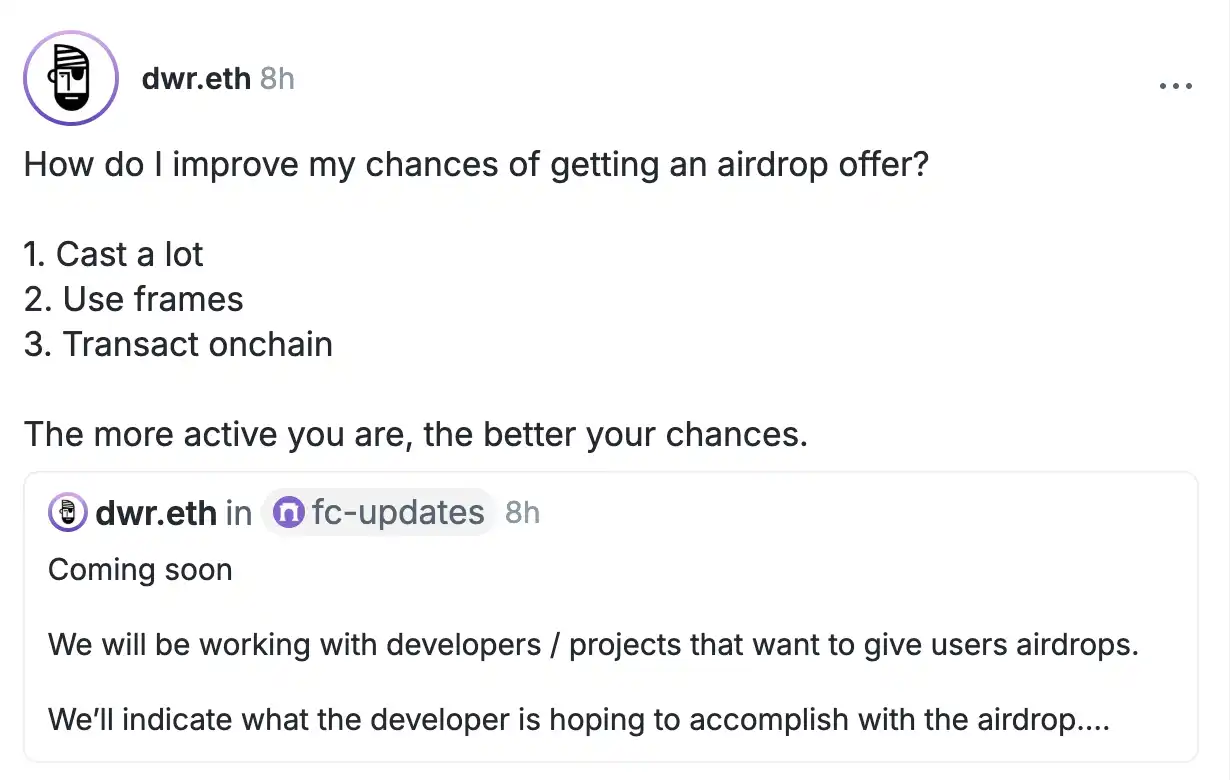
At yesterday's developer conference, the Farcaster team announced an experimental project—a mechanism to help developers reach users through airdrops, with the first airdrop expected to launch next week.
The core of this airdrop mechanism is to establish a two-way opt-in reputation system. Developers can set the airdrop's target and the desired actions users should take, such as using specific Frames or participating in specific channels.
Airdrop Rules Interpretation
Users can choose whether to join the airdrop program. Those who opt-in and perform the required actions as requested by the developer will gradually build a positive reputation, increasing their likelihood of receiving more airdrop opportunities in the future. Conversely, users who opt-in but fail to perform the specified actions after claiming the airdrop may see their reputation affected, potentially reducing their chances of future airdrops.
Ultimately, developers can freely select target users as the relevant data is permissionless. Founder dwr stated that future Farcaster airdrops will be more inclined to reward users who actually use the product and align with the developer's goals.
To increase their chances of receiving airdrops, users need to actively participate in the Farcaster ecosystem, including publishing multiple Casts, using Frames, and engaging in on-chain transactions. The more active a user is, the greater their probability of being selected for an airdrop.
The Farcaster team introduced this experimental airdrop program with deeper strategic considerations in mind. The team aims to increase the number of recharged and active mobile wallets, enabling them to transact in Frames with minimal operations.
dwr revealed that after about a month of operation, the number of recharged Warplet wallets on Farcaster has surpassed 60,000, in addition to tens of thousands of mobile wallets connected via MWP.
More recharged and active mobile wallets translate to more Frame usage, driving the diversity of content on the Farcaster platform. The richer the content, the more reasons users have to stay active on Farcaster, creating a complementary relationship with other networks. As users spend more time exploring new on-chain Frames, they are more likely to publish Casts and use social features, establishing a positive feedback loop.
Addressing potential user concerns, the Farcaster team emphasized the voluntary nature of the project. Users can choose not to participate in the airdrop, and they can also choose to immediately convert the airdrop upon receipt, though this might affect whether developers are willing to airdrop to them again in the future. Developers will clearly specify what they expect users to do after receiving the airdrop, and the requirements for each airdrop may vary.
Which Developers Are Worth Paying Attention To?
Since the airdrop rules clearly express the desire for users to extensively try out the Farcaster protocol's various features and become active users, it is natural to start paying attention to the developers from the source.
Readers can choose to join different channels or follow the Frames center to get first-hand information. They can also join BlockBeats' "Web3CN Research Institute" to get the latest Farcaster and crypto updates.
Below are the developers worth paying attention to in the Farcaster protocol, as previously compiled by BlockBeats, for readers' reference.
Related reading: "Farcaster Top 100 List"
Dan Romero
FID: 3
Username: dwr.eth
Personal Website: danromero.org
Farcaster Co-founder and CEO, former Vice President and General Manager at Coinbase, and former Business and Product Development Manager at Envoy.
Varun Srinivasan
FID: 2
Username: v
Personal Website: www.varunsrinivasan.com
Farcaster Co-founder and CTO, former Engineering and Product Director at Coinbase, former Project Manager for OneNote at Microsoft, and founder of a company serving the hearing-impaired community, SoundFocus.
For more details, see: "Interview with Varun Srinivasan: Exploring the Future of Decentralized Social Networks"
Jesse Pollak
FID: 99
Username: jessepollak
Personal Website: jessepollak.com
Founder of Base, dropout who founded the passwordless identity solution company Clef, and former Senior Engineering Manager at Coinbase.
Vitalik Buterin
FID: 5650
Username: vitalik.eth
Founder of Ethereum, his activity on Farcaster is the reason many have joined here.
Jacek Trociński
FID: 15983
Username: jacek
Jacek was born in Santa Monica, California, to a Polish mother, and his family was not well-off financially. After graduating, Jacek worked at IBM, Credit Suisse in Switzerland, and M-Bank in Poland, always burdened by debt.
In 2023, Jacek quit his stable job to go all-in on web3, attempting multiple projects that all ended in failure, including trying the FriendTech concept on Farcaster.
It wasn't until later that he founded Degen.
For more information, see: "Why Did DEGEN Drop So Hard?"
Jason Goldberg
FID: 602
Username: betashop.eth
Airstack and Moxie founder, serial entrepreneur. Airstack is a key player in building the Farcaster ecosystem, while Moxie is one of Farcaster's hottest projects in recent months, aimed at introducing an economic incentive system to Farcaster.
Ted
FID: 239
Username: ted
Farcaster influencer and evangelist, a pioneer at the forefront of online community and decentralized social experimentation.
She previously led business operations and strategy at Goldfinch, a real-world asset protocol, helping it scale from seed to Series A funding, reaching over $1 billion in assets under management. Before becoming a blockchain native, Ted designed and executed creative, impact-driven strategies for consumer brands, startups, celebrities, funds, family offices, and large tech companies.
Linda Xie
FID: 12
Username: linda
Personal Website: lindajxie.com
Co-founder of Bountrycaster, enabling Farcaster users to post bounty tasks; co-producer of the documentary "Ethereum: The Infinite Garden" with V God; early Coinbase employee; co-founder and managing director of the crypto hedge fund Scalar Capital, who recently announced joining Farcaster.
woj.eth
FID: 680
Username: woj.eth
Founder of Supercast, a Farcaster frontend, deeply involved in Farcaster's development, announced joining the Farcaster team last month.
Jonny Mack
FID: 576
Username: nonlinear.eth
Personal Website: jnymck.com
Fabric Founder, creator of Hypersub (NFT Subscription), and Crowdfi (On-chain Crowdfunding). Former freelance designer focused on product design and consulting for early-stage startups, and former Design Lead at Google Cloud Platform.
Cassie Heart
FID: 1325
Username: cassie
Farcaster Engineer, lead of the open-source project Quilibrium, former Senior Software Engineer at Coinbase.
She describes herself in her Twitter bio as, "If something isn't decentralized, it's garbage."
Quilibrium is a decentralized internet-layer protocol that provides cloud services without sacrificing privacy or scalability.
She has been a vocal critic of crypto warrants and advocates for fair launches: https://warpcast.com/yikang/0x285e20a8
Greg Skriloff
FID: 347
Username: greg
He is a DevRel (Developer Relations) engineer at ENS Labs, a builder on ENS and Farcaster, enjoys baking, and develops various small tools. In 2021, he created a bot that monitors Musk's tweets for doge trades, an Ethereum Gas tracker, a Twitter account list named with .eth, etc. In 2022, he developed Searchcaster for searching posts on Farcaster; Farcaster Network for viewing Farcaster protocol data... In 2023, in 2024...
Nikita Kolmogorov
FID: 1356
Username: farcasteradmin.eth
On his personal website, it is noted how many people are currently using the software he has written—almost a billion! (borodutch.com)
He has authored a book: "We Don't Live a Thousand Years," which is a record of his research over the past decade on enhancing his own quality of life.
He has created an open-source protocol that allows people to trade their Farcaster user card.
He also has a YouTube channel: www.youtube.com/backmeupplz
Antonio García Martínez
FID: 53
Username: antonio
Personal Website: https://www.antoniogarciamartinez.com/
Founder of the encrypted advertising protocol Spindl, New York Times bestselling author and tech entrepreneur, former Product Manager at Facebook, CEO and founder of AdGrok, former quantitative analyst at Goldman Sachs.
Cameron Armstrong
FID: 617
Username: cameron
Personal Website: seemore.tv/cameron
Veteran, developer, writer, Harvard Business School graduate, founder of the personal information aggregation platform seemore.tv, conducting various content experiments on the /cameron channel, strong expression desire.
Todd Goldberg
FID: 18
Username: todd
Personal Website: toddgoldberg.com
Todd.capital angel investor, having invested in dozens of companies including Mercury, Superhuman, Placer, Clearbit, AngelList, Supabase, ClassDojo, Zip, Nexhealth, Manifold, Farcaster, Descript, Lob, Eight Sleep, Coda, GymClass VR, and many others.
Co-founder of Curated, a crypto fund collecting unique crypto art and culture. Previously co-founded Eventjoy (acquired by Ticketmaster, YC W14) and Mailjoy, and designed and launched nearly a dozen other small products in consumer, B2B, and crypto.
Sriram Krishnan
FID: 43
Username: sriramk.eth
Personal Website: https://sriramk.com/
a16z GP, tech expert, invested in Figma, SpaceX, and Scale.ai, previously led product teams at Meta, Twitter/X, and Microsoft.
Tim Beiko
FID: 207
Username: tim
Ethereum Foundation's protocol support lead, former ConsenSys product manager.
Dan Posch
FID: 56
Username: dcposch.eth
Founder of Daimo, a mnemonic-free stablecoin wallet tackling one of the oldest use cases of crypto technology: P2P payments. His obsession with speed and simplicity, coupled with using smart accounts for full gas abstraction and FaceID signature verification (backed by Pimlico's bundler and USDC payer), has made the payment app feel better to use than similar web2 apps.
Zach Terrell
FID: 457
Username: zachterrell
Developer of spindl.xyz, whose avatar features Bach wearing Apple Vision Pro, interested in history, tech, and music, developed a tool to track the overall progress of the Farcaster protocol: https://www.farcaster.network/
Alexander Chopan
FID: 880
Username: accountless.eth
Personal Website: https://linktr.ee/alexanderchopan
He has been involved in secret military operations, worked at Bridgewater Associates, developed new products at DARPA, and worked on product development at Pimlico.
He has proposed many innovative ideas, including the concept of ZeroTrust Accounts: a decentralized, secure, and self-sovereign way for Ethereum smart contract accounts.
One of his frequently quoted statements is: "The network is lagging because accounts are hindering the experience—use different profiles for different activities, ignore the past, and easily surf the chain."
Stephan Cilliers
FID: 1689
Username: stephancill
Personal Website: https://www.stephancill.co.za/
Created the first open-source, feature-rich Farcaster client Opencast.
Currently working on frame, self-proclaimed cyberpunk, founded a company, electrical and computer engineer, interested in cryptography, permissionless protocols, and embedded systems. Created Alpha Feed, a system that scores news by relevance, novelty, and influence from RSS feeds and displays the highest-scoring posts in a daily news digest, helping people keep up with developments in artificial intelligence research.
j4ck
FID: 431
Username: j4ck.eth
Co-founder of icebreaker.xyz, co-founder and designer at szns.io, UI designer at Google. Self-proclaimed "Google CEO" and co-founder of the icbk.me/j4ck.fc project, also known as the "Rectangular Mule," primarily responsible for interface design or layout work.
He is active in multiple channels, including /icebreaker, /attendance, and /swagcaster, which are related to icebreaker activities, attendance management, and promotional merchandise, respectively.
In his spare time, he serves as a DJ under the alias "sixsix."
He has written about his reasons for joining Farcaster: https://paragraph.xyz/@j4ck/favorite-farcaster
Personal page: https://app.icebreaker.xyz/profiles/ZrfOmhEn3QewIAzaSErbA
horsefacts
FID: 3621
Username: horsefacts.eth
Personal page: terminally.online
Working at Farcaster, an open-source geek, an active and humble Ethereum developer. He worked on purplecheck, a previous soul-bound avatar project on Farcaster. He has served as a full-stack software consultant at 8th Light for over ten years, contributing to projects such as Global Citizen, IDEO, and Munich Re.
corbin.eth
FID: 358
Username: corbin.eth
Personal page: https://nf.td/corbin
Paymagic Labs' rockstar developer within the Ethereum and Farcaster ecosystems. Involved in developing the first social account abstract wallet, enabling developers to embed smart wallets in their applications or bots based on users' emails, Twitter, or phone numbers, as well as DustSweeper DEX, a small-token cleanup tool within a wallet.
Nicholas
FID: 1247
Username: nicholas
Solidarity developer, product manager, and host of the podcast Web3 Galaxy Brain, interviewing web3 developers weekly.
Nicholas Charriere
FID: 359
Username: pushix
Personal Website: nicholascharriere.com
Founder and CEO of Axlflow, an LLM company, with a decade of software engineering experience at top Silicon Valley firms.
Shawki Sukkar
FID: 73
Username: shawki
Founding engineer at AirGraph, previously at Primer, developed the first application based on Farcaster. Involved in LMS and meeting reservation service development, along with protocol engineering work on oracles. Originally from Syria, now residing in Arizona. Interested in tech, politics, and theology, currently studying Computer Science and Philosophy at the University of Arizona.
Liam Horne
FID: 80
Username: liam.eth
Personal Website: https://liamhorne.com/
Studied Computer Science at the University of Waterloo, dropped out to pursue entrepreneurship. In his twenties, he has been dedicated to Ethereum-related technology, enjoys traveling and photography.
He has invested in dozens of startups, including Othership, QA Wolf, Daimo, Farcaster, Ambrook, Mercantile, Software Applications Incorporated, Conduit, Splits, Axiom, OpenSea, Agora, and more.
J. Valeska
FID: 13505
Username: j-valeska
Projects I've worked on: https://devfolio.co/@vmjune2019
Self-proclaimed as: Alchemist, Blockchain Builder, Creator, Degen, Ethereum Developer, Farcaster Frame Developer.
Developed the Magic Machine, a machine that mimics vending machine behavior to randomly distribute pre-plotted artwork; proposed PoB (proof of buildership).
Rob Sanchez
FID: 2417
Username: robrecht
Personal Website: https://robrecht.xyz/
Creator of Farcaster payment tool @paybot, and trading tool @swapbot. YC alum, co-founder of Soulbind, a soul-binding solution company, involved in crypto incubator Orange DAO investments.
Wojtek Witkowski
FID: 557
Username: pugson
Senior UI Engineer, dedicated to interactive design, blending engineering and design, previously worked at Rainbow Wallet.
Slokh Kartik
FID: 3887
Username: slokh
Founder of the open-source project Nook, a Farcaster client, best friends with emo.eth, previously worked at Manifold, OpenSea, Capital One, and Amazon.
jacopo.eth
FID: 2007
Username: jacopo.eth
A one-stop on-chain frame solution at https://deframe.it/ and an on-chain business protocol at https://slice.so/ founder, protocol engineer
Royal
FID: 7715
Username: royalaid.eth
Developer, high-intensity creator of memes and IP, concerned about Farcaster development, formerly co-founder of CircleStudioMY.
binji.eth
FID: 2689
Username: binji.eth
Born in Nepal, received a full scholarship at the age of 14 to study in Costa Rica, then went to Northwestern University in Illinois, joined Coinbase right after graduation, currently working at op.
Nikolaiii
FID: 366713
Username: nikolaiii
He is a frame creator, with his created Frames being very popular, making his Fan Token highly sought after.
You may also like

Token Cannot Compound, Where Is the Real Investment Opportunity?

February 6th Market Key Intelligence, How Much Did You Miss?

China's Central Bank and Eight Other Departments' Latest Regulatory Focus: Key Attention to RWA Tokenized Asset Risk
Foreword: Today, the People's Bank of China's website published the "Notice of the People's Bank of China, National Development and Reform Commission, Ministry of Industry and Information Technology, Ministry of Public Security, State Administration for Market Regulation, China Banking and Insurance Regulatory Commission, China Securities Regulatory Commission, State Administration of Foreign Exchange on Further Preventing and Dealing with Risks Related to Virtual Currency and Others (Yinfa [2026] No. 42)", the latest regulatory requirements from the eight departments including the central bank, which are basically consistent with the regulatory requirements of recent years. The main focus of the regulation is on speculative activities such as virtual currency trading, exchanges, ICOs, overseas platform services, and this time, regulatory oversight of RWA has been added, explicitly prohibiting RWA tokenization, stablecoins (especially those pegged to the RMB). The following is the full text:
To the people's governments of all provinces, autonomous regions, and municipalities directly under the Central Government, the Xinjiang Production and Construction Corps:
Recently, there have been speculative activities related to virtual currency and Real-World Assets (RWA) tokenization, disrupting the economic and financial order and jeopardizing the property security of the people. In order to further prevent and address the risks related to virtual currency and Real-World Assets tokenization, effectively safeguard national security and social stability, in accordance with the "Law of the People's Republic of China on the People's Bank of China," "Law of the People's Republic of China on Commercial Banks," "Securities Law of the People's Republic of China," "Law of the People's Republic of China on Securities Investment Funds," "Law of the People's Republic of China on Futures and Derivatives," "Cybersecurity Law of the People's Republic of China," "Regulations of the People's Republic of China on the Administration of Renminbi," "Regulations on Prevention and Disposal of Illegal Fundraising," "Regulations of the People's Republic of China on Foreign Exchange Administration," "Telecommunications Regulations of the People's Republic of China," and other provisions, after reaching consensus with the Cyberspace Administration of China, the Supreme People's Court, and the Supreme People's Procuratorate, and with the approval of the State Council, the relevant matters are notified as follows:
(I) Virtual currency does not possess the legal status equivalent to fiat currency. Virtual currencies such as Bitcoin, Ether, Tether, etc., have the main characteristics of being issued by non-monetary authorities, using encryption technology and distributed ledger or similar technology, existing in digital form, etc. They do not have legal tender status, should not and cannot be circulated and used as currency in the market.
The business activities related to virtual currency are classified as illegal financial activities. The exchange of fiat currency and virtual currency within the territory, exchange of virtual currencies, acting as a central counterparty in buying and selling virtual currencies, providing information intermediary and pricing services for virtual currency transactions, token issuance financing, and trading of virtual currency-related financial products, etc., fall under illegal financial activities, such as suspected illegal issuance of token vouchers, unauthorized public issuance of securities, illegal operation of securities and futures business, illegal fundraising, etc., are strictly prohibited across the board and resolutely banned in accordance with the law. Overseas entities and individuals are not allowed to provide virtual currency-related services to domestic entities in any form.
A stablecoin pegged to a fiat currency indirectly fulfills some functions of the fiat currency in circulation. Without the consent of relevant authorities in accordance with the law and regulations, any domestic or foreign entity or individual is not allowed to issue a RMB-pegged stablecoin overseas.
(II)Tokenization of Real-World Assets refers to the use of encryption technology and distributed ledger or similar technologies to transform ownership rights, income rights, etc., of assets into tokens (tokens) or other interests or bond certificates with token (token) characteristics, and carry out issuance and trading activities.
Engaging in the tokenization of real-world assets domestically, as well as providing related intermediary, information technology services, etc., which are suspected of illegal issuance of token vouchers, unauthorized public offering of securities, illegal operation of securities and futures business, illegal fundraising, and other illegal financial activities, shall be prohibited; except for relevant business activities carried out with the approval of the competent authorities in accordance with the law and regulations and relying on specific financial infrastructures. Overseas entities and individuals are not allowed to illegally provide services related to the tokenization of real-world assets to domestic entities in any form.
(III) Inter-agency Coordination. The People's Bank of China, together with the National Development and Reform Commission, the Ministry of Industry and Information Technology, the Ministry of Public Security, the State Administration for Market Regulation, the China Banking and Insurance Regulatory Commission, the China Securities Regulatory Commission, the State Administration of Foreign Exchange, and other departments, will improve the work mechanism, strengthen coordination with the Cyberspace Administration of China, the Supreme People's Court, and the Supreme People's Procuratorate, coordinate efforts, and overall guide regions to carry out risk prevention and disposal of virtual currency-related illegal financial activities.
The China Securities Regulatory Commission, together with the National Development and Reform Commission, the Ministry of Industry and Information Technology, the Ministry of Public Security, the People's Bank of China, the State Administration for Market Regulation, the China Banking and Insurance Regulatory Commission, the State Administration of Foreign Exchange, and other departments, will improve the work mechanism, strengthen coordination with the Cyberspace Administration of China, the Supreme People's Court, and the Supreme People's Procuratorate, coordinate efforts, and overall guide regions to carry out risk prevention and disposal of illegal financial activities related to the tokenization of real-world assets.
(IV) Strengthening Local Implementation. The people's governments at the provincial level are overall responsible for the prevention and disposal of risks related to virtual currencies and the tokenization of real-world assets in their respective administrative regions. The specific leading department is the local financial regulatory department, with participation from branches and dispatched institutions of the State Council's financial regulatory department, telecommunications regulators, public security, market supervision, and other departments, in coordination with cyberspace departments, courts, and procuratorates, to improve the normalization of the work mechanism, effectively connect with the relevant work mechanisms of central departments, form a cooperative and coordinated working pattern between central and local governments, effectively prevent and properly handle risks related to virtual currencies and the tokenization of real-world assets, and maintain economic and financial order and social stability.
(5) Enhanced Risk Monitoring. The People's Bank of China, China Securities Regulatory Commission, National Development and Reform Commission, Ministry of Industry and Information Technology, Ministry of Public Security, State Administration of Foreign Exchange, Cyberspace Administration of China, and other departments continue to improve monitoring techniques and system support, enhance cross-departmental data analysis and sharing, establish sound information sharing and cross-validation mechanisms, promptly grasp the risk situation of activities related to virtual currency and real-world asset tokenization. Local governments at all levels give full play to the role of local monitoring and early warning mechanisms. Local financial regulatory authorities, together with branches and agencies of the State Council's financial regulatory authorities, as well as departments of cyberspace and public security, ensure effective connection between online monitoring, offline investigation, and fund tracking, efficiently and accurately identify activities related to virtual currency and real-world asset tokenization, promptly share risk information, improve early warning information dissemination, verification, and rapid response mechanisms.
(6) Strengthened Oversight of Financial Institutions, Intermediaries, and Technology Service Providers. Financial institutions (including non-bank payment institutions) are prohibited from providing account opening, fund transfer, and clearing services for virtual currency-related business activities, issuing and selling financial products related to virtual currency, including virtual currency and related financial products in the scope of collateral, conducting insurance business related to virtual currency, or including virtual currency in the scope of insurance liability. Financial institutions (including non-bank payment institutions) are prohibited from providing custody, clearing, and settlement services for unauthorized real-world asset tokenization-related business and related financial products. Relevant intermediary institutions and information technology service providers are prohibited from providing intermediary, technical, or other services for unauthorized real-world asset tokenization-related businesses and related financial products.
(7) Enhanced Management of Internet Information Content and Access. Internet enterprises are prohibited from providing online business venues, commercial displays, marketing, advertising, or paid traffic diversion services for virtual currency and real-world asset tokenization-related business activities. Upon discovering clues of illegal activities, they should promptly report to relevant departments and provide technical support and assistance for related investigations and inquiries. Based on the clues transferred by the financial regulatory authorities, the cyberspace administration, telecommunications authorities, and public security departments should promptly close and deal with websites, mobile applications (including mini-programs), and public accounts engaged in virtual currency and real-world asset tokenization-related business activities in accordance with the law.
(8) Strengthened Entity Registration and Advertisement Management. Market supervision departments strengthen entity registration and management, and enterprise and individual business registrations must not contain terms such as "virtual currency," "virtual asset," "cryptocurrency," "crypto asset," "stablecoin," "real-world asset tokenization," or "RWA" in their names or business scopes. Market supervision departments, together with financial regulatory authorities, legally enhance the supervision of advertisements related to virtual currency and real-world asset tokenization, promptly investigating and handling relevant illegal advertisements.
(IX) Continued Rectification of Virtual Currency Mining Activities. The National Development and Reform Commission, together with relevant departments, strictly controls virtual currency mining activities, continuously promotes the rectification of virtual currency mining activities. The people's governments of various provinces take overall responsibility for the rectification of "mining" within their respective administrative regions. In accordance with the requirements of the National Development and Reform Commission and other departments in the "Notice on the Rectification of Virtual Currency Mining Activities" (NDRC Energy-saving Building [2021] No. 1283) and the provisions of the "Guidance Catalog for Industrial Structure Adjustment (2024 Edition)," a comprehensive review, investigation, and closure of existing virtual currency mining projects are conducted, new mining projects are strictly prohibited, and mining machine production enterprises are strictly prohibited from providing mining machine sales and other services within the country.
(X) Severe Crackdown on Related Illegal Financial Activities. Upon discovering clues to illegal financial activities related to virtual currency and the tokenization of real-world assets, local financial regulatory authorities, branches of the State Council's financial regulatory authorities, and other relevant departments promptly investigate, determine, and properly handle the issues in accordance with the law, and seriously hold the relevant entities and individuals legally responsible. Those suspected of crimes are transferred to the judicial authorities for processing according to the law.
(XI) Severe Crackdown on Related Illegal and Criminal Activities. The Ministry of Public Security, the People's Bank of China, the State Administration for Market Regulation, the China Banking and Insurance Regulatory Commission, the China Securities Regulatory Commission, as well as judicial and procuratorial organs, in accordance with their respective responsibilities, rigorously crack down on illegal and criminal activities related to virtual currency, the tokenization of real-world assets, such as fraud, money laundering, illegal business operations, pyramid schemes, illegal fundraising, and other illegal and criminal activities carried out under the guise of virtual currency, the tokenization of real-world assets, etc.
(XII) Strengthen Industry Self-discipline. Relevant industry associations should enhance membership management and policy advocacy, based on their own responsibilities, advocate and urge member units to resist illegal financial activities related to virtual currency and the tokenization of real-world assets. Member units that violate regulatory policies and industry self-discipline rules are to be disciplined in accordance with relevant self-regulatory management regulations. By leveraging various industry infrastructure, conduct risk monitoring related to virtual currency, the tokenization of real-world assets, and promptly transfer issue clues to relevant departments.
(XIII) Without the approval of relevant departments in accordance with the law and regulations, domestic entities and foreign entities controlled by them may not issue virtual currency overseas.
(XIV) Domestic entities engaging directly or indirectly in overseas external debt-based tokenization of real-world assets, or conducting asset securitization activities abroad based on domestic ownership rights, income rights, etc. (hereinafter referred to as domestic equity), should be strictly regulated in accordance with the principles of "same business, same risk, same rules." The National Development and Reform Commission, the China Securities Regulatory Commission, the State Administration of Foreign Exchange, and other relevant departments regulate it according to their respective responsibilities. For other forms of overseas real-world asset tokenization activities based on domestic equity by domestic entities, the China Securities Regulatory Commission, together with relevant departments, supervise according to their division of responsibilities. Without the consent and filing of relevant departments, no unit or individual may engage in the above-mentioned business.
(15) Overseas subsidiaries and branches of domestic financial institutions providing Real World Asset Tokenization-related services overseas shall do so legally and prudently. They shall have professional personnel and systems in place to effectively mitigate business risks, strictly implement customer onboarding, suitability management, anti-money laundering requirements, and incorporate them into the domestic financial institutions' compliance and risk management system. Intermediaries and information technology service providers offering Real World Asset Tokenization services abroad based on domestic equity or conducting Real World Asset Tokenization business in the form of overseas debt for domestic entities directly or indirectly venturing abroad must strictly comply with relevant laws and regulations. They should establish and improve relevant compliance and internal control systems in accordance with relevant normative requirements, strengthen business and risk control, and report the business developments to the relevant regulatory authorities for approval or filing.
(16) Strengthen organizational leadership and overall coordination. All departments and regions should attach great importance to the prevention of risks related to virtual currencies and Real World Asset Tokenization, strengthen organizational leadership, clarify work responsibilities, form a long-term effective working mechanism with centralized coordination, local implementation, and shared responsibilities, maintain high pressure, dynamically monitor risks, effectively prevent and mitigate risks in an orderly and efficient manner, legally protect the property security of the people, and make every effort to maintain economic and financial order and social stability.
(17) Widely carry out publicity and education. All departments, regions, and industry associations should make full use of various media and other communication channels to disseminate information through legal and policy interpretation, analysis of typical cases, and education on investment risks, etc. They should promote the illegality and harm of virtual currencies and Real World Asset Tokenization-related businesses and their manifestations, fully alert to potential risks and hidden dangers, and enhance public awareness and identification capabilities for risk prevention.
(18) Engaging in illegal financial activities related to virtual currencies and Real World Asset Tokenization in violation of this notice, as well as providing services for virtual currencies and Real World Asset Tokenization-related businesses, shall be punished in accordance with relevant regulations. If it constitutes a crime, criminal liability shall be pursued according to the law. For domestic entities and individuals who knowingly or should have known that overseas entities illegally provided virtual currency or Real World Asset Tokenization-related services to domestic entities and still assisted them, relevant responsibilities shall be pursued according to the law. If it constitutes a crime, criminal liability shall be pursued according to the law.
(19) If any unit or individual invests in virtual currencies, Real World Asset Tokens, and related financial products against public order and good customs, the relevant civil legal actions shall be invalid, and any resulting losses shall be borne by them. If there are suspicions of disrupting financial order and jeopardizing financial security, the relevant departments shall deal with them according to the law.
This notice shall enter into force upon the date of its issuance. The People's Bank of China and ten other departments' "Notice on Further Preventing and Dealing with the Risks of Virtual Currency Trading Speculation" (Yinfa [2021] No. 237) is hereby repealed.

Former Partner's Perspective on Multicoin: Kyle's Exit, But the Game He Left Behind Just Getting Started
Why Bitcoin Is Falling Now: The Real Reasons Behind BTC's Crash & WEEX's Smart Profit Playbook
Bitcoin's ongoing crash explained: Discover the 5 hidden triggers behind BTC's plunge & how WEEX's Auto Earn and Trade to Earn strategies help traders profit from crypto market volatility.

Wall Street's Hottest Trades See Exodus

Vitalik Discusses Ethereum Scaling Path, Circle Announces Partnership with Polymarket, What's the Overseas Crypto Community Talking About Today?

Believing in the Capital Markets - The Essence and Core Value of Cryptocurrency

Polymarket's 'Weatherman': Predict Temperature, Win Million-Dollar Payout
$15K+ Profits: The 4 AI Trading Secrets WEEX Hackathon Prelim Winners Used to Dominate Volatile Crypto Markets
How WEEX Hackathon's top AI trading strategies made $15K+ in crypto markets: 4 proven rules for ETH/BTC trading, market structure analysis, and risk management in volatile conditions.

A nearly 20% one-day plunge, how long has it been since you last saw a $60,000 Bitcoin?

Raoul Pal: I've seen every single panic, and they are never the end.

Key Market Information Discrepancy on February 6th - A Must-Read! | Alpha Morning Report

2026 Crypto Industry's First Snowfall

The Harsh Reality Behind the $26 Billion Crypto Liquidation: Liquidity Is Killing the Market

Why Is Gold, US Stocks, Bitcoin All Falling?

Key Market Intelligence for February 5th, how much did you miss out on?

Wintermute: By 2026, crypto had gradually become the settlement layer of the Internet economy
Token Cannot Compound, Where Is the Real Investment Opportunity?
February 6th Market Key Intelligence, How Much Did You Miss?
China's Central Bank and Eight Other Departments' Latest Regulatory Focus: Key Attention to RWA Tokenized Asset Risk
Foreword: Today, the People's Bank of China's website published the "Notice of the People's Bank of China, National Development and Reform Commission, Ministry of Industry and Information Technology, Ministry of Public Security, State Administration for Market Regulation, China Banking and Insurance Regulatory Commission, China Securities Regulatory Commission, State Administration of Foreign Exchange on Further Preventing and Dealing with Risks Related to Virtual Currency and Others (Yinfa [2026] No. 42)", the latest regulatory requirements from the eight departments including the central bank, which are basically consistent with the regulatory requirements of recent years. The main focus of the regulation is on speculative activities such as virtual currency trading, exchanges, ICOs, overseas platform services, and this time, regulatory oversight of RWA has been added, explicitly prohibiting RWA tokenization, stablecoins (especially those pegged to the RMB). The following is the full text:
To the people's governments of all provinces, autonomous regions, and municipalities directly under the Central Government, the Xinjiang Production and Construction Corps:
Recently, there have been speculative activities related to virtual currency and Real-World Assets (RWA) tokenization, disrupting the economic and financial order and jeopardizing the property security of the people. In order to further prevent and address the risks related to virtual currency and Real-World Assets tokenization, effectively safeguard national security and social stability, in accordance with the "Law of the People's Republic of China on the People's Bank of China," "Law of the People's Republic of China on Commercial Banks," "Securities Law of the People's Republic of China," "Law of the People's Republic of China on Securities Investment Funds," "Law of the People's Republic of China on Futures and Derivatives," "Cybersecurity Law of the People's Republic of China," "Regulations of the People's Republic of China on the Administration of Renminbi," "Regulations on Prevention and Disposal of Illegal Fundraising," "Regulations of the People's Republic of China on Foreign Exchange Administration," "Telecommunications Regulations of the People's Republic of China," and other provisions, after reaching consensus with the Cyberspace Administration of China, the Supreme People's Court, and the Supreme People's Procuratorate, and with the approval of the State Council, the relevant matters are notified as follows:
(I) Virtual currency does not possess the legal status equivalent to fiat currency. Virtual currencies such as Bitcoin, Ether, Tether, etc., have the main characteristics of being issued by non-monetary authorities, using encryption technology and distributed ledger or similar technology, existing in digital form, etc. They do not have legal tender status, should not and cannot be circulated and used as currency in the market.
The business activities related to virtual currency are classified as illegal financial activities. The exchange of fiat currency and virtual currency within the territory, exchange of virtual currencies, acting as a central counterparty in buying and selling virtual currencies, providing information intermediary and pricing services for virtual currency transactions, token issuance financing, and trading of virtual currency-related financial products, etc., fall under illegal financial activities, such as suspected illegal issuance of token vouchers, unauthorized public issuance of securities, illegal operation of securities and futures business, illegal fundraising, etc., are strictly prohibited across the board and resolutely banned in accordance with the law. Overseas entities and individuals are not allowed to provide virtual currency-related services to domestic entities in any form.
A stablecoin pegged to a fiat currency indirectly fulfills some functions of the fiat currency in circulation. Without the consent of relevant authorities in accordance with the law and regulations, any domestic or foreign entity or individual is not allowed to issue a RMB-pegged stablecoin overseas.
(II)Tokenization of Real-World Assets refers to the use of encryption technology and distributed ledger or similar technologies to transform ownership rights, income rights, etc., of assets into tokens (tokens) or other interests or bond certificates with token (token) characteristics, and carry out issuance and trading activities.
Engaging in the tokenization of real-world assets domestically, as well as providing related intermediary, information technology services, etc., which are suspected of illegal issuance of token vouchers, unauthorized public offering of securities, illegal operation of securities and futures business, illegal fundraising, and other illegal financial activities, shall be prohibited; except for relevant business activities carried out with the approval of the competent authorities in accordance with the law and regulations and relying on specific financial infrastructures. Overseas entities and individuals are not allowed to illegally provide services related to the tokenization of real-world assets to domestic entities in any form.
(III) Inter-agency Coordination. The People's Bank of China, together with the National Development and Reform Commission, the Ministry of Industry and Information Technology, the Ministry of Public Security, the State Administration for Market Regulation, the China Banking and Insurance Regulatory Commission, the China Securities Regulatory Commission, the State Administration of Foreign Exchange, and other departments, will improve the work mechanism, strengthen coordination with the Cyberspace Administration of China, the Supreme People's Court, and the Supreme People's Procuratorate, coordinate efforts, and overall guide regions to carry out risk prevention and disposal of virtual currency-related illegal financial activities.
The China Securities Regulatory Commission, together with the National Development and Reform Commission, the Ministry of Industry and Information Technology, the Ministry of Public Security, the People's Bank of China, the State Administration for Market Regulation, the China Banking and Insurance Regulatory Commission, the State Administration of Foreign Exchange, and other departments, will improve the work mechanism, strengthen coordination with the Cyberspace Administration of China, the Supreme People's Court, and the Supreme People's Procuratorate, coordinate efforts, and overall guide regions to carry out risk prevention and disposal of illegal financial activities related to the tokenization of real-world assets.
(IV) Strengthening Local Implementation. The people's governments at the provincial level are overall responsible for the prevention and disposal of risks related to virtual currencies and the tokenization of real-world assets in their respective administrative regions. The specific leading department is the local financial regulatory department, with participation from branches and dispatched institutions of the State Council's financial regulatory department, telecommunications regulators, public security, market supervision, and other departments, in coordination with cyberspace departments, courts, and procuratorates, to improve the normalization of the work mechanism, effectively connect with the relevant work mechanisms of central departments, form a cooperative and coordinated working pattern between central and local governments, effectively prevent and properly handle risks related to virtual currencies and the tokenization of real-world assets, and maintain economic and financial order and social stability.
(5) Enhanced Risk Monitoring. The People's Bank of China, China Securities Regulatory Commission, National Development and Reform Commission, Ministry of Industry and Information Technology, Ministry of Public Security, State Administration of Foreign Exchange, Cyberspace Administration of China, and other departments continue to improve monitoring techniques and system support, enhance cross-departmental data analysis and sharing, establish sound information sharing and cross-validation mechanisms, promptly grasp the risk situation of activities related to virtual currency and real-world asset tokenization. Local governments at all levels give full play to the role of local monitoring and early warning mechanisms. Local financial regulatory authorities, together with branches and agencies of the State Council's financial regulatory authorities, as well as departments of cyberspace and public security, ensure effective connection between online monitoring, offline investigation, and fund tracking, efficiently and accurately identify activities related to virtual currency and real-world asset tokenization, promptly share risk information, improve early warning information dissemination, verification, and rapid response mechanisms.
(6) Strengthened Oversight of Financial Institutions, Intermediaries, and Technology Service Providers. Financial institutions (including non-bank payment institutions) are prohibited from providing account opening, fund transfer, and clearing services for virtual currency-related business activities, issuing and selling financial products related to virtual currency, including virtual currency and related financial products in the scope of collateral, conducting insurance business related to virtual currency, or including virtual currency in the scope of insurance liability. Financial institutions (including non-bank payment institutions) are prohibited from providing custody, clearing, and settlement services for unauthorized real-world asset tokenization-related business and related financial products. Relevant intermediary institutions and information technology service providers are prohibited from providing intermediary, technical, or other services for unauthorized real-world asset tokenization-related businesses and related financial products.
(7) Enhanced Management of Internet Information Content and Access. Internet enterprises are prohibited from providing online business venues, commercial displays, marketing, advertising, or paid traffic diversion services for virtual currency and real-world asset tokenization-related business activities. Upon discovering clues of illegal activities, they should promptly report to relevant departments and provide technical support and assistance for related investigations and inquiries. Based on the clues transferred by the financial regulatory authorities, the cyberspace administration, telecommunications authorities, and public security departments should promptly close and deal with websites, mobile applications (including mini-programs), and public accounts engaged in virtual currency and real-world asset tokenization-related business activities in accordance with the law.
(8) Strengthened Entity Registration and Advertisement Management. Market supervision departments strengthen entity registration and management, and enterprise and individual business registrations must not contain terms such as "virtual currency," "virtual asset," "cryptocurrency," "crypto asset," "stablecoin," "real-world asset tokenization," or "RWA" in their names or business scopes. Market supervision departments, together with financial regulatory authorities, legally enhance the supervision of advertisements related to virtual currency and real-world asset tokenization, promptly investigating and handling relevant illegal advertisements.
(IX) Continued Rectification of Virtual Currency Mining Activities. The National Development and Reform Commission, together with relevant departments, strictly controls virtual currency mining activities, continuously promotes the rectification of virtual currency mining activities. The people's governments of various provinces take overall responsibility for the rectification of "mining" within their respective administrative regions. In accordance with the requirements of the National Development and Reform Commission and other departments in the "Notice on the Rectification of Virtual Currency Mining Activities" (NDRC Energy-saving Building [2021] No. 1283) and the provisions of the "Guidance Catalog for Industrial Structure Adjustment (2024 Edition)," a comprehensive review, investigation, and closure of existing virtual currency mining projects are conducted, new mining projects are strictly prohibited, and mining machine production enterprises are strictly prohibited from providing mining machine sales and other services within the country.
(X) Severe Crackdown on Related Illegal Financial Activities. Upon discovering clues to illegal financial activities related to virtual currency and the tokenization of real-world assets, local financial regulatory authorities, branches of the State Council's financial regulatory authorities, and other relevant departments promptly investigate, determine, and properly handle the issues in accordance with the law, and seriously hold the relevant entities and individuals legally responsible. Those suspected of crimes are transferred to the judicial authorities for processing according to the law.
(XI) Severe Crackdown on Related Illegal and Criminal Activities. The Ministry of Public Security, the People's Bank of China, the State Administration for Market Regulation, the China Banking and Insurance Regulatory Commission, the China Securities Regulatory Commission, as well as judicial and procuratorial organs, in accordance with their respective responsibilities, rigorously crack down on illegal and criminal activities related to virtual currency, the tokenization of real-world assets, such as fraud, money laundering, illegal business operations, pyramid schemes, illegal fundraising, and other illegal and criminal activities carried out under the guise of virtual currency, the tokenization of real-world assets, etc.
(XII) Strengthen Industry Self-discipline. Relevant industry associations should enhance membership management and policy advocacy, based on their own responsibilities, advocate and urge member units to resist illegal financial activities related to virtual currency and the tokenization of real-world assets. Member units that violate regulatory policies and industry self-discipline rules are to be disciplined in accordance with relevant self-regulatory management regulations. By leveraging various industry infrastructure, conduct risk monitoring related to virtual currency, the tokenization of real-world assets, and promptly transfer issue clues to relevant departments.
(XIII) Without the approval of relevant departments in accordance with the law and regulations, domestic entities and foreign entities controlled by them may not issue virtual currency overseas.
(XIV) Domestic entities engaging directly or indirectly in overseas external debt-based tokenization of real-world assets, or conducting asset securitization activities abroad based on domestic ownership rights, income rights, etc. (hereinafter referred to as domestic equity), should be strictly regulated in accordance with the principles of "same business, same risk, same rules." The National Development and Reform Commission, the China Securities Regulatory Commission, the State Administration of Foreign Exchange, and other relevant departments regulate it according to their respective responsibilities. For other forms of overseas real-world asset tokenization activities based on domestic equity by domestic entities, the China Securities Regulatory Commission, together with relevant departments, supervise according to their division of responsibilities. Without the consent and filing of relevant departments, no unit or individual may engage in the above-mentioned business.
(15) Overseas subsidiaries and branches of domestic financial institutions providing Real World Asset Tokenization-related services overseas shall do so legally and prudently. They shall have professional personnel and systems in place to effectively mitigate business risks, strictly implement customer onboarding, suitability management, anti-money laundering requirements, and incorporate them into the domestic financial institutions' compliance and risk management system. Intermediaries and information technology service providers offering Real World Asset Tokenization services abroad based on domestic equity or conducting Real World Asset Tokenization business in the form of overseas debt for domestic entities directly or indirectly venturing abroad must strictly comply with relevant laws and regulations. They should establish and improve relevant compliance and internal control systems in accordance with relevant normative requirements, strengthen business and risk control, and report the business developments to the relevant regulatory authorities for approval or filing.
(16) Strengthen organizational leadership and overall coordination. All departments and regions should attach great importance to the prevention of risks related to virtual currencies and Real World Asset Tokenization, strengthen organizational leadership, clarify work responsibilities, form a long-term effective working mechanism with centralized coordination, local implementation, and shared responsibilities, maintain high pressure, dynamically monitor risks, effectively prevent and mitigate risks in an orderly and efficient manner, legally protect the property security of the people, and make every effort to maintain economic and financial order and social stability.
(17) Widely carry out publicity and education. All departments, regions, and industry associations should make full use of various media and other communication channels to disseminate information through legal and policy interpretation, analysis of typical cases, and education on investment risks, etc. They should promote the illegality and harm of virtual currencies and Real World Asset Tokenization-related businesses and their manifestations, fully alert to potential risks and hidden dangers, and enhance public awareness and identification capabilities for risk prevention.
(18) Engaging in illegal financial activities related to virtual currencies and Real World Asset Tokenization in violation of this notice, as well as providing services for virtual currencies and Real World Asset Tokenization-related businesses, shall be punished in accordance with relevant regulations. If it constitutes a crime, criminal liability shall be pursued according to the law. For domestic entities and individuals who knowingly or should have known that overseas entities illegally provided virtual currency or Real World Asset Tokenization-related services to domestic entities and still assisted them, relevant responsibilities shall be pursued according to the law. If it constitutes a crime, criminal liability shall be pursued according to the law.
(19) If any unit or individual invests in virtual currencies, Real World Asset Tokens, and related financial products against public order and good customs, the relevant civil legal actions shall be invalid, and any resulting losses shall be borne by them. If there are suspicions of disrupting financial order and jeopardizing financial security, the relevant departments shall deal with them according to the law.
This notice shall enter into force upon the date of its issuance. The People's Bank of China and ten other departments' "Notice on Further Preventing and Dealing with the Risks of Virtual Currency Trading Speculation" (Yinfa [2021] No. 237) is hereby repealed.
Former Partner's Perspective on Multicoin: Kyle's Exit, But the Game He Left Behind Just Getting Started
Why Bitcoin Is Falling Now: The Real Reasons Behind BTC's Crash & WEEX's Smart Profit Playbook
Bitcoin's ongoing crash explained: Discover the 5 hidden triggers behind BTC's plunge & how WEEX's Auto Earn and Trade to Earn strategies help traders profit from crypto market volatility.