
Is This Crypto Winter? The Market Landscape Has Changed

Original Title: Is This a Crypto Winter? Post-Regulation Market Shift
Original Author: Ryan Yoon, Tiger Research
Original Translation: Luffy, Foresight News
As the market enters a downturn, doubts about the crypto market are increasing. The key question now is: Have we entered a new crypto winter?
How Did Past Crypto Winters Unfold?
The first crypto winter began in 2014. At that time, the Mt. Gox exchange carried out 70% of global Bitcoin transactions, with about 850,000 Bitcoins stolen in a hack, leading to an instant collapse of market trust. Subsequently, new exchanges with internal controls and audit functions emerged, gradually restoring industry trust. Ethereum also emerged through its initial coin offering (ICO), opening up a new vision and funding model for the industry.
This ICO frenzy became the catalyst for the next bull market. When anyone could issue tokens for fundraising, the 2017 crypto bull market took off. Projects raising billions of dollars with just a whitepaper sprung up everywhere, but the vast majority of projects lacked actual substance.
In 2018, Korea, China, and the U.S. introduced intensive regulatory policies, the market bubble burst, and the second crypto winter arrived as expected, lasting until 2020. After the COVID-19 pandemic, market liquidity surged, and decentralized finance (DeFi) protocols such as Uniswap, Compound, and Aave gained popularity, reattracting capital to the crypto market.
The third winter was the most brutal in history. In 2022, the Terra-Luna algorithmic stablecoin collapsed, followed by major institutions like Celsius, Three Arrows Capital, and FTX facing successive crises. This was not just a simple price drop but a severe blow to the underlying infrastructure of the crypto industry. In January 2024, the U.S. Securities and Exchange Commission (SEC) approved a Bitcoin exchange-traded fund (ETF), and with the subsequent Bitcoin halving event and Trump's crypto-friendly policies in place, capital began flowing back into the crypto market.
The Fixed Trajectory of Crypto Winters: Major Events → Trust Collapse → Talent Drain
All three crypto winters followed the exact same development trajectory: a major event eruption leading to a collapse of industry trust, ultimately resulting in a massive talent exodus.
Every crypto winter is ushered in by a major event: the Mt. Gox hack, tightening ICO regulations, the Terra-Luna crash combined with the FTX insolvency. Although each event's scale and form are different, the result is the same: the entire crypto market is thrown into turmoil.
Market turbulence quickly spreads to a comprehensive collapse of industry trust. Practitioners who once discussed next-generation product development begin to question whether blockchain technology truly holds inherent value. The collaborative atmosphere among developers vanishes, replaced by internal strife of blame and accountability.
The atmosphere of doubt continues to ferment, eventually leading to a talent drain. Developers who once injected new vitality into the blockchain industry are now filled with doubt. In 2014, they flocked to fintech and large tech companies, in 2018 they shifted to traditional institutions and the field of artificial intelligence, all heading towards seemingly more certain paths.
Is It Crypto Winter Again?
The various characteristics of past crypto winters are now manifesting in the market.
· Major events unfolding in succession: Trump Meme Coin issuance: single-day market cap soared to $27 billion, then plummeted by 90%; "10·10" liquidation event: US announced 100% tariffs on China, triggering Binance's largest-ever liquidation, involving $19 billion
· Industry trust is crumbling: Skepticism within the industry continues to spread, shifting practitioners' focus from "next-generation product development" to "blame game accountability."
· Talent drain pressure emerges: The artificial intelligence industry is growing rapidly, offering faster monetization paths and higher wealth returns for practitioners compared to the crypto field.
Nevertheless, defining the current situation as a crypto winter is still somewhat biased. Past winters were all caused by internal industry issues: Mt. Gox security vulnerabilities, most ICO projects proven to be scams, FTX's internal mismanagement, all were industry-induced breaches of market trust.
However, the current situation is markedly different.
A Bitcoin spot ETF approval became the catalyst for igniting the bull market; while tariff policies and interest rate adjustments were core factors driving the market decline. External factors have both buoyed and crushed the market.
At the same time, crypto industry developers have not exited.
Real-world asset tokenization (RWA), decentralized perpetual contract trading platforms (perpDEX), prediction markets, InfoFi (Informational Finance), privacy computing... New narratives continue to emerge, and new narratives are continually being created. While these new narratives have not driven the entire market up like DeFi did in the past, they have never disappeared. The industry has not collapsed, only the external development environment has changed.
We did not create the spring of the industry with our own hands, so we will not see a real winter either.
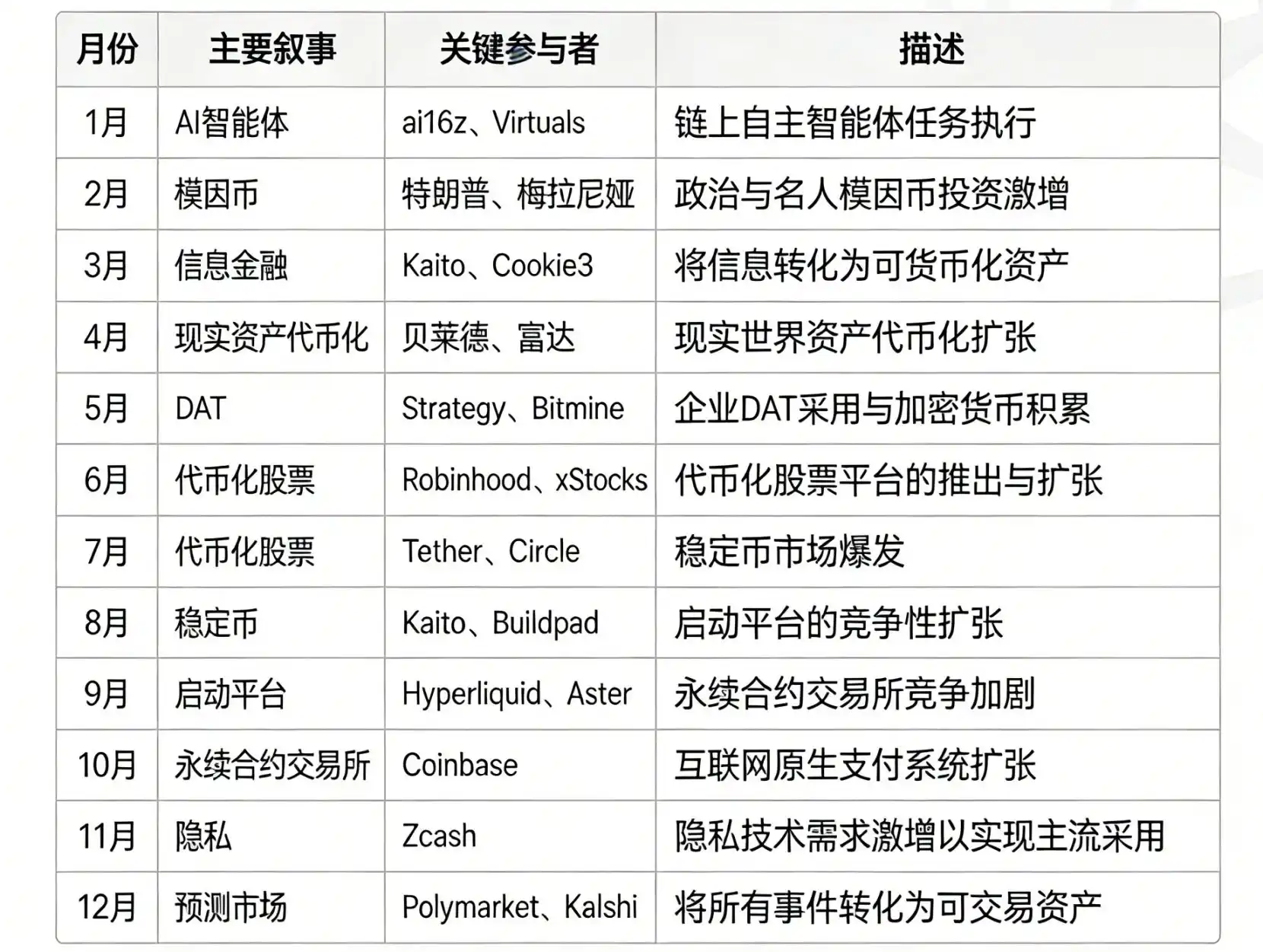
2025 Crypto Industry Mainstream Narrative
After Regulation Implementation, Foundational Market Structure Transformation
Behind all this is a significant transformation of the crypto market structure after the implementation of regulation. The current market has clearly differentiated into three major segments: the compliant zone, the non-compliant zone, and the shared infrastructure.
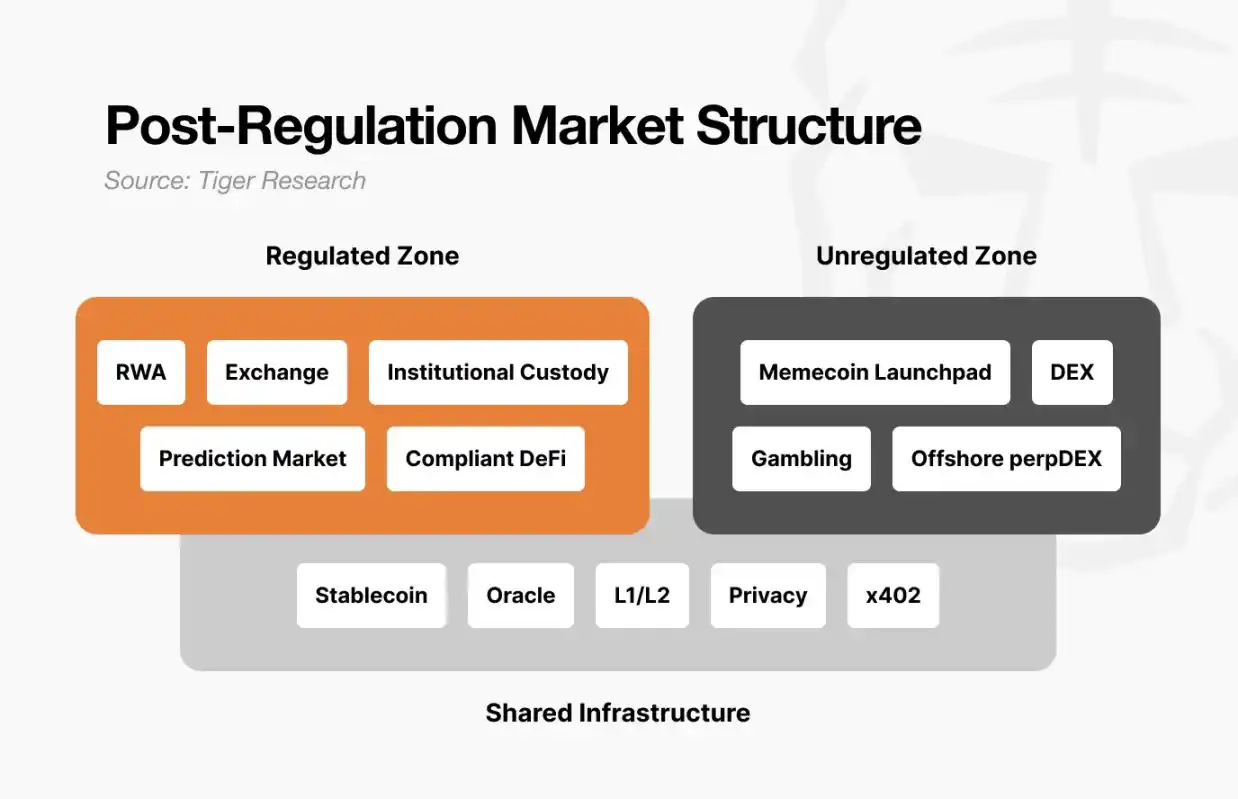
Encompassing areas such as real asset tokenization, compliant trading platforms, institutional custody, compliant prediction markets, and regulation-based decentralized finance. Projects in this segment need to undergo audits, disclose information, and are legally protected. Although the development pace is slower, the capital is huge and stable.
However, once in the compliant zone, practitioners will find it difficult to replicate past explosive gains: market volatility decreases, profit limits are locked in, but the risk of losses is also significantly controlled.
In contrast, the speculative nature of the non-compliant zone will intensify further. This segment has a low entry barrier, fast trading pace, where scenarios of a tenfold increase in a single day followed by a 90% crash the next day will become the norm.
But this segment is not without value: industry innovations born in the non-compliant zone, after market validation, can migrate to the compliant zone. DeFi back in the day was like this, and today's prediction markets are also on this path. The non-compliant zone is actually the "innovation test field" of the crypto industry. However, the business boundaries between the non-compliant zone and the compliant zone will become increasingly clear.
The shared infrastructure mainly includes stablecoins and oracles, serving as shared foundational infrastructure for both the compliant and non-compliant zones. The same USDC can be used for institutional real asset tokenization payments and for speculative trading on platforms like Pump.fun; oracles can provide data verification for the authenticity of national debt tokenization and also support data for the settlement process of anonymous decentralized trading platforms.
In other words, with the differentiation of the market structure, the capital flow logic of the crypto market has also undergone a complete change.
In the past, after Bitcoin's price surged, it would drive an overall increase in altcoins through a wealth effect; but today, this logic no longer holds. The institutional capital flowing into the crypto market through ETFs is long-term entrenched in the Bitcoin field and does not flow out to the non-compliant zone. Compliant zone capital will not enter the non-compliant zone either. Liquidity will only remain in areas that have been verified to have value, and even Bitcoin, compared to traditional risk assets, has yet to prove its value as a safe asset.
What Are the Conditions for the Next Bull Market?
Today, the regulatory framework of the crypto industry has gradually become clear, and developers are still holding their ground. To usher in the next bull market, two core conditions need to be met.
First, a brand-new killer use case needs to emerge from the non-compliant zone. Just like the DeFi wave in 2020, creating previously unseen value. Artificial intelligence agents, informational finance, and on-chain social networks are all potential battlegrounds, but the current scale is still insufficient to drive the entire market. The market needs to reestablish a positive cycle of "non-compliant zone experimental innovation → migration to compliant zone after validation." DeFi back then did this, and today's prediction markets are also following this logic.
Second, a favorable macroeconomic environment needs to materialize. Even with a refined regulatory framework, continuous developer innovation, and ongoing infrastructure development, without the support of a macro environment, the industry's upside potential will be limited. The DeFi explosion in 2020 stemmed from the release of market liquidity post-pandemic; the market rally following the approval of a Bitcoin ETF in 2024 also aligned closely with market rate-cut expectations. Regardless of how the crypto industry evolves, it cannot influence interest rate adjustments and market liquidity trends. Only with a warming macroeconomic environment can all the industry's accumulation and construction truly gain market recognition.
The "crypto bull season" where all coins rise and fall together in the past is unlikely to reoccur. Market structural differentiation has determined the industry's development pace. The compliant zone will steadily grow, while the non-compliant zone will continue its trend of extreme volatility.
The next bull market will eventually arrive, but this windfall will not belong to everyone.
You may also like

Cheers, Charts & AI: A Recap of WEEX Labs' Openguin Party Energy at ETHMilan 26

SpaceX officially submitted its prospectus, unveiling the largest IPO in history

Insiders: DeepSeek is forming a Harness team to compete with Claude Code

Morning Report | SpaceX reveals it holds approximately $1.45 billion in Bitcoin; Nvidia's Q1 financial report shows revenue of $81.6 billion; Manus plans to raise $1 billion for buyback business

IOSG Founder: Please tell Vitalik the truth, let the OGs who have enjoyed the industry's dividends enlighten the young people

Morning Report | Deloitte acquires crypto infrastructure company Blocknative; stablecoin company Checker completes $8 million financing; a16z may have become the largest external institutional holder of HYPE

Interpretation of xBubble SOP: Packaging Vibe Coding for non-technical users
From Followers to Price Setters: The Role of the Crypto Market is Reversing

a16z invested $356 million to aggressively acquire HYPE, surpassing Paradigm to become the largest external holding institution
Google officially declares war

Coinbase stuffed USDC into Hyperliquid; who made money from this transaction?

It is Bankless that needs Ethereum, not Ethereum that needs Bankless

Real Madrid vs Athletic Bilbao: Can Los Blancos Close Out the Season with a Home Win? (LALIGA Preview)

Futures Trading Hours Explained: How Smart Traders Cut Futures Fees and Earn More Cryptocurrency in 2026

Beast Industries Acquires Step – Expanding Fintech Horizons
Key Takeaways Beast Industries, led by YouTube celeb MrBeast, has acquired the teen-focused fintech banking app Step, aiming…

MrBeast’s Strategic Acquisition and Bitcoin’s Critical Threshold: An In-Depth Analysis
Key Takeaways Bitcoin faces crucial threshold levels, notably $55,000 and $60,000, which may determine its future trajectory, including…

BankrCoin Reaches New All-Time High Following Major Exchange Listing
Key Takeaways BankrCoin (BNKR) recently surged to a new all-time high of $0.00094 after being listed on a…
Bitcoin Could Face Price Drop as Analysts Predict $55K Support Challenge
Key Takeaways Analysts forecast a potential Bitcoin price drop to as low as $55,000 if current support levels…
Cheers, Charts & AI: A Recap of WEEX Labs' Openguin Party Energy at ETHMilan 26
SpaceX officially submitted its prospectus, unveiling the largest IPO in history
Insiders: DeepSeek is forming a Harness team to compete with Claude Code
Morning Report | SpaceX reveals it holds approximately $1.45 billion in Bitcoin; Nvidia's Q1 financial report shows revenue of $81.6 billion; Manus plans to raise $1 billion for buyback business
IOSG Founder: Please tell Vitalik the truth, let the OGs who have enjoyed the industry's dividends enlighten the young people
Morning Report | Deloitte acquires crypto infrastructure company Blocknative; stablecoin company Checker completes $8 million financing; a16z may have become the largest external institutional holder of HYPE