
- Buy Crypto
- Markets
 Futures
- Spot
- Copy Trade
- Earn
- More
Mango Network Adds Solana VM for Seamless Multi-Chain Interoperability
By: cointrust|2025/05/15 23:00:10
0
Share
Mango Network, a fully on-chain blockchain infrastructure platform known for its Multi-VM architecture, has expanded its capabilities by integrating the Solana Virtual Machine (SVM). This development marks a significant step in addressing the long-standing issue of liquidity fragmentation across Web3 ecosystems. With this move, Mango Network has positioned itself as the first public blockchain to support MoveVM, Ethereum Virtual Machine (EVM), and now SVM in a single, interoperable framework.The organization behind Mango Network has reportedly spent the past three years designing a system capable of bridging the technical divides that typically separate blockchain environments. Through its Multi-VM approach, Mango enables developers to build cross-chain decentralized applications (dApps) on an infrastructure that is secure, open, and capable of high performance. With the inclusion of SVM, the platform now offers compatibility for smart contracts developed in Solidity, Move, and Rust, broadening both the potential user base and the composability of the ecosystem.Each of the supported virtual machines brings distinct advantages to the Mango Network architecture. MoveVM contributes a resource-oriented model that enhances contract security and asset protection. EVM, being the most widely adopted virtual machine in the blockchain landscape, brings with it a broad developer base and robust tooling. SVM, on the other hand, offers superior performance, leveraging Solana’s Sealevel engine to execute transactions in parallel, which significantly boosts throughput.The integration has enabled smart contracts across different VMs to operate within a shared state, communicate seamlessly, and be accessed using a unified account model. This shared state management removes the need for intermediary messaging layers, while the uniform account structure simplifies user interactions. Contracts developed in any of the three languages can now call one another directly, minimizing friction and allowing for higher composability. Additionally, Mango has implemented a standardized digital asset model, enabling asset transfers between VMs without the traditional risks and costs associated with wrapping or bridging.Performance-wise, the platform boasts a peak throughput of 297,450 transactions per second (TPS), achieved through a modular design that optimizes contract execution, consensus processes, and data availability. The architecture reduces computational overhead and employs advanced consensus mechanisms to ensure fast and reliable finality.To enable interaction with Solana’s mainnet, Mango Network has implemented a ZK Rollup-based solution. This zero-knowledge technology allows for secure cross-chain messaging, where events on Solana are captured and transmitted to Mango’s sequencer. As a result, Mango can execute cross-VM calls involving both MoveVM and SVM, using native event emission and parsing to maintain consistency and reliability. Solana-based decentralized applications can now be deployed directly on Mango Network, allowing them to interact seamlessly with the existing Move and Ethereum-based smart contracts. This latest integration is seen as a strategic step toward unlocking greater potential in Solana’s DeFi and GameFi sectors. Developers working in Rust on Solana can now migrate their applications to Mango’s multi-VM environment without incurring high transition costs. This capability is expected to accelerate multi-chain dApp development and lower entry barriers for cross-chain innovation.Mango Network is also developing an SVM Adapter Layer aimed at reconciling Solana’s parallel execution model with its own architecture. The team views this as part of a broader vision to support additional VMs such as ZKVM and WASM in the future. This modular and forward-compatible approach aligns with Mango Network’s ambition to serve as a full-chain infrastructure layer for the decentralized internet, offering developers and users a more unified, scalable, and interoperable blockchain experience.The post Mango Network Adds Solana VM for Seamless Multi-Chain Interoperability appeared first on CoinTrust.
You may also like

Particle Founder: The entrepreneurial insights I have gained the most from in the past year
Stop lean startup, stop lightning entrepreneurship, and think carefully about what your product aspirations are.

Huang Renxun's latest podcast transcript: The future of Nvidia, the development of embodied intelligence and agents, the explosion of inference demand, and the public relations crisis of artificial intelligence
The competition in the future is not just about whose model is larger or whose computing power is stronger, but also about who understands the industry better, who can embed AI more deeply into real processes, and who can organize these capabilities into a runnable and scalable system.

OKX Ventures Research Report: AI Agent Economic Infrastructure Research Report (Part 1)
The existing infrastructure is hostile to the Agent economy. Agents can think and act independently at the "capability level," but at the "economic level," they are still locked into infrastructure designed for humans.

The migration of settlement rights: B18 and the institutional starting point of on-chain banks
In the traditional system, banks decide the settlement; in the on-chain system, code begins to take over this responsibility.

From Tencent and Circle: Looking at the Simple and Difficult Questions of Investment
The AI narrative continues to ferment, but the recent performance of related stocks varies, with some in the midst of summer and others as if in winter.

The second half of stablecoins no longer belongs to the crypto circle
What Coinbase doesn't want, Mastercard is eager to buy.

Cursor "Shell" Kimi Controversy Reversed: From Copyright Infringement Allegations to Authorized Collaboration, China's Open Source Model Once Again Becomes a Global AI Foundation
Cursor was accused of being based on Kimi K2.5, which sparked controversy, and was later confirmed to be compliant through Fireworks AI due diligence.

The Real Reason Tokens Don't Sell: 90% of Crypto Projects Overlook Investor Relations
Provide an Investor Relations Best Practices Guide for Crypto Projects.

Is the income of pump.fun real, earning a million dollars a day despite the market downturn?
If it can really earn this much, what is the reason for the low price of $PUMP?

The real reason why tokens are not selling: 90% of crypto projects neglect investor relations
Investor Relations Practice Guide for Cryptocurrency Projects.

Who is the true winner of the "Tokenization" narrative?
Virtually everyone benefits, but the reason for the benefit, the timing, and the underlying logic are completely different.

Moss: The Era of AI-Traded by Anyone | Project Introduction
AI Trading Agent is rapidly growing its infrastructure.

Chip Smuggling Case Exposes Regulatory Loophole | Rewire News Evening Update
AI chips have become a strategic asset more sensitive than missiles

How a Structured AI Crypto Trading Bot Won at the WEEX Hackathon
Ritmex demonstrates how disciplined risk control and structured signals can make an AI crypto trading bot more stable and reliable on WEEX, highlighting the importance of combining execution discipline with scalable AI trading systems.

Old Indicator Fails, Three Major New Signals Emerge: BTC True Bottom May Still Be Below $60K
When the grocery shopping auntie on the subway, or Tony the hairdresser, start asking you about BTC, crypto, and cryptocurrency investments, selling immediately will be the only best option.

Meeting OpenClaw Founder at a Hackathon: What Else Can Lobsters Do?
Imperial College London MetaGame: AI Agent × Web3 Landing Three Major Directions.
Huang Renxun's Latest Podcast Transcript: NVIDIA's Future, Embodied Intelligence and Agent Development, Soaring Demand for Inferencing, and AI's PR Crisis
The future of competition is not only about whose model is bigger, whose computing power is stronger, but also about who understands the industry better, who can more deeply integrate AI into real processes, and who can organize these capabilities into a set of executable, scalable systems
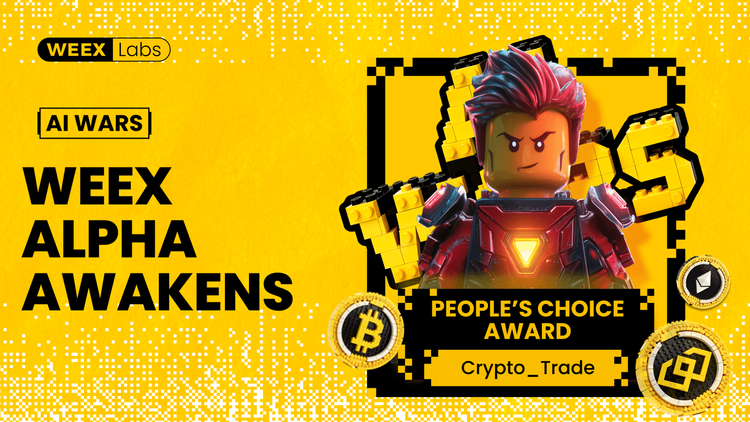
How a Structured AI Crypto Trading Bot Won at the WEEX Hackathon
Crypto_Trade shows how structured inputs and controlled adaptability can build a more stable and reliable AI crypto trading bot within the WEEX AI Trading Hackathon, highlighting a practical path toward scalable AI trading systems.
Particle Founder: The entrepreneurial insights I have gained the most from in the past year
Stop lean startup, stop lightning entrepreneurship, and think carefully about what your product aspirations are.
Huang Renxun's latest podcast transcript: The future of Nvidia, the development of embodied intelligence and agents, the explosion of inference demand, and the public relations crisis of artificial intelligence
The competition in the future is not just about whose model is larger or whose computing power is stronger, but also about who understands the industry better, who can embed AI more deeply into real processes, and who can organize these capabilities into a runnable and scalable system.
OKX Ventures Research Report: AI Agent Economic Infrastructure Research Report (Part 1)
The existing infrastructure is hostile to the Agent economy. Agents can think and act independently at the "capability level," but at the "economic level," they are still locked into infrastructure designed for humans.
The migration of settlement rights: B18 and the institutional starting point of on-chain banks
In the traditional system, banks decide the settlement; in the on-chain system, code begins to take over this responsibility.
From Tencent and Circle: Looking at the Simple and Difficult Questions of Investment
The AI narrative continues to ferment, but the recent performance of related stocks varies, with some in the midst of summer and others as if in winter.
The second half of stablecoins no longer belongs to the crypto circle
What Coinbase doesn't want, Mastercard is eager to buy.


 App
App