
- Buy Crypto
- Markets
 Futures
- Spot
- Copy Trade
- Earn
- More
Pavel Durov slams Mark Zuck, calls WhatsApp a cheap copycat of Telegram
By: bitcoin ethereum news|2025/05/15 23:30:07
0
Share
Telegram’s founder Pavel Durov is going directly after Mark Zuckerberg and WhatsApp, accusing the Meta-owned messaging app of stealing features and launching smear campaigns. In a post on his official Telegram channel, Pavel said the company has started its first contest for content creators to make viral videos exposing how Telegram has led the industry for years while WhatsApp follows behind. Pavel claimed, “We’ve caught WhatsApp running smear PR campaigns against Telegram, so it’s only fair we hit back.” He described WhatsApp as a platform for users “trapped in the past,” relying on delayed, stripped-down copies of innovations Telegram introduced first. Telegram has now listed 30 different features it brought to market before WhatsApp, and Pavel made it clear that the list isn’t even complete. The goal is to inform users and expose the ongoing pattern of copying. Pavel added, “That’s why we’re not worried about WhatsApp trying to catch up with us — we’re too far ahead.” The contest comes with a $50,000 prize and runs through May 26. Durov accuses Meta of stealing, lobbying, and hiding behind PR Now, Telegram and WhatsApp have competed in the same space since Telegram launched in 2013. The following year, Meta bought WhatsApp for $19 billion. Just days after the deal, WhatsApp suffered a major outage that sent nearly 5 million users flocking to Telegram in a single day. That sudden jump marked a turning point, as Telegram began branding itself as the secure alternative. Since then, Pavel has used every opportunity to discredit WhatsApp’s handling of user data. He’s described WhatsApp as a “surveillance tool” and a “honeypot”, warning that its system design makes it easy for hackers and state actors to gain access to user phones. In 2019, Pavel went as far as urging users to delete the app, claiming it created a backdoor for spying. The same pattern continued in 2021, when WhatsApp changed its privacy policy to integrate deeper with Meta services. Pavel publicly mocked Meta, pointing out the irony of them building an entire department just to figure out how Telegram kept growing. While Telegram boasts more than 1 billion active users as of 2025, WhatsApp still dominates with over 2 billion, but that hasn’t stopped the attacks. Pavel maintains that his platform’s growth is due to transparency and independence — Telegram doesn’t run ads and doesn’t depend on outside investors. But admittedly, Telegram doesn’t enable end-to-end encryption by default, a feature WhatsApp has across all chats, so that’s something. Past tension, public jabs, and legal heat come to the surface The tension between the two CEOs isn’t new. When Pavel was still running VK, Russia’s version of Facebook, he met Zuck in 2009. Pavel later claimed that Meta copied VK’s app platform based on ideas he discussed during that meeting. He said Meta implemented features based on “what I told them we did,” accusing them of long-term imitation. In 2024, Pavel criticized WhatsApp again, this time calling it a “cheap, watered-down imitation of Telegram” and accusing Meta of using lobbying and PR firms to try and slow down Telegram’s expansion. He said that despite this, Telegram remains financially independent, a claim he uses to contrast his company with WhatsApp’s full reliance on Meta. In 2025, when Zuck said Meta would drop fact-checkers from its platforms, Pavel responded by calling him an “opportunist” who only uses the idea of free speech when it suits him. He said Zuck lacks the conviction of people like Elon Musk, who take a more open stance on information sharing. All in all, Pavel and Zuck represent two sides of the same coin. One refuses to bow to authorities and maintains full control of his platform without ads or oversight. The other plays by the rules moderates content, and protects his legal standing. But both face criticism – either for enabling criminals or suppressing freedom. KEY Difference Wire: the secret tool crypto projects use to get guaranteed media coverage Source: https://www.cryptopolitan.com/pavel-durov-slams-mark-zuck-whatsapp/
You may also like

Particle Founder: The entrepreneurial insights I have gained the most from in the past year
Stop lean startup, stop lightning entrepreneurship, and think carefully about what your product aspirations are.

Huang Renxun's latest podcast transcript: The future of Nvidia, the development of embodied intelligence and agents, the explosion of inference demand, and the public relations crisis of artificial intelligence
The competition in the future is not just about whose model is larger or whose computing power is stronger, but also about who understands the industry better, who can embed AI more deeply into real processes, and who can organize these capabilities into a runnable and scalable system.

OKX Ventures Research Report: AI Agent Economic Infrastructure Research Report (Part 1)
The existing infrastructure is hostile to the Agent economy. Agents can think and act independently at the "capability level," but at the "economic level," they are still locked into infrastructure designed for humans.

The migration of settlement rights: B18 and the institutional starting point of on-chain banks
In the traditional system, banks decide the settlement; in the on-chain system, code begins to take over this responsibility.

From Tencent and Circle: Looking at the Simple and Difficult Questions of Investment
The AI narrative continues to ferment, but the recent performance of related stocks varies, with some in the midst of summer and others as if in winter.

The second half of stablecoins no longer belongs to the crypto circle
What Coinbase doesn't want, Mastercard is eager to buy.

Cursor "Shell" Kimi Controversy Reversed: From Copyright Infringement Allegations to Authorized Collaboration, China's Open Source Model Once Again Becomes a Global AI Foundation
Cursor was accused of being based on Kimi K2.5, which sparked controversy, and was later confirmed to be compliant through Fireworks AI due diligence.

The Real Reason Tokens Don't Sell: 90% of Crypto Projects Overlook Investor Relations
Provide an Investor Relations Best Practices Guide for Crypto Projects.

Is the income of pump.fun real, earning a million dollars a day despite the market downturn?
If it can really earn this much, what is the reason for the low price of $PUMP?

The real reason why tokens are not selling: 90% of crypto projects neglect investor relations
Investor Relations Practice Guide for Cryptocurrency Projects.

Who is the true winner of the "Tokenization" narrative?
Virtually everyone benefits, but the reason for the benefit, the timing, and the underlying logic are completely different.

Moss: The Era of AI-Traded by Anyone | Project Introduction
AI Trading Agent is rapidly growing its infrastructure.

Chip Smuggling Case Exposes Regulatory Loophole | Rewire News Evening Update
AI chips have become a strategic asset more sensitive than missiles

How a Structured AI Crypto Trading Bot Won at the WEEX Hackathon
Ritmex demonstrates how disciplined risk control and structured signals can make an AI crypto trading bot more stable and reliable on WEEX, highlighting the importance of combining execution discipline with scalable AI trading systems.

Old Indicator Fails, Three Major New Signals Emerge: BTC True Bottom May Still Be Below $60K
When the grocery shopping auntie on the subway, or Tony the hairdresser, start asking you about BTC, crypto, and cryptocurrency investments, selling immediately will be the only best option.

Meeting OpenClaw Founder at a Hackathon: What Else Can Lobsters Do?
Imperial College London MetaGame: AI Agent × Web3 Landing Three Major Directions.
Huang Renxun's Latest Podcast Transcript: NVIDIA's Future, Embodied Intelligence and Agent Development, Soaring Demand for Inferencing, and AI's PR Crisis
The future of competition is not only about whose model is bigger, whose computing power is stronger, but also about who understands the industry better, who can more deeply integrate AI into real processes, and who can organize these capabilities into a set of executable, scalable systems
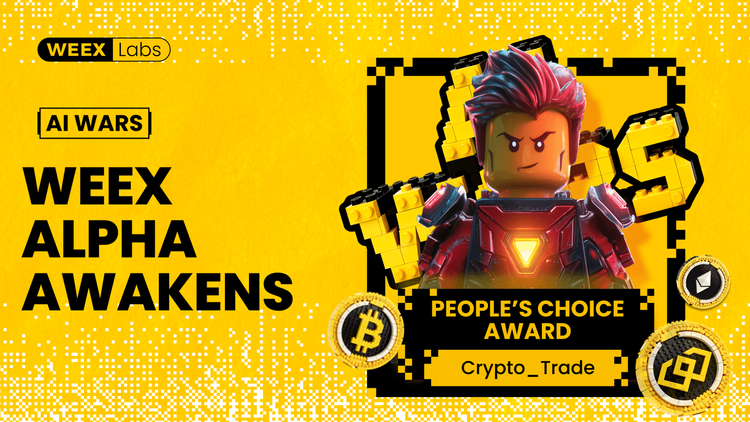
How a Structured AI Crypto Trading Bot Won at the WEEX Hackathon
Crypto_Trade shows how structured inputs and controlled adaptability can build a more stable and reliable AI crypto trading bot within the WEEX AI Trading Hackathon, highlighting a practical path toward scalable AI trading systems.
Particle Founder: The entrepreneurial insights I have gained the most from in the past year
Stop lean startup, stop lightning entrepreneurship, and think carefully about what your product aspirations are.
Huang Renxun's latest podcast transcript: The future of Nvidia, the development of embodied intelligence and agents, the explosion of inference demand, and the public relations crisis of artificial intelligence
The competition in the future is not just about whose model is larger or whose computing power is stronger, but also about who understands the industry better, who can embed AI more deeply into real processes, and who can organize these capabilities into a runnable and scalable system.
OKX Ventures Research Report: AI Agent Economic Infrastructure Research Report (Part 1)
The existing infrastructure is hostile to the Agent economy. Agents can think and act independently at the "capability level," but at the "economic level," they are still locked into infrastructure designed for humans.
The migration of settlement rights: B18 and the institutional starting point of on-chain banks
In the traditional system, banks decide the settlement; in the on-chain system, code begins to take over this responsibility.
From Tencent and Circle: Looking at the Simple and Difficult Questions of Investment
The AI narrative continues to ferment, but the recent performance of related stocks varies, with some in the midst of summer and others as if in winter.
The second half of stablecoins no longer belongs to the crypto circle
What Coinbase doesn't want, Mastercard is eager to buy.


 App
App