
People unable to buy Anthropic have driven its shadow stock up 16x

Original Article Title: "Those Who Couldn't Buy Anthropic's Stock Skyrocketed its Shadow Stock by 16x"
Original Article Author: David, Shen Chao TechFlow
Last Thursday, a new stock was added to the NYSE, with the code VCX.
It is actually a fund. The fund holds shares of companies such as Anthropic, OpenAI, and SpaceX. Anthropic accounts for 21% of the fund, and OpenAI accounts for 10%.
These companies have one thing in common: they are not publicly traded, and regular people cannot buy their stocks.
VCX is currently one of the very few things on the market that allows ordinary investors to indirectly hold Anthropic shares.
Its net asset value is $19 per share. On the first day of trading, the opening price was $42, surged to $125 intra-day, and closed at $76. On the fourth trading day, the intra-day high was $315, triggering two circuit breakers.
From $19 to $315 in four days.
Investors are essentially buying this fund at a price 16 times higher than its actual asset value. Not because the fund manager is so great, but because Anthropic is inside.
A month ago, Anthropic, with a $380 billion valuation, raised $30 billion, the second-largest funding round globally this year. It has an annual revenue of $14 billion. But it is not publicly traded, has no stock symbol, and you won't find it in any brokerage's search box.
If you can't buy the real deal, go after the shadow. VCX is currently the shadow of Anthropic, or rather, the shadow of AI FOMO.
Why So Expensive?
VCX is not a traditional fund.
With a regular fund, if you think it's expensive, you can wait for it to drop because the fund manager can issue more shares, and the supply is elastic. VCX is a closed-end fund, and the shares are locked in at the time of listing, and will not increase.
More importantly, the vast majority of shares cannot be sold at all. Investors who bought in before February 20 have their shares locked for six months and cannot trade until September. VCX has over 100,000 investors, but currently, only a very small portion of shares in the market can actually be traded.
What does this mean? There are many buyers interested, but very few shares available for purchase. A small amount of buying pressure can drastically distort the price.
So, that 16x premium is actually priced in based on "how many people want to get into Anthropic and how narrow the entrance is." But this kind of eagerness wasn't created by VCX.
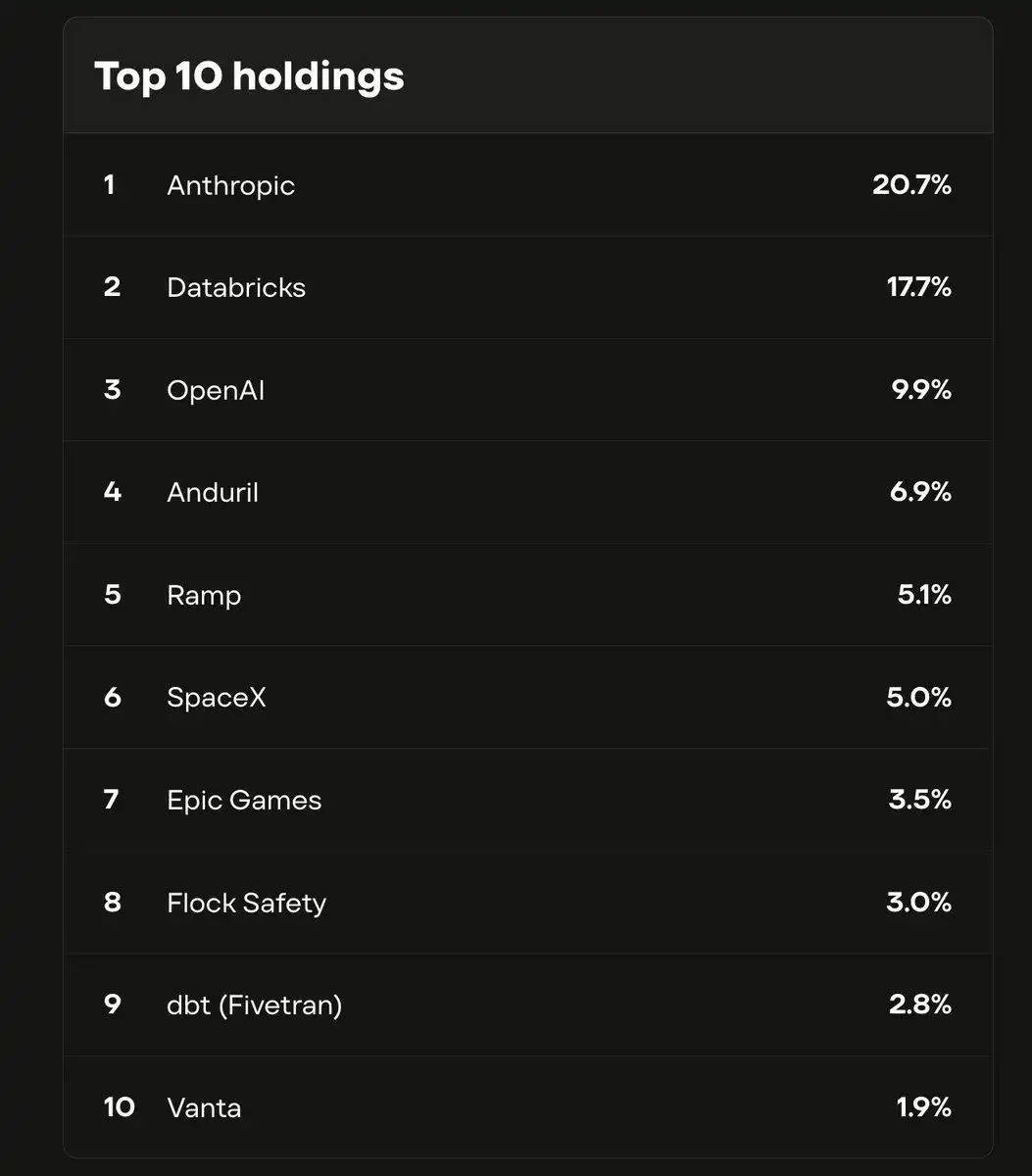
Image: VCX Fund's Top 10 Holdings at Fundrise
Over the past decade, the tech industry has undergone a structural shift: the best companies are going public later, or not at all.
When Facebook went public in 2012 with a valuation of $104 billion, it was already a staggering number at the time. Today, Anthropic's private valuation is over three times that of Facebook's IPO, yet it didn't even have a clear plan to go public;
OpenAI, with a valuation of $500 billion, hasn't gone public either. SpaceX's IPO plans have been rumored for over a year, with no concrete date yet.
A decade ago, a company achieving this scale would have long since rung the bell at the NYSE. Now, they don't need to. The private markets can offer almost unlimited funding without the pressure of quarterly reports or dealing with retail investors and short sellers.
For founders, this is a rational choice. For ordinary investors, it means that the fastest-growing companies in history are ones you can only watch from afar.
VCX was originally planning to go public on March 9, but the Iran war delayed it by ten days. Nothing changed during those ten days—Anthropic's price didn't go up or down, the fund's holdings remained unchanged. But the delay itself incubated ten more days of anticipation.
On the day it finally listed, all the pent-up demand from those ten days squeezed into an extremely narrow channel.
Not all shadows are valuable
If you want exposure to the stock of unlisted companies, there is more than one way besides the VCX fund.
But before discussing these avenues, there is a more fundamental question: If Anthropic is not public, how did a publicly traded fund get its shares?
The answer is backdoor.
Large private companies raise a new round of funding every few months, from Series A to Series G, allowing new investors to enter each round. Just last month, Anthropic closed a $30 billion Series G round, with participating institutions ranging from GIC to Sequoia to Goldman Sachs in a long line. These rounds are usually open only to institutional investors, with entry thresholds often starting in the tens of millions of dollars.
But there is a second path.
Just because a company is not public does not mean its shares cannot be traded privately. Early employees, angel investors, all hold shares, and some of these individuals want to cash out early. Thus, the private company's secondary market was born—non-public, opaque, but real transactions take place.
Since 2022, Fundrise has been buying on both of these paths, when valuations of private tech companies had just experienced a steep decline and prices were cheap. Over four years, it accumulated a portfolio including Anthropic, OpenAI, and SpaceX. It then packaged this into VCX, listed it on the NYSE, and now ordinary people can buy into it just like buying stocks.
In the same month, at least three similar funds were also trading on the NYSE, all selling the same concept:
Buying something through the backdoor and selling it to you through the front door.
Robinhood launched a fund called RVI, which debuted on March 6th at $25. Its holdings include Databricks, Revolut, and Ramp, all good private companies. On the first day of trading, it dropped by 11% and closed at $21.
Destiny Tech100, with the ticker DXYZ, went public in 2024, considered a pioneer in this space. It has a heavy holding in SpaceX, which makes up 16% of its portfolio. It only recently added a small exposure to Anthropic through an indirect way in February this year. Its stock price is currently hovering around $24.
Then there is XOVR, the first ETF approved to directly hold stakes in private companies, with SpaceX accounting for approximately 21%.
Four funds, similar structures, similar concepts, all trading on the same platform. But their fates are entirely different.
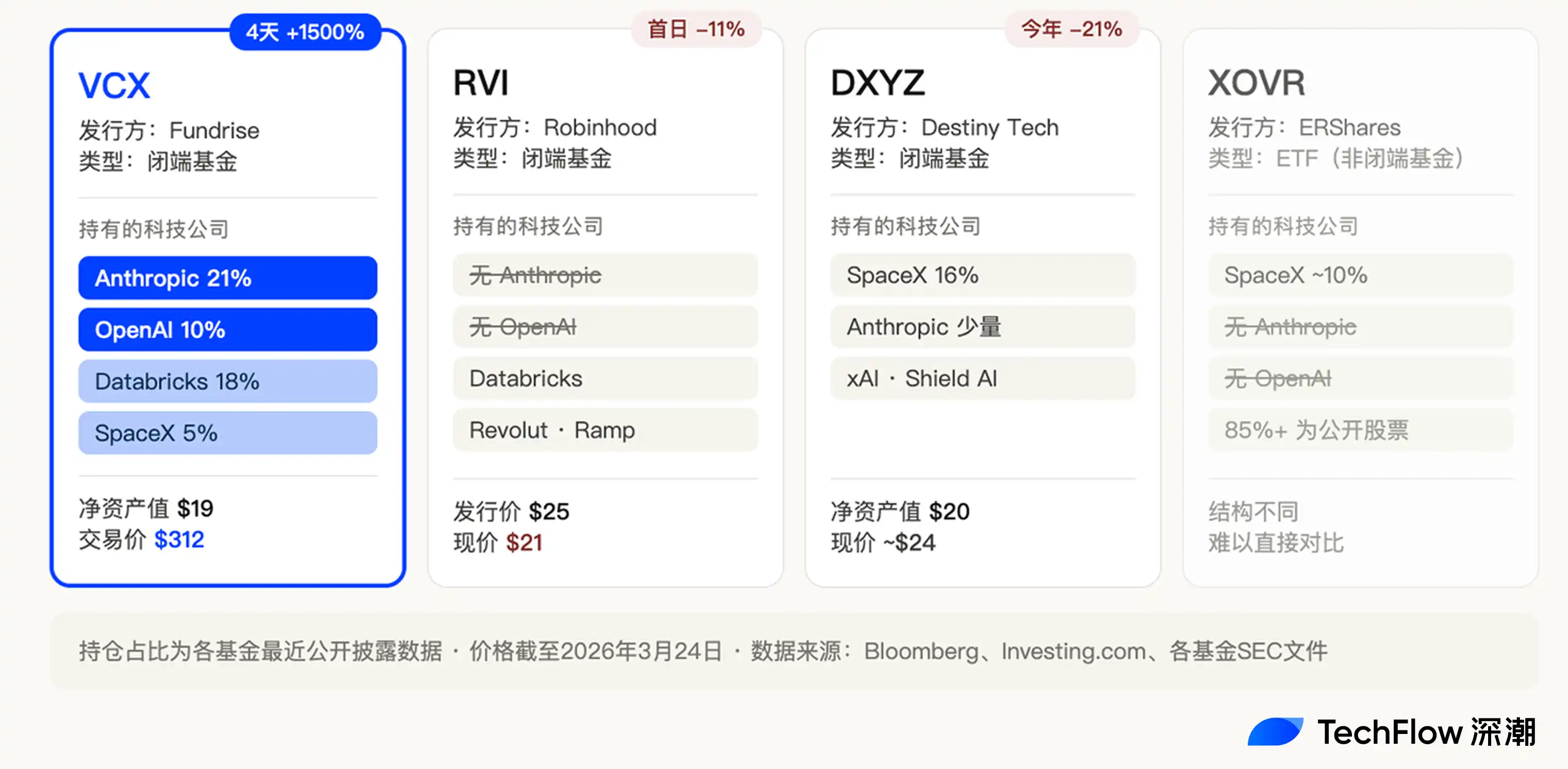
VCX surged 1500% in four days. RVI broke its IPO price on the first day. DXYZ is lukewarm.
VCX holds 21% of Anthropic and 10% of OpenAI. RVI's portfolio includes neither Anthropic nor OpenAI. DXYZ recently added exposure to Anthropic, but the allocation is small.
This indicates that, at least for now, the market is not really after "shares of private companies." The market is after Anthropic.
Whoever is closest to them is the most valuable.
This is where Robinhood's RVI fell short. While Databricks and Revolut are undoubtedly great companies, at this point, they are not the names people are willing to pay a 16x premium for.
Even Shadows Have an Expiry Date
What was the $312 bet on VCX all about?
It was a bet that, before the door opens, there will be someone willing to pay a higher price to buy Anthropic, which they cannot get.
However, this door will not remain closed forever.
VCX has over 100,000 investors, the vast majority of whom have their shares locked up for six months. The lockup period ends on September 19. At that time, a large number of shares will flood the market, transitioning from extreme scarcity to abundance overnight.
The reason VCX was able to sell at a 16x premium is half because of Anthropic inside and perhaps the other half because the tradable float was too small. Once the lockup period ends, the second condition disappears.
There is an even bigger variable.
Anthropic, OpenAI, and SpaceX, these three companies are all rumored to IPO in the second half of 2026 to 2027. Anthropic just raised $30 billion last month, valued at $380 billion, and has engaged Silicon Valley law firm Wilson Sonsini for its IPO readiness. SpaceX's CFO has been in talks with investors about an IPO since the end of last year, aiming for mid-this-year.
Once the main event goes public, the shadows lose their value.
If you can type Anthropic's stock ticker directly into the brokerage search box, why pay a 16x premium to buy a fund that indirectly holds it?
For example, as mentioned earlier, when the DXYZ for 2024 went public, it also experienced a frenzy. Later, when SpaceX delayed its IPO, the hype subsided, and the stock price dropped by more than half from its peak.
So, VCX investors are going through a classic countdown.
What they bought at 16 times the price isn't shares of Anthropic but a ticket with an expiration date. The ticket will open whenever Anthropic decides to go public.
Until then, the premium is maintained through scarcity; after that, the premium goes to zero.
But the concept of shadow stock itself is not incidental.
Every tech wave creates the same anxiety: the most important companies are out of reach. In the 2000s, before Google went public, Goldman Sachs employees fought fiercely for allocations internally. In 2020, it was SpaceX, and overnight, Silicon Valley's secondary market middlemen became the most sought-after connections.
Now it's AI's turn.
And this time, the anxiety runs deeper; Anthropic and OpenAI may not be profitable now, but they are rewriting the rules. Because of AI's impact, SaaS stocks are plummeting, cybersecurity stocks are plummeting, and IBM lost $31 billion in a day.
Investors are not just seeing "this company is making money," but rather "if I'm not on its side, I might be in its way."
The 16x premium of VCX doesn't just price in a fund; it prices in this anxiety itself.
The ticket will expire, and the premium will fade. But as long as AI keeps accelerating, as long as the most valuable companies remain closed off, some will be willing to pay an irrational price for the shadow.
Not because the shadow is worth that money, but because the feeling of being locked out is too costly.
You may also like

Why Is Bitcoin Down Today? What the Hawkish FOMC Means for SpaceX, Gold and Nasdaq

OKX Star analyzes Binance's competitive advantages: when regulation levels the playing field, competition has just begun

Full version of the debut Q&A! Federal Reserve Chairman Waller: Sticking to the 2% inflation target, establishing five special working groups, individual did not submit the dot plot

From Disruptor to Shadow Market: The Crypto Market is Becoming a Colony of Traditional Finance

Dalio's important long article: How to position in the current market environment?

DeepSeek Financing Story

Morning Report | Illinois signs the strictest digital asset tax law in the U.S.; RWA tokenization market size surpasses $43 billion, institutions accelerate the migration of on-chain assets
Morning Report | DeepSeek completes over $7 billion in financing, with a valuation exceeding $50 billion; Musk's personal wealth has surpassed the total market value of Bitcoin

Cursor, why did you get on Musk's spaceship?
In the name of charity, for the benefit of the family: How the Trump family turned charity into profit?

Will Gold Break $4,500 After Tonight's Fed Decision? What XAUT and PAXG Traders Need to Know
SharpLink CEO: How to understand that Ethereum developers have just surpassed 1 million?

Morning Report | MiCA grace period expires on July 1; Kalshi's trading volume in the first week of the World Cup breaks $5.1 billion, setting a record

The foundation of SpaceX's trillion-dollar valuation: Who is dividing Musk's annual capital expenditure of tens of billions?
How to exit after asset tokenization?
The stablecoin positioning battle escalates: When compliance is just a ticket to entry, will USD1 become the biggest winner?

A16Z: The sun bears witness, SpaceX is worth 7.5 trillion

Mergers and acquisitions in the cryptocurrency market are exceptionally active
Why Is Bitcoin Down Today? What the Hawkish FOMC Means for SpaceX, Gold and Nasdaq
OKX Star analyzes Binance's competitive advantages: when regulation levels the playing field, competition has just begun
Full version of the debut Q&A! Federal Reserve Chairman Waller: Sticking to the 2% inflation target, establishing five special working groups, individual did not submit the dot plot
From Disruptor to Shadow Market: The Crypto Market is Becoming a Colony of Traditional Finance
Dalio's important long article: How to position in the current market environment?
DeepSeek Financing Story


