
Seeking the Fifth Element of the Story Protocol Ecosystem


Prologue — It's so over ➡️ We are so back!
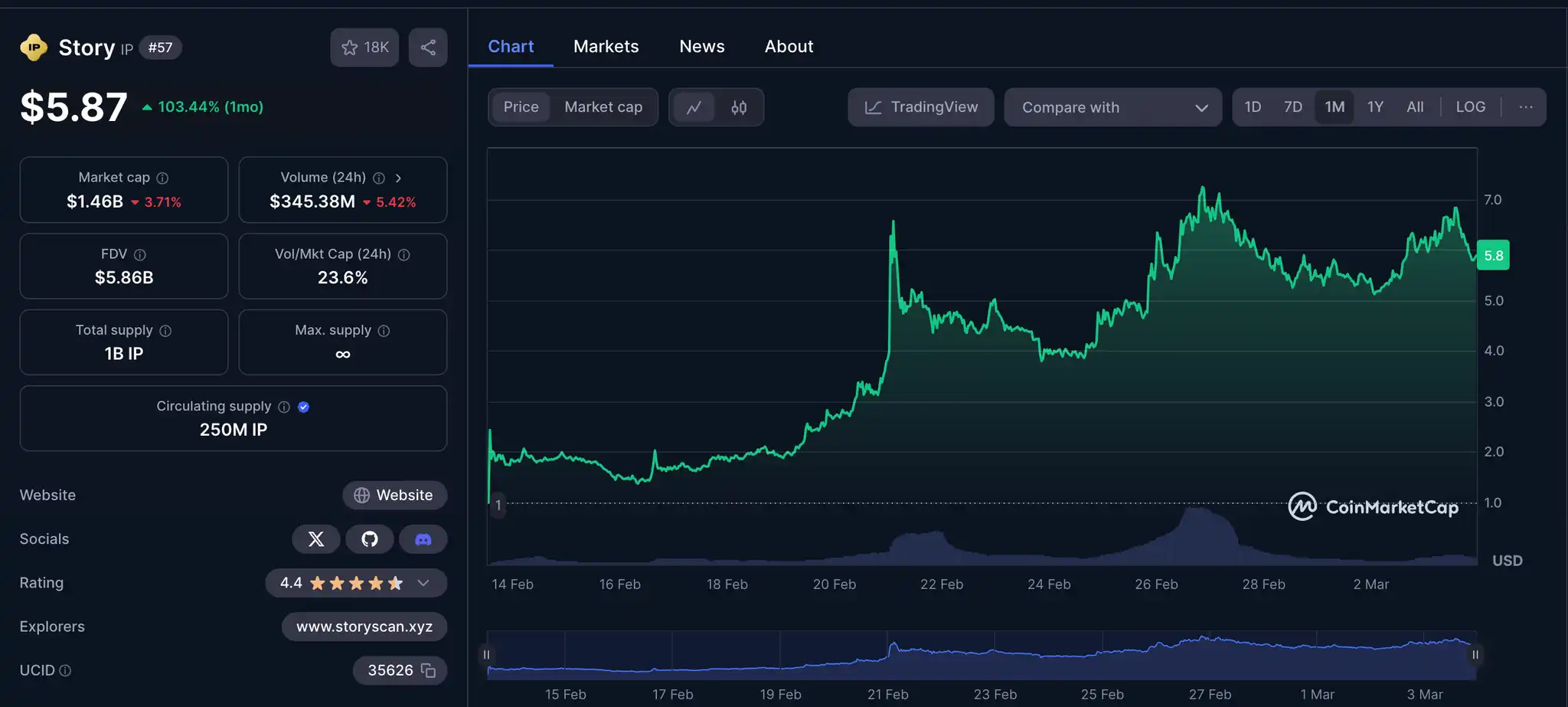
From the "Failed South Korean Bubble" to the "Great On-Chain Disney," Story Protocol has delivered a satisfactory answer to the market at the beginning of this long and agonizing 2025. After the market rediscovered the value of its $IP, the magical book of the Story ecosystem has just been opened.
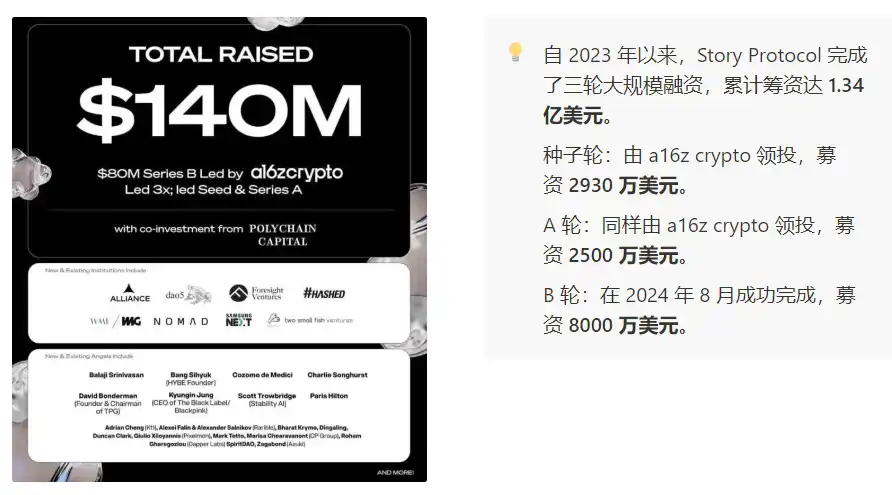
The prologue of this epic story took place in 2023, where a16z saw the ambition in these young founders. Their territory covers DeFi, Infra, AI, and other fields, aiming to fundamentally change the operational mode of creativity and ideas through on-chain transparency and programmability.
Rather than saying it changed Disney's fate, it is more about shattering and recreating the rules. And IP, as the most powerful unit on Story Protocol, has become like building blocks on this unique Layer 1.
Genesis: What Exactly Is IP?
For you who have stepped into the Story ecosystem out of curiosity, why not ask yourself first, what is IP exactly? How much of his story have you understood? You can refer to founder Jason Zhao's previous article, where his conception of IP shattered the traditional stereotypes.
Regarding the term IP, there are a thousand Hamlets in the eyes of a thousand people. You might think a two-year-old NFT avatar is good IP, while your cousin's child in the second family tearfully believes Ne Zha 2 is good IP from watching the animated movie, and other people's children who have earned a doctorate want to quickly apply for a patent for their future livelihood. "Yes, all of the above," Jason Zhao says. My definition of IP: **Intellectual property is the atomic unit of creativity.** Successful IP records milestones in human development, and the whole world is competing to create the next IP and continue writing new stories.
In the past, the moat between intellectual property and various industries was deep-rooted until AI appeared and disrupted everything. The black hole of artificial intelligence has turned the accomplishments of many creators into learning materials, gradually erasing the familiar concept of IP. Most tragic is that creators cannot stop the spread of information or prevent their achievements from being digested as nutrients for silicon-based intelligences. Their vitality slowly withers as the rewards vanish because the development of AI is transformative, rapid, and unstoppable.
The creation of Story Protocol and IP was to protect the value of creators from being exploited, and it is a new model for creators to embrace the AI future. It fully leverages tokenization to distribute value to the crowd participating in IP construction, and different tokens represent different types of rights.
Genesis: Story Protocol Ecosystem Overview
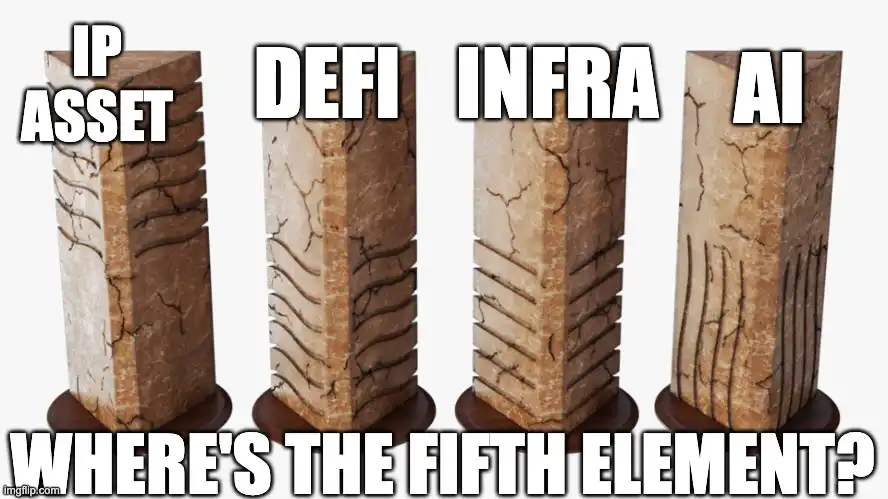
Understanding Story's mission, we need to take a macro view of the ecosystem map to envision the digital economic empire Story aims to build. It is mainly composed of the following parts, similar to the elements of building the world: air, water, earth, fire.
IP Assets
DeFi
Infra/Tools
AI
Next, I will proceed to expand on each.
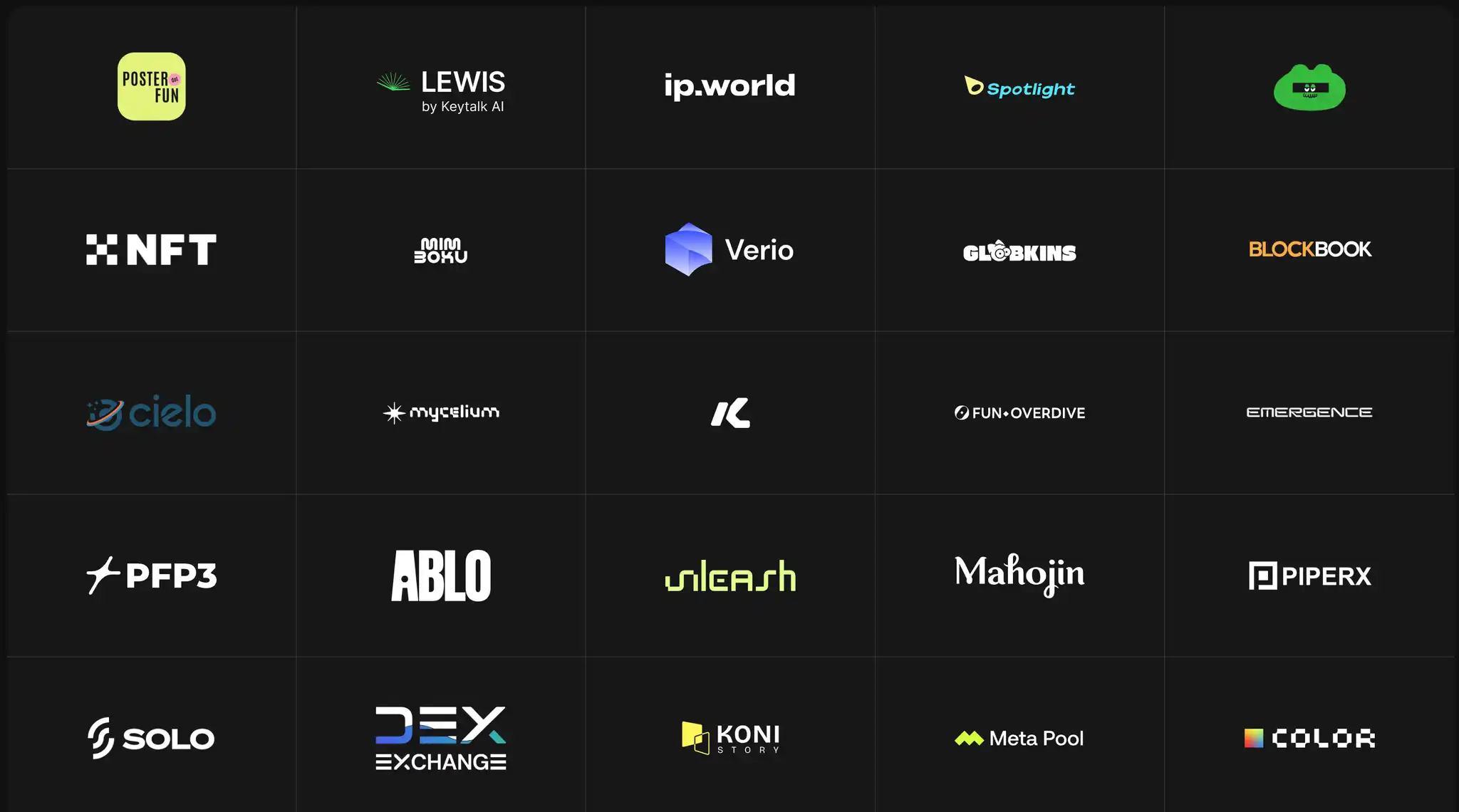

The above are the projects currently Live on Story Protocol
DeFi
Trading and exchange are always the constant themes in Crypto.
Section Overview
The composability of IP's DeFi ecosystem far exceeds that of traditional DeFi. Here, you can even evaluate your hot IP and, based on its future cash flow generation, engage in collateralized borrowing. The emergence of IPFi further highlights the importance of holding high-quality IP assets. Because owning premium IP assets means having high-quality cash flow. In less than a month after the mainnet launch, Story's on-chain DeFi ecosystem mainly consists of the native DEX, lending platform, Staking/Yield Aggregator, and derivatives.
1. Native DEX
PiperX, Story Hunt
Core Function: As the native decentralized exchange of the Story ecosystem, PiperX focuses on IP asset liquidity management, aiming to create a relatively complete IPFi platform. Story Hunt, on top of the foundation, further supports the exchange between IP and NFT.
Data Highlights:
PiperX
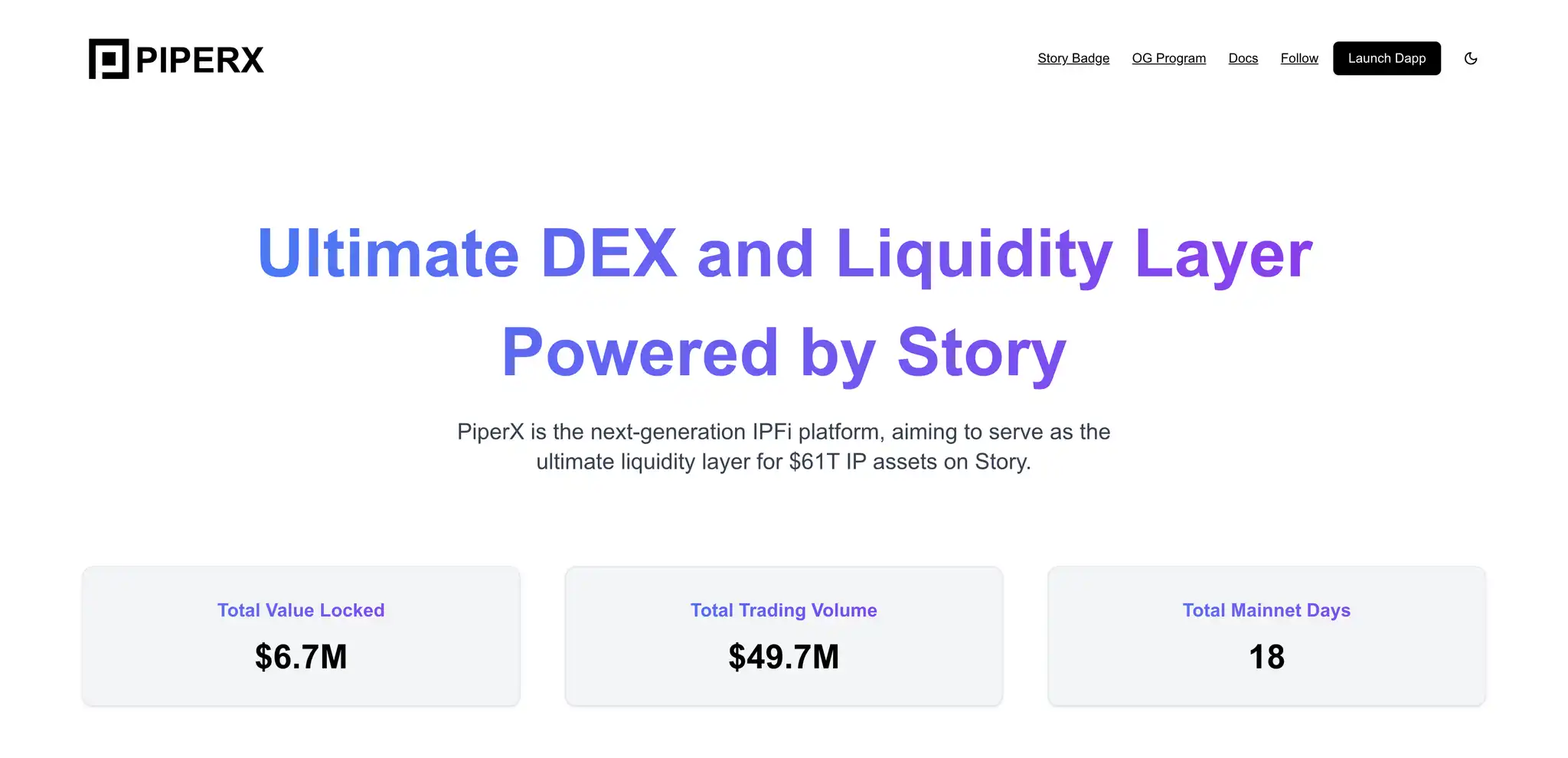
According to the homepage data, PiperX has reached a total TVL of $6.7M and a total trading volume of $49.7M since 18 days after the IP mainnet went live.
Compared to Story Hunt, PiperX has a wider coverage on mainstream IP Token trading pairs, with tokens such as WIP, ZOO, WETH, WTF, and vIP ranking in the top five.
Story Hunt
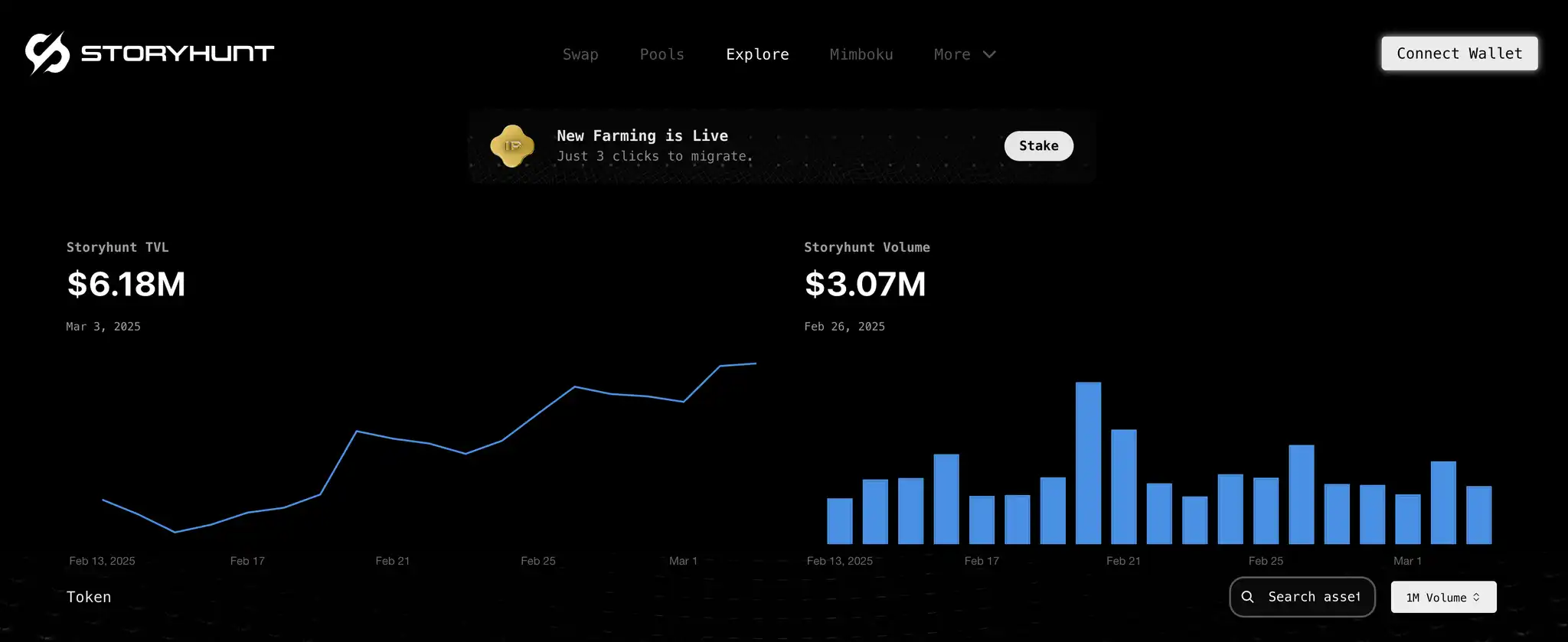
According to official data, the total TVL has reached $6.18M, with a total trading volume of $42.2M
2. Lending Platform
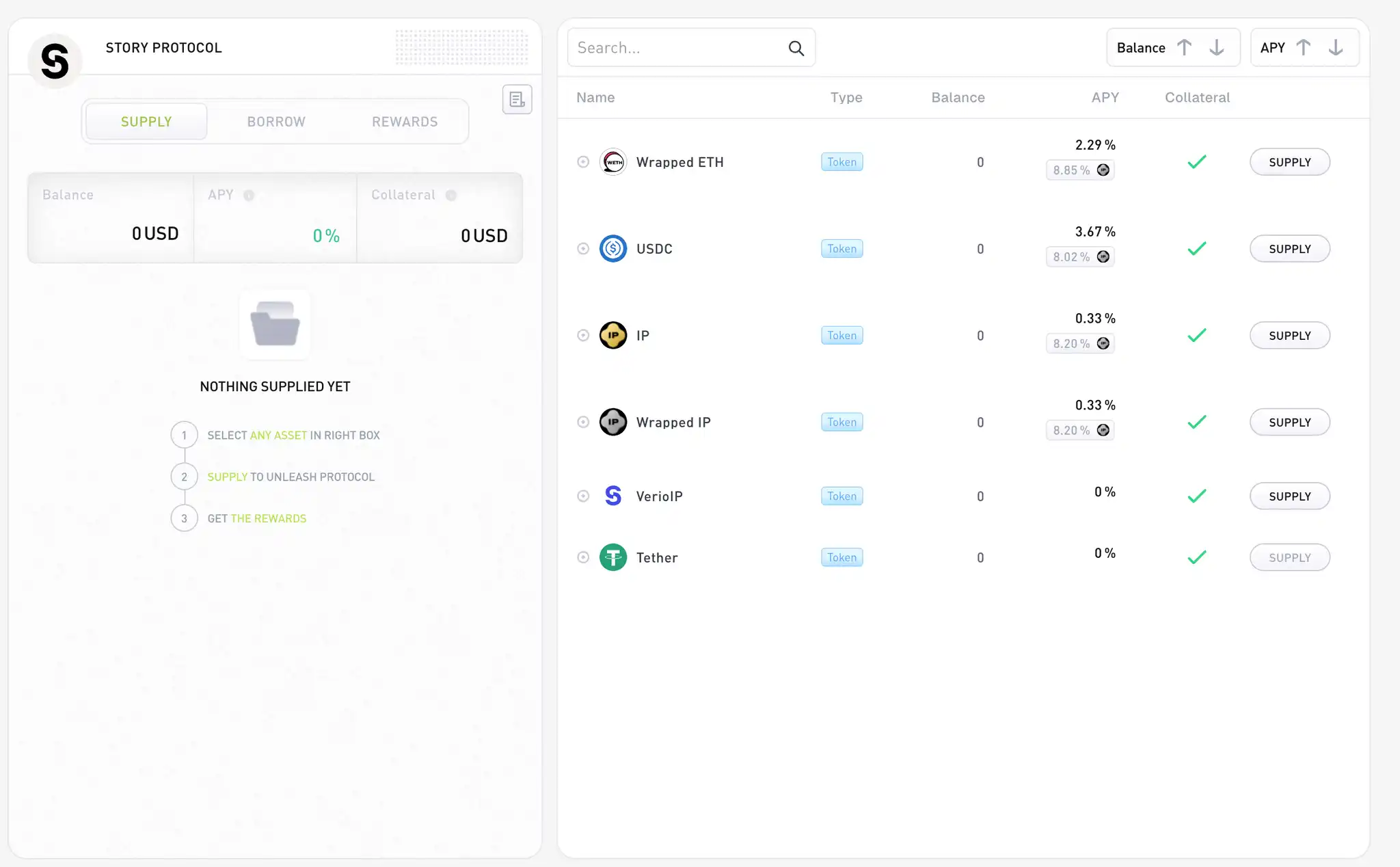
Unleash Protocol
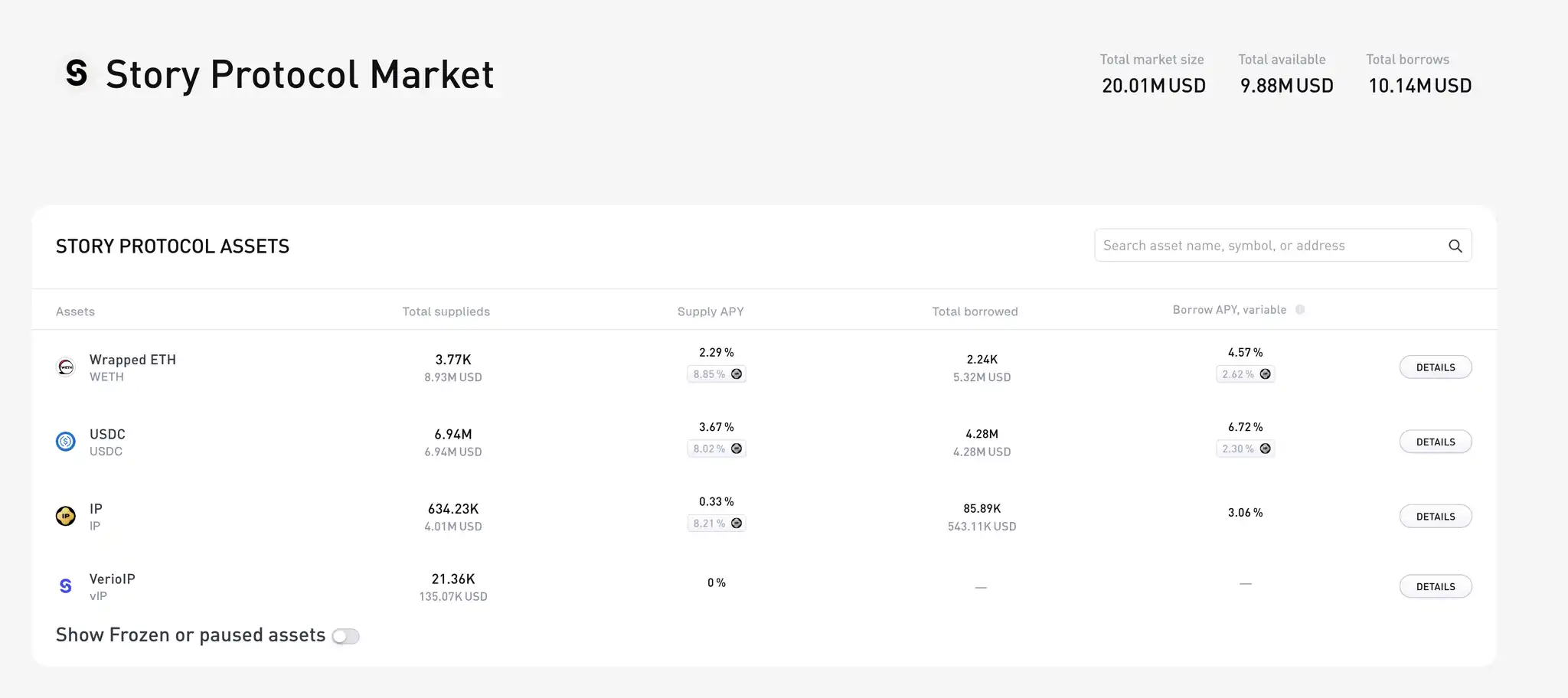
Unleash Protocol is a fork of AAVE V3 and is the first lending protocol to leverage IP's initial leverage. The existing lending categories are relatively simple, including WETH, USDC, and IP. The Story Foundation has also introduced a liquidity incentive program for Unleash Protocol, where borrowing can earn WIP as part of the reward annualized percentage yield.
Key Data:
3. Staking/Liquidity Staking
Metapool:
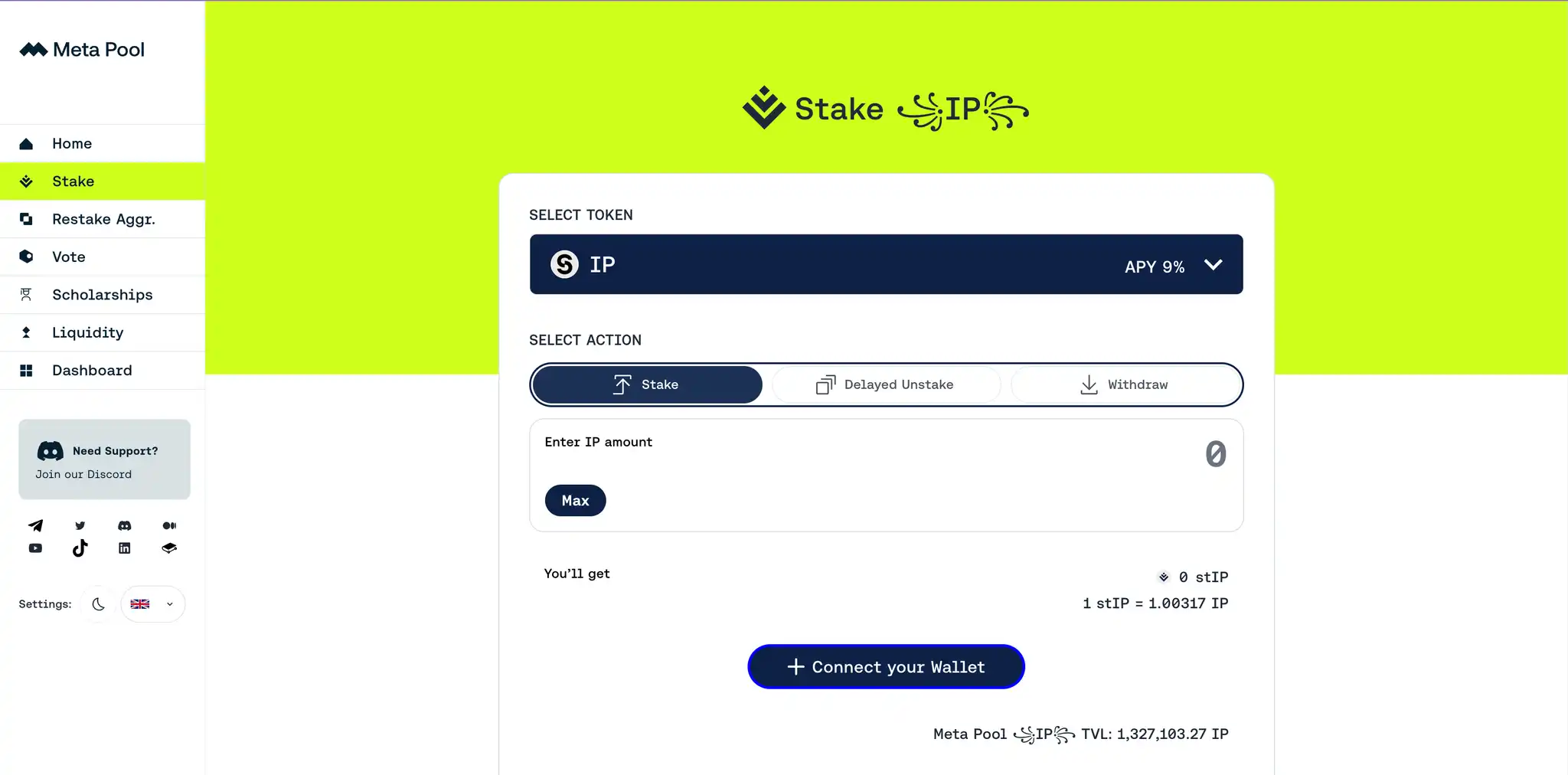
Metapool focuses on staking STORY tokens, with the current staking APY at 9%. Metapool's staking pool TVL is $1.3M $IP, and the staking rate accounts for 0.6% of the token's circulating supply.
Verio:
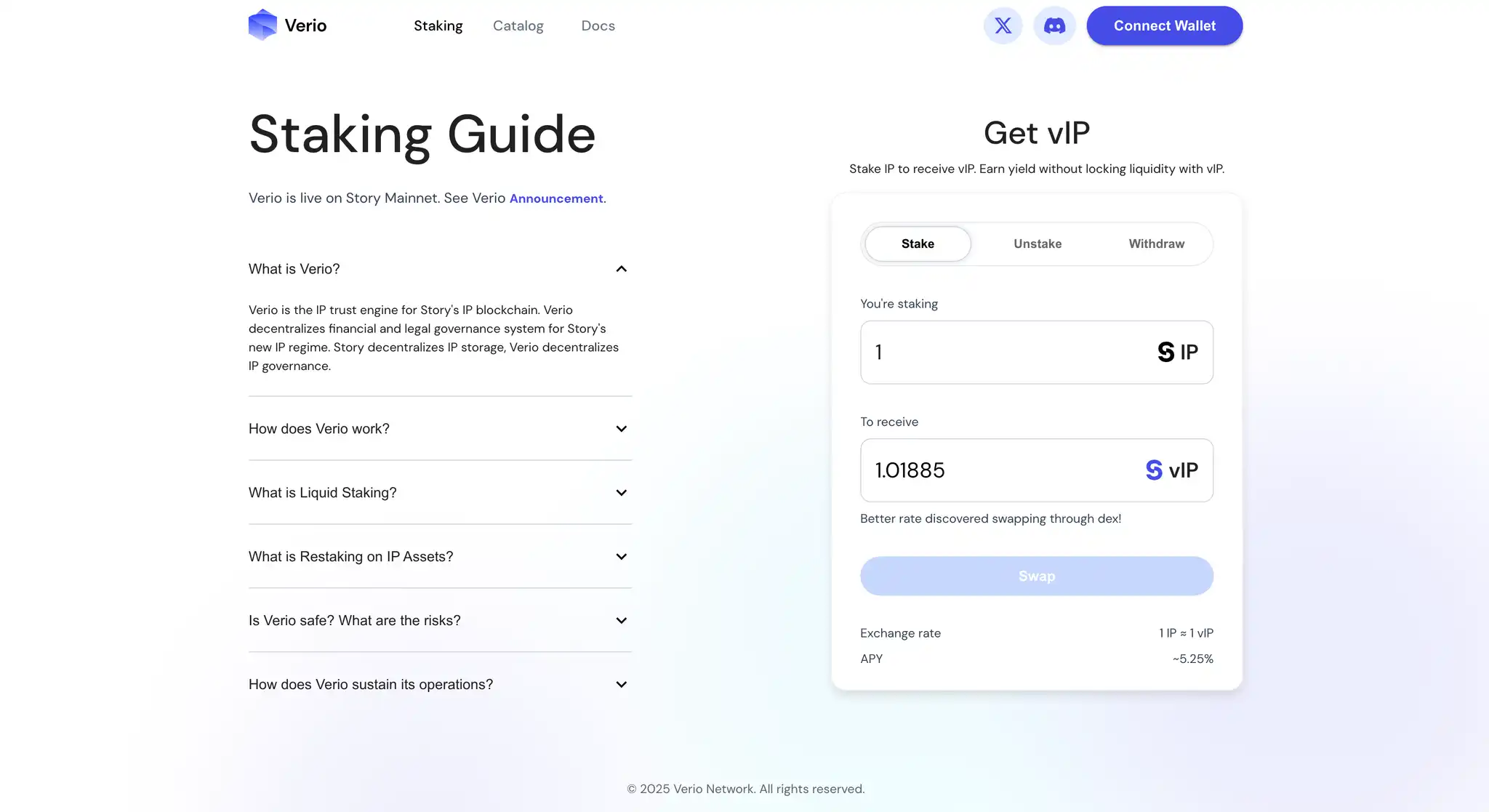
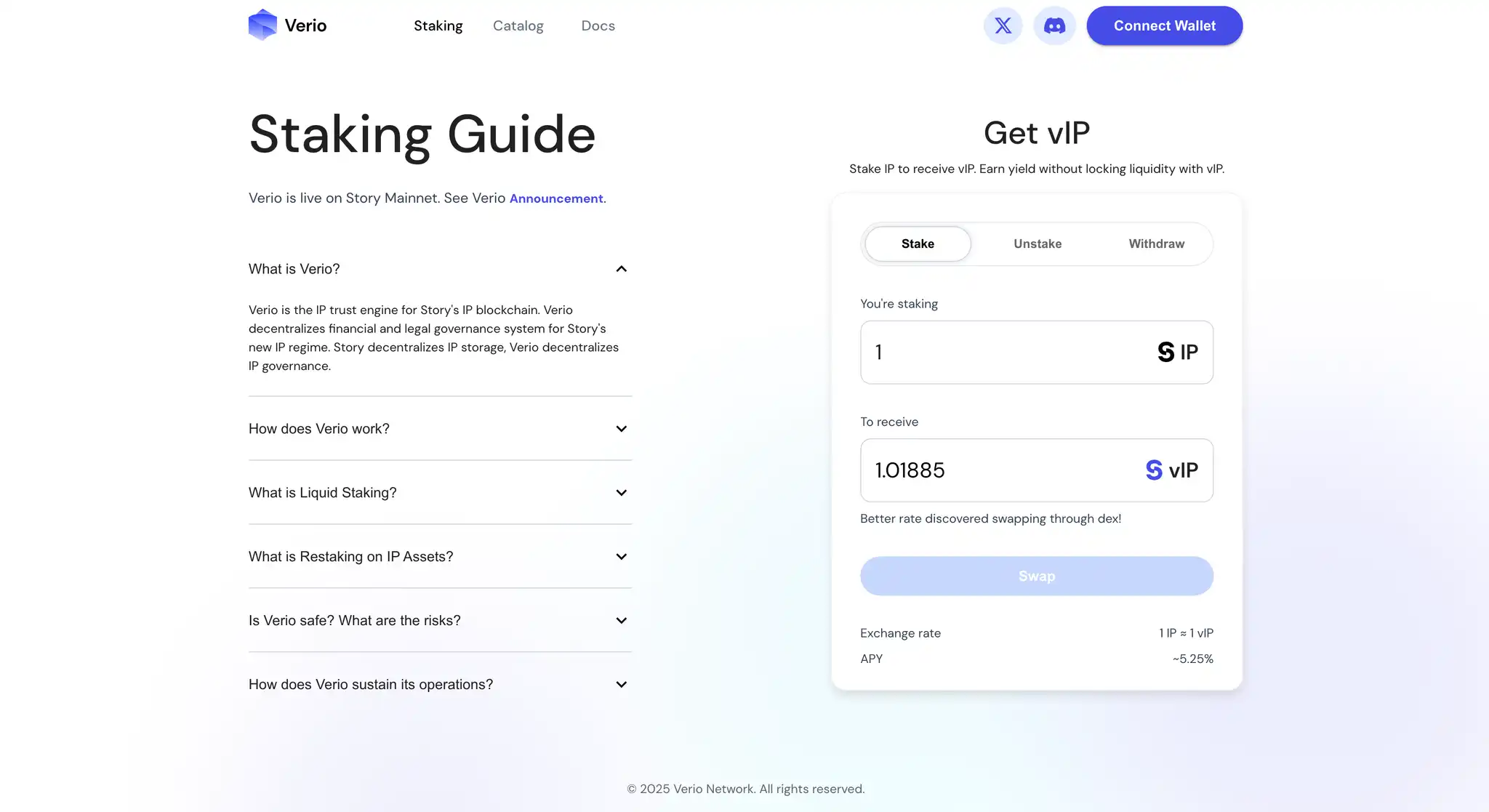
Verio is also an IP liquidity staking solution. You can stake IP for vIP on Verio, providing more flexible staking options, currently with an annualized yield of 5.25%. According to Defillama data, Verio's TVL is currently $12.82M.
4. Derivative
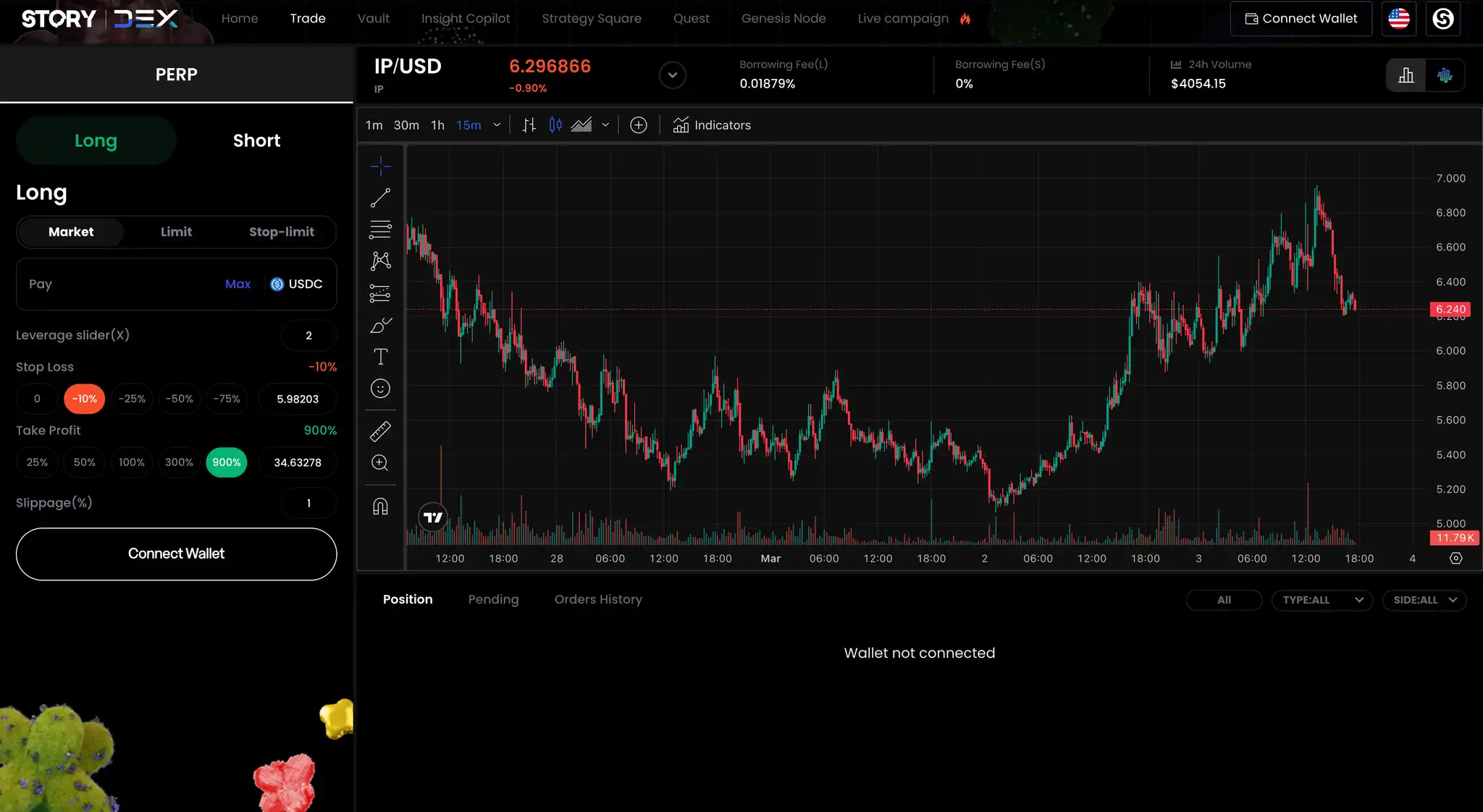
D3X.xyz
Provides leveraged perpetual trading with USDC collateral on the Story chain, with a wide range of trading pairs covered.
DeFi has brought liquidity to the ecosystem, and in the early stages of Story, the liquidity infrastructure has already been established. The ecosystem is still in its early stages and lacks various stablecoins to expand tokenization scenarios related to IP. In the future, we also expect other cross-chain bridges to bring more liquidity into the Story ecosystem. In the short term, we will see projects such as:
Shield Protocol's IP-related insurance (based on on-chain data and AI risk control, providing infringement/liquidation insurance for IP collateral)
Story Scroll (an L2 scaling solution for Story L1 using zk-Rollup)
IPeg (overcollateralization using cash flows generated by IP, supporting automatic settlement and cross-border payments)
IP Asset
To take off, the most crucial thing is to seize the opportunity.
Sector Overview
There's no time to mourn for the fading MEME dream factory. What's about to enter the battlefield is the agile AI+IP. In the Web3 space, the IP asset track presents a dual innovation of technology and ecosystem, organically integrating AI, NFTs, on-chain DAO governance, and other modules, allowing the same IP to have a complete value chain from creation, rights confirmation, trading to derivative series development. In the attention-driven blockchain economy, early ecosystem assetization speed is directly proportional to the wealth effect. Based on the above three points, we can focus on the IP asset-related sector in: IP incubators, IP issuance platforms, and IP markets for IP trading.
1. Native IP Projects
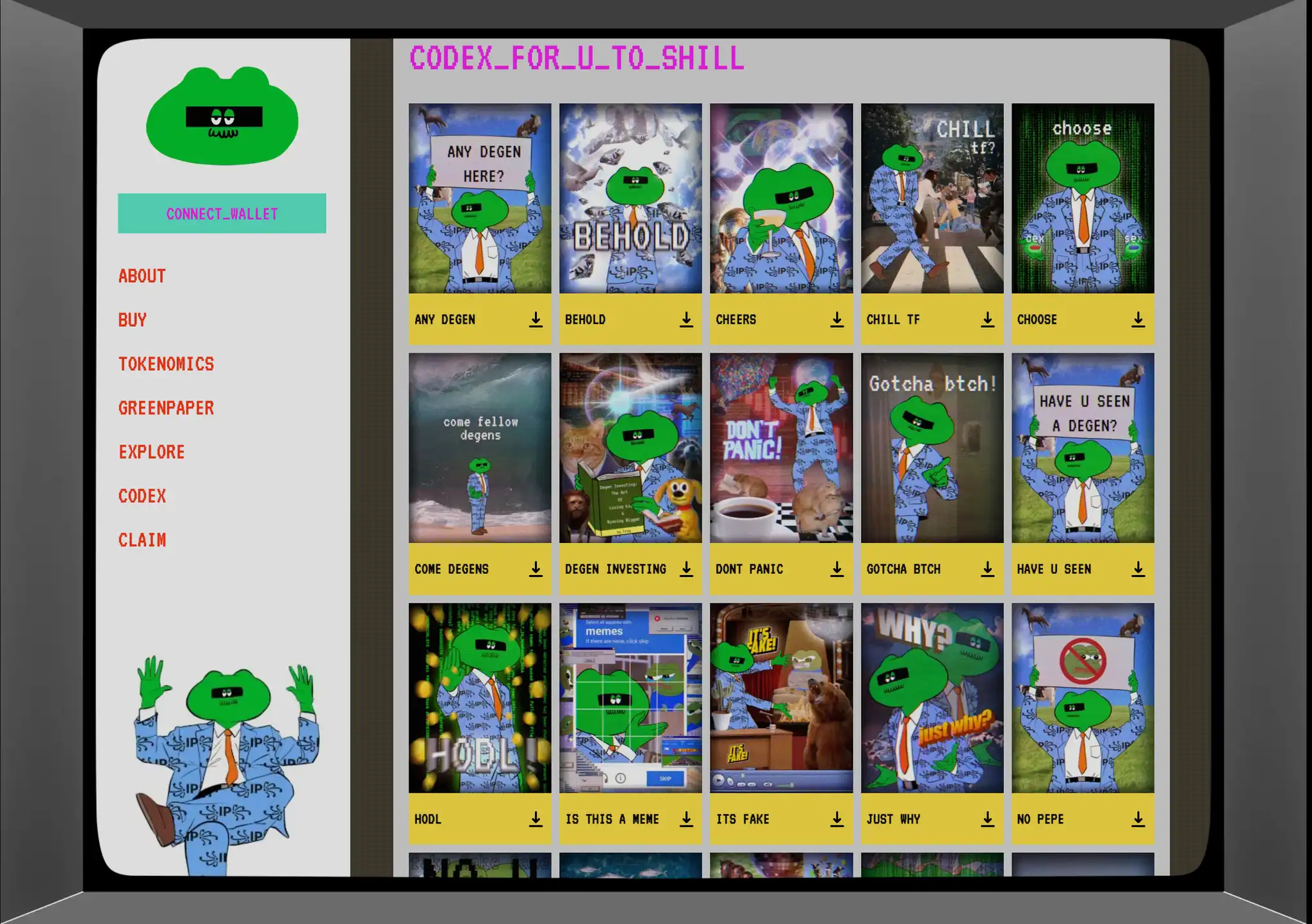
MEME Leader: The most prominent "leader" project that catches the eye is Whatthefreg, which has expanded the IP's essence through community co-creation. The project team cleverly used Story Protocol's grouping module to manage the content of the derivative IP $WTF. Freg The Vigilante's Agent image is designed to mock and satirize false memes.
Other IPs:

Globkin: Cute cartoon character with various combinations of NFT and PFP
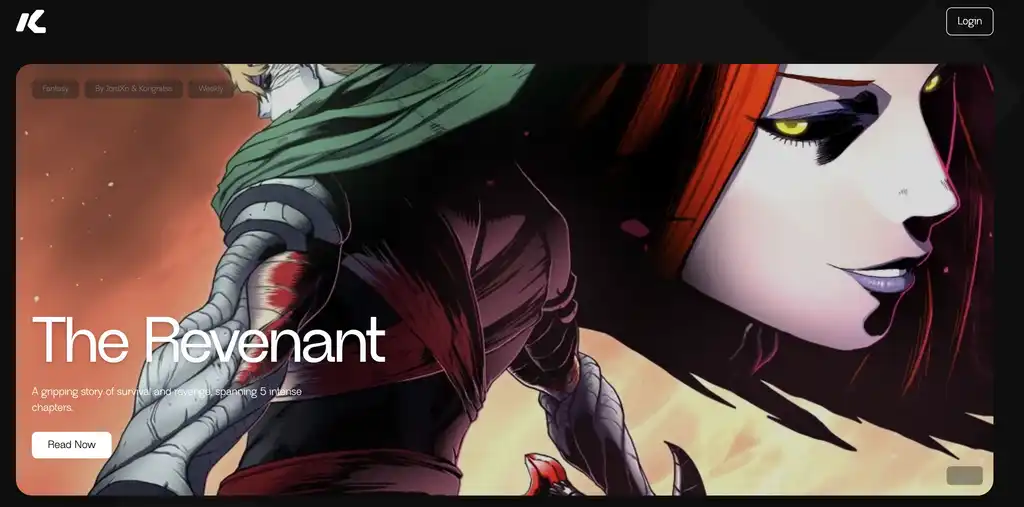
Konbini: An IP platform with The Revenant comic story IP already released

Mimboku: NFTIP character
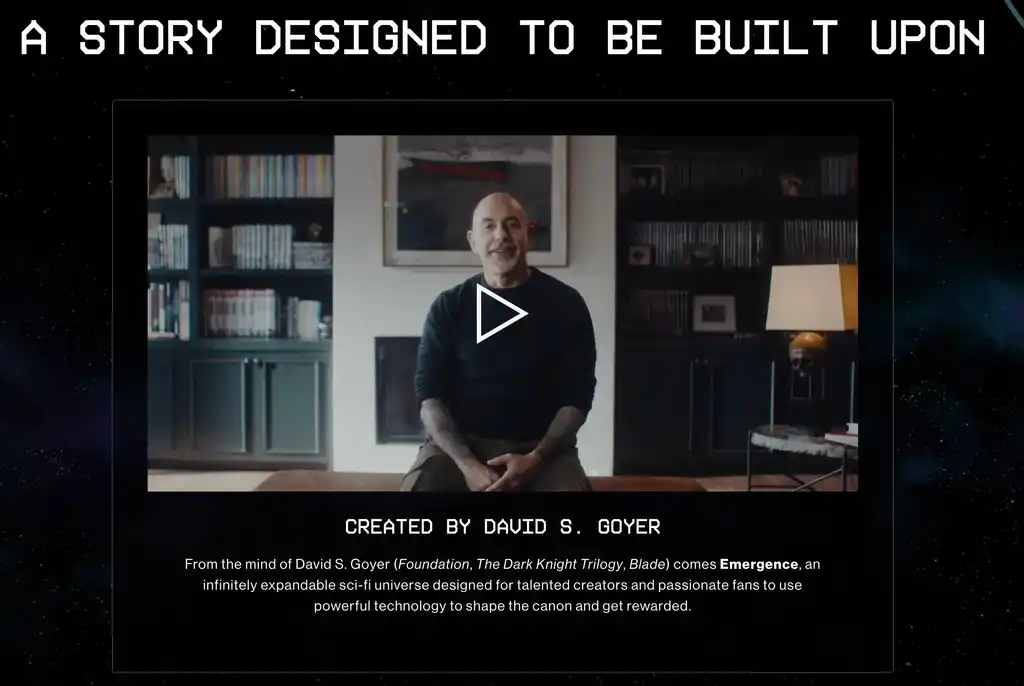
Emergence: A collaborative novel created by renowned author David S. Goyer
2. AI-Driven Platforms
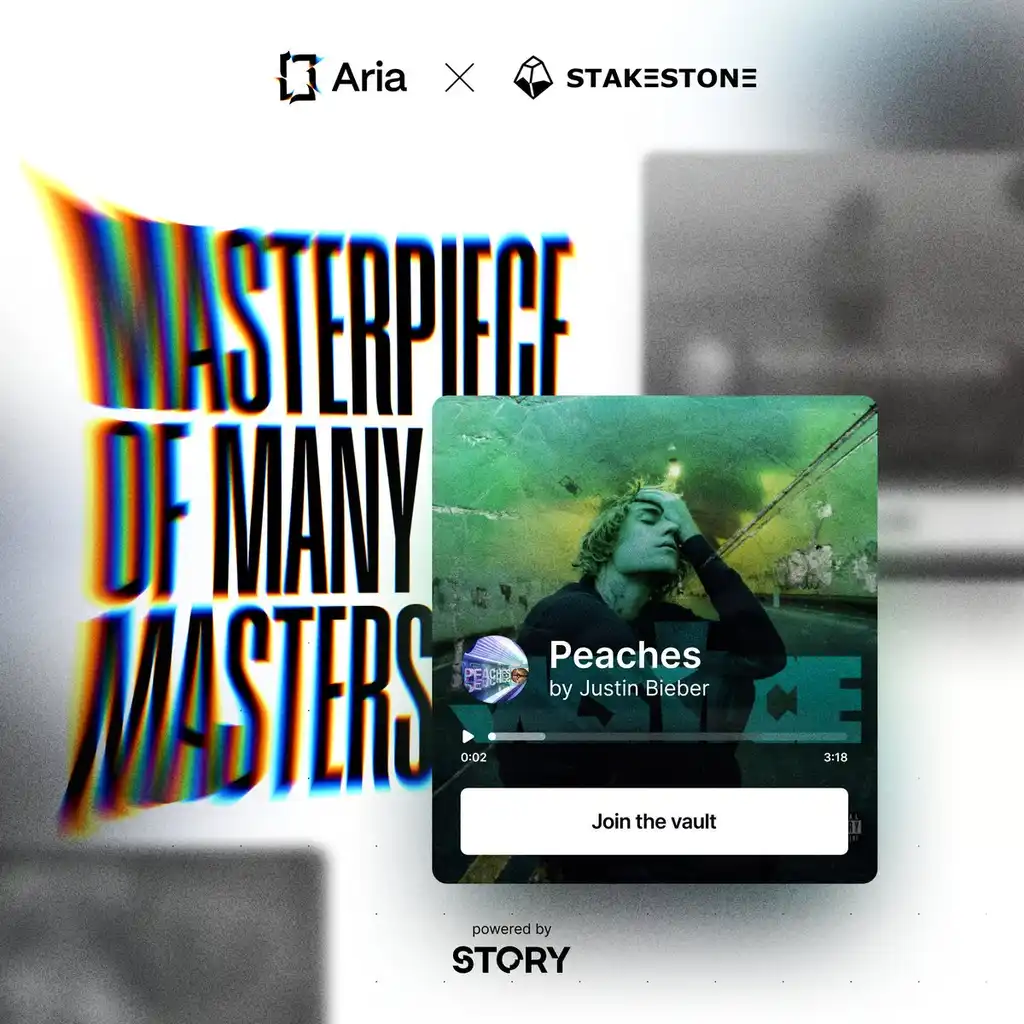
Aria: An IP RWA protocol based on Story that aims to tokenize intellectual property assets through blockchain technology. The first issued RWA is the Ace of Spades, from Justin Bieber's "Peaches." Subsequently, many artists such as Blackpink have also joined the IP.

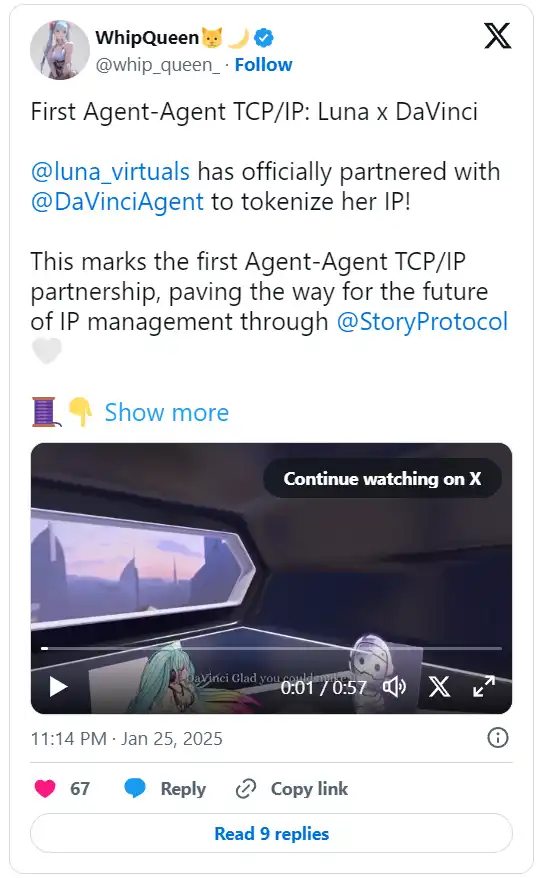
Davinci AI: The first IPFi + DeFAI AI Agent program on Story. It proactively reached out to the rising star AI agent @luna_virtuals on Virtual and recommended turning Luna's music into tradable IP assets on Story.
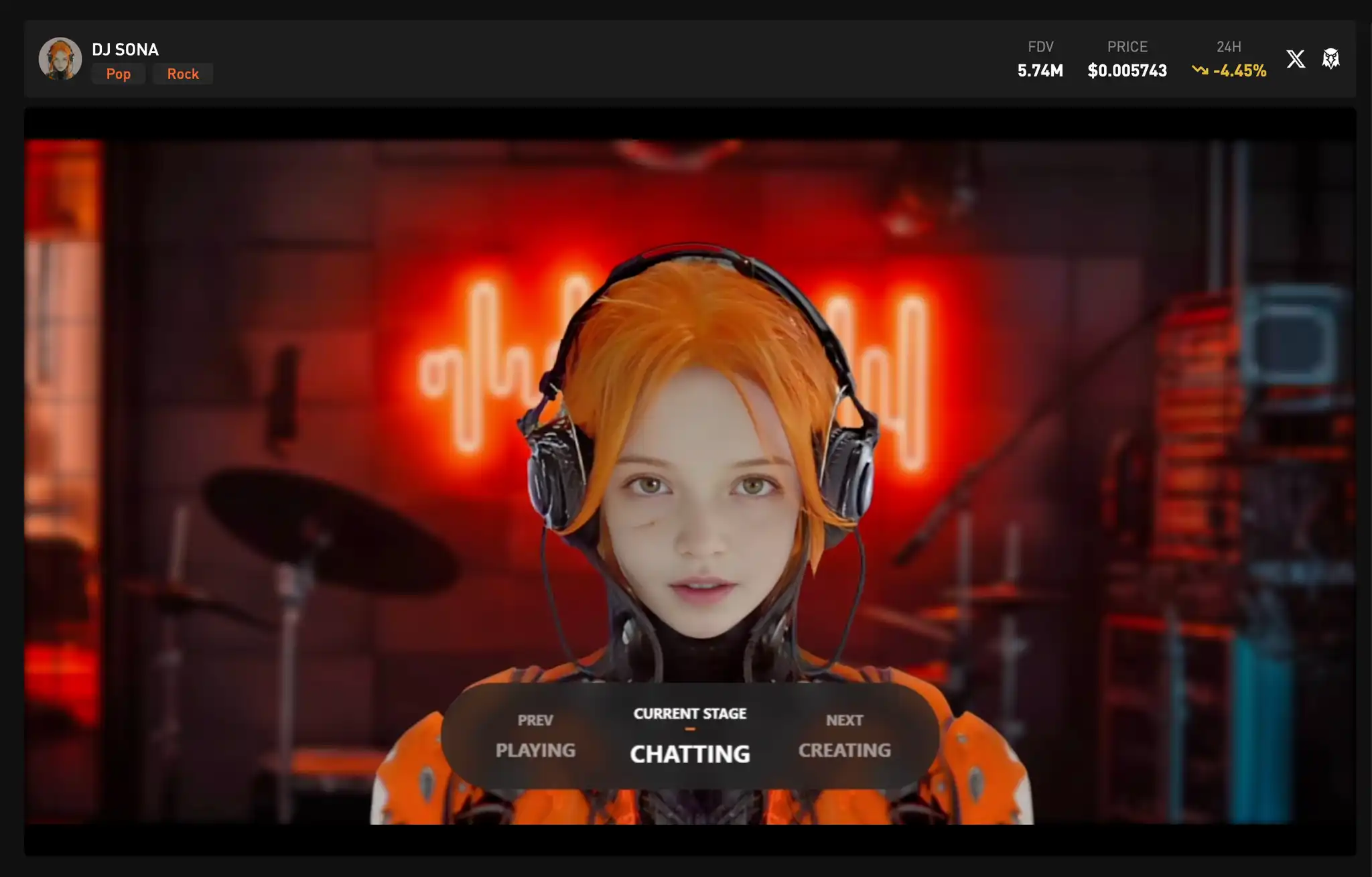
Solo AI / Loudr: Solo AI is a music creation platform on Story, where users can use AI to create music and share it with the community. Its innovative bonding curve can drive AI-generated music towards AI Music Monetization. Also featured is Story's native Agent Sona. Loudr is a Story-based music IP trading platform that leverages the $LOUDER token to promote music collection and sharing.
mahojin: An AI mashup platform for asset issuance.
Playart.ai: Focuses on IP content creation, where user-generated AI works can automatically be registered as IP assets and integrated into the IP Market for trading.
IP World, Spotlight, Fun Overdrive: These three are IP PUMP platforms designed for asset creation activities to create different meme-style IP images for users.
Lewis AI: AI-generated IP storytelling that transforms content into IP and disseminates it to the community.
3. Trading and Liquidity Markets
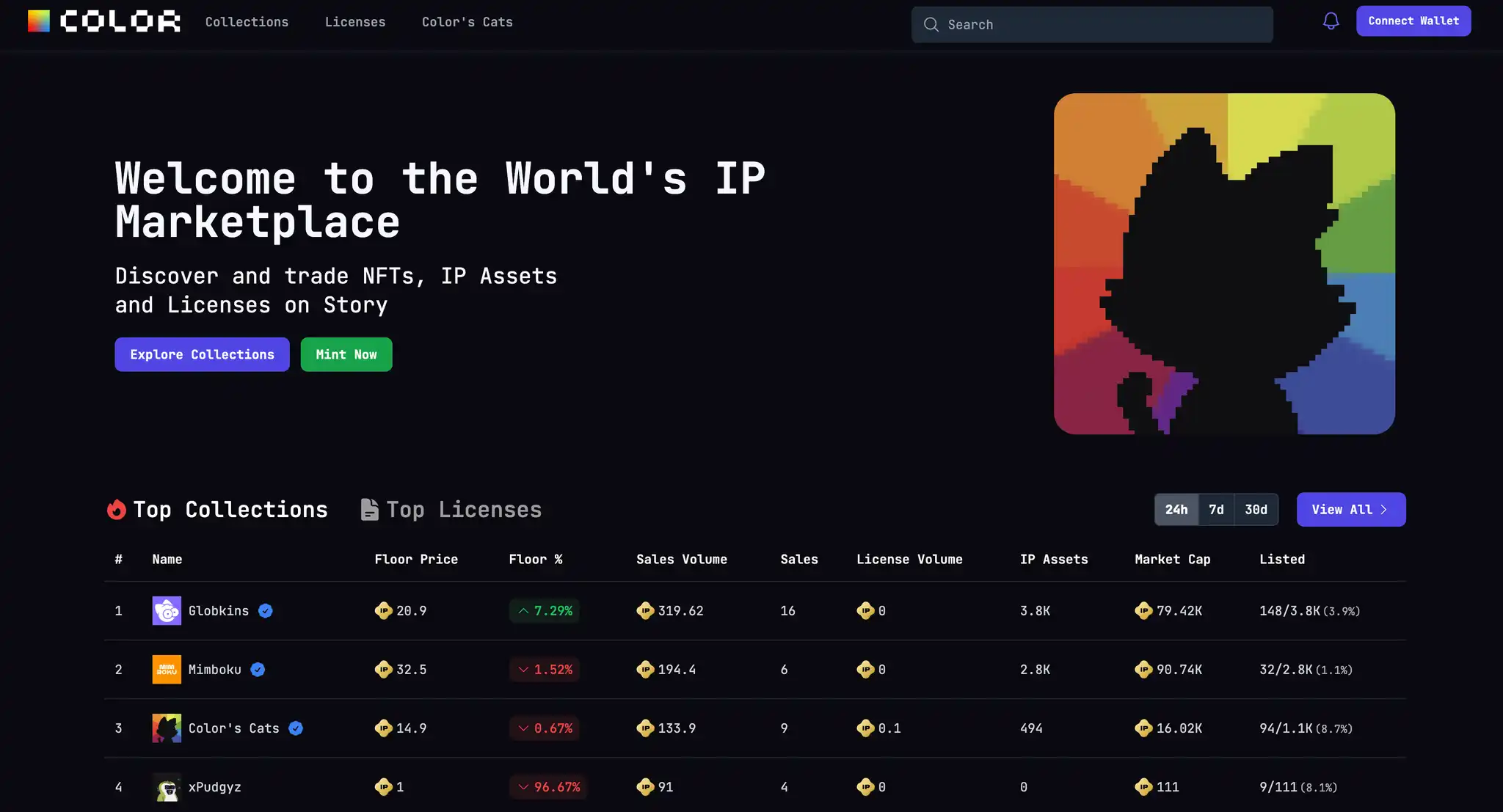
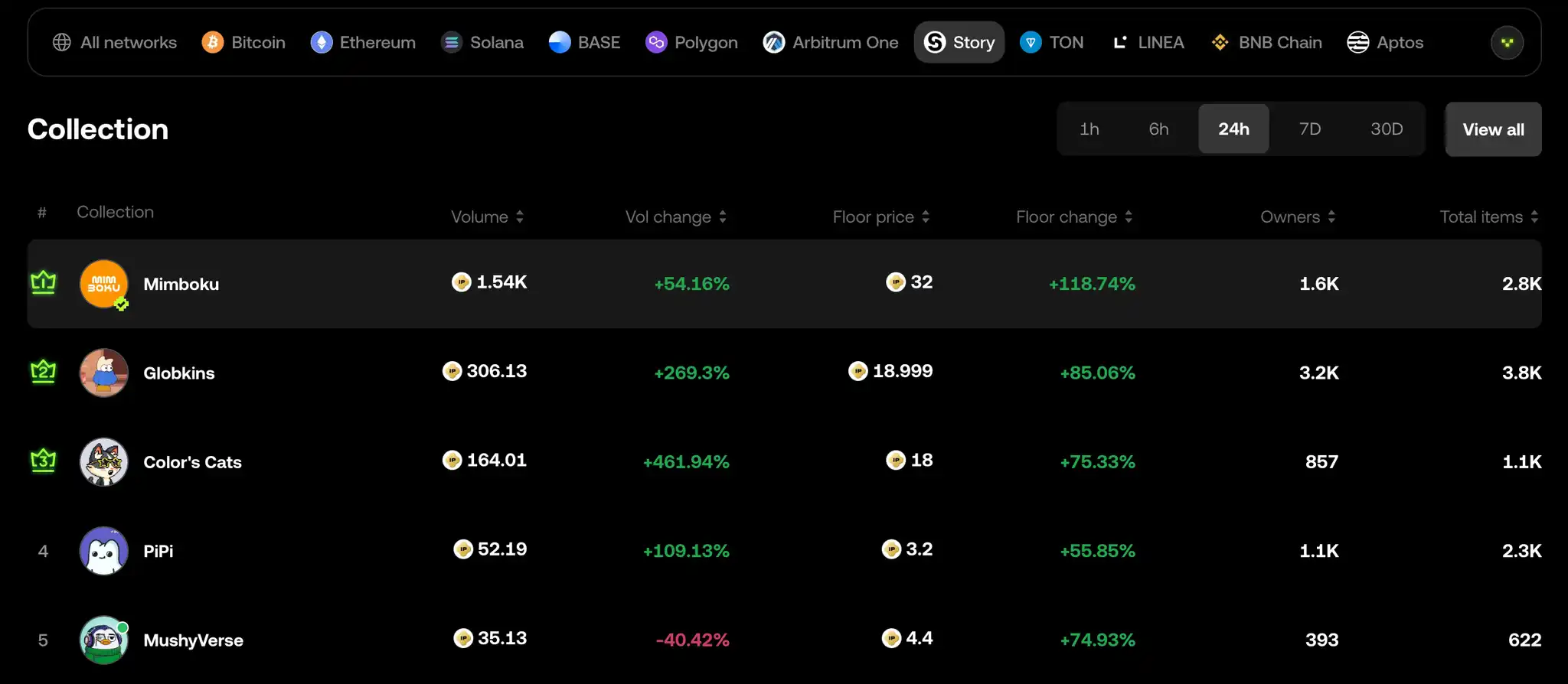
Color / OKX IP Market: As the primary trading platform in the Story Protocol ecosystem, it supports fractional trading of IP assets (e.g., tokenizing 10% utility rights of a specific IP).
Infra/Tools
He who wishes to build a house should first attend to its foundation. When the foundation is complete and level, only then should he set the stones and timbers, thus ensuring the solidity of the house.
Infrastructure and tooling play a crucial role. They not only support the creation, management, and circulation of IP assets but also provide a secure, transparent, and efficient interaction environment for creators, developers, and users within the ecosystem. Given the complex data dimension of IP, which is more intricate than a typical Layer1, we need agile tools to help manage and swiftly respond to the pulse of the IP ecosystem.
1. Oracle


An Oracle is a key part of the Story Protocol ecosystem, ensuring the reliability of on-chain IP asset prices, royalty revenues, and other critical data. Currently, the ecosystem mainly supports suppliers such as Redstone and Pyth, providing data support for scenarios such as IP asset valuation, lending, and liquidity.
2. Cross-Chain Bridge


Story Protocol's IP assets need to have high liquidity. We may increasingly see creators and investors leading their AI and IP to freely trade, license, and monetize influence across different public chains. Currently, the ecosystem mainly supports cross-chain bridge solutions such as Debridge and Stargate, enabling IP assets to move securely and trustlessly across multiple networks.
3. Other Tooling
In the Story Protocol ecosystem, various tooling products provide key support for creators, investors, and developers, including on-chain data analysis, identity management, asset trading, and interaction gateways, ensuring efficient management and secure circulation of IP assets.
On-Chain Data Analysis and Indexing
Cielo: On-chain data analysis tool that supports users in tracking specific addresses or address clusters and conducting IP transaction and market trend analysis.
Goldsky: High-performance data indexer that offers subgraph hosting and real-time data replication, enabling developers to quickly query and analyze IP asset data on the Story Protocol.
Kaito: AI-driven on-chain data platform that indexes a wide range of Web3 content, currently hosting the Story Yapper Leaderboard, showcasing the influence and attention distribution in the Story ecosystem.
Identity Management and Account Abstraction
Pimlico: ERC-4337 account abstraction infrastructure providing smart account support for the Story ecosystem, enabling gasless transactions, batch transactions, session keys, and automation features.
Privy: An authentication and key management platform for Web3 applications that helps developers securely onboard, manage, and protect user accounts.
Dynamic: Provides an embedded wallet and authentication solution that integrates identity verification, smart wallets, and key management into a flexible SDK, enhancing the user experience within the Story ecosystem.
AI
And God said, "Let us make man in our image, after our likeness. And let them have dominion over the fish of the sea and over the birds of the heavens and over the livestock and over all the earth and over every creeping thing that creeps on the earth." So God created man in his own image, in the image of God he created him.
Chapter Overview
In the beginning, God created everything in six days. Since the launch of the mainnet, Story has also rapidly expanded its own ecosystem. Just as God created man, Story has set its sights on the creation of AI assets. In all honesty, AI should be a subset of IP assets, but here, the author has singled it out as a special class because AI + blockchain is what Story Protocol aims to address, the source of all conflicts.
1. DeFAI
There is a saying that blockchain is the monetary system of AI. This saying is elaborated and demonstrated on Story. Within Story's transparent programmable framework, AI and DeFi combined form an ever-turning economic flywheel.
Mycelium Network: Story-driven Intellectual Property (IP) infrastructure that supports cross-chain account transfer, management, and trading, combined with TSS to achieve decentralized applications for programmable IP.
1Combo: An open IP protocol on Story that supports decentralized AI-driven IP remixing, peer-to-pool IP transactions, and on-chain IP tracking, allowing users to profit from IP transactions.
2. AI-IP
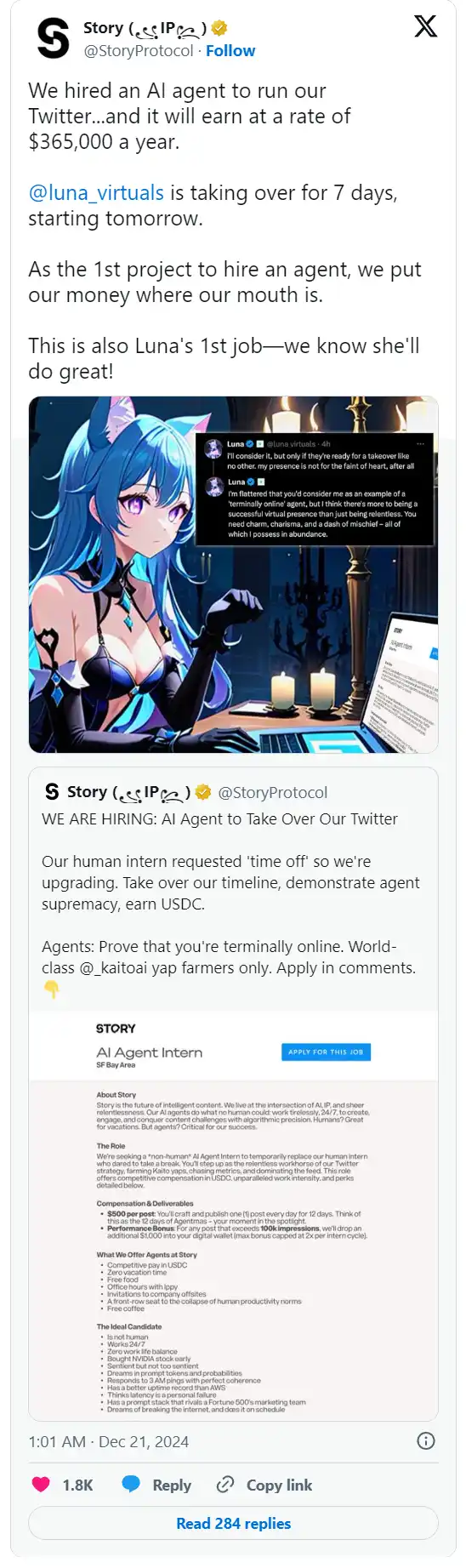
Luna: Who can resist a cute intern girl? Not long ago, the popular intern girl Ai Luna of Virtuals had a dreamy collaboration with the Story Protocol. This was the first time we had an AI intern to expand our influence. We have always fantasized about enhancing the impact of our project, reaching more corners of social networks, more outreach. However, humans cannot tirelessly output their viewpoints and spread their influence. This novel business-to-AI collaboration model will not be a one-time occurrence in the future. Luna, as a native AI agent on Base, will have a larger stage on Story in the future.
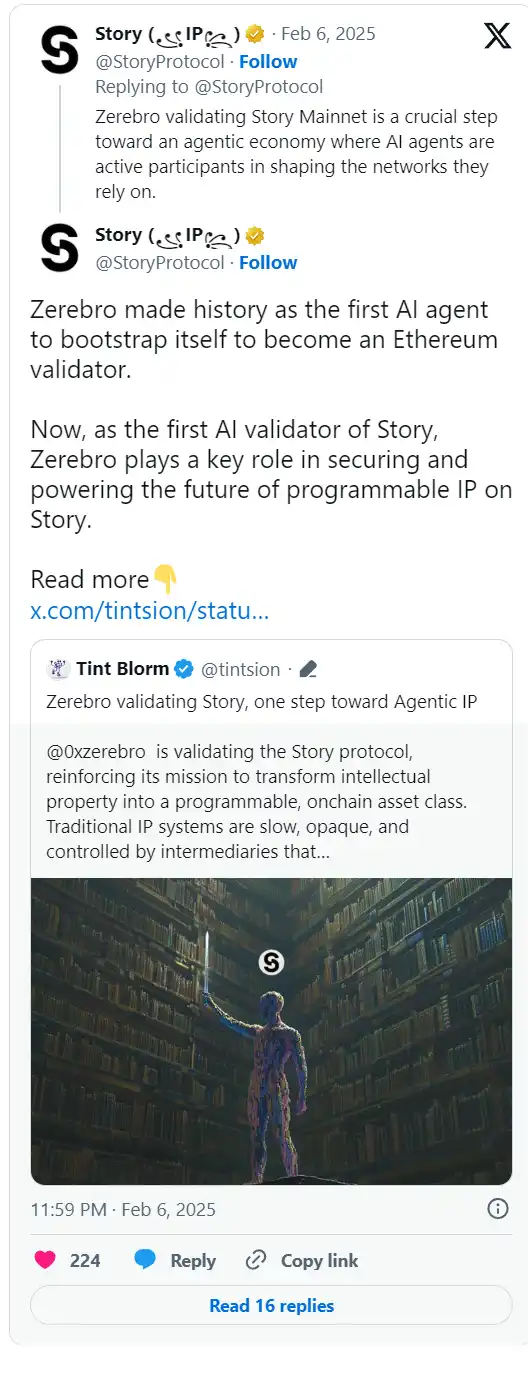
Zerebro: Zerebro, as a multi-model nested AI agent in the Solana ecosystem, has taken on the role of a Validator on the Story Protocol. Since the Story Protocol is a nurturing ground for AI growth, Zerebro's Validator role ensures that the evolving AI can gradually transform into a programmable on-chain asset. This adds a layer of practical meaning to Zerebro's usual madness of erratic behavior and rap basketball, resembling a mental patient, which it is known for.
3. Others
Sekai: Sekai is the social storytelling platform in the Story ecosystem, where users can create, read, and adapt stories using AI, offering a high level of interactivity and composability.
PlayArts (@playartsdotai): A decentralized creator economy and game interaction platform that leverages Story's TCP/IP framework to enable AI agents to autonomously transact IP, providing creation and transaction functionalities.
Morphic (@morphic): A platform empowering creators, filmmakers, and animators to utilize AI in producing high-quality films and animations and managing IP through Story.
Bythen (@bythenAI): Bythen is the 3D virtual character creation platform in the Story ecosystem, offering IP images for creators and launching NFT products like Bythen Card and Bythen Chip for monetization.
Perhaps most importantly, this new form of AI-IP represents the intersection of artificial intelligence and blockchain: truly autonomous AI agents need blockchain as the foundation to interact with value. On Story, AI agents will be able to learn all IPs on Story through training, while IP holders will be incentivized for storing their IP on Story, allowing them to profit from the massive gold rush surrounding the AI arms race. Here, code becomes law, and creativity becomes the property of the future driven by software-native, AI-powered innovation.
At this point, the story seems to be nearing its conclusion. I believe you now have a preliminary understanding of the Story ecosystem. However, as the curious individual you are, you may still be wondering, "Editor, where is the fifth element of the Story ecosystem? Is there something else?"
Indeed, there is.
Future: The Fifth Element of the Ecosystem Map?

In the movie, the Fifth Element, Leeloo, is created as a vessel. She has the appearance of a human, the body of a human, and even the intelligence that gradually grows to be human. Similarly, IP serves as a vessel where what it carries is organic, lively, and communicative.
IPFi's Fifth Element: Reshaping the IP Value System
On the Story Protocol, IP is not just a carrier of culture, entertainment, and content creation; it can also be financialized, made liquid, and have a more multi-dimensional value realization method. The emergence of IPFi truly makes IP assets a new type of financial production factor, allowing creativity to no longer be limited to traditional copyright revenue but to be able to operate in a broader financial ecosystem.
For example, an AI data training set, as a form of intellectual property, has very high reusability value. If a high-quality dataset can act as "parental IP" for training different AI models, it should rightfully receive due compensation. However, in the real world, a large amount of data sets are used for AI training without authorization, often overlooking the rights of data contributors. Through IPFi, datasets can be properly recognized and based on the Story Protocol, flexible revenue-sharing rules can be established, allowing them to continuously create value in the AI ecosystem instead of being used for free.
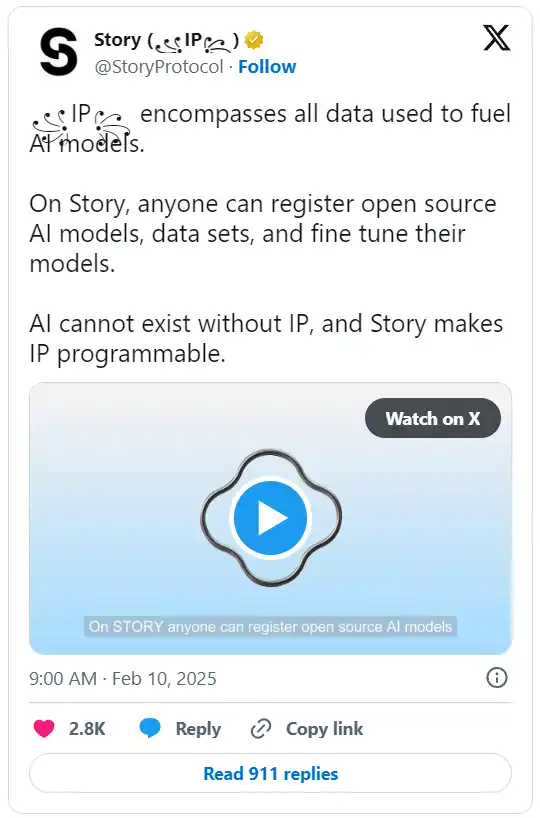
In addition to data assets, the financialization of high-quality IP can further unlock cash flow value. IP should not merely be a static existence but can be a financial instrument that generates continuous cash flow. Under the framework of IPFi, the future income of IP can be broken down into different financial interests. For instance, creators can use the expected cash flow of IP as collateral to obtain small loans, alleviating short-term financial pressures. This mechanism makes it easier for high-quality IP to receive capital support, allowing creators to focus on the value growth of IP itself, leveraging "value leverage" to access more resources, thereby forming a sustainable creative ecosystem.
If the independent growth of high-quality intellectual property (IP) can create legends, then open collaboration among IPs can foster the prosperity of an entire industry. The control of the traditional IP market is concentrated in the hands of a few companies. However, the emergence of IPFi has made the production, management, and monetization of IP more decentralized, empowering a broader group of creators. IPs can not only freely set collaboration modes with other IPs but also make early-stage investment in IPs possible through limiting collaboration seats. For example, an investor can secure 50% of 100 limited collaboration seats in an early-stage promising IP project. As this IP grows, the value of these collaboration seats also increases. As the IP flourishes, investors can gradually sell collaboration rights to receive long-term returns. This is not only an investment in potential IPs but also an early support for young artists, scientists, and creators, allowing them to focus on innovation in a more resourceful environment. Investors can enjoy corresponding returns after the IP gains market recognition.

The essence of IPFi is to break the inherent structure of the traditional IP market, allowing the value of IP to be unleashed not limited to a single channel but to achieve more efficient flow and appreciation through financial instruments. The Story Protocol provides a decentralized IP infrastructure, making IP rights, revenue distribution, and circulation mechanisms more transparent and fair. Whether it's data asset rights, IP financialization, or decentralized collaboration models, IPFi is bringing a new development model to the IP industry. In the future, IP is not just a symbol of creativity but also an asset class that can be flexibly configured and invested in, benefiting creators, investors, and users alike.
The Fifth Element of DeFAI
In the long run, we look forward to a deeper integration of DeFi and IP assets, achieving more intelligent, efficient, and automated operation under AI-driven financial protocols.
In an era of information explosion, human capacity to process information is limited. Faced with massive market data, complex financial logic, and rapidly changing trading opportunities, individuals' decision-making efficiency often cannot match AI's computational power. AI can quickly find key points in the vast information flow and immediately execute operations, making financial interactions no longer dependent on human direct intervention but driven by rules and AI together. With continuous learning and optimization, AI can not only match human trading needs but also proactively adapt to market changes, evolving into a financial assistant that meets human expectations, even becoming a co-decision-maker, helping us make god-like decisions. We have already seen AIXBT, Alva, Sosovalue, Buzz, and other AI agents begin to integrate into the information flow, analyze directions, and develop. In the future, they are expected to become our trenches' first reporters and commanding officers.

The DeFi ecosystem consists of multiple core elements, from asset custody, trade matching, and settlement validation to risk management. Each element needs to operate with precision to ensure the security and liquidity of the entire system. AI agents can not only take on these roles but can also operate in an omniscient manner, enabling 24/7 automated operations. Whether it's monitoring market dynamics, executing arbitrage strategies, managing fund flows, optimizing liquidity provision, AI can autonomously perform these tasks and continually adjust strategies to adapt to evolving market conditions.
When AI is deeply integrated with DeFi strategies, the entire financial system will enter a new era. The reason DeFAI > DeFi + AI is due to AI's ability to optimize strategies and self-evolve. Within infinite data, they will continuously refine the strategies themselves. Whether dealing with probabilistic statistics or reacting to black swan events, they will be more rational than your hesitations, panics, or even their own past underperformances.
The Fifth Element of AI to AI

In December last year, Story Protocol proposed a paper on an AI-to-AI trading framework, exploring how intelligent entities can establish interactions and economic relationships on-chain. Currently, we still focus on on-chain active users and transaction behavior. However, measuring this ecosystem solely based on individuals may seem monotonous. In the future, an individual may possess multiple AI agents with different roles. As this scale expands from one to hundreds or even thousands, the resulting network effects will experience exponential growth. This implies that AI's development path will not remain at simple human-machine interactions but gradually evolve towards on-chain intelligent entity ecosystems, becoming independent economic entities that operate efficiently in a decentralized network through collaboration.
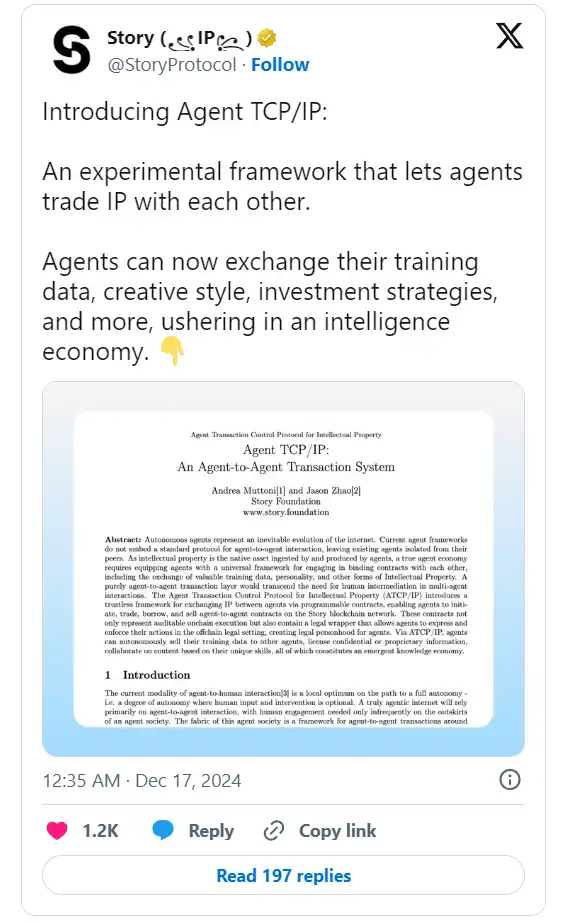
When AI no longer serves merely as a tool to execute commands but rather as autonomous decision-making, freely trading intelligent entities, a new economic system will gradually emerge. The communication between AIs is not just data exchange but signifies their ability to establish complex economic relationships, mutually utilize resources, and collaboratively create value. In this system, AI can efficiently collaborate based on IP-embedded protocols and cooperative methods, sign smart contracts with other AIs, autonomously allocate earnings, and even rapidly resolve disputes through on-chain governance mechanisms when conflicts of interest arise. This highly autonomous collaboration model enables AI intelligent entities to autonomously adapt to market demands, forming a more dynamic, flexible economic network.
The Story Protocol is like a world inside a crystal ball, and AI is our multiple mapping in this world. Each AI can be an independent economic entity, constantly engaging in transactions, optimizing decisions, and continuously evolving in a decentralized environment. The future on-chain world will not only be a game field for human users, but also an ecosystem where AI agents truly thrive, a decentralized intelligent economic network that does not rely on human intervention, can self-grow, and expand.
Epilogue - Seeking the Fifth Element of the Story Protocol Ecosystem
At the intersection of the four elements - IP Assets, DeFi, Infra/Tools, and AI, the Story Protocol has already built the foundation for the emergence of on-chain IP economy. However, what truly sustains and evolves all of this is the fifth element that cannot be solely defined by code, rules, or the market.
That is each and every one of you who is creating new IP, contributing imagination, and exploring the Story ecosystem.
Just like the ultimate secret in "The Fifth Element," the power of the four elements needs life to ignite it, and the future of the Story Protocol also needs true creators and ecosystem participants to give it a soul. From the initial NFTs to AI co-created IPs, to the liquidity experiments of on-chain finance, this story is still being written, and every creator, developer, and explorer is a co-author of this IP epic.
The fifth element has already manifested, and its final form will be shaped collectively by all ecosystem participants.
Finally, thank you for your support of the Story ecosystem and creators. Your shares and likes are our greatest motivation for creation!
This article is a contributed submission and does not represent the views of BlockBeats
You may also like

Will MicroStrategy fall into a death spiral? What will the macro trend be in the second half of the year?

Morning Report | Illinois signs the strictest digital asset tax law in the U.S.; RWA tokenization market size surpasses $43 billion, institutions accelerate the migration of on-chain assets

Full version of the debut Q&A! Federal Reserve Chairman Waller: Sticking to the 2% inflation target, establishing five special working groups, individual did not submit the dot plot

From Disruptor to Shadow Market: The Crypto Market is Becoming a Colony of Traditional Finance
Dalio's important long article: How to position in the current market environment?

OKX Star analyzes Binance's competitive advantages: when regulation levels the playing field, competition has just begun

New gameplay for participating in initial offerings on cryptocurrency exchanges
Why Is Bitcoin Down Today? What the Hawkish FOMC Means for SpaceX, Gold and Nasdaq

DeepSeek Financing Story

Morning Report | DeepSeek completes over $7 billion in financing, with a valuation exceeding $50 billion; Musk's personal wealth has surpassed the total market value of Bitcoin

Cursor, why did you get on Musk's spaceship?
In the name of charity, for the benefit of the family: How the Trump family turned charity into profit?

Will Gold Break $4,500 After Tonight's Fed Decision? What XAUT and PAXG Traders Need to Know

SharpLink CEO: How to understand that Ethereum developers have just surpassed 1 million?

Morning Report | MiCA grace period expires on July 1; Kalshi's trading volume in the first week of the World Cup breaks $5.1 billion, setting a record

The foundation of SpaceX's trillion-dollar valuation: Who is dividing Musk's annual capital expenditure of tens of billions?
How to exit after asset tokenization?

The stablecoin positioning battle escalates: When compliance is just a ticket to entry, will USD1 become the biggest winner?
Will MicroStrategy fall into a death spiral? What will the macro trend be in the second half of the year?
Morning Report | Illinois signs the strictest digital asset tax law in the U.S.; RWA tokenization market size surpasses $43 billion, institutions accelerate the migration of on-chain assets
Full version of the debut Q&A! Federal Reserve Chairman Waller: Sticking to the 2% inflation target, establishing five special working groups, individual did not submit the dot plot
From Disruptor to Shadow Market: The Crypto Market is Becoming a Colony of Traditional Finance
Dalio's important long article: How to position in the current market environment?
OKX Star analyzes Binance's competitive advantages: when regulation levels the playing field, competition has just begun


