Sonic DeFi Ecosystem Explosion: USDC Whale Entry, TVL Surges Against the Trend by 83%, How Much Further Can Token S Rise?

By: blockbeats|2025/03/21 18:15:02
0
Share
copy
Original Title: "Sonic DeFi Ecosystem Explosion: USDC Whale Entry, TVL Soars Against the Trend by 83%, Can Token S Surge Again?"
Original Author: Lawrence, Mars Finance

Sonic DeFi Ecosystem Explosion: USDC Whale Entry, TVL Surges Against the Trend by 83%, How Much Further Can Token S Rise?

Over the past tumultuous month in the crypto market, almost all mainstream chains' TVL has experienced a decline.

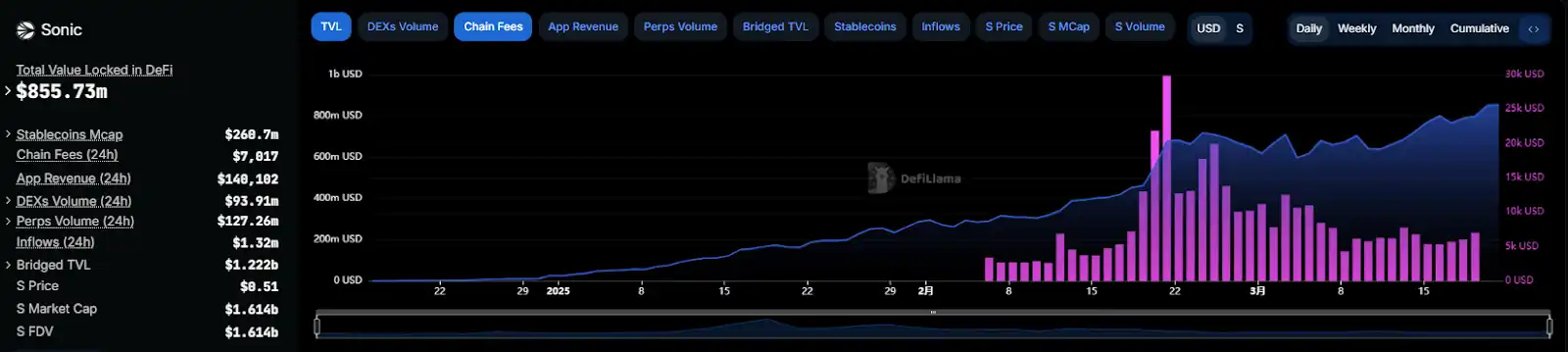
However, in this gloom, the Sonic Network has become a bright scenery, becoming the fastest-growing Layer1 public chain in terms of TVL due to its breakthrough growth. With Circle announcing the official deployment of native USDC and the cross-chain protocol CCTP V2 on Sonic, the network's TVL (Total Value Locked) has surpassed $854 million, with an astonishing increase of 83%. This leap, driven by technological innovation and capital support, is redefining the competitive landscape of Layer1 public chains.

Strategic Partnership: Circle's "Trust Vote" and On-Chain Prosperity

Native USDC and CCTP V2 cross-chain protocol are about to land on Sonic. This means:

· $10 Billion-Level Liquidity Injection: As the first high-performance chain to directly support native USDC, Sonic can accommodate Circle's ecosystem of over $28 billion in stablecoin reserves;

· Cross-Chain Efficiency Revolution: CCTP V2 will compress cross-chain asset transfer time from an average of 15 minutes to within 2 minutes, reducing Gas costs by 76%;

· Compliance Upgrade: USDC's institutional-grade audit and compliance framework pave the way for Sonic to expand into RWA, payment, and other scenarios.
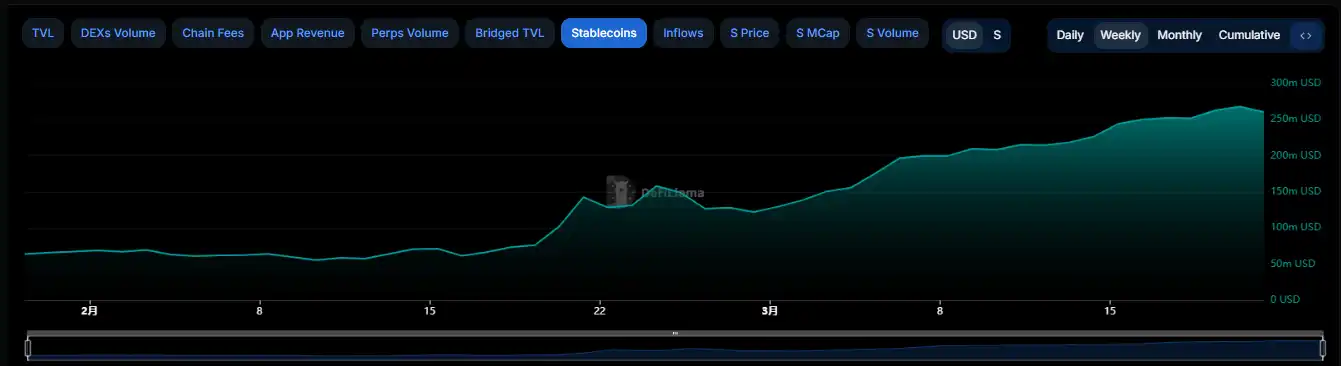
Over the past month, Sonic's on-chain stablecoin reserves have grown from $100 million to $260 million, a surge of over 160%, with competitors such as DAI and FRAX seeing a 22 percentage point decrease, demonstrating strong whale recognition of the infrastructure upgrade.

TVL Soaring Against the Trend: The "Three Musketeers" Behind the 83% Growth
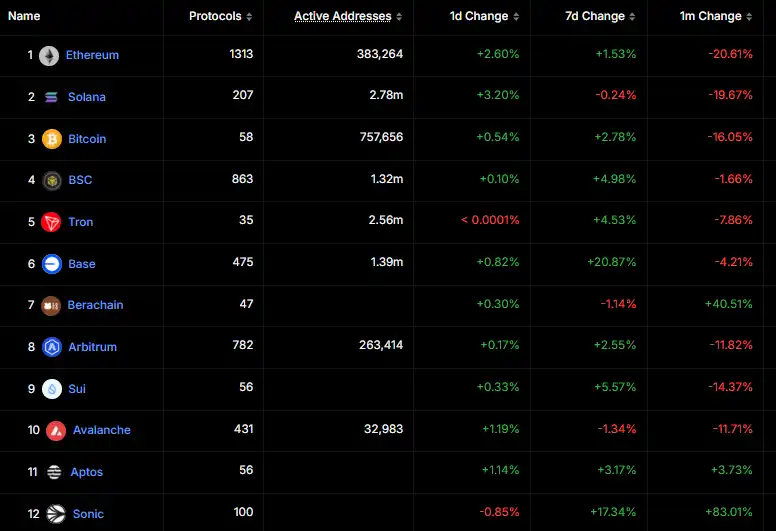
Over the past month and a half, while most public chains have been trapped in a TVL stagnation, Sonic has been absorbing funds at a daily average rate of $13 million. At the time of writing, Sonic's chain TVL has exceeded $850 million, ranking 12th on the Layer1 leaderboard. Its growth over the past month has exceeded 83%, leading all public chains.

Its growth momentum comes from three core protocols:

1. Silo Finance (Lending, TVL $1.94 Billion)

Adopting an isolated risk pool design, it supports overcollateralization of non-standard assets such as BTC and ETH. Its innovative "Dynamic Interest Rate Curve" ensures that the borrowing APY is always below the 30% liquidation threshold, with a default rate of only 0.17%, making it the top choice for institutional arbitrage.

2. Beets (Liquidity Staking, TVL $1.87 Billion)

It converts staked tokens S into interest-bearing assets stS, achieving a 23% annualized yield through an auto-compounding strategy. Users can further stake $stS in Aave V3, creating a "yield farming" model with an actual APY exceeding 35%.

3. Aave V3 (Lending, TVL $1.8 Billion)

On March 3, Aave deployed a lending market on Sonic, a high-performance blockchain evolved from Fantom. This marked Aave's first Layer 1 extension this year, signaling another step in its cross-chain expansion efforts. On the first day of launch, the supply limit was triggered. The Sonic Foundation and Aave DAO jointly provided $15.8 million in liquidity incentives, driving the USDC deposit APY to briefly surge to 19%, with a daily liquidation volume as low as $370,000, demonstrating better risk control than most competitors.
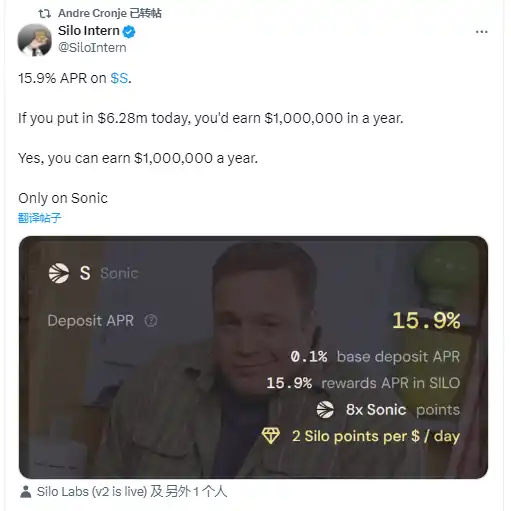
Sonic co-founder Andre Cronje (AC) also retweeted, stating that the current APY for the Sonic token S is 15.9%. If you invest $6.28 million today, you will earn $1 million in a year. This return far exceeds that of other Layer 1 token staking.
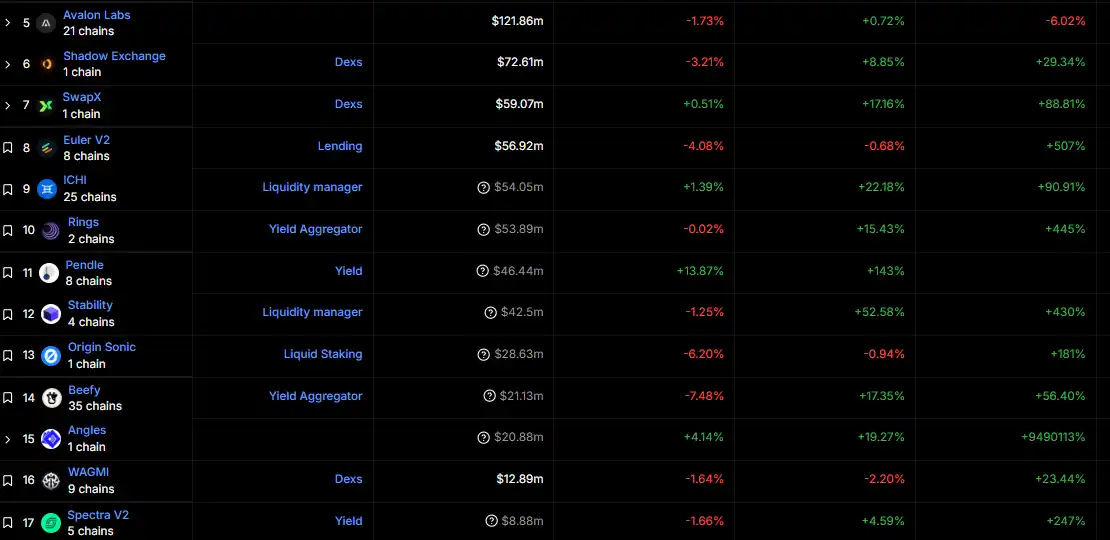
Furthermore, in just over a month, several DeFi protocol rookies have emerged on Sonic, with impressive data. Readers can also choose a project that suits them based on APY, risk, and other factors, achieving a decent stable return in the current turbulent crypto market.

Technological Breakthrough: Algorithmic Stablecoin Breakthrough and AC's "PTSD Paradox"
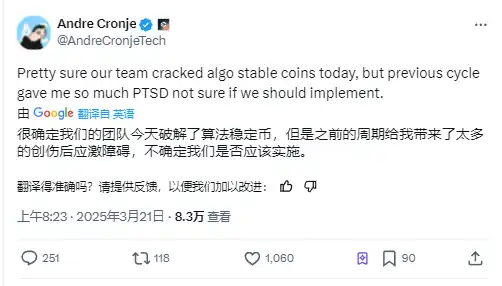
​"We have cracked the algorithmic stablecoin puzzle, but past traumas make me hesitant."​ Sonic co-founder Andre Cronje (AC) threw out a shocking statement in a tweet on March 21. His team claimed to have solved the fatal flaws of predecessor projects like UST through a dynamic collateralization rate adjustment algorithm and a multi-level liquidation protection mechanism. Despite the significant technological breakthrough, AC still admits that the PTSD from the LUNA crash has not yet faded.
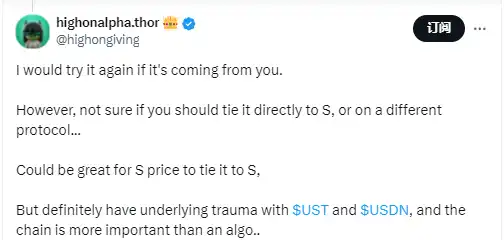
In response, DeFi researcher highonalpha said: "Not sure if it should be directly pegged to S, or pegged to a different protocol... Price pegging to S might be a good idea, but $UST and $USDN definitely have underlying trauma, and the blockchain is more important than the algorithm itself."

Others have also proposed the following solutions:

​· Anti-Death Spiral Design: When the stablecoin uncouples, the system prioritizes burning governance tokens instead of minting more, avoiding liquidity dilution;

· Third-Order Interest Rate Model: Dynamically adjust borrowing rates based on collateralization rate, allowing APY to fluctuate elastically in the -5% to +25% range, suppressing speculative selling;

· Cross-Chain Breaker Mechanism: If the price deviates from $1 for more than 48 hours, trigger automatic cross-chain asset redemption to prevent systemic risk contagion.

The Sonic co-founder's contradictory mindset reflects the deep-seated dilemma of the algorithmic stablecoin race—algorithmic stablecoins do not have a perfect solution—and the $400 billion-level wealth evaporation caused by historical collapses like UST has made restoring market confidence far more challenging than achieving technological breakthroughs.

Capital Entry: Top Institutions' "Value Vote" and Valuation Game

In May 2024, Sonic completed a $10 million strategic funding round led by Hashed, with participation from SoftBank, Aave DAO, Bitkraft, and other institutions. This funding was precisely allocated to three major areas:

· Developer Incentive Pool: 30% allocated to DApp gas fee sharing subsidies, driving the number of ecosystem protocols from 62 to 312;

· Compliance Infrastructure: 40% invested in the Sonic Pay payment system, obtaining EU EMI licensing and Singapore MPI approval;

· Cross-Chain Security: 30% is allocated to the development of the Sonic Gateway's Fail-Safe mechanism, increasing the number of validating nodes from 7 to 21.

The current circulating market cap of $S is $1.6 billion, with a Market Cap/TVL ratio of only 1.9, putting it at a value proposition discount compared to mainstream Layer1 solutions. For comparison:
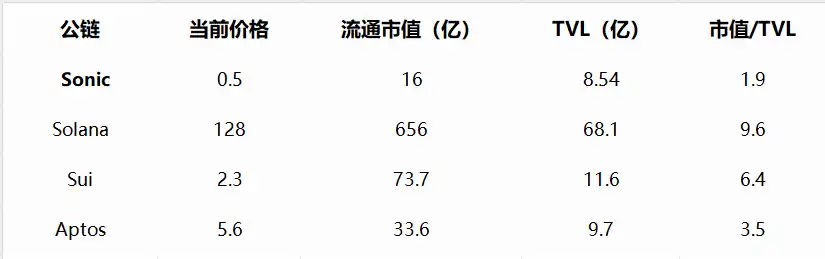
Looking at key metrics, Sonic has established a dual advantage in performance efficiency (TPS/Gas fees) and valuation rationality (Market Cap/TVL ratio):

· Capital Efficiency 306% Higher Than Solana: The market cap per $1 TVL is only 32.7% of Solana's;

· Healthier Staking Economy: A 62% staking rate higher than Sui and Aptos, with an annualized deflation rate of 1.8% forming the value support;

· Institutional Holdings Concentration: The top 10 addresses hold 39% of the circulating tokens, 17 percentage points higher than SUI, signaling strong market control.

​"The value of $S is still significantly undervalued." Crypto fund UOB Ventures analyst Lucas Wong pointed out that if Sonic's TVL surpasses $2 billion within the year (150% annual growth rate), calculated at the industry average Market Cap/TVL ratio of 4, the token price could potentially hit $1, representing a 100% upside from the current $0.5.
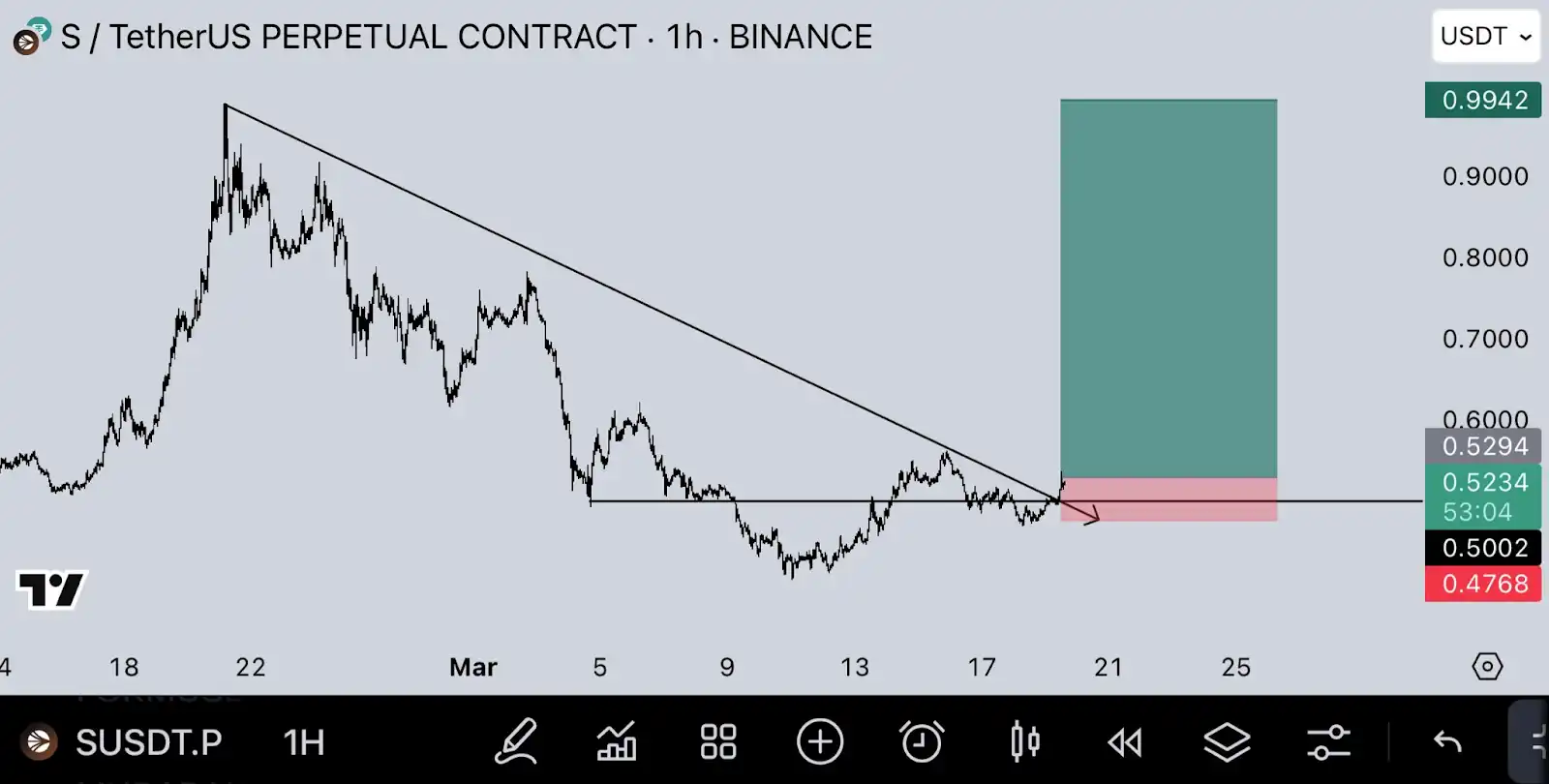
Senior trader NihilusBTC stated that $S is breaking out of a descending wedge and once reversed, it could reach a price of $0.99.

Eve of Ecosystem Breakout: Where Is the Next Wealth Code?

On February 28, Pendle has officially launched on the Sonic Network, introducing the first set of liquidity pools in collaboration with Rings: stkscUSD (May 29, 2025) stkscETH (May 29, 2025). The Rings Protocol is an interest-earning stablecoin protocol where users can mint scUSD/scETH using various stablecoins or ETH assets. scUSD and scETH can be staked in the Veda Vault (becoming stkscUSD and stkscETH) and earn yield through blue-chip DeFi protocols like Aave.

On March 19, the EVM transaction aggregator Enso announced in a post that the Sonic Network is now officially live. Enso Shortcuts is currently supporting the Royco market to earn Sonic rewards. Sonic has kicked off its Sonic Points Season 1, allocating a portion of its approximately 200 million S token airdrop to its ecosystem. Royco makes earning and comparing rewards easy, while Enso works behind the scenes on protocol integrations and deposit operations.

With top protocols like Pendle and Enso joining in, Sonic's DeFi LEGO has revealed a unique opportunity:

1. Yield Tokenization (Pendle × Rings)

By splitting the principal and yield of scUSD/scETH, users can lock in a 40%+ fixed APY or leverage bet on interest rate fluctuations. The first pool attracted $43 million in deposits within 24 hours of launch.

2. On-Chain Payments (Sonic Pay)

Supporting Apple/Google Pay for direct USDC spending, with only a 0.3% fee, 92% lower than Visa's cross-border rates. The average daily transaction volume from beta users surpassed 12,000.

3. Meme Craze (THC, GOGLZ)

Community tokens saw over a 200% weekly surge, with DEX trading volume share spiking to 37%, replicating the early wealth effect of the Solana ecosystem.

Investment Conclusion: The Undervalued Layer1 Alpha Opportunity

From a fundamental standpoint, Sonic has built a sustainable DeFi growth flywheel through a triple innovation of technical performance, economic model, and ecosystem incentives. Its current market cap/TVL ratio is in the base layer's bottom range, with a higher safety margin compared to SUI at a similar stage. If TVL surpasses $20 billion within the year (annual growth rate of 150%), the S token price could potentially reach the $2-3 range (corresponding to a market cap of $60-90 billion), echoing the market movement from August to December 2024, where the emerging public chain SUI surged from $0.46 to $5.36.

Investor Strategy Recommendation:

· Long-Term Holding: Allocate to S Spot and participate in staking (APY15.9%), capturing ecosystem growth dividends;

· Leverage Strategy: Amplify gains through Pendle minting yield tokens or Shadow's x(3,3) model;

· Risk Hedging: Pay attention to airdrop unlock schedules, utilizing contracts and other tools to mitigate short-term volatility.

Sonic's rise is not only a rebirth of the Fantom ecosystem but also a benchmark case of the "efficiency revolution" in the Layer1 competition. In the DeFi narrative resurgence of 2025, its valuation restructuring may become one of the core storylines of this cycle.

Original Article Link

You may also like

Token Cannot Compound, Where Is the Real Investment Opportunity?

The next chapter in the crypto industry will undoubtedly be written by Crypto-empowered Stocks.

February 6th Market Key Intelligence, How Much Did You Miss?

1. On-chain Flows: $508.2M USD inflow to Ethereum today; $390.8M USD outflow from Arbitrum 2. Biggest Gainers/Losers: $HBTC, $AIO 3. Top News: Current Bitcoin weekly RSI oversold signal comparable to June 2022

China's Central Bank and Eight Other Departments' Latest Regulatory Focus: Key Attention to RWA Tokenized Asset Risk


Foreword: Today, the People's Bank of China's website published the "Notice of the People's Bank of China, National Development and Reform Commission, Ministry of Industry and Information Technology, Ministry of Public Security, State Administration for Market Regulation, China Banking and Insurance Regulatory Commission, China Securities Regulatory Commission, State Administration of Foreign Exchange on Further Preventing and Dealing with Risks Related to Virtual Currency and Others (Yinfa [2026] No. 42)", the latest regulatory requirements from the eight departments including the central bank, which are basically consistent with the regulatory requirements of recent years. The main focus of the regulation is on speculative activities such as virtual currency trading, exchanges, ICOs, overseas platform services, and this time, regulatory oversight of RWA has been added, explicitly prohibiting RWA tokenization, stablecoins (especially those pegged to the RMB). The following is the full text:


To the people's governments of all provinces, autonomous regions, and municipalities directly under the Central Government, the Xinjiang Production and Construction Corps:


  Recently, there have been speculative activities related to virtual currency and Real-World Assets (RWA) tokenization, disrupting the economic and financial order and jeopardizing the property security of the people. In order to further prevent and address the risks related to virtual currency and Real-World Assets tokenization, effectively safeguard national security and social stability, in accordance with the "Law of the People's Republic of China on the People's Bank of China," "Law of the People's Republic of China on Commercial Banks," "Securities Law of the People's Republic of China," "Law of the People's Republic of China on Securities Investment Funds," "Law of the People's Republic of China on Futures and Derivatives," "Cybersecurity Law of the People's Republic of China," "Regulations of the People's Republic of China on the Administration of Renminbi," "Regulations on Prevention and Disposal of Illegal Fundraising," "Regulations of the People's Republic of China on Foreign Exchange Administration," "Telecommunications Regulations of the People's Republic of China," and other provisions, after reaching consensus with the Cyberspace Administration of China, the Supreme People's Court, and the Supreme People's Procuratorate, and with the approval of the State Council, the relevant matters are notified as follows:


  I. Clarify the essential attributes of virtual currency, Real-World Assets tokenization, and related business activities


  (I) Virtual currency does not possess the legal status equivalent to fiat currency. Virtual currencies such as Bitcoin, Ether, Tether, etc., have the main characteristics of being issued by non-monetary authorities, using encryption technology and distributed ledger or similar technology, existing in digital form, etc. They do not have legal tender status, should not and cannot be circulated and used as currency in the market.


  The business activities related to virtual currency are classified as illegal financial activities. The exchange of fiat currency and virtual currency within the territory, exchange of virtual currencies, acting as a central counterparty in buying and selling virtual currencies, providing information intermediary and pricing services for virtual currency transactions, token issuance financing, and trading of virtual currency-related financial products, etc., fall under illegal financial activities, such as suspected illegal issuance of token vouchers, unauthorized public issuance of securities, illegal operation of securities and futures business, illegal fundraising, etc., are strictly prohibited across the board and resolutely banned in accordance with the law. Overseas entities and individuals are not allowed to provide virtual currency-related services to domestic entities in any form.


  A stablecoin pegged to a fiat currency indirectly fulfills some functions of the fiat currency in circulation. Without the consent of relevant authorities in accordance with the law and regulations, any domestic or foreign entity or individual is not allowed to issue a RMB-pegged stablecoin overseas.


(II)Tokenization of Real-World Assets refers to the use of encryption technology and distributed ledger or similar technologies to transform ownership rights, income rights, etc., of assets into tokens (tokens) or other interests or bond certificates with token (token) characteristics, and carry out issuance and trading activities.


  Engaging in the tokenization of real-world assets domestically, as well as providing related intermediary, information technology services, etc., which are suspected of illegal issuance of token vouchers, unauthorized public offering of securities, illegal operation of securities and futures business, illegal fundraising, and other illegal financial activities, shall be prohibited; except for relevant business activities carried out with the approval of the competent authorities in accordance with the law and regulations and relying on specific financial infrastructures. Overseas entities and individuals are not allowed to illegally provide services related to the tokenization of real-world assets to domestic entities in any form.


  II. Sound Work Mechanism


  (III) Inter-agency Coordination. The People's Bank of China, together with the National Development and Reform Commission, the Ministry of Industry and Information Technology, the Ministry of Public Security, the State Administration for Market Regulation, the China Banking and Insurance Regulatory Commission, the China Securities Regulatory Commission, the State Administration of Foreign Exchange, and other departments, will improve the work mechanism, strengthen coordination with the Cyberspace Administration of China, the Supreme People's Court, and the Supreme People's Procuratorate, coordinate efforts, and overall guide regions to carry out risk prevention and disposal of virtual currency-related illegal financial activities.


  The China Securities Regulatory Commission, together with the National Development and Reform Commission, the Ministry of Industry and Information Technology, the Ministry of Public Security, the People's Bank of China, the State Administration for Market Regulation, the China Banking and Insurance Regulatory Commission, the State Administration of Foreign Exchange, and other departments, will improve the work mechanism, strengthen coordination with the Cyberspace Administration of China, the Supreme People's Court, and the Supreme People's Procuratorate, coordinate efforts, and overall guide regions to carry out risk prevention and disposal of illegal financial activities related to the tokenization of real-world assets.


  (IV) Strengthening Local Implementation. The people's governments at the provincial level are overall responsible for the prevention and disposal of risks related to virtual currencies and the tokenization of real-world assets in their respective administrative regions. The specific leading department is the local financial regulatory department, with participation from branches and dispatched institutions of the State Council's financial regulatory department, telecommunications regulators, public security, market supervision, and other departments, in coordination with cyberspace departments, courts, and procuratorates, to improve the normalization of the work mechanism, effectively connect with the relevant work mechanisms of central departments, form a cooperative and coordinated working pattern between central and local governments, effectively prevent and properly handle risks related to virtual currencies and the tokenization of real-world assets, and maintain economic and financial order and social stability.


  III. Strengthened Risk Monitoring, Prevention, and Disposal


  (5) Enhanced Risk Monitoring. The People's Bank of China, China Securities Regulatory Commission, National Development and Reform Commission, Ministry of Industry and Information Technology, Ministry of Public Security, State Administration of Foreign Exchange, Cyberspace Administration of China, and other departments continue to improve monitoring techniques and system support, enhance cross-departmental data analysis and sharing, establish sound information sharing and cross-validation mechanisms, promptly grasp the risk situation of activities related to virtual currency and real-world asset tokenization. Local governments at all levels give full play to the role of local monitoring and early warning mechanisms. Local financial regulatory authorities, together with branches and agencies of the State Council's financial regulatory authorities, as well as departments of cyberspace and public security, ensure effective connection between online monitoring, offline investigation, and fund tracking, efficiently and accurately identify activities related to virtual currency and real-world asset tokenization, promptly share risk information, improve early warning information dissemination, verification, and rapid response mechanisms.


  (6) Strengthened Oversight of Financial Institutions, Intermediaries, and Technology Service Providers. Financial institutions (including non-bank payment institutions) are prohibited from providing account opening, fund transfer, and clearing services for virtual currency-related business activities, issuing and selling financial products related to virtual currency, including virtual currency and related financial products in the scope of collateral, conducting insurance business related to virtual currency, or including virtual currency in the scope of insurance liability. Financial institutions (including non-bank payment institutions) are prohibited from providing custody, clearing, and settlement services for unauthorized real-world asset tokenization-related business and related financial products. Relevant intermediary institutions and information technology service providers are prohibited from providing intermediary, technical, or other services for unauthorized real-world asset tokenization-related businesses and related financial products.


  (7) Enhanced Management of Internet Information Content and Access. Internet enterprises are prohibited from providing online business venues, commercial displays, marketing, advertising, or paid traffic diversion services for virtual currency and real-world asset tokenization-related business activities. Upon discovering clues of illegal activities, they should promptly report to relevant departments and provide technical support and assistance for related investigations and inquiries. Based on the clues transferred by the financial regulatory authorities, the cyberspace administration, telecommunications authorities, and public security departments should promptly close and deal with websites, mobile applications (including mini-programs), and public accounts engaged in virtual currency and real-world asset tokenization-related business activities in accordance with the law.


  (8) Strengthened Entity Registration and Advertisement Management. Market supervision departments strengthen entity registration and management, and enterprise and individual business registrations must not contain terms such as "virtual currency," "virtual asset," "cryptocurrency," "crypto asset," "stablecoin," "real-world asset tokenization," or "RWA" in their names or business scopes. Market supervision departments, together with financial regulatory authorities, legally enhance the supervision of advertisements related to virtual currency and real-world asset tokenization, promptly investigating and handling relevant illegal advertisements.


  (IX) Continued Rectification of Virtual Currency Mining Activities. The National Development and Reform Commission, together with relevant departments, strictly controls virtual currency mining activities, continuously promotes the rectification of virtual currency mining activities. The people's governments of various provinces take overall responsibility for the rectification of "mining" within their respective administrative regions. In accordance with the requirements of the National Development and Reform Commission and other departments in the "Notice on the Rectification of Virtual Currency Mining Activities" (NDRC Energy-saving Building [2021] No. 1283) and the provisions of the "Guidance Catalog for Industrial Structure Adjustment (2024 Edition)," a comprehensive review, investigation, and closure of existing virtual currency mining projects are conducted, new mining projects are strictly prohibited, and mining machine production enterprises are strictly prohibited from providing mining machine sales and other services within the country.


  (X) Severe Crackdown on Related Illegal Financial Activities. Upon discovering clues to illegal financial activities related to virtual currency and the tokenization of real-world assets, local financial regulatory authorities, branches of the State Council's financial regulatory authorities, and other relevant departments promptly investigate, determine, and properly handle the issues in accordance with the law, and seriously hold the relevant entities and individuals legally responsible. Those suspected of crimes are transferred to the judicial authorities for processing according to the law.


 (XI) Severe Crackdown on Related Illegal and Criminal Activities. The Ministry of Public Security, the People's Bank of China, the State Administration for Market Regulation, the China Banking and Insurance Regulatory Commission, the China Securities Regulatory Commission, as well as judicial and procuratorial organs, in accordance with their respective responsibilities, rigorously crack down on illegal and criminal activities related to virtual currency, the tokenization of real-world assets, such as fraud, money laundering, illegal business operations, pyramid schemes, illegal fundraising, and other illegal and criminal activities carried out under the guise of virtual currency, the tokenization of real-world assets, etc.


  (XII) Strengthen Industry Self-discipline. Relevant industry associations should enhance membership management and policy advocacy, based on their own responsibilities, advocate and urge member units to resist illegal financial activities related to virtual currency and the tokenization of real-world assets. Member units that violate regulatory policies and industry self-discipline rules are to be disciplined in accordance with relevant self-regulatory management regulations. By leveraging various industry infrastructure, conduct risk monitoring related to virtual currency, the tokenization of real-world assets, and promptly transfer issue clues to relevant departments.


  IV. Strict Supervision of Domestic Entities Engaging in Overseas Business Activities


(XIII) Without the approval of relevant departments in accordance with the law and regulations, domestic entities and foreign entities controlled by them may not issue virtual currency overseas.


  (XIV) Domestic entities engaging directly or indirectly in overseas external debt-based tokenization of real-world assets, or conducting asset securitization activities abroad based on domestic ownership rights, income rights, etc. (hereinafter referred to as domestic equity), should be strictly regulated in accordance with the principles of "same business, same risk, same rules." The National Development and Reform Commission, the China Securities Regulatory Commission, the State Administration of Foreign Exchange, and other relevant departments regulate it according to their respective responsibilities. For other forms of overseas real-world asset tokenization activities based on domestic equity by domestic entities, the China Securities Regulatory Commission, together with relevant departments, supervise according to their division of responsibilities. Without the consent and filing of relevant departments, no unit or individual may engage in the above-mentioned business.


  (15) Overseas subsidiaries and branches of domestic financial institutions providing Real World Asset Tokenization-related services overseas shall do so legally and prudently. They shall have professional personnel and systems in place to effectively mitigate business risks, strictly implement customer onboarding, suitability management, anti-money laundering requirements, and incorporate them into the domestic financial institutions' compliance and risk management system. Intermediaries and information technology service providers offering Real World Asset Tokenization services abroad based on domestic equity or conducting Real World Asset Tokenization business in the form of overseas debt for domestic entities directly or indirectly venturing abroad must strictly comply with relevant laws and regulations. They should establish and improve relevant compliance and internal control systems in accordance with relevant normative requirements, strengthen business and risk control, and report the business developments to the relevant regulatory authorities for approval or filing.


  V. Strengthen Organizational Implementation


  (16) Strengthen organizational leadership and overall coordination. All departments and regions should attach great importance to the prevention of risks related to virtual currencies and Real World Asset Tokenization, strengthen organizational leadership, clarify work responsibilities, form a long-term effective working mechanism with centralized coordination, local implementation, and shared responsibilities, maintain high pressure, dynamically monitor risks, effectively prevent and mitigate risks in an orderly and efficient manner, legally protect the property security of the people, and make every effort to maintain economic and financial order and social stability.


  (17) Widely carry out publicity and education. All departments, regions, and industry associations should make full use of various media and other communication channels to disseminate information through legal and policy interpretation, analysis of typical cases, and education on investment risks, etc. They should promote the illegality and harm of virtual currencies and Real World Asset Tokenization-related businesses and their manifestations, fully alert to potential risks and hidden dangers, and enhance public awareness and identification capabilities for risk prevention.


  VI. Legal Responsibility


  (18) Engaging in illegal financial activities related to virtual currencies and Real World Asset Tokenization in violation of this notice, as well as providing services for virtual currencies and Real World Asset Tokenization-related businesses, shall be punished in accordance with relevant regulations. If it constitutes a crime, criminal liability shall be pursued according to the law. For domestic entities and individuals who knowingly or should have known that overseas entities illegally provided virtual currency or Real World Asset Tokenization-related services to domestic entities and still assisted them, relevant responsibilities shall be pursued according to the law. If it constitutes a crime, criminal liability shall be pursued according to the law.


  (19) If any unit or individual invests in virtual currencies, Real World Asset Tokens, and related financial products against public order and good customs, the relevant civil legal actions shall be invalid, and any resulting losses shall be borne by them. If there are suspicions of disrupting financial order and jeopardizing financial security, the relevant departments shall deal with them according to the law.


  This notice shall enter into force upon the date of its issuance. The People's Bank of China and ten other departments' "Notice on Further Preventing and Dealing with the Risks of Virtual Currency Trading Speculation" (Yinfa [2021] No. 237) is hereby repealed.


Former Partner's Perspective on Multicoin: Kyle's Exit, But the Game He Left Behind Just Getting Started

Kyle knew his game, so he decided to focus on playing the game he was good at and interested in.

Why Bitcoin Is Falling Now: The Real Reasons Behind BTC's Crash & WEEX's Smart Profit Playbook

Bitcoin's ongoing crash explained: Discover the 5 hidden triggers behind BTC's plunge & how WEEX's Auto Earn and Trade to Earn strategies help traders profit from crypto market volatility.

Wall Street's Hottest Trades See Exodus

This time there is no single triggering factor, but rather market anxiety about asset valuation, with many already skeptical of these valuations being too high, leading to investors choosing to retreat almost simultaneously.