
Stargate Debut Illustrated: The 1.4 Trillion Computing Power Empire Dream, Awakened


$14 Trillion. That was the total value of the Stargate compute roadmap presented to investors by OpenAI CEO Sam Altman by the end of 2025. 14 months later, this number was slashed to $6 trillion.
According to The Information on March 16, OpenAI has undergone a significant reorganization of the Stargate computing infrastructure project, abandoning plans to build its own data centers and fully pivoting to leasing compute power from cloud providers such as Microsoft Azure, Oracle, Amazon AWS, and others. Stargate has been split into three functional teams, all under the unified leadership of former Intel CTO and AI Chief Sachin Katti.
The direct reason for this pivot is not complicated. Stargate was unveiled at the White House in January 2025, announcing a joint venture with SoftBank and Oracle to build a large-scale data center, with an initial investment of $100 billion and a total four-year investment of $500 billion. However, over a year into the project, not a single employee was hired, and no physical data center was substantially developed. CNBC reported that lenders were unwilling to provide tens of billions of dollars in construction financing to a company still operating at a massive loss. Earlier this month, OpenAI also pulled out of expansion negotiations at the Oracle Stargate facility in Abilene, Texas.
Over a year, zero employees, zero groundbreaking. Stargate's "self-built" path never truly got off the ground.
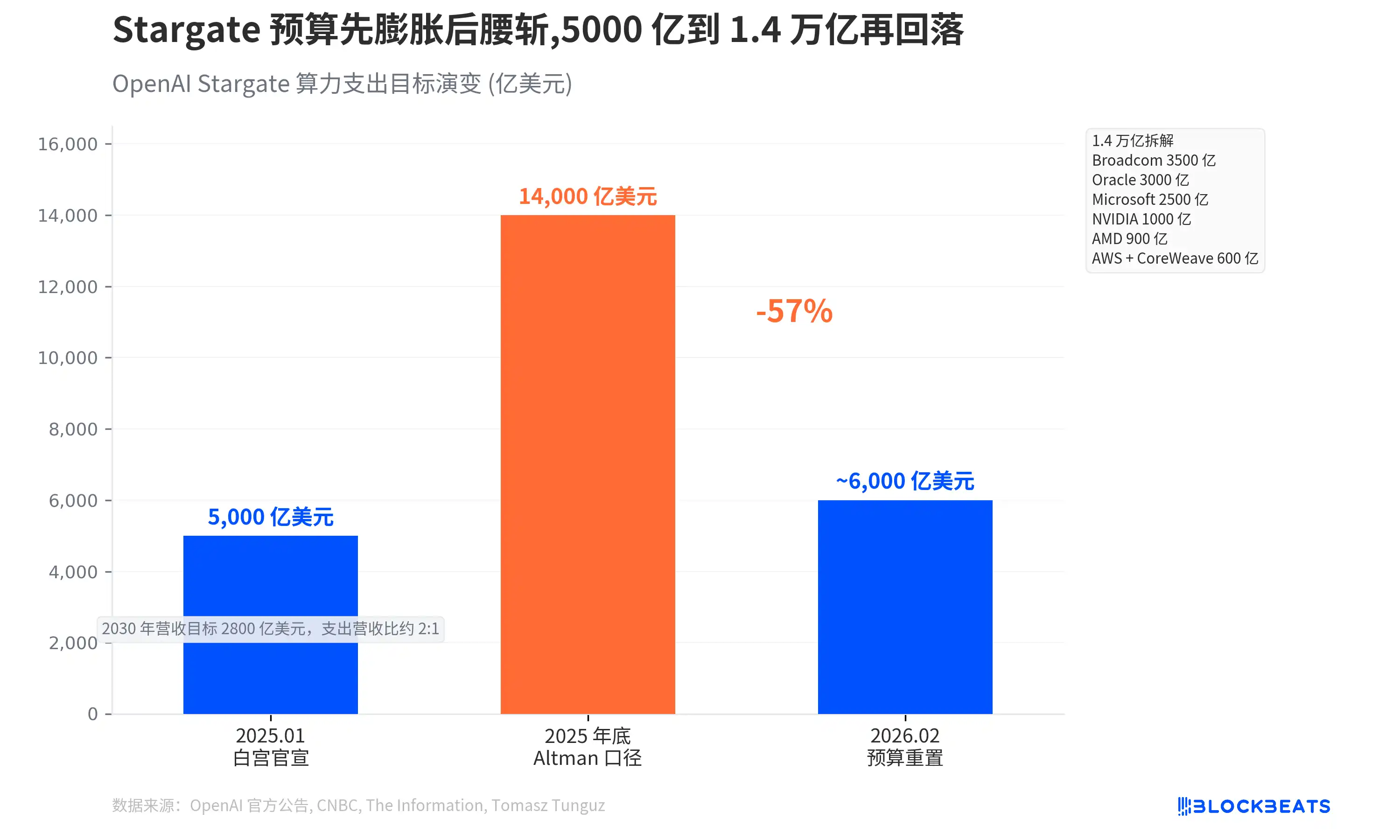
Breakdown data from investor materials shows that, according to Altman's calculations, the $14 trillion total commitment was distributed among seven vendors. According to venture analyst Tomasz Tunguz's analysis of investor materials, Broadcom accounts for $3.5 trillion, Oracle $3 trillion, Microsoft $2.5 trillion, NVIDIA $1 trillion, AMD $900 billion, and AWS and CoreWeave together total $600 billion.
In February 2026, according to CNBC, this figure was reset to around $6 trillion (by 2030), a 57% cut. The same report provided a slightly different but directionally consistent figure, with OpenAI expected to spend $665 billion on cloud servers by 2030.
$6 trillion is still a number that requires an anchor to feel. According to internal OpenAI forecasts, the company's revenue target for 2030 is $280 billion, which means a 2:1 cumulative spending-to-revenue ratio over five years. As per internal financial data cited by ainvest, the company's projected loss in 2026 is $14 billion, with reported gross margins of only 33% (Note: Gross margin reflects the product's inherent profitability, while net loss is the final result after deducting all costs such as R&D, management, etc., and both can coexist).
Placing OpenAI's spending goal in the context of Big Tech's computing power race provides a clearer scale reference.
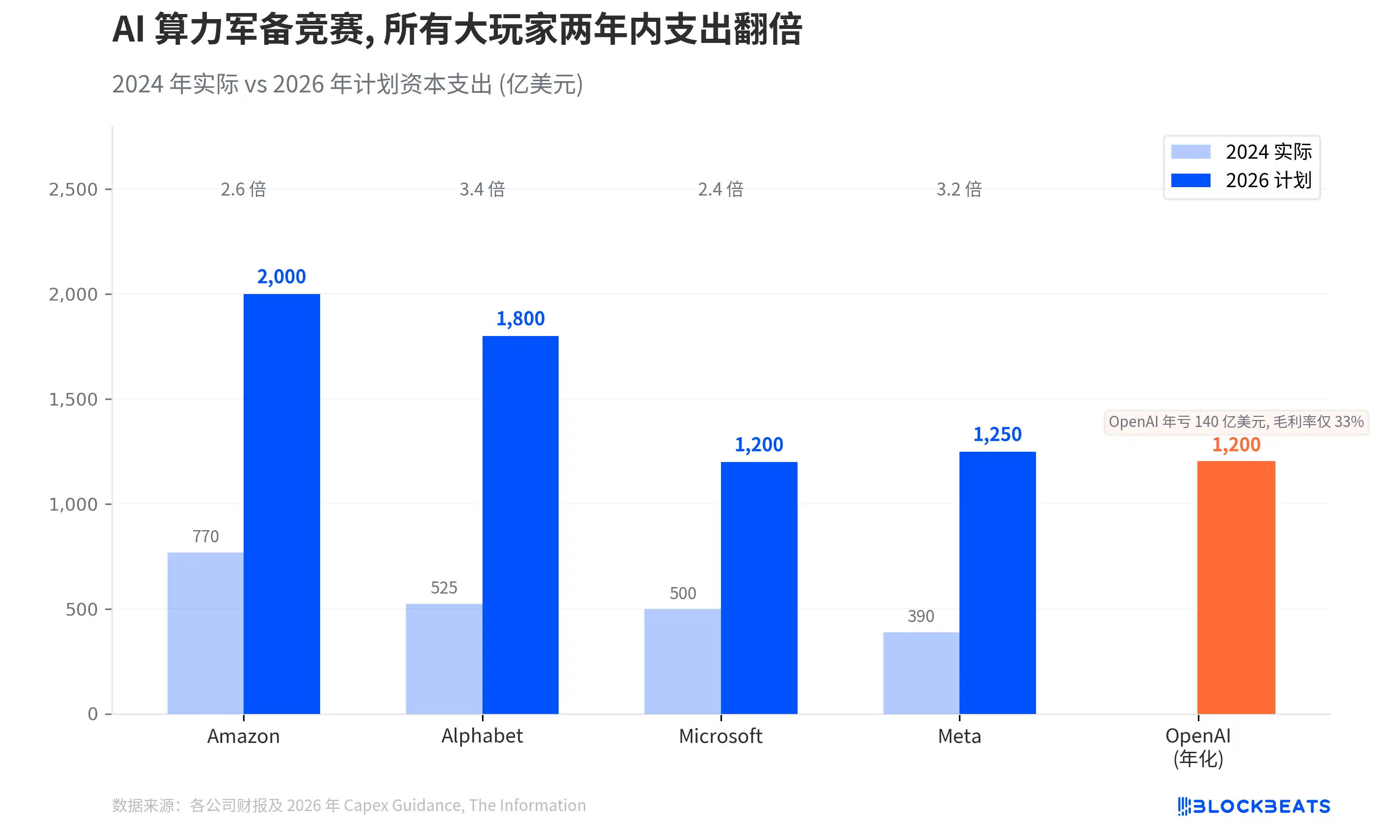
According to various company reports and public guidance, Amazon plans a $200 billion capital expenditure in 2026, Alphabet $180 billion, Meta $125 billion, and Microsoft around $120 billion. The four companies have broadly doubled to tripled their spending within two years, totaling over $650 billion, with approximately three-quarters of it going towards AI infrastructure.
OpenAI's $600 billion target is a five-year cumulative goal, averaging around $120 billion annually, equivalent to Microsoft's annual capital expenditure. The difference is that Microsoft's annual revenue exceeds $240 billion, while OpenAI's projected annual revenue has just reached $25 billion, with no expectation of achieving positive cash flow before 2030.
Stargate's restructuring is more than just a change in budget numbers; the organizational realignment has revealed a deeper strategic shift.
Post-restructuring, Stargate is divided into three lines. The Epic Business Development team, led by former OpenAI employee and ex-Deloitte manager Peter Hoeschele, oversees management of cloud contracts with Microsoft, Oracle, Amazon, and transactions with chip manufacturers. These transactions include a multi-year contract with AMD (using up to 6 gigawatt chips, at a cost of up to 10% of AMD common stock) and an agreement with chip startup Cerebras Systems.
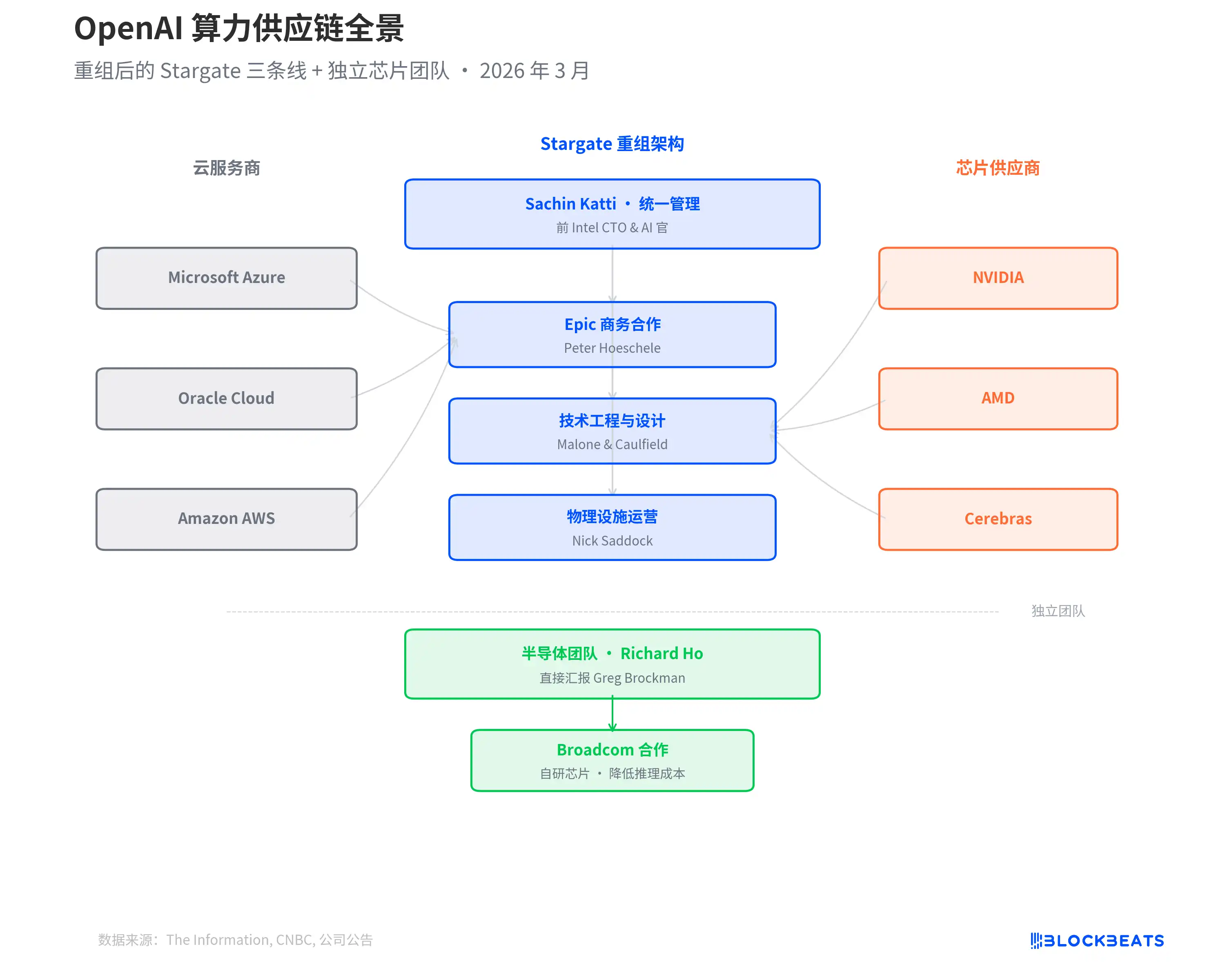
The Technology Engineering and Design group, co-led by former Meta and Google engineer Chris Malone and ex-Microsoft engineering lead Adrian Caulfield, is responsible for redesigning the AI server clusters used by OpenAI. The Physical Infrastructure Operations team, headed by former Google data center director Nick Saddock, has taken over from Keith Heyde, who left weeks ago.
The semiconductor team, led by former Google chip executive Richard Ho, operates outside of Katti's jurisdiction and reports directly to OpenAI President Greg Brockman. This team is collaborating with Broadcom to develop custom chips, with the goal of ultimately reducing the inference costs of running products like ChatGPT.
The name "Stargate" still exists, but what it refers to has completely changed. In January 2025, it was a joint project with SoftBank and Oracle to build a data center. By March 2026, it became a broad strategic move by OpenAI to bring exascale server capacity online. It shifted from "I will build my own power plant" to "I will sign the best lease." The planned total capacity for all sites remains at nearly 7 gigawatts, with a total investment of over $400 billion over three years. OpenAI is shifting its compute focus to NVIDIA's Vera Rubin platform, aiming to achieve the first gigawatt-scale capacity online by the second half of 2026.
You may also like

Will MicroStrategy fall into a death spiral? What will the macro trend be in the second half of the year?

Blockchain Capital Partner: The Core Secret of Arbitrage

STRC unanchored by 11%, can the perpetual motion machine of Strategy still operate?

Bitcoin Market Analysis 2026: Can BTC Reach $150K by Year-End?

Bitcoin ETF Outflows Hit a Record $4.4 Billion: What Are Traders Doing With Their Cash?

WEEX App Just Got Smarter – New Tabs for Faster Trades & Easy Asset Management

WEEX All-New Search Features: Find, Trade & Earn Faster Than Ever

Morning Report | Illinois signs the strictest digital asset tax law in the U.S.; RWA tokenization market size surpasses $43 billion, institutions accelerate the migration of on-chain assets

Full version of the debut Q&A! Federal Reserve Chairman Waller: Sticking to the 2% inflation target, establishing five special working groups, individual did not submit the dot plot

From Disruptor to Shadow Market: The Crypto Market is Becoming a Colony of Traditional Finance
Dalio's important long article: How to position in the current market environment?
OKX Star analyzes Binance's competitive advantages: when regulation levels the playing field, competition has just begun

New gameplay for participating in initial offerings on cryptocurrency exchanges
Why Is Bitcoin Down Today? What the Hawkish FOMC Means for SpaceX, Gold and Nasdaq

DeepSeek Financing Story

Morning Report | DeepSeek completes over $7 billion in financing, with a valuation exceeding $50 billion; Musk's personal wealth has surpassed the total market value of Bitcoin

Cursor, why did you get on Musk's spaceship?
In the name of charity, for the benefit of the family: How the Trump family turned charity into profit?
Will MicroStrategy fall into a death spiral? What will the macro trend be in the second half of the year?
Blockchain Capital Partner: The Core Secret of Arbitrage
STRC unanchored by 11%, can the perpetual motion machine of Strategy still operate?
Bitcoin Market Analysis 2026: Can BTC Reach $150K by Year-End?
Bitcoin ETF Outflows Hit a Record $4.4 Billion: What Are Traders Doing With Their Cash?
WEEX App Just Got Smarter – New Tabs for Faster Trades & Easy Asset Management


