
The US government is about to reopen, and Bitcoin is finally going to moon!

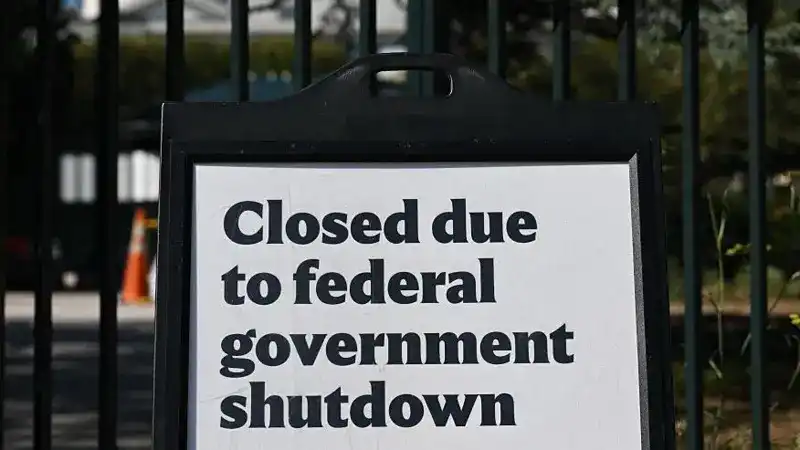
The longest government shutdown in history is finally coming to an end.
The government shutdown, caused by a budget impasse, is a phenomenon almost unique to the U.S. political system. The 40-day shutdown has significantly impacted the global financial markets. The Nasdaq, Bitcoin, tech stocks, the Nikkei Index, and even safe-haven assets like U.S. Treasuries and gold were not spared.
Even the most rigid two-party relationship could not resist the desire for everyone to have a good Thanksgiving before November 27. The recently concluded Senate meeting finally reached the 60-vote threshold to push the budget forward. The longest government shutdown in history may soon come to an end, and the subsequent process will smoothly "reopen" the U.S. government.

Why the Shutdown?
This shutdown originated from the Republicans and Democrats failing to reach an agreement on the fiscal budget past October 1.
On that day, the federal budget for the previous year officially expired. While the Republicans currently control both houses of Congress, they still lack the 60 votes needed to pass the budget in the Senate, giving the Democrats significant negotiating leverage.
The core disagreement between both parties focused on healthcare spending. The Democrats demanded an extension of expiring tax breaks to allow millions of Americans to continue receiving lower healthcare insurance rates and to reverse Trump's cuts to the Medicaid assistance plan. The Republicans insisted on cutting healthcare and government medical-related spending to control the budget size.
Although the House of Representatives passed a temporary funding bill to avoid a shutdown, the Senate refused, ultimately leading to the government's shutdown from October 1, the first time in nearly seven years.
Insiders revealed that the turning point in this round of negotiations came from preliminary agreements between at least eight moderate Democratic senators and Republican leaders and the White House: voting to extend subsidies for the Affordable Care Act in the future as an exchange condition to allow the government to "reopen" first.
What Are the Consequences of the Shutdown?
If one were to describe the economic impact of a government shutdown, "a hurricane" might be a very apt comparison.
The first impacts were felt in financing and commercial approvals: loan permits and company IPO reviews were significantly delayed; approximately $800 million in federal contracts could not be signed each day; contractors and suppliers were unable to receive compensation, with many being small businesses relying on government orders.
This means that for every week the government is shut down, economic growth will decrease by 0.1–0.2 percentage points, equivalent to a loss of around $15 billion per week.
As the shutdown prolongs, these losses will be harder to recover, especially potentially impacting the traditional holiday season consumption in November and December. As warned by White House economic adviser Kevin Hassett, the impact of this shutdown is "beyond expectations," with fourth-quarter growth potentially plummeting from the original forecast of 3% to 1.5%. Industries such as tourism, leisure, and construction have already been significantly affected.
The most recent severe government shutdown in U.S. history was in 2018–2019, lasting 35 days due to the U.S.-Mexico border wall dispute. A study by the U.S. Congressional Budget Office found that this shutdown caused approximately $11 billion in losses to the U.S. economy. However, most of the losses were later recovered, with $3 billion remaining as permanent losses.
For those in the cryptocurrency community who have experienced the longest-ever shutdown, it has not been easy. Related reading: "Wall Street continues to sell off, how low will Bitcoin go."
In just the first week of November, Bitcoin had already plunged to a new low called "10.11," falling below not only the $100,000 milestone but also dropping below $99,000, marking a new low for the past six months, while Ethereum hit a low of $3,000. On the HTX trading platform, a long position of BTC-USDT triggered a liquidation of $47.87 million in a single transaction, ranking it at the top of the industry's liquidation list.
An earlier article by Wall Street See showed that the shutdown forced the U.S. Treasury Department to increase its General Account (TGA) balance at the Federal Reserve from around $300 billion to over $1 trillion in the past three months, reaching a nearly five-year high. This process effectively withdrew over $700 billion in cash from the market.
With the market lacking liquidity, the cryptocurrency industry has depleted liquidity accordingly.
From October 29 to November 3, the IBIT, the world's largest Bitcoin spot ETF with a 45% market share owned by BlackRock, saw net outflows totaling $715 million over four trading days, accounting for more than half of the total outflows of $1.34 billion in the U.S. Bitcoin ETF market.
Looking at the entire week from October 28 to November 3, IBIT had net outflows of $403 million, representing 50.4% of the $799 million outflows in the entire market, with a single-day outflow of $149 million on October 31, setting a record for the highest single-day outflow in the industry.
What's even more fierce than an ETF is actually the OG players on-chain.
Over the past 30 days (October 5 to November 4), wallet addresses belonging to "Long-Term Holders" (LTH) - those holding for over 155 days - collectively sold approximately 405,000 BTC, representing 2% of circulating supply. At an average price of $105,000 during the period, they cashed out over $42 billion.
When Will the Market Rise?
Despite the government funding plan not being fully in place yet, the market has already shown some movement, with US stock index futures surging significantly during the Asian morning session.
We can also continue to monitor the following dimensions to help judge the future direction of finance and liquidity.
First is the U.S. Treasury General Account (TGA). Related reading: "Why does the U.S. government need to open up for Bitcoin to rise?".
This can be understood as the US government's central checking account at the Federal Reserve. All federal revenue, whether from taxes or the issuance of treasury bonds, is deposited into this account. Similarly, all government spending, from paying civil servant salaries to defense expenditures, is also disbursed from this account. Normally, the TGA acts as a fund's transit station, maintaining a dynamic balance. The Treasury Department receives money and then quickly spends it, with funds flowing into the private financial system, turning into bank reserves, and providing liquidity to the market.
The government shutdown has disrupted this cycle. The Treasury Department continues to collect money through taxes and bond issuance, leading to a continuous increase in the TGA balance. However, since Congress has not approved a budget, most government departments are closed, and the Treasury Department cannot spend as planned. The TGA has become a one-way financial black hole.
Since the shutdown began on October 10, 2025, the TGA balance has ballooned from around $800 billion to surpass $1 trillion by October 30. In just 20 days, over $200 billion has been withdrawn from the market, locked in the Federal Reserve's vault.
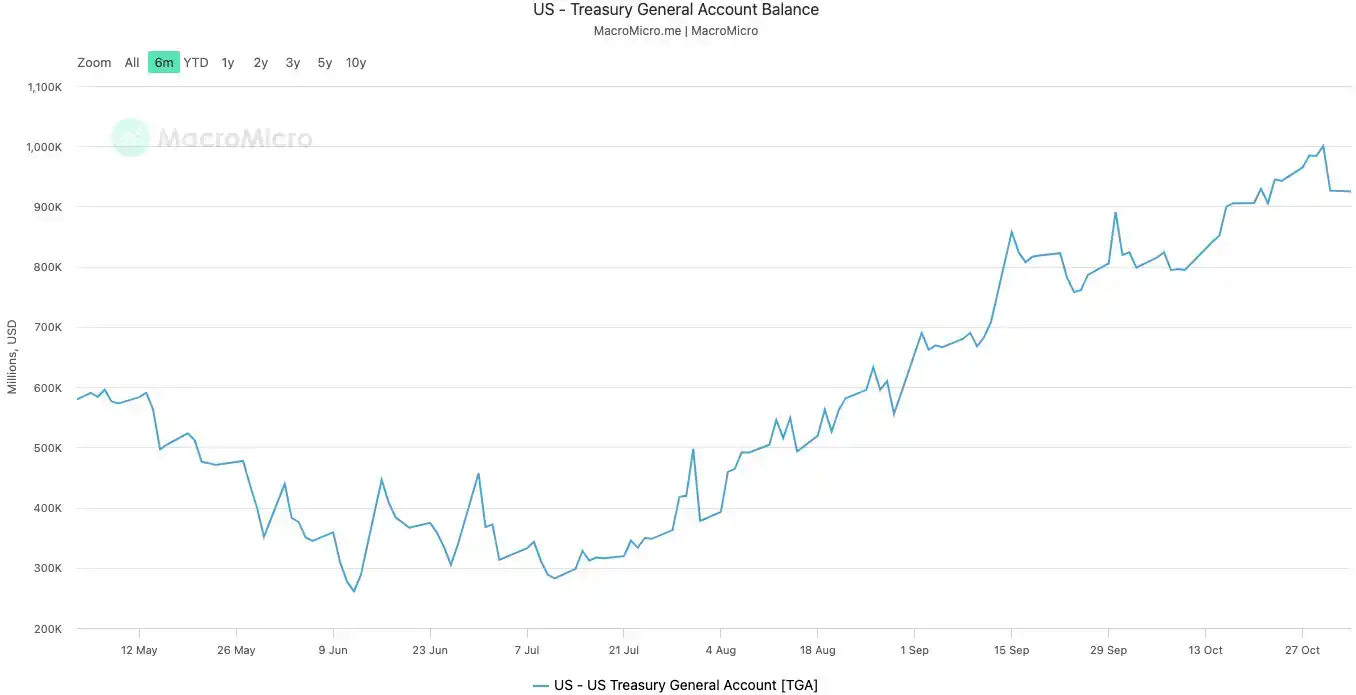
U.S. Government's TGA Balance | Image Source: MicroMacro
TGA is the "cause" of the liquidity crisis, while the soaring overnight repo rate is the most direct symptom of the financial system "running a fever."
The overnight repo market is where banks lend short-term funds to each other, serving as the capillary of the entire financial system. Its rate is the most authentic indicator of the tightness of the interbank "money root." When liquidity is ample, interbank borrowing is easy, and rates are stable. However, when liquidity is drained, banks face a cash shortage and are willing to pay a higher price to borrow overnight.
This leads to two other key indicators: SOFR (Secured Overnight Financing Rate) and the Fed's SRF (Standing Repo Facility) usage.
On October 31, SOFR surged to 4.22%, marking the largest daily increase in a year. Not only did it exceed the upper limit of the Fed's target federal funds rate of 4.00%, but it was also 32 basis points higher than the Fed's effective fund rate, reaching the highest level since the market crisis in March 2020. The actual borrowing cost in the interbank market has spun out of control, far surpassing the central bank's policy rate.

Secured Overnight Financing Rate (SOFR) Index|Source: Federal Reserve Bank of New York
On the other hand, the SRF is an emergency liquidity tool provided by the Fed to banks. When banks cannot borrow money in the market, they can pledge high-grade bonds to the Fed in exchange for cash. On October 31, SRF usage surged to $503.5 billion, hitting the highest level since the March 2020 pandemic crisis. The banking system has plunged into a severe dollar shortage, having to knock on the Fed's last-resort window for help.
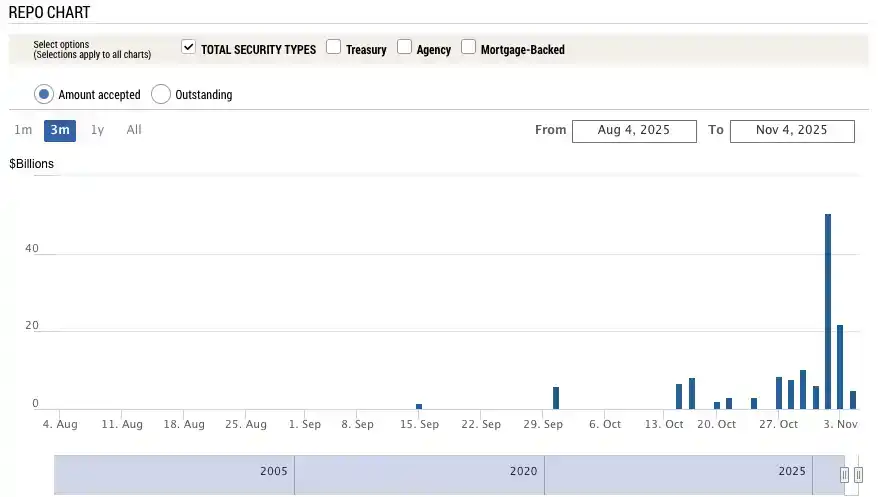
Standing Repo Facility (SRF) Usage|Source: Federal Reserve Bank of New York
Beyond the fiscal side, one can also track the pace of U.S. Treasury issuance, short-term rates, and RRP (Reverse Repo Program) balances' reactions. The combination of "large Treasury issuance by the Treasury Department + significant drop in RRP balance" signifies that liquidity has shifted from money market funds to treasuries, further influencing the performance of risk assets. Additionally, the Treasury Department's end-of-month announcement of the Quarterly Refunding Announcement (QRA) is a crucial signal to observe government cash needs and funding pressures.
Furthermore, there are still several key steps in the process worthy of attention. Even if the House of Representatives votes in favor, it still needs to go through a Senate vote and presidential signing to take effect.
According to related information, after the procedural vote, the Senate must amend three appropriation bills (legislative, military construction, and agriculture, including the SNAP program) and then send them back to the House. Each amendment will trigger a 30-hour debate period, which could delay the process.
If the Democrats choose to extend these debates, the government may not reopen until Wednesday or Thursday, but if they expedite the process to "end the government shutdown" tonight, the U.S. government could reopen tomorrow night. Any delay would mean that the "shutdown risk" has not been completely averted.
Therefore, to complete the entire process of government "reopening," it is estimated to take several more days to a week. And for the crypto world, perhaps this is the last chance to "get on board" before the upcoming mini bull run.
You may also like

The other side of Musk's trillion-dollar fortune: 85% cannot be sold

The U.S. government prohibits foreigners from using Fable 5, Anthropic issues a rebuttal

Citibank releases "2030 Asset Tokenization Market Outlook": 6 major trends may create a $8.2 trillion market

The trillion-dollar valuation test: Are the three major super IPOs a celebration for tech stocks or a nightmare for the crypto market?

Morning Report | Digital Asset completes $355 million financing led by a16z Crypto; Meta completes operational separation from Manus

a16z Crypto Partner: Cash flow is the moat

Cryptocurrency market makers collectively seek change as it becomes increasingly difficult to make money

How TradeXYZ, xStocks, and Alpaca break down the SpaceX IPO into three different strategies
$75 billion in risk asset redistribution: How will SpaceX's IPO affect U.S. stocks and Bitcoin?

Why Is BlackRock Investing $5 Billion in the SpaceX IPO?
Morning News | CME Group launches Nasdaq Cryptocurrency Index futures; Asset management giant Janus Henderson strategically invests in Ethena

Bitcoin Layer 2 Network Botanix: Why Did We Choose to Dissolve?

Why did Oracle deliver the strongest financial report in history, yet its stock price fell?
When the P2P illicit funds from ten years ago turned into 60,000 bitcoins
Dialogue with OmenX Founder: Why does the prediction market need an evolution from "spot" to "derivatives"?
Galaxy in-depth report: Is Solana still worth paying attention to?
Young people in South Korea make a "final effort" in the epic bull market
The pricing controversy of Trade.xyz exposes the fatal weakness of Pre-IPO perpetual contracts
The other side of Musk's trillion-dollar fortune: 85% cannot be sold
The U.S. government prohibits foreigners from using Fable 5, Anthropic issues a rebuttal
Citibank releases "2030 Asset Tokenization Market Outlook": 6 major trends may create a $8.2 trillion market
The trillion-dollar valuation test: Are the three major super IPOs a celebration for tech stocks or a nightmare for the crypto market?
Morning Report | Digital Asset completes $355 million financing led by a16z Crypto; Meta completes operational separation from Manus
a16z Crypto Partner: Cash flow is the moat


