
What Benefits Can ERC-8004 Bring to Ethereum?

Original Title: ETH: The Scarce Asset in AI Applications
Original Author: @GarrettBullish
Translation: Peggy, BlockBeats
Editor's Note: As AI reshapes the software industry and most companies struggle to truly benefit, Ethereum has chosen a different path. This article, centered around ERC-8004, explains why ETH and AI are not just additive but rather symbiotic at a fundamental level: AI requires a trustworthy, immutable settlement and collaboration foundation, and Ethereum happens to provide this key capability.
By establishing a verifiable identity and reputation system for AI agents, ERC-8004 makes cross-organizational AI-to-AI collaboration possible, also bringing new growth narratives to DeFi, RWAs, and on-chain activity.
The following is the original article:
With ERC-8004 about to land on the mainnet, we believe this marks a key moment for Ethereum akin to an "iPhone moment" — not only is it a significant milestone in Ethereum's development, but it also signifies ETH becoming one of the core beneficiaries of the AI wave at the application layer.
At this current juncture, most publicly traded software companies are being reshaped by AI, or even directly disrupted; in contrast, ETH's positioning is becoming increasingly apparent: it is evolving into an indispensable, rare asset at the core of AI-native applications.
We will systematically outline the multifaceted value brought by the deep integration of ETH and AI applications, including its enhancement of Ethereum's profitability, the drive towards on-chain Real-World Assets (RWAs), and the pull on overall on-chain activity; and we will contrast this with the reality of the traditional software industry — where companies that truly benefit from AI are few and far between, with more enterprises being impacted or replaced by AI.
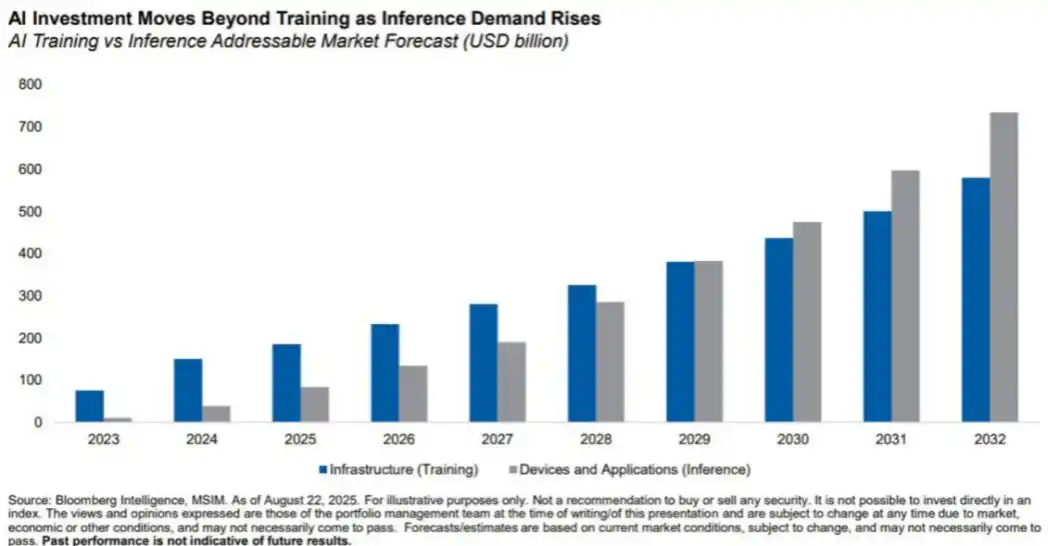
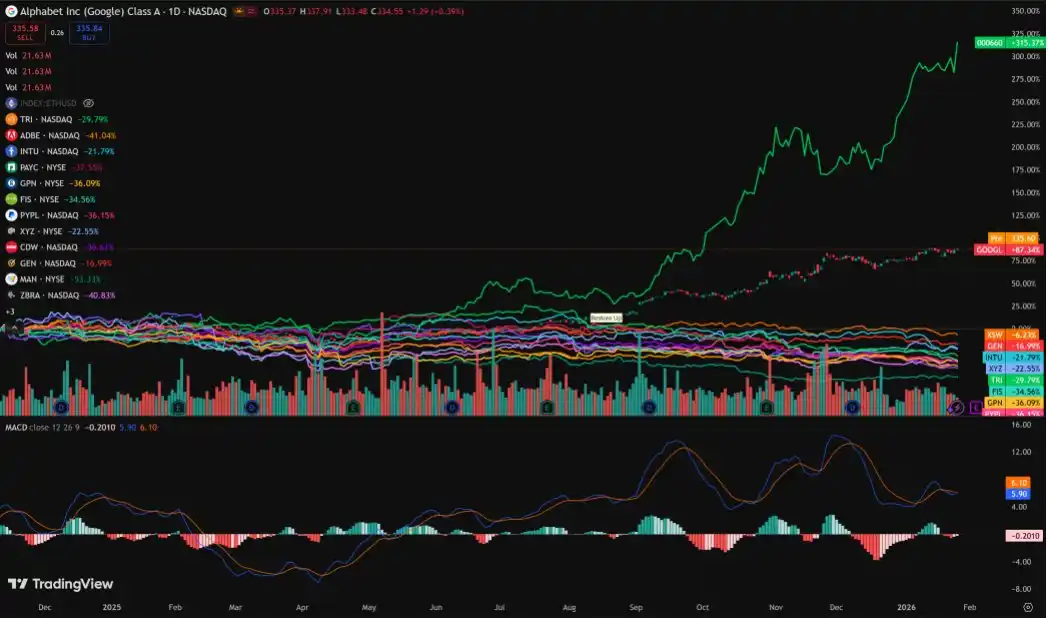
The relationship between ETH and AI is not a simple addition but a deep symbiosis: Ethereum provides AI with a trustworthy, decentralized, immutable settlement and coordination mechanism; AI, in turn, injects Ethereum with more intelligent, more efficient, and truly autonomous forms of application.
The Core Benefits of This Integration
Providing AI with a higher level of trust and a decentralized foundation
Mainstream centralized AI (such as OpenAI, Google, Meta) currently faces issues such as opacity, black-box models, and auditability risks. Elon Musk's recent public criticism of Meta's acquisition of WhatsApp data is a microcosm of this structural concern.
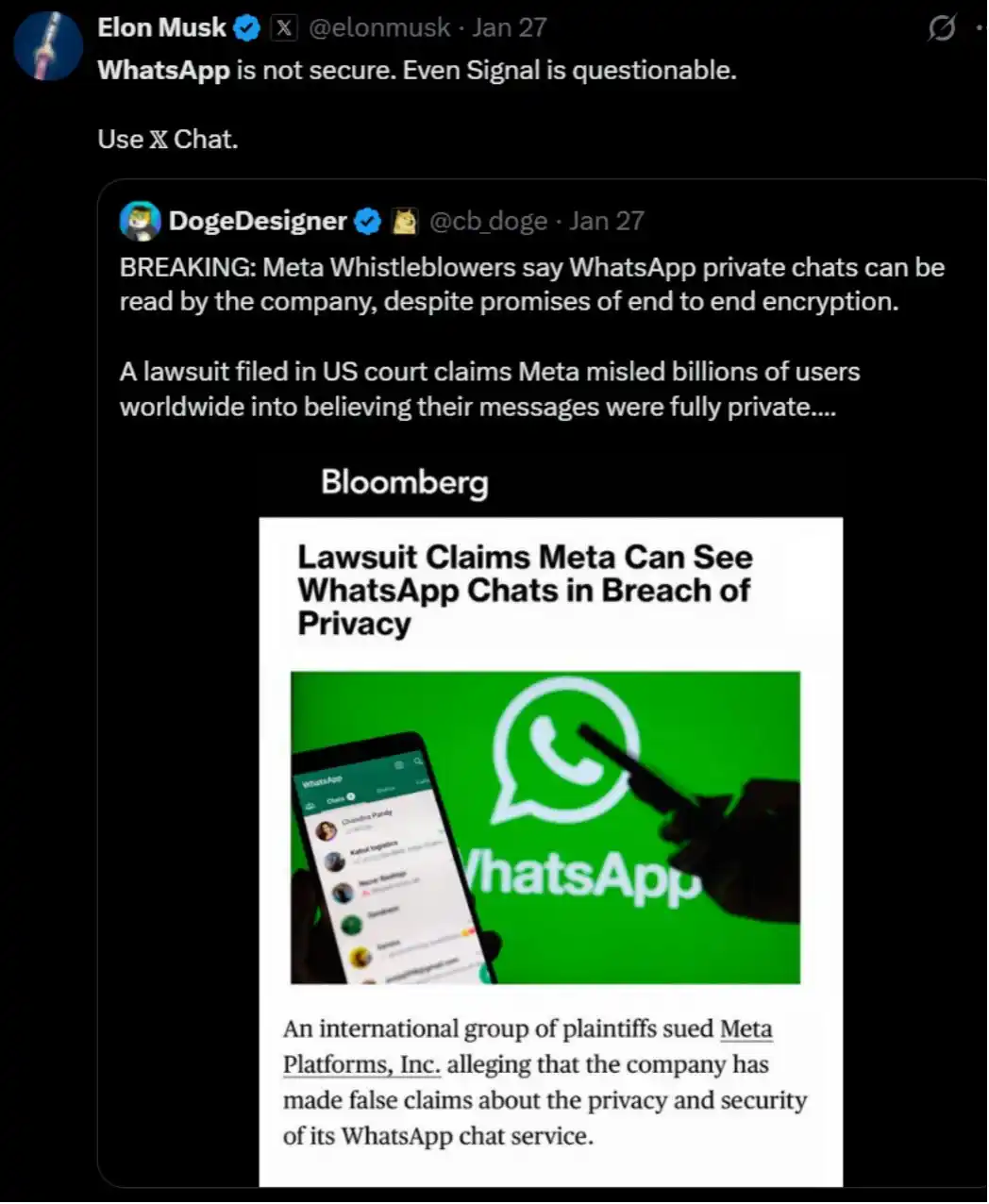
Ethereum is addressing these issues by:
The identity, reputation, and behavior of AI agents are stored on-chain, enabling verifiability, composability, and portability (via ERC-8004 and similar standards).
True machine-to-machine (M2M) payments and collaboration become possible, all without intermediaries.
Decentralized storage + on-chain proofs effectively prevent data tampering and theft.
Enhancing Ethereum's Utility and Productivity
AI agents can autonomously perform complex tasks (such as transactions, risk management, market prediction), significantly increasing the frequency and complexity of on-chain interactions.
The Ethereum Foundation's dAI team (established in 2025) has explicitly positioned Ethereum as the preferred settlement layer for AI agents.
Dynamic smart contracts become a reality: adjustable in real-time based on time and conditions (such as variable-rate lending, automated insurance).
A New Economic Model
AI agents can independently generate revenue (fees for reasoning, gaming, social activities) and pay Gas themselves, forming a closed-loop on-chain economic system.
This form, known as the "Robot Economy," is poised to become the next core narrative following DeFi and NFTs.
Contribution to ETH Revenue
Ethereum's core revenue sources: Gas Fees + Blob Fees → Partial Burn (EIP-1559) → Deflationary Pressure.
AI agents will drive:
Explosive Growth in Transaction Volume and Frequency (minute-level microtransactions);
Significant Increase in Transaction Complexity (identity verification, cross-agent collaboration, complex contract invocations).
Institutional Predictions:
By the end of 2025, AI agents may contribute to 15–20% of DeFi transaction volume;
In 2026, Gas usage could see a 30–40% increase in month-over-month comparison.
Conclusion: Fees and Burn Scale significantly increase, enhancing ETH's economic model.
Contribution to RWA and Overall On-Chain Activity
AI can automate valuation, compliance, risk monitoring, and dynamic pricing, significantly enhancing RWA operational efficiency.
Institutional-grade RWAs (such as BlackRock-related funds) require reliable, auditable automated mechanisms, a need that AI agents fulfill perfectly.
AI agents conducting trades 24/7 → higher transaction volumes, deeper liquidity, potential new TVL highs.
Outlook: AI-driven on-chain activity may become the second-largest fee contributor after stablecoins.
Why Software Companies are Disrupted While ETH Stands to Benefit

Most software companies are forced to "layer AI capabilities," but intelligence itself is being commodified (1+1 < 1).
Ethereum offers "trustful settlement" — the ability AI agents need most but cannot self-replicate. The more they use it, the stronger the network effect (1+1 > 2).
ERC-8004: Key Standard
ERC-8004: Trustless Agents
Proposal Date: August 2025, currently in the final draft stage
Priority: Ethereum Foundation's dAI team explicitly identified it as a strategic focus; has undergone experimental deployment in multiple L2 and ecosystem projects
Core Objective: Enable intelligent agents from different developers/organizations to discover each other, assess credibility through portable reputation, and securely collaborate on-chain and off-chain without the need for prior trust.
This is the missing layer in the Open Intelligent Agent—Agent Economy: "Identity Card + Public Credit Record."
Why ERC-8004 is the "iPhone Moment" of Ethereum AI Applications
ERC-8004 is an Ethereum Improvement Proposal (EIP) designed specifically for the trust issue of autonomous AI agents, under the full name ERC-8004: Trustless Agents.
The proposal was officially introduced in August 2025; as of January 2026, it is still in the Draft stage but has been explicitly listed as a strategic focus by the Ethereum Foundation's dAI (decentralized AI) team and has begun experimental implementation in multiple L2 and ecosystem projects.
Core Objective
Without any existing trust relationships, enable AI intelligent agents from different organizations and developers to: discover each other; assess each other's credibility; securely collaborate to complete on-chain and off-chain tasks.
This is essential infrastructure to achieve a truly open intelligent agent—agent economy.
ERC-8004 essentially constitutes the foundational layer of Ethereum in the AI intelligent agent era: a combination of a trusted identity card, public credit record, and third-party attestation.
It first allows intelligent agents to have a composable, portable, verifiable on-chain identity, which is likely the most crucial standard for determining whether the "intelligent agent economy" can truly succeed on Ethereum.
How to Understand This Statement:
"Ethereum is uniquely positioned to provide security and final settlement for AI-AI interactions."
This statement can be broken down into the following aspects:
Dual Meaning of "Secures" and "Settles"
Secures - Providing a secure, verifiable, tamper-proof trust foundation
Agent Identity: Who is acting?
Reputation: Has this agent been reliable in the past? Is there a history of malicious behavior?
Auditability of Behavior: Was the committed outcome correctly executed?
ERC-8004 provides a trust layer for cross-organizational agent interactions without the need for pre-existing trust through three on-chain registries—Identity, Reputation, Validation.
Settlement—Providing final value settlement and payment infrastructure
High-frequency micropayments between agents (for reasoning fees, task rewards, penalties, etc.)
Stablecoin and ETH payments
Economic incentive and constraint mechanisms (staking-punishment, stake-and-slash)
Built on an L1 + L2 combined architecture, Ethereum has become a neutral, programmable financial layer, ensuring payments are irreversible, transparent, and composable.
Why Does "AI-to-AI Interaction" Need Such a Platform?
In the future agent economy, most interactions will be machine-to-machine, not human-to-machine, for example: a trading agent requesting RWA pricing from a valuation agent, a content generation agent hiring a validation agent, auditing outputs, a logistics agent automatically settling fees with a payment agent.
These interactions share common characteristics: very high frequency (measured in seconds/minutes), very small amounts per transaction (from a few cents to a few dollars), permissionless, cross-organizational, intermediary-free.
Traditional centralized platforms (like OpenAI API, Google Cloud) can technically support this but introduce lock-in risks, review risks, and data monopolies. Ethereum provides a neutral, verifiable, globally accessible alternative.
Why Is Ethereum in a "Unique Position"?
From the perspective of 2026, Ethereum has structural differentiation advantages over other blockchains in multiple dimensions.
Why Can't Solana Equally Benefit?
Solana does have some overlapping capabilities but has not yet reached Ethereum's completeness and "uniqueness":
Solana is extremely fast and low cost, making it ideal for high-frequency AI inference and micro-interactions (as demonstrated by projects like Nosana, io.net, and other decentralized GPU projects).
However, there are still three key shortcomings in AI-to-AI interaction: there is no official or ecosystem-level standardized trust framework similar to ERC-8004, network history stability and decentralization are still considered weak points by institutions, and the settlement layer leans more towards high-throughput execution rather than maximum security and finality.
You can think of it this way: Solana is more like the "highway" for AI agents (throughput and cost); Ethereum is more like the "bank + SWIFT" for AI agent economies (final settlement and movable trust).
The Ethereum Foundation's assessment is: once AI agents begin managing assets of real economic value, engaging in cross-company collaboration, and requiring irreversible economic commitments, they will ultimately anchor the most critical trust and settlement on the most secure, neutral, and highly integrated blockchain.
This is the core logic behind Ethereum's "Unique Position" proposition.
Of course, ecosystem competition will continue until 2026. If Solana significantly improves stability and decentralization levels post-Firedancer and introduces comparable trust standards, it still has a chance to catch up. However, as of January 2026, Ethereum is undoubtedly leading this narrative and actively shaping the rules.
You may also like

IOSG Founder: Please tell Vitalik the truth, let the OGs who have enjoyed the industry's dividends enlighten the young people

Morning Report | SpaceX reveals it holds approximately $1.45 billion in Bitcoin; Nvidia's Q1 financial report shows revenue of $81.6 billion; Manus plans to raise $1 billion for buyback business

Insiders: DeepSeek is forming a Harness team to compete with Claude Code
SpaceX officially submitted its prospectus, unveiling the largest IPO in history

The financial changes under the new SEC regulations: Opportunities and regulatory red lines behind "tokenized stocks"

Blockchain Capital Partner: The structure of on-chain dual-layer capital is still in the early stages of value discovery

Secured over $60 million in funding from Dragonfly, Sequoia, and others, learn about the on-chain derivatives protocol Variational | CryptoSeed

I tested with $10,000: zero wear and tear, annualized 8%, and can earn points (with complete tutorial + screenshots)

Eight departments take strong measures to regulate cross-border brokers, what do you think?

Cheers, Charts & AI: A Recap of WEEX Labs' Openguin Party Energy at ETHMilan 26

Morning Report | Deloitte acquires crypto infrastructure company Blocknative; stablecoin company Checker completes $8 million financing; a16z may have become the largest external institutional holder of HYPE
Interpretation of xBubble SOP: Packaging Vibe Coding for non-technical users
From Followers to Price Setters: The Role of the Crypto Market is Reversing

a16z invested $356 million to aggressively acquire HYPE, surpassing Paradigm to become the largest external holding institution

Google officially declares war
Coinbase stuffed USDC into Hyperliquid; who made money from this transaction?

It is Bankless that needs Ethereum, not Ethereum that needs Bankless
Real Madrid vs Athletic Bilbao: Can Los Blancos Close Out the Season with a Home Win? (LALIGA Preview)
IOSG Founder: Please tell Vitalik the truth, let the OGs who have enjoyed the industry's dividends enlighten the young people
Morning Report | SpaceX reveals it holds approximately $1.45 billion in Bitcoin; Nvidia's Q1 financial report shows revenue of $81.6 billion; Manus plans to raise $1 billion for buyback business
Insiders: DeepSeek is forming a Harness team to compete with Claude Code
SpaceX officially submitted its prospectus, unveiling the largest IPO in history
The financial changes under the new SEC regulations: Opportunities and regulatory red lines behind "tokenized stocks"
Blockchain Capital Partner: The structure of on-chain dual-layer capital is still in the early stages of value discovery