
Wintermute: The four-year cycle is dead, Crypto Breakthrough 2026, where to next?


Original Title: The four-year cycle is dead. What will drive crypto in 2026?
Original Source: Wintermute
Original Translation: DeepTech TechFlow
Abstract:
What was once considered the "iron rule" of the crypto market, the four-year halving cycle, is facing an unprecedented challenge. Top market maker Wintermute pointed out in its latest 2025 annual report that the traditional cycle narrative has collapsed, and the market logic has shifted from "seasonal rotation" to "liquidity locking."
2025 did not see the expected widespread frenzy; instead, it showed extreme emotional polarization: on one hand, BTC and ETH entered the institutional hall under the blessing of ETFs, while on the other hand, altcoins experienced a sudden loss of momentum and shortened lifecycle.
Looking into 2026, can the crypto market break free from the current stockpile deadlock? Wintermute has outlined three core variables that could disrupt the status quo.
Body:
2025 did not bring the anticipated bull market, but this may be seen by future generations as the beginning of the cryptocurrency's transition from a speculative tool to a mature asset class.
The traditional four-year cycle is becoming obsolete. Market performance is no longer dominated by self-fulfilling timed narratives but rather depends on the flow of liquidity and the concentration of investor attention.
What changed in 2025?
Historically, native crypto wealth has acted as a fungible fund. Bitcoin's gains would spill over to Ethereum (ETH), then to blue-chip stocks, and finally reach altcoins.
Wintermute's over-the-counter (OTC) trading flow data indicates that this transmission mechanism significantly weakened in 2025.
Spot exchange traded funds (ETFs) and digital asset trust companies (DATs) have evolved into a "walled garden." They provide sustained demand for large-cap assets but do not naturally rotate funds into the broader market.
As retail interest shifted to the stock market, 2025 became a year of extreme polarization.
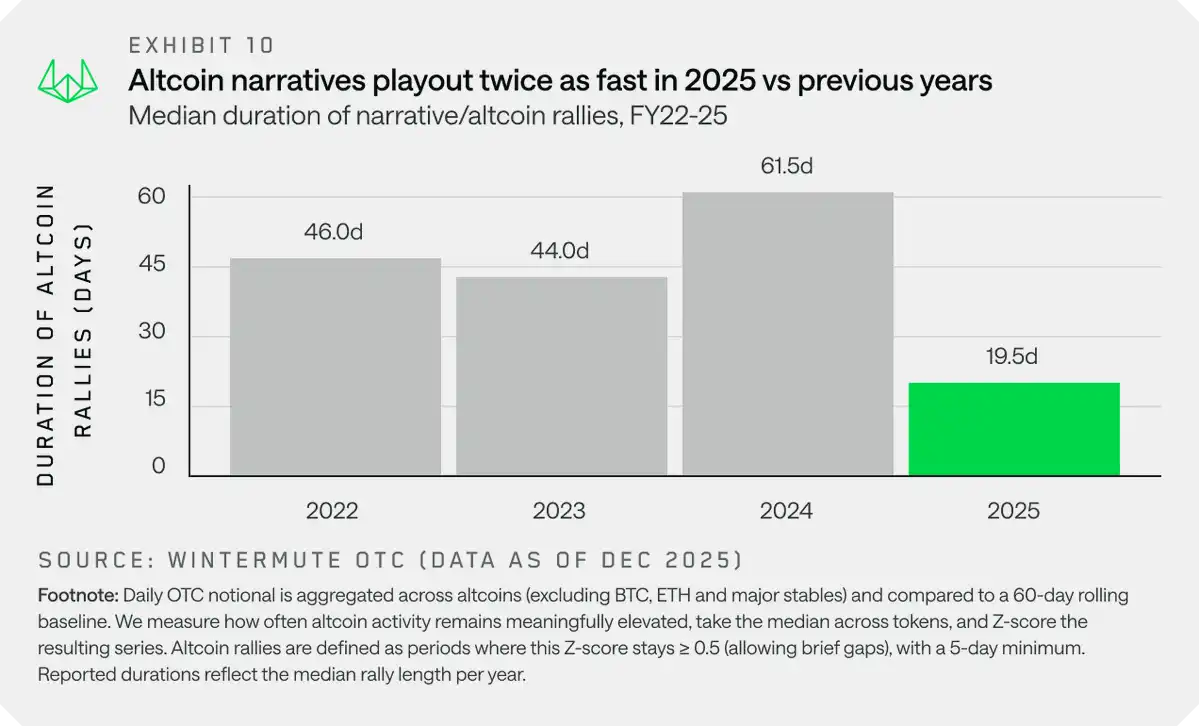
In 2025, the average rebound duration of altcoins was 20 days, much lower than 60 days in 2024.
A few mainstream assets absorbed the majority of the new inflows, while the broader market struggled.
Three Paths for 2026
If market participation beyond mainstream assets is to grow further, at least one of the following three things needs to happen:
1. Expanding Institutional Mandates
Currently, most of the new liquidity remains within institutional channels. A full market recovery requires institutional investors to expand the range of assets they can invest in.
Early signs are evident through Solana (SOL) and XRP's ETF applications.
2. The Wealth Effect from Mainstream Assets
A strong rebound in Bitcoin or Ethereum could trigger the wealth effect, spilling over to the broader market, similar to what happened in 2024.
The level of funds eventually flowing back into digital assets remains uncertain.
3. Rotation from Equities
Retail investors' focus may rotate back from the stock market (into areas like artificial intelligence AI, rare earths, quantum computing, etc.) to cryptocurrency, bringing in new inflows and stablecoin minting.
While this is the least probable scenario, it would significantly increase market participation.
The future outcome will depend on whether the above catalysts can effectively diffuse liquidity beyond a few large-cap assets, or if the trend of centralization will persist.
Understanding fund flows and the necessary structural changes will determine which strategies will succeed in 2026.
You may also like

Football, Web3 & Champions' Energy: A Recap of WEEX's LALIGA VIP Meetup in Barcelona

Pizza, Poker & AI Trading: A Recap of WEEX Crypto Pizza Day in Dubai

Why have foreign exchange stablecoins never taken off?

IOSG Founder: Please tell Vitalik the truth, let the OGs who have enjoyed the industry's dividends enlighten the young people

Morning Report | SpaceX reveals it holds approximately $1.45 billion in Bitcoin; Nvidia's Q1 financial report shows revenue of $81.6 billion; Manus plans to raise $1 billion for buyback business
Insiders: DeepSeek is forming a Harness team to compete with Claude Code
SpaceX officially submitted its prospectus, unveiling the largest IPO in history

The financial changes under the new SEC regulations: Opportunities and regulatory red lines behind "tokenized stocks"

Blockchain Capital Partner: The structure of on-chain dual-layer capital is still in the early stages of value discovery

Secured over $60 million in funding from Dragonfly, Sequoia, and others, learn about the on-chain derivatives protocol Variational | CryptoSeed

I tested with $10,000: zero wear and tear, annualized 8%, and can earn points (with complete tutorial + screenshots)

Eight departments take strong measures to regulate cross-border brokers, what do you think?

Cheers, Charts & AI: A Recap of WEEX Labs' Openguin Party Energy at ETHMilan 26

Morning Report | Deloitte acquires crypto infrastructure company Blocknative; stablecoin company Checker completes $8 million financing; a16z may have become the largest external institutional holder of HYPE
Interpretation of xBubble SOP: Packaging Vibe Coding for non-technical users
From Followers to Price Setters: The Role of the Crypto Market is Reversing

a16z invested $356 million to aggressively acquire HYPE, surpassing Paradigm to become the largest external holding institution

Google officially declares war
Football, Web3 & Champions' Energy: A Recap of WEEX's LALIGA VIP Meetup in Barcelona
Pizza, Poker & AI Trading: A Recap of WEEX Crypto Pizza Day in Dubai
Why have foreign exchange stablecoins never taken off?
IOSG Founder: Please tell Vitalik the truth, let the OGs who have enjoyed the industry's dividends enlighten the young people
Morning Report | SpaceX reveals it holds approximately $1.45 billion in Bitcoin; Nvidia's Q1 financial report shows revenue of $81.6 billion; Manus plans to raise $1 billion for buyback business
Insiders: DeepSeek is forming a Harness team to compete with Claude Code