With a troubled past, Jump fully resumes its cryptocurrency operations, facing an awkward situation.


By: blockbeats|2025/03/10 17:15:04
0
Share
copy
Original Article Title: "Tainted by Dark History, Jump Fully Restores Crypto Business Facing Awkward Situation"
Original Article Author: Nianqing, ChainCatcher

In August last year, Jump Trading's sudden and massive sell-off plunged the crypto market into the abyss, further triggering the "805 Crash." At that time, rumors about Jump, "the big guy," going down became increasingly intense.

Over the following six months, almost all of the few news stories about Jump revolved around its internal and external litigations and lawsuits.

Recently, CoinDesk cited sources familiar with the matter reporting that Jump is currently in the process of fully restoring its cryptocurrency business. The Jump Trading website shows that Jump is hiring a group of cryptocurrency engineers for its offices in Chicago, Sydney, Singapore, and London. In addition, another source added that Jump plans to start filling U.S. policy and government liaison positions at the appropriate time.

Jump was once referred to as the "undisputed king" of trading. With its ultra-low-latency trading system and sophisticated algorithm design, Jump has been a key liquidity provider in traditional finance. As the crypto market has continued to expand, Jump began market-making for cryptocurrencies, invested in crypto projects, and formally established the crypto business division Jump Crypto in 2021.

However, a gamble that accompanied the birth of Jump Crypto also sowed the seeds of its later tragedy.

Jump Trading Rise and Fall: The Cryptic Gamble of a Secretive Giant

In the early days, traders in trading pits used shouting, hand signals, and jumping to openly bid prices. This was also the inspiration for Jump Trading's name.

Headquartered in Chicago, Jump Trading was founded in 1999 by two former Chicago Mercantile Exchange (CME) floor traders, Bill DiSomma and Paul Gurinas. Jump quickly grew into one of the world's largest high-frequency trading firms, active on futures, options, and securities exchanges worldwide, as well as a major trader in U.S. Treasuries and cryptocurrencies.

For protection of trading strategies, Jump has always maintained a low profile, and as market makers have always operated in the shadows, a layer of mystery has always surrounded them. Jump rarely discloses its financial data, and the founders have always remained tight-lipped about its operations. Since 2020, perhaps to reduce exposure, after a strategy adjustment and business restructuring, Jump no longer needs to submit the 13F filings to the SEC but rather continues to do so through its parent company, Jump Financial LLC. The latest 13F filings submitted by the latter show that Jump Financial's AUM exceeds $7.6 billion, with approximately 1600 employees. Additionally, Jump Trading has offices in the U.S., Europe, Australia, and Asia.

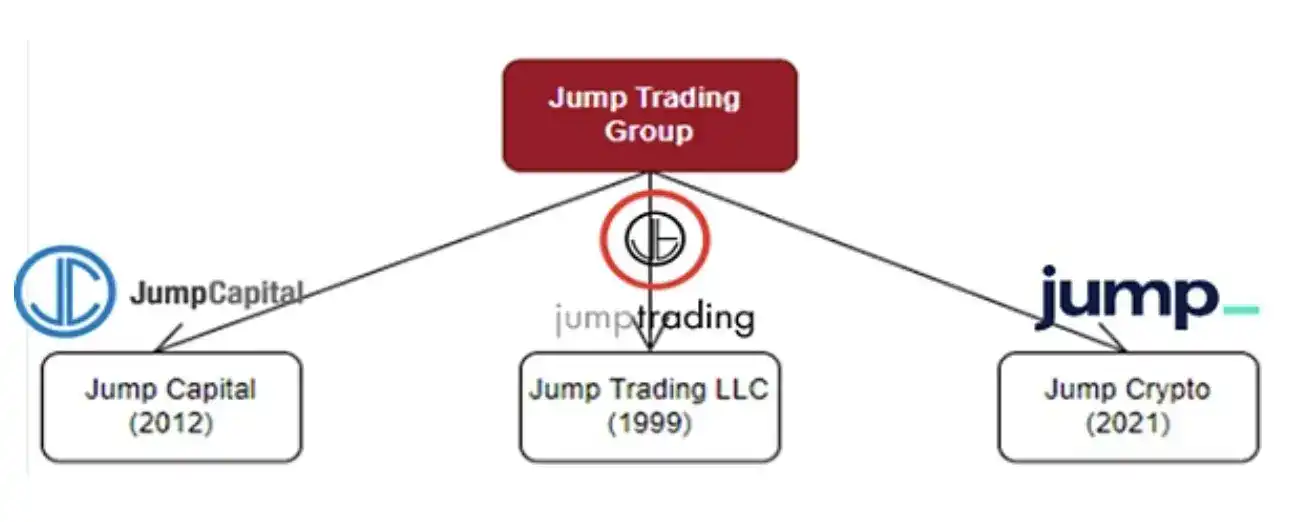
Jump Trading has two subsidiary business units, namely Jump Capital and Jump Crypto.

With a troubled past, Jump fully resumes its cryptocurrency operations, facing an awkward situation.

Jump Capital

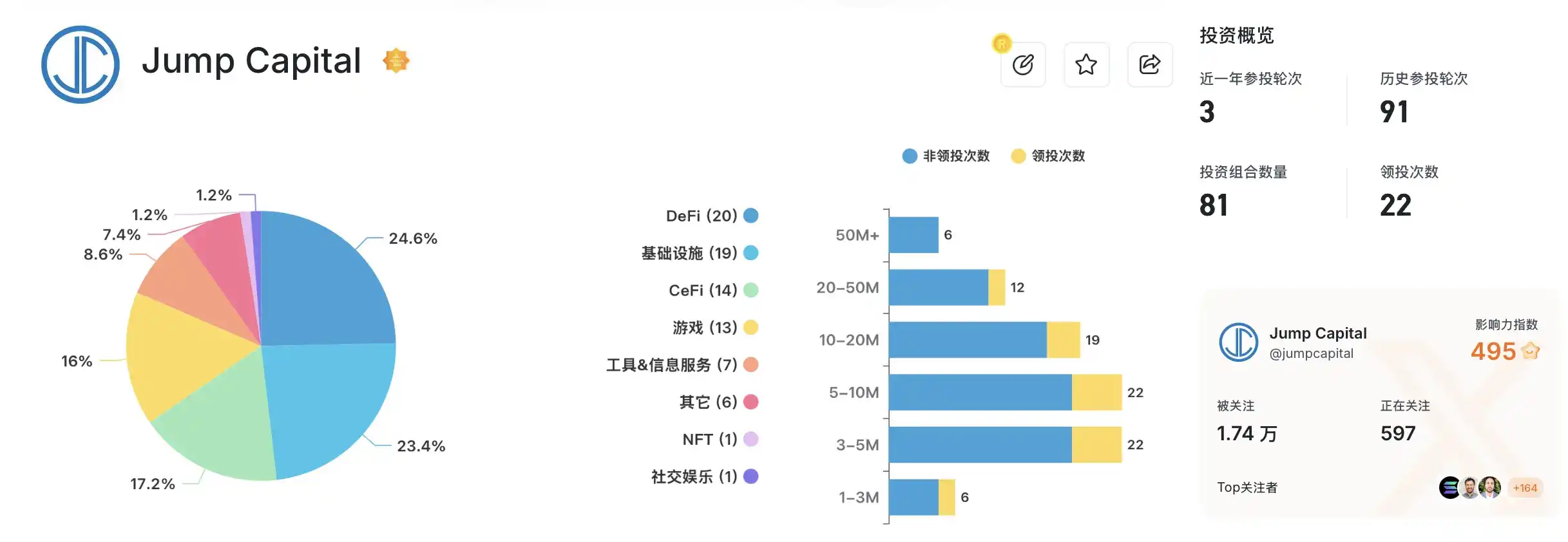
Jump Capital, headquartered in Chicago, was founded in 2012. Although Jump's crypto division was officially established in 2021, Jump Capital has been involved in crypto investments early on. One of its partners and head of crypto strategy, Peter Johnson, revealed that the company has been stealthily deploying crypto strategies for years.

According to relevant RootData pages, Jump Capital's crypto investment portfolio has exceeded 80 projects, focusing mainly on DeFi, infrastructure, and CeFi, with investments in projects such as loTeX, Sei, Galxe, Mantle, and Phantom.
In July 2021, Jump launched its largest fund to date with a total capital commitment of $350 million, attracting 167 investors. This marks Jump Capital's 7th venture fund.

Jump Crypto

In 2021, alongside the completion of its seventh fundraising for the investment fund, Jump announced the formation of the crypto investment division, Jump Crypto. 40% of the seventh investment fund was allocated to the cryptocurrency space, focusing on stocks, tokens, and projects in DeFi, financial applications, blockchain infrastructure, and Web 3.0.

At only 26 years old, Kanav Kariya was appointed as the inaugural President of Jump Crypto in 2021. Kariya joined Jump Trading as an intern in early 2017 and was tasked with building the early-stage cryptocurrency trading infrastructure.

Related Reading: "Digging Deep into Jump's History: Intern to President in 4 Months"

In May 2021, Terra's algorithmic stablecoin UST first experienced a depegging incident. Over the following week, Jump secretly purchased a large amount of UST to create the illusion of demand and restore UST's value to $1. This trade earned Jump $1 billion, and Kanav Kariya, the mastermind behind the scheme, rapidly ascended to President of Jump Crypto four months later.

However, this secret transaction also laid the groundwork for Jump's fall from grace.

With the complete collapse of the Terra UST stablecoin in 2022, Jump faced criminal charges of price manipulation in collusion with Terra. In the same year, Jump suffered significant losses in the FTX bankruptcy due to its deep integration with the FTX and Solana ecosystems.

Following the FTX incident, the United States tightened its regulation of the crypto market, and Jump Trading was reportedly forced to downsize its operations and gradually withdraw from the U.S. crypto market. For example, after the FTX incident, Robinhood ended its partnership with Jump. Jump Crypto's subsidiary, Tai Mo Shan, was once Robinhood's largest market maker, responsible for handling Robinhood's daily volume of billions of dollars. However, since the fourth quarter of 2022, Robinhood's financial reports no longer mention Tai Mo Shan, and Robinhood has instead partnered with market makers like B2C2.

Furthermore, to reduce its cryptocurrency business, in November 2023, Jump Crypto officially spun off Wormhole. Key personnel, including Wormhole's CEO and COO, left Jump Crypto. The Jump Crypto team was also nearly halved during this period.

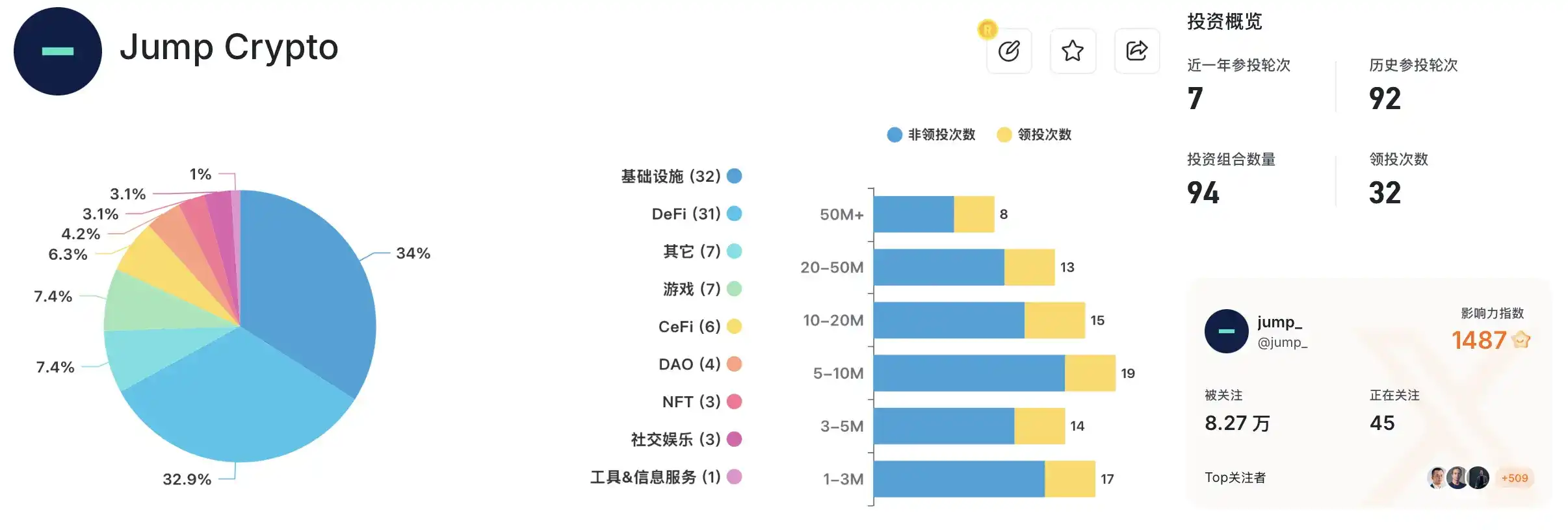
Jump Crypto's investment activities significantly decreased after 2023. According to RootData, Jump Crypto's crypto portfolio had exceeded 90 projects, mainly investing in infrastructure and DeFi, with investments in projects such as Aptos, Sui, Celestia, Injective, NEAR, and Kucoin. However, its "Number of deals in the past year" was only in single digits.
On June 20, 2024, according to Fortune, the U.S. Commodity Futures Trading Commission (CFTC) was investigating Jump Crypto. A few days later, Kanav Kariya, who had served at Jump Trading for six years, announced his resignation.

A month later, Jump Crypto initiated a large-scale ETH sell-off. Within 10 days, Jump Crypto had sold ETH worth over $300 million, and the panic directly caused a market downturn on August 5, 2024, with Ethereum experiencing a single-day decline of over 25%. The community speculated that Jump Crypto's ETH sell-off might have been due to pressure from the CFTC investigation, in exchange for stablecoins to facilitate a timely exit from the cryptocurrency business. Jump Crypto was rumored to be "the big guy on the brink of collapse."

Related Reading: "Accused of Crashing the Market, Uncovering Crypto Market Maker Jump Crypto"

In December 2024, Jump Crypto's subsidiary Tai Mo Shan agreed to pay approximately $123 million to settle with the U.S. SEC. According to later SEC enforcement filings, Tai Mo Shan was involved in the Terra UST market making that year. Tai Mo Shan is reportedly domiciled in the Cayman Islands and was established to handle specific market making and cryptocurrency trading business.

After over three years of painful entanglement, Jump's and Terra's event seems to have finally settled.

Jump Fully Restores Crypto Business: The Return of the King or a Long Way Back?

Why did Jump choose this time to fully restore its crypto business?

In addition to Jump's legal resolution in the Terra event, a more crucial reason is the Trump administration's friendly stance towards cryptocurrencies.

Just two days ago, on March 5th, Jump's long-time rival DRW's crypto arm Cumberland DRW signed a joint application with the U.S. Securities and Exchange Commission (SEC) seeking to dismiss the SEC's lawsuit against them. The agreement was preliminarily reached by the parties on February 20th and is currently awaiting approval by the SEC Commission. The SEC sued Cumberland DRW in October of last year, accusing them of operating as an unregistered securities dealer and selling over $2 billion in unregistered securities.

The SEC's new leadership team has adopted a more tolerant regulatory approach towards crypto companies, a stance that has given Jump hope for a resurgence. Furthermore, the potential approval of spot ETFs for altcoins like Solana this year has motivated Jump Crypto, deeply involved in the Solana ecosystem, to seek a piece of the pie.

By the end of 2023, Jump had negotiated with BlackRock on "market-making for a Bitcoin spot ETF," but perhaps due to regulatory concerns, Jump Crypto ultimately did not participate in Bitcoin or even later Ethereum spot ETF market making.

Jump Still Has the Strength to Make a Comeback

A lean camel is greater than a dead horse. Jump Trading still holds around $677 million in on-chain assets, with Solana tokens accounting for nearly half at 47%, holding 2.175 million SOL. Stablecoins account for about 30%.
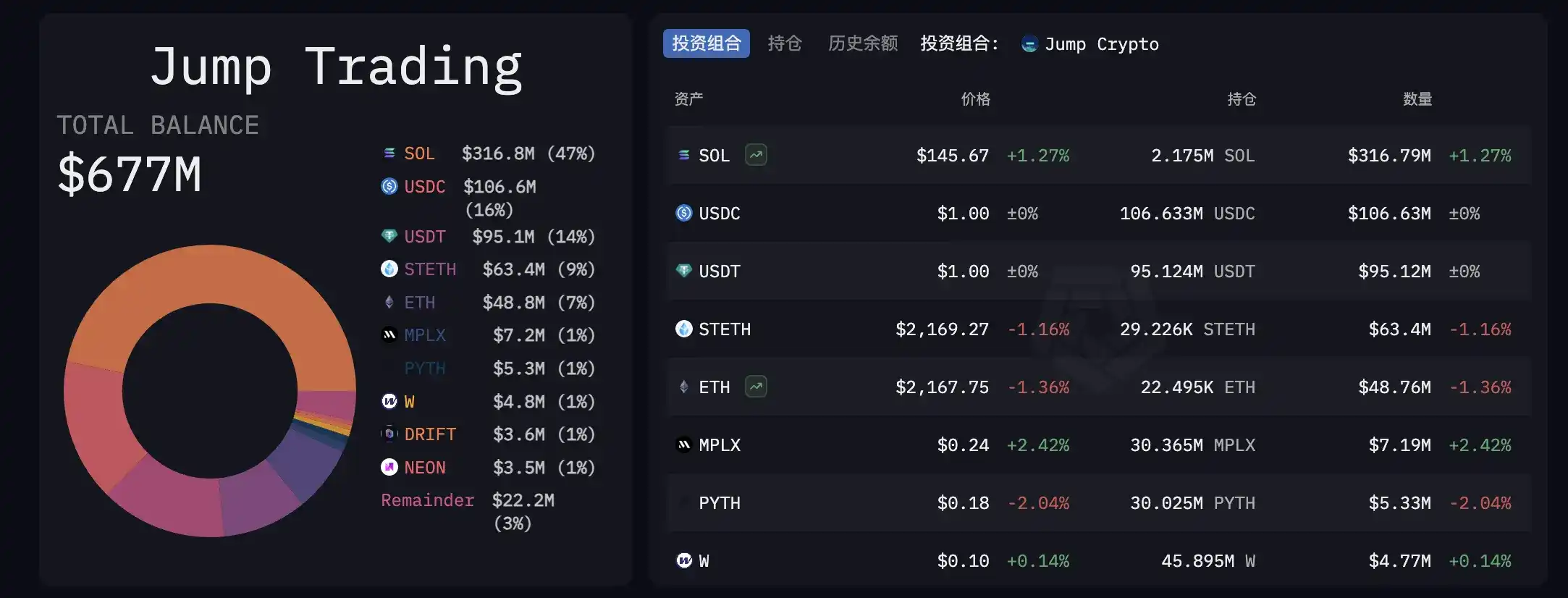
Source: ARKHAM

Jump Trading's on-chain fund size remains one of the largest among several crypto market makers. As of March 8, 2025, when comparing Jump's fund balance with other market makers, the ranking from high to low is as follows:

1. Jump Trading: $677 million

2. Wintermute: $594 million

3. QCP Capital: $128 million

4. GSR Markets: $96 million

5. B2C2 Group: $82 million

6. Cumberland DRW: $65 million

7. Amber Group: $20 million

8. DWF Labs: $10 million

In addition to fund size, Jump also boasts a series of technical advantages. Taking deep involvement in the Solana ecosystem as an example, Jump is currently engaged in the Solana ecosystem through various forms such as technical development (developing the Firedancer validation client, providing technical support for Pyth Network, Wormhole), investments (Jump has invested in multiple Solana ecosystem projects), market making, etc. The sample provided by Jump to the Solana ecosystem construction may bring more cooperation opportunities.

However, from another perspective, Solana's decentralization has been weakened by Jump's dominant position.

A Checkered Past, Jump Fearful of Sinking

Jump has a halo, but it also has a checkered past.

The UST incident in Terra clearly shows that Jump Crypto's market-making style in the crypto market is extremely aggressive. Although the market maker's visible income comes from the spread earned from trades, collaborating with project teams to pump prices for options and other massive revenues is not uncommon in the crypto industry.

In the traditional financial industry, market making is a strictly regulated business, and oversight needs to ensure there are no conflicts of interest. Market makers do not directly cooperate with the company issuing the stock but operate with trading platforms under regulatory supervision. Market making and other businesses such as venture capital are usually physically separated to avoid any possibility of insider trading or market manipulation.

A researcher once accused Jump of colluding with Alameda to inflate Serum's fully diluted valuation for a rug pull, but the matter was quickly swept under the rug. Additionally, in October last year, video game developer FractureLabs filed a lawsuit against Jump Trading in the U.S. District Court in Chicago, accusing it of fraudulent and deceptive practices through manipulating the price of the DIO token. FractureLabs had planned to debut the DIO token to raise funds on the Huobi (now renamed HTX) exchange in 2021.

The company engaged Jump Trading as the market maker for DIO and lent 10 million tokens to its subsidiary, while sending 6 million to HTX for the launch. However, Jump Trading systematically liquidated the DIO holdings, causing the token price to plummet to around $0.005, pocketing millions of dollars in profit. Subsequently, Jump repurchased approximately $53,000 worth of tokens at a significant discount and returned them to FractureLabs, after which the market-maker agreement was terminated. Currently, there have been no further developments in this lawsuit.

Although departments like Jump Crypto and Jump Trading appear independent on the surface, in practice, there are clear business ties between these departments. The inability to distinguish between market-making venture activities and trading activities, coupled with the lack of clear regulation in the crypto industry, to some extent, is not a specific market maker's style but a common practice among market makers in the industry, such as the former Alameda and today's DWF. In traditional finance, market-making is heavily regulated, and market makers do not directly collaborate with companies issuing stocks but work with trading platforms under regulatory oversight. To prevent insider trading or market manipulation, there is often a physical separation between market-making and venture capital, among other different businesses.

Yesterday, a GPS token liquidity provider caused a token price crash on a trading platform due to one-sided liquidity addition, bringing the market maker's style and ethical boundaries back into discussion. @Mirror Tang believes that market makers and project teams together constitute a shadow banking system. Project teams usually provide funding to market makers through unsecured loan credit lines, and market makers leverage this funding to provide liquidity, thus enhancing market liquidity. During a bull market, this system can generate huge profits, but it can easily trigger a liquidity crisis during a bear market.

It is currently uncertain whether Jump will resume its cryptocurrency market-making business. However, if the crypto community still remembers, perhaps caution should be exercised regarding Jump's new market-making projects.

Original Article Link

You may also like

Token Cannot Compound, Where Is the Real Investment Opportunity?

The next chapter in the crypto industry will undoubtedly be written by Crypto-empowered Stocks.

February 6th Market Key Intelligence, How Much Did You Miss?

1. On-chain Flows: $508.2M USD inflow to Ethereum today; $390.8M USD outflow from Arbitrum 2. Biggest Gainers/Losers: $HBTC, $AIO 3. Top News: Current Bitcoin weekly RSI oversold signal comparable to June 2022

China's Central Bank and Eight Other Departments' Latest Regulatory Focus: Key Attention to RWA Tokenized Asset Risk


Foreword: Today, the People's Bank of China's website published the "Notice of the People's Bank of China, National Development and Reform Commission, Ministry of Industry and Information Technology, Ministry of Public Security, State Administration for Market Regulation, China Banking and Insurance Regulatory Commission, China Securities Regulatory Commission, State Administration of Foreign Exchange on Further Preventing and Dealing with Risks Related to Virtual Currency and Others (Yinfa [2026] No. 42)", the latest regulatory requirements from the eight departments including the central bank, which are basically consistent with the regulatory requirements of recent years. The main focus of the regulation is on speculative activities such as virtual currency trading, exchanges, ICOs, overseas platform services, and this time, regulatory oversight of RWA has been added, explicitly prohibiting RWA tokenization, stablecoins (especially those pegged to the RMB). The following is the full text:


To the people's governments of all provinces, autonomous regions, and municipalities directly under the Central Government, the Xinjiang Production and Construction Corps:


  Recently, there have been speculative activities related to virtual currency and Real-World Assets (RWA) tokenization, disrupting the economic and financial order and jeopardizing the property security of the people. In order to further prevent and address the risks related to virtual currency and Real-World Assets tokenization, effectively safeguard national security and social stability, in accordance with the "Law of the People's Republic of China on the People's Bank of China," "Law of the People's Republic of China on Commercial Banks," "Securities Law of the People's Republic of China," "Law of the People's Republic of China on Securities Investment Funds," "Law of the People's Republic of China on Futures and Derivatives," "Cybersecurity Law of the People's Republic of China," "Regulations of the People's Republic of China on the Administration of Renminbi," "Regulations on Prevention and Disposal of Illegal Fundraising," "Regulations of the People's Republic of China on Foreign Exchange Administration," "Telecommunications Regulations of the People's Republic of China," and other provisions, after reaching consensus with the Cyberspace Administration of China, the Supreme People's Court, and the Supreme People's Procuratorate, and with the approval of the State Council, the relevant matters are notified as follows:


  I. Clarify the essential attributes of virtual currency, Real-World Assets tokenization, and related business activities


  (I) Virtual currency does not possess the legal status equivalent to fiat currency. Virtual currencies such as Bitcoin, Ether, Tether, etc., have the main characteristics of being issued by non-monetary authorities, using encryption technology and distributed ledger or similar technology, existing in digital form, etc. They do not have legal tender status, should not and cannot be circulated and used as currency in the market.


  The business activities related to virtual currency are classified as illegal financial activities. The exchange of fiat currency and virtual currency within the territory, exchange of virtual currencies, acting as a central counterparty in buying and selling virtual currencies, providing information intermediary and pricing services for virtual currency transactions, token issuance financing, and trading of virtual currency-related financial products, etc., fall under illegal financial activities, such as suspected illegal issuance of token vouchers, unauthorized public issuance of securities, illegal operation of securities and futures business, illegal fundraising, etc., are strictly prohibited across the board and resolutely banned in accordance with the law. Overseas entities and individuals are not allowed to provide virtual currency-related services to domestic entities in any form.


  A stablecoin pegged to a fiat currency indirectly fulfills some functions of the fiat currency in circulation. Without the consent of relevant authorities in accordance with the law and regulations, any domestic or foreign entity or individual is not allowed to issue a RMB-pegged stablecoin overseas.


(II)Tokenization of Real-World Assets refers to the use of encryption technology and distributed ledger or similar technologies to transform ownership rights, income rights, etc., of assets into tokens (tokens) or other interests or bond certificates with token (token) characteristics, and carry out issuance and trading activities.


  Engaging in the tokenization of real-world assets domestically, as well as providing related intermediary, information technology services, etc., which are suspected of illegal issuance of token vouchers, unauthorized public offering of securities, illegal operation of securities and futures business, illegal fundraising, and other illegal financial activities, shall be prohibited; except for relevant business activities carried out with the approval of the competent authorities in accordance with the law and regulations and relying on specific financial infrastructures. Overseas entities and individuals are not allowed to illegally provide services related to the tokenization of real-world assets to domestic entities in any form.


  II. Sound Work Mechanism


  (III) Inter-agency Coordination. The People's Bank of China, together with the National Development and Reform Commission, the Ministry of Industry and Information Technology, the Ministry of Public Security, the State Administration for Market Regulation, the China Banking and Insurance Regulatory Commission, the China Securities Regulatory Commission, the State Administration of Foreign Exchange, and other departments, will improve the work mechanism, strengthen coordination with the Cyberspace Administration of China, the Supreme People's Court, and the Supreme People's Procuratorate, coordinate efforts, and overall guide regions to carry out risk prevention and disposal of virtual currency-related illegal financial activities.


  The China Securities Regulatory Commission, together with the National Development and Reform Commission, the Ministry of Industry and Information Technology, the Ministry of Public Security, the People's Bank of China, the State Administration for Market Regulation, the China Banking and Insurance Regulatory Commission, the State Administration of Foreign Exchange, and other departments, will improve the work mechanism, strengthen coordination with the Cyberspace Administration of China, the Supreme People's Court, and the Supreme People's Procuratorate, coordinate efforts, and overall guide regions to carry out risk prevention and disposal of illegal financial activities related to the tokenization of real-world assets.


  (IV) Strengthening Local Implementation. The people's governments at the provincial level are overall responsible for the prevention and disposal of risks related to virtual currencies and the tokenization of real-world assets in their respective administrative regions. The specific leading department is the local financial regulatory department, with participation from branches and dispatched institutions of the State Council's financial regulatory department, telecommunications regulators, public security, market supervision, and other departments, in coordination with cyberspace departments, courts, and procuratorates, to improve the normalization of the work mechanism, effectively connect with the relevant work mechanisms of central departments, form a cooperative and coordinated working pattern between central and local governments, effectively prevent and properly handle risks related to virtual currencies and the tokenization of real-world assets, and maintain economic and financial order and social stability.


  III. Strengthened Risk Monitoring, Prevention, and Disposal


  (5) Enhanced Risk Monitoring. The People's Bank of China, China Securities Regulatory Commission, National Development and Reform Commission, Ministry of Industry and Information Technology, Ministry of Public Security, State Administration of Foreign Exchange, Cyberspace Administration of China, and other departments continue to improve monitoring techniques and system support, enhance cross-departmental data analysis and sharing, establish sound information sharing and cross-validation mechanisms, promptly grasp the risk situation of activities related to virtual currency and real-world asset tokenization. Local governments at all levels give full play to the role of local monitoring and early warning mechanisms. Local financial regulatory authorities, together with branches and agencies of the State Council's financial regulatory authorities, as well as departments of cyberspace and public security, ensure effective connection between online monitoring, offline investigation, and fund tracking, efficiently and accurately identify activities related to virtual currency and real-world asset tokenization, promptly share risk information, improve early warning information dissemination, verification, and rapid response mechanisms.


  (6) Strengthened Oversight of Financial Institutions, Intermediaries, and Technology Service Providers. Financial institutions (including non-bank payment institutions) are prohibited from providing account opening, fund transfer, and clearing services for virtual currency-related business activities, issuing and selling financial products related to virtual currency, including virtual currency and related financial products in the scope of collateral, conducting insurance business related to virtual currency, or including virtual currency in the scope of insurance liability. Financial institutions (including non-bank payment institutions) are prohibited from providing custody, clearing, and settlement services for unauthorized real-world asset tokenization-related business and related financial products. Relevant intermediary institutions and information technology service providers are prohibited from providing intermediary, technical, or other services for unauthorized real-world asset tokenization-related businesses and related financial products.


  (7) Enhanced Management of Internet Information Content and Access. Internet enterprises are prohibited from providing online business venues, commercial displays, marketing, advertising, or paid traffic diversion services for virtual currency and real-world asset tokenization-related business activities. Upon discovering clues of illegal activities, they should promptly report to relevant departments and provide technical support and assistance for related investigations and inquiries. Based on the clues transferred by the financial regulatory authorities, the cyberspace administration, telecommunications authorities, and public security departments should promptly close and deal with websites, mobile applications (including mini-programs), and public accounts engaged in virtual currency and real-world asset tokenization-related business activities in accordance with the law.


  (8) Strengthened Entity Registration and Advertisement Management. Market supervision departments strengthen entity registration and management, and enterprise and individual business registrations must not contain terms such as "virtual currency," "virtual asset," "cryptocurrency," "crypto asset," "stablecoin," "real-world asset tokenization," or "RWA" in their names or business scopes. Market supervision departments, together with financial regulatory authorities, legally enhance the supervision of advertisements related to virtual currency and real-world asset tokenization, promptly investigating and handling relevant illegal advertisements.


  (IX) Continued Rectification of Virtual Currency Mining Activities. The National Development and Reform Commission, together with relevant departments, strictly controls virtual currency mining activities, continuously promotes the rectification of virtual currency mining activities. The people's governments of various provinces take overall responsibility for the rectification of "mining" within their respective administrative regions. In accordance with the requirements of the National Development and Reform Commission and other departments in the "Notice on the Rectification of Virtual Currency Mining Activities" (NDRC Energy-saving Building [2021] No. 1283) and the provisions of the "Guidance Catalog for Industrial Structure Adjustment (2024 Edition)," a comprehensive review, investigation, and closure of existing virtual currency mining projects are conducted, new mining projects are strictly prohibited, and mining machine production enterprises are strictly prohibited from providing mining machine sales and other services within the country.


  (X) Severe Crackdown on Related Illegal Financial Activities. Upon discovering clues to illegal financial activities related to virtual currency and the tokenization of real-world assets, local financial regulatory authorities, branches of the State Council's financial regulatory authorities, and other relevant departments promptly investigate, determine, and properly handle the issues in accordance with the law, and seriously hold the relevant entities and individuals legally responsible. Those suspected of crimes are transferred to the judicial authorities for processing according to the law.


 (XI) Severe Crackdown on Related Illegal and Criminal Activities. The Ministry of Public Security, the People's Bank of China, the State Administration for Market Regulation, the China Banking and Insurance Regulatory Commission, the China Securities Regulatory Commission, as well as judicial and procuratorial organs, in accordance with their respective responsibilities, rigorously crack down on illegal and criminal activities related to virtual currency, the tokenization of real-world assets, such as fraud, money laundering, illegal business operations, pyramid schemes, illegal fundraising, and other illegal and criminal activities carried out under the guise of virtual currency, the tokenization of real-world assets, etc.


  (XII) Strengthen Industry Self-discipline. Relevant industry associations should enhance membership management and policy advocacy, based on their own responsibilities, advocate and urge member units to resist illegal financial activities related to virtual currency and the tokenization of real-world assets. Member units that violate regulatory policies and industry self-discipline rules are to be disciplined in accordance with relevant self-regulatory management regulations. By leveraging various industry infrastructure, conduct risk monitoring related to virtual currency, the tokenization of real-world assets, and promptly transfer issue clues to relevant departments.


  IV. Strict Supervision of Domestic Entities Engaging in Overseas Business Activities


(XIII) Without the approval of relevant departments in accordance with the law and regulations, domestic entities and foreign entities controlled by them may not issue virtual currency overseas.


  (XIV) Domestic entities engaging directly or indirectly in overseas external debt-based tokenization of real-world assets, or conducting asset securitization activities abroad based on domestic ownership rights, income rights, etc. (hereinafter referred to as domestic equity), should be strictly regulated in accordance with the principles of "same business, same risk, same rules." The National Development and Reform Commission, the China Securities Regulatory Commission, the State Administration of Foreign Exchange, and other relevant departments regulate it according to their respective responsibilities. For other forms of overseas real-world asset tokenization activities based on domestic equity by domestic entities, the China Securities Regulatory Commission, together with relevant departments, supervise according to their division of responsibilities. Without the consent and filing of relevant departments, no unit or individual may engage in the above-mentioned business.


  (15) Overseas subsidiaries and branches of domestic financial institutions providing Real World Asset Tokenization-related services overseas shall do so legally and prudently. They shall have professional personnel and systems in place to effectively mitigate business risks, strictly implement customer onboarding, suitability management, anti-money laundering requirements, and incorporate them into the domestic financial institutions' compliance and risk management system. Intermediaries and information technology service providers offering Real World Asset Tokenization services abroad based on domestic equity or conducting Real World Asset Tokenization business in the form of overseas debt for domestic entities directly or indirectly venturing abroad must strictly comply with relevant laws and regulations. They should establish and improve relevant compliance and internal control systems in accordance with relevant normative requirements, strengthen business and risk control, and report the business developments to the relevant regulatory authorities for approval or filing.


  V. Strengthen Organizational Implementation


  (16) Strengthen organizational leadership and overall coordination. All departments and regions should attach great importance to the prevention of risks related to virtual currencies and Real World Asset Tokenization, strengthen organizational leadership, clarify work responsibilities, form a long-term effective working mechanism with centralized coordination, local implementation, and shared responsibilities, maintain high pressure, dynamically monitor risks, effectively prevent and mitigate risks in an orderly and efficient manner, legally protect the property security of the people, and make every effort to maintain economic and financial order and social stability.


  (17) Widely carry out publicity and education. All departments, regions, and industry associations should make full use of various media and other communication channels to disseminate information through legal and policy interpretation, analysis of typical cases, and education on investment risks, etc. They should promote the illegality and harm of virtual currencies and Real World Asset Tokenization-related businesses and their manifestations, fully alert to potential risks and hidden dangers, and enhance public awareness and identification capabilities for risk prevention.


  VI. Legal Responsibility


  (18) Engaging in illegal financial activities related to virtual currencies and Real World Asset Tokenization in violation of this notice, as well as providing services for virtual currencies and Real World Asset Tokenization-related businesses, shall be punished in accordance with relevant regulations. If it constitutes a crime, criminal liability shall be pursued according to the law. For domestic entities and individuals who knowingly or should have known that overseas entities illegally provided virtual currency or Real World Asset Tokenization-related services to domestic entities and still assisted them, relevant responsibilities shall be pursued according to the law. If it constitutes a crime, criminal liability shall be pursued according to the law.


  (19) If any unit or individual invests in virtual currencies, Real World Asset Tokens, and related financial products against public order and good customs, the relevant civil legal actions shall be invalid, and any resulting losses shall be borne by them. If there are suspicions of disrupting financial order and jeopardizing financial security, the relevant departments shall deal with them according to the law.


  This notice shall enter into force upon the date of its issuance. The People's Bank of China and ten other departments' "Notice on Further Preventing and Dealing with the Risks of Virtual Currency Trading Speculation" (Yinfa [2021] No. 237) is hereby repealed.


Former Partner's Perspective on Multicoin: Kyle's Exit, But the Game He Left Behind Just Getting Started

Kyle knew his game, so he decided to focus on playing the game he was good at and interested in.

Why Bitcoin Is Falling Now: The Real Reasons Behind BTC's Crash & WEEX's Smart Profit Playbook

Bitcoin's ongoing crash explained: Discover the 5 hidden triggers behind BTC's plunge & how WEEX's Auto Earn and Trade to Earn strategies help traders profit from crypto market volatility.

Wall Street's Hottest Trades See Exodus

This time there is no single triggering factor, but rather market anxiety about asset valuation, with many already skeptical of these valuations being too high, leading to investors choosing to retreat almost simultaneously.

Popular coins

Latest Crypto News

Read more