Crypto Wallet Basics: The Ultimate Beginner's Guide 2026

TLDR
A crypto wallet is a digital wallet for the secure management of cryptocurrencies. It does not store actual coins on the device but merely manages the cryptographic keys (public and private keys) that grant access to blockchain assets. For beginners, the choice between custodial wallets and those with full self-custody (non-custodial), as well as between internet-connected (hot) and offline-based (cold) storage methods, is the decisive factor for the security of one's digital assets.
Key Takeaways
- Wallets store keys, not coins: The balance always remains on the blockchain.
- Full control requires personal responsibility: Only with non-custodial wallets does the user possess exclusive access to their assets.
- Hardware wallets offer the highest security: As cold storage, they keep sensitive keys strictly offline, making them resistant to online hacks.
- The seed phrase is the master key: This combination of words must never be stored digitally or online.
- Regulated custody: Commercial crypto custody is strictly regulated for service providers in Germany and the EU (MiCAR), while self-custody remains free.
Introduction
Anyone investing in digital assets quickly faces a central question: How do I store my cryptocurrencies securely? The answer is: with a crypto wallet. Unlike a traditional bank account, a wallet does not store actual coins, but rather the cryptographic keys that secure access to your assets on the blockchain. In this guide, we will explain the basics of a crypto wallet in an easy-to-understand way. You will learn how hot and cold wallets differ, who really has control over your coins, and which best practices you can use to effectively protect your crypto portfolio from hackers.
How does a crypto wallet work? (Public & Private Keys explained)
A crypto wallet primarily acts as an interface to the respective blockchain. The software reads the data on the blockchain and displays the current balance. To perform transactions, the wallet manages a key pair consisting of a public and a private part.
The public key is best compared to an account number or IBAN. The public address is derived from it and shared with other users to receive cryptocurrencies. The private key, on the other hand, corresponds to a secret PIN. It authorizes outgoing transactions and proves ownership of the digital assets to the network beyond any doubt. These cryptographic foundations make the system so tamper-proof.
Furthermore, every modern wallet generates a secure seed phrase (recovery phrase) upon creation. It usually consists of 12 to 24 English words and serves as a master password. It can be used to restore the entire wallet, including all associated private keys, on a new device if the original access is destroyed or lost.
Hot wallet vs. cold wallet: Which storage method suits you?
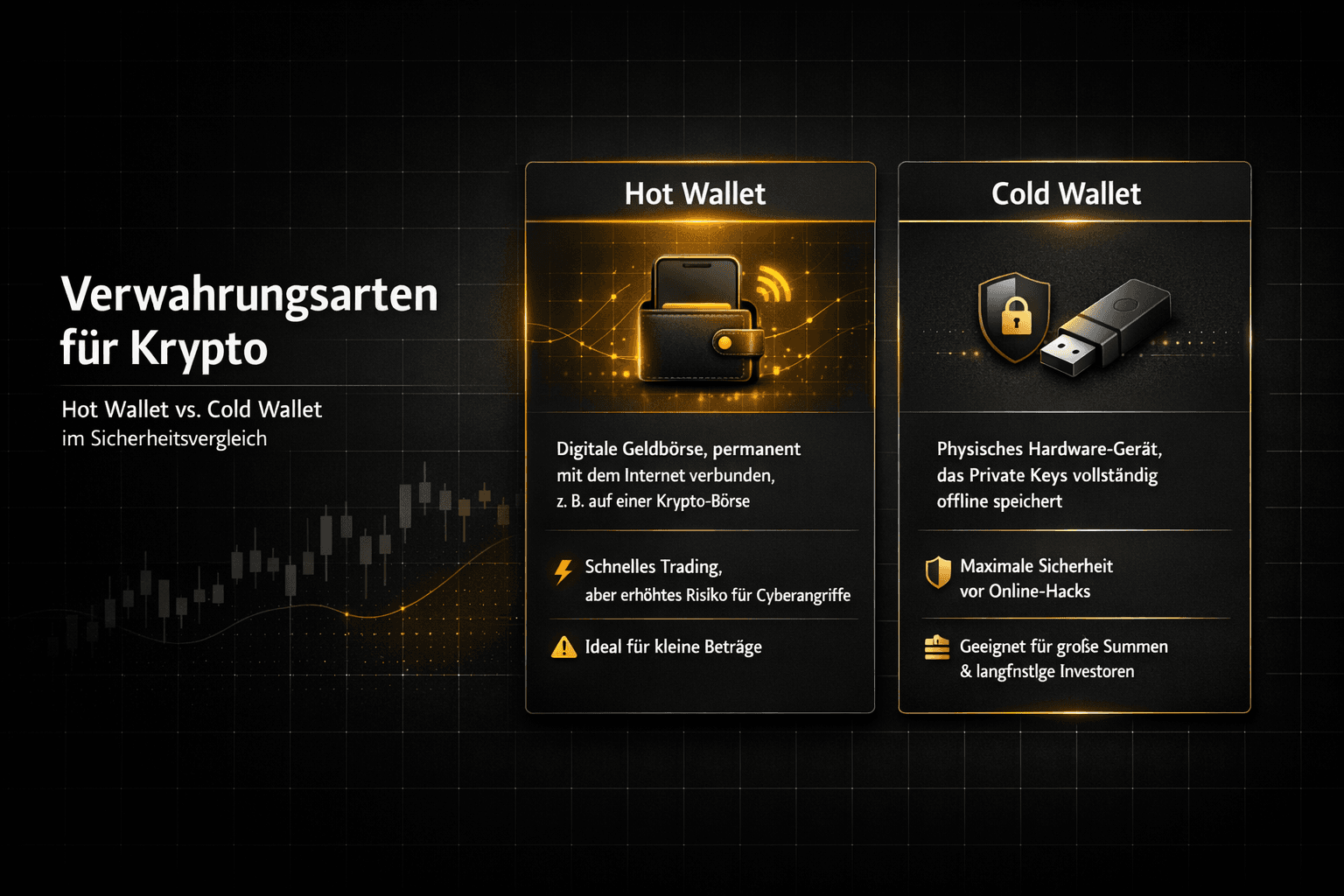
The most important distinction for digital wallets lies in their permanent connection to the internet. Depending on the intended use, this results in different advantages and disadvantages.
Hot wallets (online)
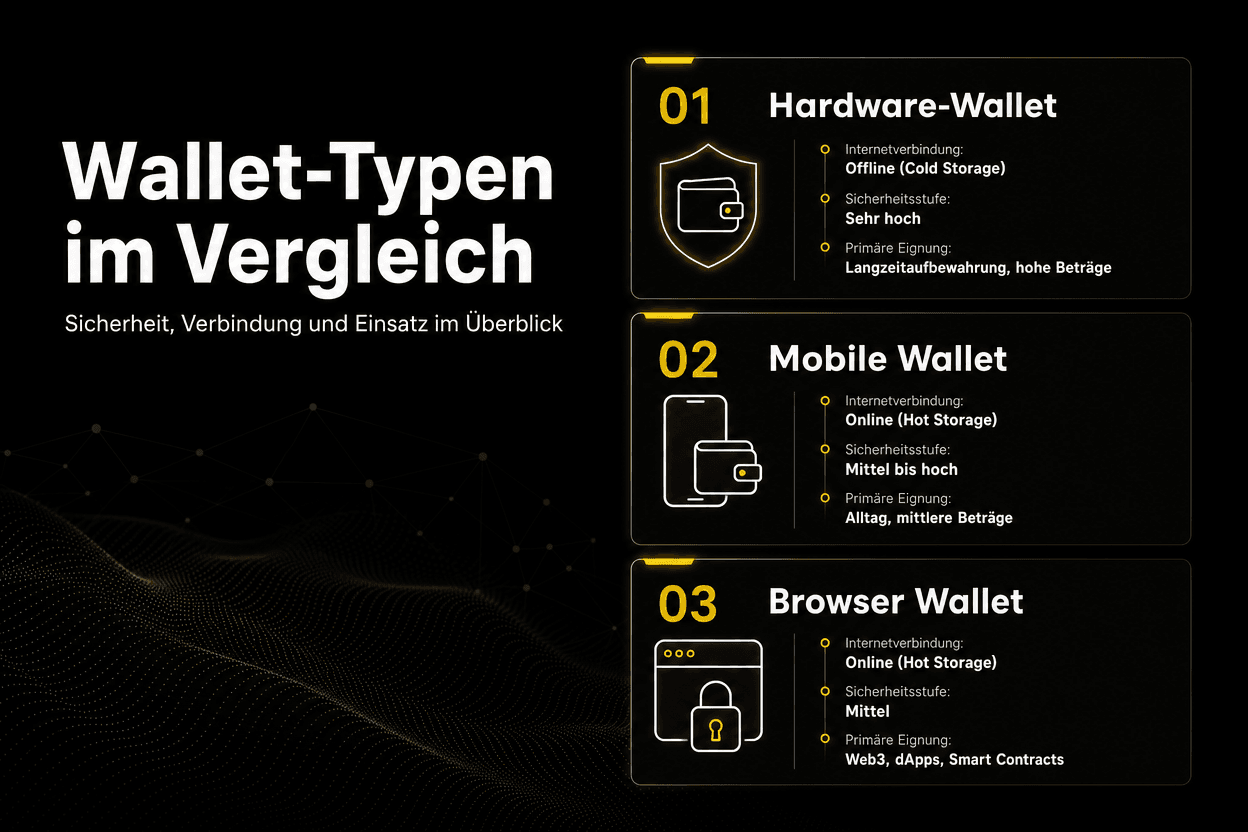
Hot wallets are applications that run on internet-connected devices. They are excellent for daily use, sending amounts quickly, or if users want to actively use decentralized finance (DeFi). Typical examples include mobile apps or browser extensions. Advanced desktop wallets like Electrum also fall into this category. The disadvantage: due to the constant internet connection, there is a theoretical risk from malware or phishing attacks.
Cold wallets (offline)
Physical hardware wallets store the private keys completely offline. They sign transactions securely on an isolated chip within the device. The secret key never comes into contact with an internet-capable, potentially virus-infected computer. A closer look at hardware wallets in comparison shows that this method is considered the undisputed gold standard for long-term storage.
Obsolete offline methods like the printed paper wallet carry too many risks today regarding error-free generation and the durability of the paper, and are no longer recommended for beginners.
Custodial vs. non-custodial: Who really controls your coins?
In addition to technical storage, legal and factual control over the private keys is crucial.
With a custodial wallet (managed wallet), a third-party provider secures the private keys on their own servers. This is user-friendly, as passwords can often be reset easily via email. However, this model carries counterparty risk if the platform files for bankruptcy or is hacked.
With a non-custodial wallet (self-custody), the user holds the keys locally on their own device. True to the central motto Not your keys, not your coins, the owner bears sole responsibility in this model. A third-party provider cannot freeze or seize accounts here, but if the seed phrase is lost, no customer service can help.
Crypto wallet security: 4 best practices for the seed phrase
To effectively secure a wallet, strict rules of conduct must be followed. The biggest security gaps usually arise from human error.
- Never store digitally: The seed phrase must under no circumstances be saved as a screenshot, photo, or in a text file in the cloud. Malware primarily targets these digital repositories.
- Prioritize physical backup: The words must be noted offline and kept in a secure, inaccessible place (e.g., in a safe).
- Protection against elemental damage: For more robust protection, special metal capsules or steel plates that withstand fire and water are recommended.
- Check advanced security systems: Multi-signature wallets require the confirmation of transactions by several independent keys. This eliminates the risk of a single point of failure and is suitable for very large amounts.
Legal foundations: Crypto custody in Germany (MiCAR)
The custody of crypto assets does not operate in a legal gray area in Europe. Professional crypto custody as a service is clearly defined in the German Banking Act (KWG).
Companies acting as custodial wallet providers for their customers require an explicit BaFin crypto license and must comply with the requirements of the European MiCAR (Markets in Crypto-Assets Regulation) directive. For private users who use a non-custodial wallet for their own holdings, these licensing requirements do not apply. Those who manage their own assets should still inform themselves about crypto taxes in Germany to correctly declare profits from transactions.
Conclusion
A fundamental understanding of a crypto wallet is essential to use digital currencies confidently and without loss. While hot wallets offer the necessary flexibility for daily trading and Web3 applications, cold wallets (hardware) represent the only reliable solution for the long-term protection of large assets. Regardless of the chosen system, the absolute secrecy of the seed phrase remains the most important basic rule in the entire crypto world. Anyone who has internalized the functions of private and public keys takes full responsibility and sovereignty over their own digital finances.
Frequently asked questions about crypto wallets (FAQ)
Are my cryptocurrencies physically stored on the wallet?
No. Cryptocurrencies are always located as a data entry decentrally on the respective blockchain. The wallet software merely stores the cryptographic keys to access these entries, check balances, and authorize transactions.
What happens if my hardware wallet breaks or is stolen?
As long as you have safely noted your seed phrase offline, your balance is not lost. The backup of the 12 to 24 words can be imported into a new hardware wallet at any time or, in an emergency, into a compatible software wallet to restore full access. The old, lost hardware wallet is usually protected against unauthorized use by a strong PIN.
Why shouldn't I just take a photo of my seed phrase?
Smartphones are permanently connected to the internet and usually synchronize photos automatically with iCloud, Google Drive, or other cloud services. A photo of the seed phrase ends up unencrypted on these servers and can be very easily compromised by hacker attacks, data leaks, or malware installed on the smartphone. As soon as someone possesses your seed phrase, they have full control over your assets.
WEEX | Rising star of crypto exchanges in the DACH region
WEEX combines security, innovation, and community with features for beginners and pros:
Discover current trends on WEEX Spot and start now:
Disclaimer – Legal notice from the WEEX exchange
WEEX and its affiliates offer services for the exchange of digital assets, including derivatives and margin trading, only where legal and to eligible users. All content is general information, not financial advice - seek independent advice before trading. Trading cryptocurrencies involves high risk and can lead to a total loss. By using the services of WEEX, you accept all associated risks and terms. Never invest more than you can afford to lose. Further information can be found in our Terms of Use and in the Risk Disclosure.
Follow WEEX on social media:
X: @WEEX_Official Instagram: @WEEX Exchange TikTok: @weex_global YouTube: @WEEX_official Discord: WEEX Community Telegram: WeexGlobal-Gruppe