
How Prediction Market Works?A Complete Guide to Pricing and Mechanisms

Prediction markets are built around a simple idea: people express what they think will happen in the future by trading contracts tied to real-world outcomes. Instead of focusing on asset value, the system reflects probability, where prices move based on how participants interpret new information as it appears.
In recent years, platforms like Polymarket have made this model more visible by allowing users to trade on events such as elections, economic data, and crypto market movements. As more participants enter these systems, prediction markets begin to show how collective expectations form and shift in real time.
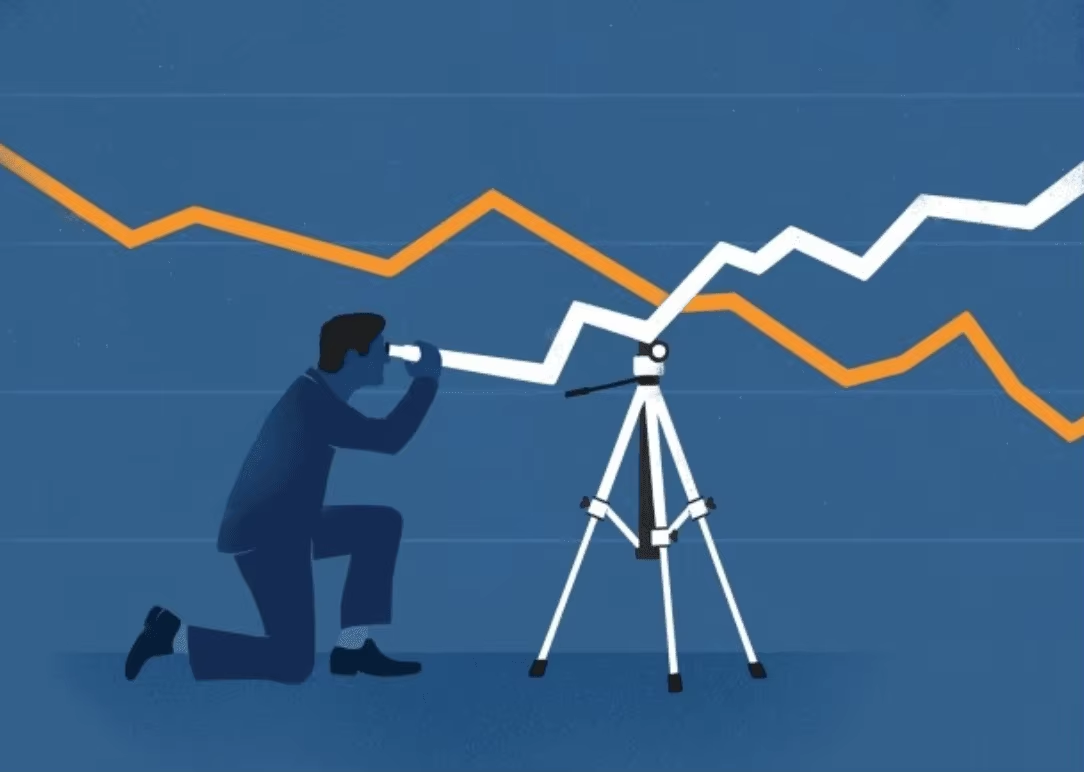
What is a Prediction Market?
Prediction market is a system where users trade contracts based on the outcome of future events. These events can include political elections, economic indicators, financial markets, crypto trends, or global developments.
Unlike traditional markets, prediction market does not focus on asset value. Instead, it focuses on probability. Each contract represents whether a specific outcome will happen.
If the event occurs, the contract settles at a fixed value. If it does not, it expires worthless. This simple structure allows prediction market systems to convert opinions into pricing.
How Prediction Market Works in Practice?
Prediction market works by allowing participants to buy and sell event-based contracts. Prices move based on supply and demand, reflecting the changing probability of an event.
A contract priced at 0.70 means the market assigns a 70% chance of that outcome happening.
When new information enters the system, traders adjust their positions. Some react immediately, while others wait for confirmation before acting. These differences create continuous price movement.
Over time, prediction market pricing becomes a reflection of collective expectations rather than individual forecasts.

Why Prediction Market Matters?
Prediction market matters because it transforms opinions into measurable signals.
Instead of relying on static forecasts or delayed reports, prediction market systems react in real time to new information.
This makes them useful for understanding expectations around financial markets, political events, economic data, and broader global developments.
As participation increases, prediction market signals often become more refined and responsive.
Prediction Market as an Information Layer
Prediction market functions as a live information layer where thousands of individual judgments are combined into one price signal.
Rather than relying on a single authority or model, prediction market aggregates distributed knowledge across participants.
However, accuracy depends on participation and liquidity. More active markets tend to produce more stable and reliable probability signals.

How Polymarket Fits Into Prediction Market Systems?
Polymarket is one of the most widely recognized platforms in the prediction market space.
It allows users to trade on real-world outcomes such as elections, inflation data, crypto trends, and geopolitical events.
Unlike traditional financial platforms, Polymarket focuses entirely on outcomes rather than asset ownership.
Its growth has helped bring prediction market concepts into mainstream discussions, especially within crypto and digital asset communities.
Polymarket and Real-Time Market Behavior
Polymarket is often used as a reference point for how prediction market systems behave under real conditions.
When new information appears, prices adjust quickly as traders reposition based on updated expectations.
In many cases, Polymarket reflects shifts in sentiment faster than traditional media coverage, since participants respond directly to information flow.
This makes it a useful example of how prediction market logic works in practice.

How Participants Behave in Prediction Market Systems
Prediction market behavior is shaped by how participants process information and respond to changing conditions.
When new events appear, some participants act quickly based on initial interpretation, while others take more time to reassess before making decisions. This difference in timing can lead to short-term price fluctuations.
Trading decisions are also influenced by how individuals evaluate uncertainty and decide how much risk they are willing to take in a given situation. As a result, market activity can shift depending on overall confidence levels.
Limitations of Prediction Market Systems
Despite its strengths, prediction market is not without limitations.
Some markets suffer from low participation, which can reduce accuracy. Others may experience short-term distortions caused by speculative trading.
Regulatory differences across regions can also affect how prediction market platforms operate.
Because of this, prediction market results should always be interpreted as probabilities rather than certainties.
Future of Prediction Market
The future of prediction market is closely linked to how global information systems evolve.
As more participants join prediction market platforms, pricing becomes more efficient and representative of collective expectations.
Blockchain infrastructure may further improve transparency and settlement reliability.
Platforms like Polymarket suggest that prediction market systems may continue expanding into mainstream decision-making environments.
Over time, prediction market could become a standard layer for understanding uncertainty in both financial and non-financial contexts.
Conclusion
Prediction market represents a shift in how information is priced and interpreted.
Instead of relying on static forecasts, prediction market systems continuously update based on collective behavior and real incentives.
Polymarket has played an important role in demonstrating how prediction market works in real environments.
As adoption grows, prediction market is likely to become a more important tool for understanding expectations and future outcomes across global markets.
FAQ
1. What is a prediction market?
A prediction market is a system where users trade contracts based on future outcomes.
2. How does prediction market work?
It works by pricing probabilities through buying and selling event-based contracts.
3. Why is Polymarket important?
Polymarket is one of the most well-known platforms that shows how prediction market works in real-world events.
4. Can prediction market be accurate?
It can be accurate when liquidity is strong and participants are well-informed, but it should still be treated as probabilistic.
5. What affects prediction market prices?
Prices are affected by new information, participation levels, and liquidity conditions
You may also like

What Is a Good APR in Crypto? What Investors Should Know
APR in crypto tells you the yearly rate you might earn from staking, lending, or liquidity programs before…
APR vs APY Explained with Simple Examples
APR and APY look similar, but they measure yield differently. APR shows a yearly rate without compounding; APY…

How to Calculate APR in Crypto Investments? What Investors Should Know
APR shows the yearly rate you earn or pay before compounding. In crypto, APR appears on staking dashboards,…

Is BlockDAG a Good Investment in 2026?
BlockDAG (BDAG) promises a faster base layer by using a directed acyclic graph instead of a single-chain design.…

What is Amkor Technology Tokenized Stock (Ondo)(AMKRON) Coin? A comprehensive guide you don’t want to miss
Amkor Technology Tokenized Stock (Ondo) (ticker: AMKRON) is a tokenized representation of Amkor Technology, Inc. equity designed for…

Why Is WLFI Trending? Key Factors Explained
WLFI is trending because it sits at the crossroads of politics, DeFi product rollouts, and fast-moving crypto liquidity.…

What Is BlockDAG? Everything You Need to Know
BlockDAG, often written as blokdag in search queries, is a blockchain design that replaces the single-chain structure with…
How to Buy WLFI: A Beginner’s Guide
This guide explains what WLFI is, how its narrative can affect price, and how beginners can buy WLFI…
APR Explained: How Crypto Lending and Staking Rewards Work
APR is the annual percentage rate you earn or pay without compounding. In crypto, APR shows how much…
What Is APR in Crypto? A Beginner’s Guide
This guide explains what apr means in crypto, how it differs from apy, where you see apr in…
What Is DEXTools? A Beginner’s Guide to Crypto Charting
DEXTools is a real-time analytics platform that helps you research tokens trading on decentralized exchanges like Uniswap and…

How to Use DEXTools to Find New Crypto Tokens
DEXTools helps you spot new crypto tokens on DEXs, read on-chain data in real time, and avoid common…

Trump’s Tariff Policies Explained: What They Mean for Markets and Crypto
This article breaks down how a tariff works, why talk of broad Trump tariff policies matters for inflation,…
How Do Tariffs Affect Bitcoin and Cryptocurrency Markets?
Tariff changes ripple through currencies, inflation, supply chains, and risk appetite—all of which feed into crypto pricing and…
Quant vs Chainlink: Which Project Has More Potential?
Quant (qnt) and Chainlink (LINK) both tackle interoperability, but they approach it from different angles. Chainlink connects blockchains…
Is Quant a Good Investment?Risks and Opportunities Explained
Quant (qnt) targets a big problem: how to connect banks, enterprises, and public blockchains without rebuilding everything. This…
What Is a Tariff? A Beginner’s Guide to Understanding Trade Taxes
Tariffs are taxes charged on imported goods and sometimes on exports. This guide explains what a tariff is,…
What Is Quant (QNT)? Everything You Need to Know
Quant (QNT) is a crypto project focused on interoperability. Its core product, Overledger, aims to connect blockchains and…
What Is a Good APR in Crypto? What Investors Should Know
APR in crypto tells you the yearly rate you might earn from staking, lending, or liquidity programs before…
APR vs APY Explained with Simple Examples
APR and APY look similar, but they measure yield differently. APR shows a yearly rate without compounding; APY…
How to Calculate APR in Crypto Investments? What Investors Should Know
APR shows the yearly rate you earn or pay before compounding. In crypto, APR appears on staking dashboards,…
Is BlockDAG a Good Investment in 2026?
BlockDAG (BDAG) promises a faster base layer by using a directed acyclic graph instead of a single-chain design.…
What is Amkor Technology Tokenized Stock (Ondo)(AMKRON) Coin? A comprehensive guide you don’t want to miss
Amkor Technology Tokenized Stock (Ondo) (ticker: AMKRON) is a tokenized representation of Amkor Technology, Inc. equity designed for…
Why Is WLFI Trending? Key Factors Explained
WLFI is trending because it sits at the crossroads of politics, DeFi product rollouts, and fast-moving crypto liquidity.…


