
LAB Token Surge: Low Float, Insider Risk and What Traders Should Watch


LAB token became one of the most watched crypto movers in early May 2026 after a sharp rally turned a relatively niche trading-infrastructure token into a market-wide talking point. The basic story is simple: LAB is tied to a multi-chain trading terminal, but the recent price action looks less like slow fundamental repricing and more like a low-float momentum event.
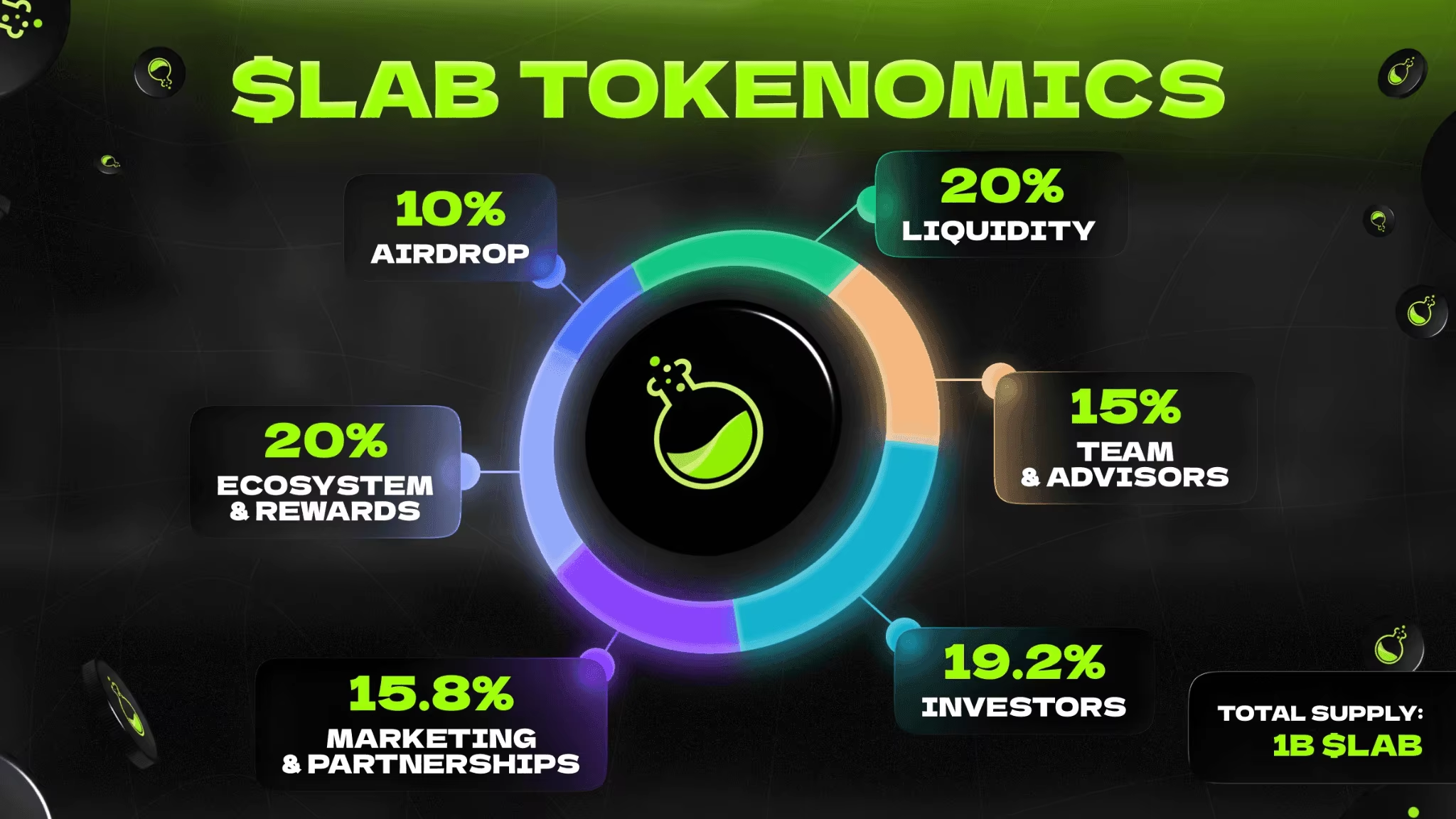
That does not mean the project has no product story. LAB is described as multi-chain trading infrastructure for spot, limit and perpetual trading, with an AI research engine built around execution and market analysis. WEEX’s earlier LAB guide also frames LAB as a utility token for trading access, rewards, staking and governance. The harder question is whether the May 2026 rally reflects durable usage or a supply-constrained squeeze.
What Is LAB Token?
LAB is the native token of a multi-chain trading terminal designed to help users trade across networks such as BNB Chain, Solana, Ethereum and other supported ecosystems from one interface. The product pitch is straightforward: instead of moving between separate DEXs, wallets and execution tools, traders use one terminal for spot trades, limit orders and perpetual markets.
The token’s stated role includes governance, ecosystem participation, rewards and platform-related utility. CoinMarketCap describes LAB as trading infrastructure with an AI research engine, while WEEX lists the LAB contract address as 0x7ec43Cf65F1663F820427C62A5780b8f2E25593A.
For a trader, the product angle matters, but it is not enough on its own. In fast-moving tokens, the supply structure often explains more of the short-term price action than the product narrative.
Why Did LAB Token Surge?
The strongest public explanation is a combination of three forces: a product catalyst, thin float and speculative momentum.
Phemex reported that LAB surged 364% on May 3, 2026, reaching $3.18 at one point and posting more than $253 million in 24-hour trading volume. The article tied the move to the expected LAB mobile app launch, low circulating supply and broader altcoin rotation.

That timing matters. Mobile access can be a real adoption catalyst for a trading terminal, but crypto markets often price these events before the actual usage data arrives. In practice, this creates a “buy the rumor, sell the news” setup: traders chase the catalyst, then the market quickly tests whether new users and real trading volume can support the valuation.
LAB Tokenomics: The Low-Float Problem
The most important LAB token issue is float. Tokenomist reported that only about 76.55 million LAB, or 7.65% of the 1 billion total supply, was unlocked, while CoinMarketCap showed 230.4 million LAB as circulating in its live market data. These different data providers may classify circulating and unlocked supply differently, but both point to the same broad risk: a large share of supply is not freely trading.
| Metric | Reported Data | Why It Matters |
|---|---|---|
| Total supply | 1 billion LAB | Sets the full dilution ceiling |
| CoinMarketCap circulating supply | 230.4 million LAB | Used in live market-cap calculations |
| Tokenomist unlocked supply | ~76.55 million LAB | Highlights the low-float trading risk |
| Team & Advisors allocation | 15% | Potential future sell-side pressure |
| Investors allocation | 19.2% | Early backers may affect supply over time |
| Marketing & Partnerships | 15.8% | Large non-public-market allocation |
Low float can push price up quickly because there are fewer tokens available to absorb demand. The same structure can also make reversals violent. If large holders move tokens to exchanges, the available sell-side supply can change faster than retail traders expect.
Insider Wallet and Market Manipulation Concerns
Another reason traders are cautious is the reported insider-wallet activity around the rally. CryptoRank, citing EmberCN, reported on May 2, 2026 that a wallet suspected of being an insider or market maker accumulated 575,000 LAB at an average price near $0.20, then deposited holdings to Gate.io and KuCoin around the surge, with an estimated profit of $1.13 million.
This does not prove team misconduct by itself. A suspicious wallet can belong to many types of market participants. But the pattern matters: accumulation before a major move, then exchange deposits near peak attention, is exactly the kind of setup traders watch in low-float tokens.
The better reading is not “LAB is definitely manipulated.” The better reading is that LAB token carries market-structure risk. When a token has a small float, large locked allocations and visible whale timing, price can become more sensitive to wallet flows than to normal product updates.
What Traders Should Watch Next
The next phase for LAB depends on whether usage can catch up with valuation. If the mobile app brings real activity, trading fees and recurring users, the market may treat the rally as an early repricing. If not, the rally may behave like a supply squeeze that fades once early buyers take profit.
Key things to monitor:
| Signal | Bullish Reading | Bearish Reading |
|---|---|---|
| Exchange deposits | Low whale inflows | Large holder transfers to CEXs |
| App usage | Rising active traders | Hype without visible adoption |
| Volume quality | Sustained spot demand | Short burst followed by thin liquidity |
| Unlock data | Clear schedule, low immediate pressure | Unclear or accelerating supply release |
| Price reaction | Holds support after catalyst | Sharp sell-the-news reversal |
Traders should also compare LAB’s market cap and FDV against actual platform traction. A high FDV is not automatically bad, but it becomes fragile when most of the valuation depends on future adoption that has not yet been proven.
Market View
LAB token is a classic high-upside, high-reflexivity trade. The narrative is strong enough to attract attention: AI trading tools, multi-chain execution, mobile launch and exchange availability. But the supply setup is equally important. Low float can make the chart look powerful, then punish late entries when liquidity thins or insiders sell into demand.
For anyone tracking LAB, the practical question is not whether the token can pump again. It can. The practical question is whether you can exit size when the market stops rewarding the story. Before trading, check live LAB market data, review the WEEX LAB overview, and understand the risks around float, unlocks and exchange inflows.
FAQ
What is LAB token?
LAB token is the native token of a multi-chain trading terminal that supports spot, limit and perpetual trading, with AI-based research and execution tools.
Why did LAB token surge in May 2026?
The rally appears to have been driven by the expected mobile app launch, low circulating float, speculative demand and broader altcoin momentum.
Is LAB token risky?
Yes. The main risks are low float, high fully diluted valuation, future unlocks, whale activity, volatile liquidity and possible sell-the-news behavior after major announcements.
Does low float make LAB easier to pump?
Low float can amplify price moves because fewer tokens are available for trading. It can also amplify downside when large holders sell or transfer tokens to exchanges.
Where can traders learn more about LAB?
Traders can start with the WEEX LAB guide, live market data pages and token unlock trackers before deciding whether the risk profile fits their strategy.
You may also like

If You Can’t Buy META Stocks, What Are the Trading Alternatives?
If you can’t open a US brokerage or fund one easily, you can still get META (Meta Platforms)…

Can CDOF Reach $0.001? What Investors Should Know
CDOF positions itself as a “digital oil” token on Solana. The project’s own materials describe a model inspired…
Is CDOF Just Hype? What Investors Should Know
CDOF markets itself as a Solana-based “digital oil fund” that borrows ideas from strategic petroleum reserves: supply security,…
Why Is CDOF Trending? What’s Driving the Recent Attention?
CDOF is drawing attention because it blends a hot energy narrative with Solana’s fast, low-fee rails. The project…
Does CDOF Have Real Oil Backing? What Investors Should Know
CDOF markets a “digital oil” story on Solana, borrowing ideas from strategic reserves and on-chain transparency. This guide…

How to Buy CDOF Crypto: A Beginner’s Guide
CDOF is a Solana-based “digital oil” narrative token that references strategic reserves, supply security, and transparent on-chain reporting.…

CDOF vs SAOS: Which Narrative Is Driving More Attention?
This article breaks down two fast-moving crypto narratives—CDOF and SAOS—and shows how to judge where attention, liquidity, and…
CDOF vs Tether Gold: Digital Oil vs Digital Gold Explained
This guide breaks down CDOF (a “digital oil” token concept) versus Tether Gold (XAUT), the leading “digital gold”…

CDOF vs NOAR: What’s the Difference?
This guide explains how to evaluate CDOF vs NOAR side by side without guesswork. You’ll learn what to…
Can NOAR Reach $0.0001? What Investors Should Know
This article breaks down what NOAR is, how its “energy” narrative fits the market, and what would need…

Is NOAR Worth Buying in 2026? Risks and Opportunities Explained
NOAR (Northern Oil Asset Reserve) is a Solana-based token that leans on an oil and energy narrative while…
If You Can’t Buy Adobe (ADBE) Stocks, What Are the Trading Alternatives?
If you want exposure to Adobe (ADBE) but can’t open a US brokerage account, this guide maps your…
Are NFTs Still Worth Buying in 2026? Trends and Risks Explained
NFT markets look different in 2026. Hype cycles have cooled, and utility-focused projects—gaming items, tickets, brand memberships, and…

If You Can’t Buy AAOI Stocks, What Are the Trading Alternatives?
If you’re tracking AAOI but can’t open a US brokerage account, this guide breaks down practical routes to…
If You Can’t Buy Chipotle (CMG) Stocks, What Are the Trading Alternatives?
If you can’t access Chipotle (CMG) on a US broker, you still have ways to trade CMG’s price…
Can SPCX Reach $250 in 2026? SpaceX Price Prediction
KEY TAKEAWAYS SPCX trades near $195 today, based on aggregated tokenized-market trackers that mirror SpaceX’s private valuation dynamics.…
Qualcomm Share Price: 2026 Outlook, Catalysts and Access
The Qualcomm share price trades in the low-$200s in mid-June 2026. See QCOM's price, analyst targets, the June 24 catalyst, and how to trade it.
Is Techsslaash.com Legit? What It Is and What to Watch in 2026
Is Techsslaash.com legit? A 2026 review of the tech/fintech content site, its creator-reward model, traffic red flags, and how to vet it safely.
If You Can’t Buy META Stocks, What Are the Trading Alternatives?
If you can’t open a US brokerage or fund one easily, you can still get META (Meta Platforms)…
Can CDOF Reach $0.001? What Investors Should Know
CDOF positions itself as a “digital oil” token on Solana. The project’s own materials describe a model inspired…
Is CDOF Just Hype? What Investors Should Know
CDOF markets itself as a Solana-based “digital oil fund” that borrows ideas from strategic petroleum reserves: supply security,…
Why Is CDOF Trending? What’s Driving the Recent Attention?
CDOF is drawing attention because it blends a hot energy narrative with Solana’s fast, low-fee rails. The project…
Does CDOF Have Real Oil Backing? What Investors Should Know
CDOF markets a “digital oil” story on Solana, borrowing ideas from strategic reserves and on-chain transparency. This guide…
How to Buy CDOF Crypto: A Beginner’s Guide
CDOF is a Solana-based “digital oil” narrative token that references strategic reserves, supply security, and transparent on-chain reporting.…


