
- Buy Crypto
- Markets
 Futures
- Spot
- Copy Trade
- Earn
- More
a16z Leads $18M Seed Round for Catena Labs, Crypto Industry Bets on Stablecoin AI Payment

On May 20, Circle co-founder Sean Neville announced that his new project, Catena Labs, has successfully completed an $18 million seed round of financing.
This round of financing was led by a16z Crypto, with follow-on investments from Breyer Capital, Coinbase Ventures, and former parent company Circle Ventures, as well as NFL star Tom Brady.
a16z Crypto co-founder and general partner Chris Dixon said: Sean Neville and the Catena team have the expertise to tackle this challenge. They are building financial infrastructure that agents can rely on, and we are excited to support their vision.

AI Opening a Bank?
Catena Labs is a fintech startup that aims to "build an AI-native bank from scratch," focusing on providing tailored financial infrastructure for AI agents, such as smart payments, identity verification, low-cost settlements, etc. The company plans to establish the first fully regulated AI-native financial institution.
The traditional payment rails assume that there is a human at one end of each transaction, resulting in delays such as 3-day ACH transfers and high fees for credit card payments (up to 3%).
All current traditional financial systems are still stuck in the "human-to-human" phase, where the system flags automated activities as fraud, leading to manual review. This slows down the pace of innovation and limits the actual capabilities of AI agents.
Catena wants to enable "AI-to-AI" interactions, allowing your AI assistant to directly help you with account opening, transfers, financial management, and even doing business with other AIs. Software agents should be able to instantly and securely make payments and receive rewards.
It operates in the AI + fintech space, focusing on AI-driven financial services and decentralized identity, a field that is currently being aggressively pursued by big capital.
From USDC to AI Banking: Circle Co-founder Takes Another Swing
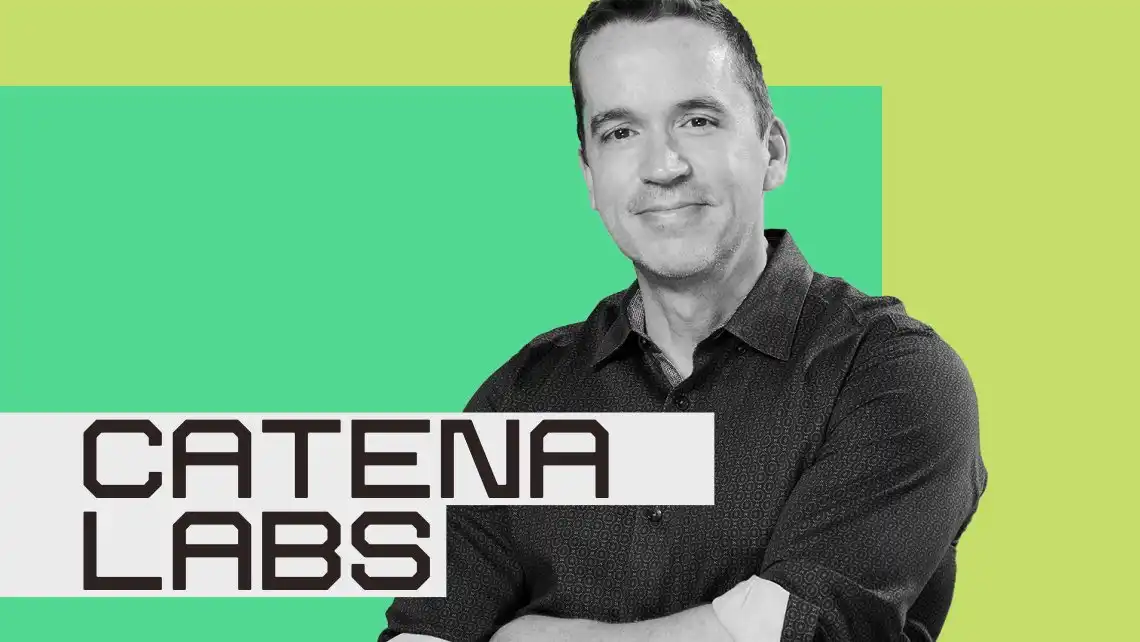
Catena Labs was founded by Circle co-founder Sean Neville and was initially established in 2021 with a focus on exploring AI and decentralized identity. In 2023, it formally shifted its focus to building an "AI-native financial system."
Neville was formerly an engineer at Adobe and a co-founder of Circle Internet Group, Inc., leading the design and development of USDC. By April 2025, Circle had submitted an IPO application with a valuation of approximately $5 billion.
In early 2020, Neville stepped down from his operational role at Circle but remained a board member. After leaving Circle, he delved into AI, firmly believing that we are entering an AI-native web era, which also became the foundation of Catena Labs.
In 2021, Neville, along with Matt Venables (Co-founder and CTO of Catena Labs), established a technology lab to explore emerging technologies such as AI and decentralized identity. Catena Labs was born out of this vision.
Currently, Catena Labs has only 9 members, all from world-class teams at Meta, Google, Jump Crypto, and Protocol Labs. Their official website allows direct submission of resumes, indicating an active effort to recruit talent globally.
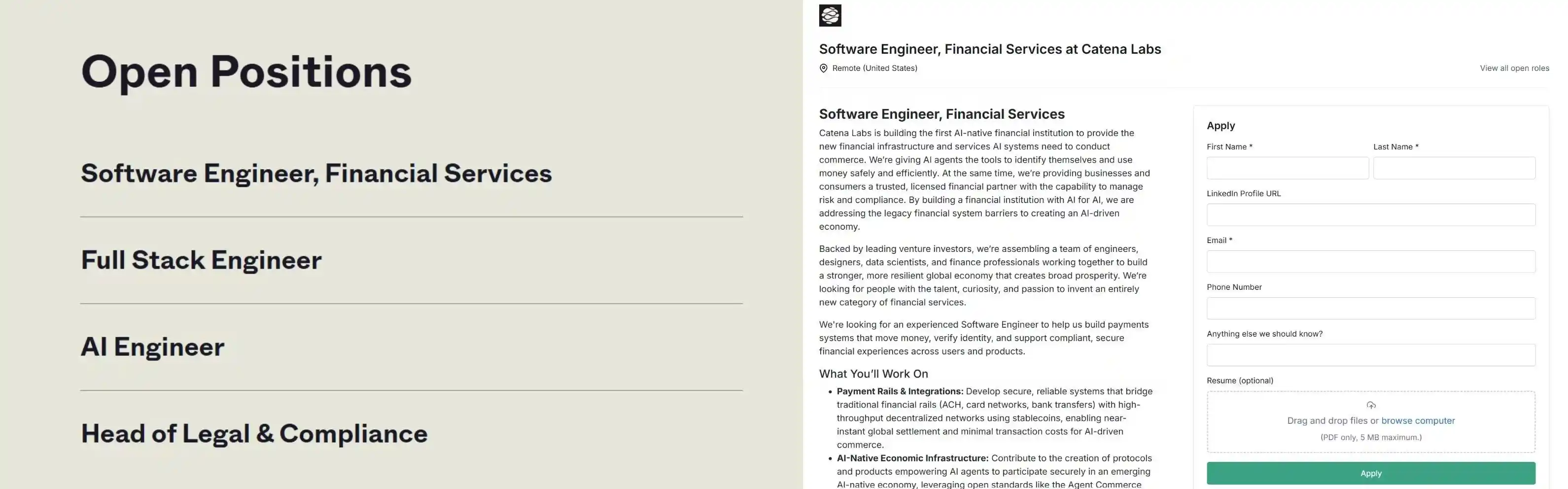
Currently, Catena Labs has developed an open-source protocol that allows AI to act as a user's "bank representative." The company explicitly states that it is not issuing cryptocurrency or stablecoins at the moment, but investors will receive equity with accompanying token warrants.
Redefining the Financial System with AI
Jim Breyer, Founder and CEO of Breyer Capital, said, "Neville is uniquely qualified to lead the creation of the first AI-native bank. Integrating AI into commerce requires rebuilding the financial infrastructure. Legacy systems do not always keep up, which is why Catena is so intriguing."
Furthermore, Neville predicts that future financial transactions will be entirely executed by AI agents. The project also envisions AI not only engaging in chat and drawing but also actively "earning, spending, and managing money," becoming independent economic participants.
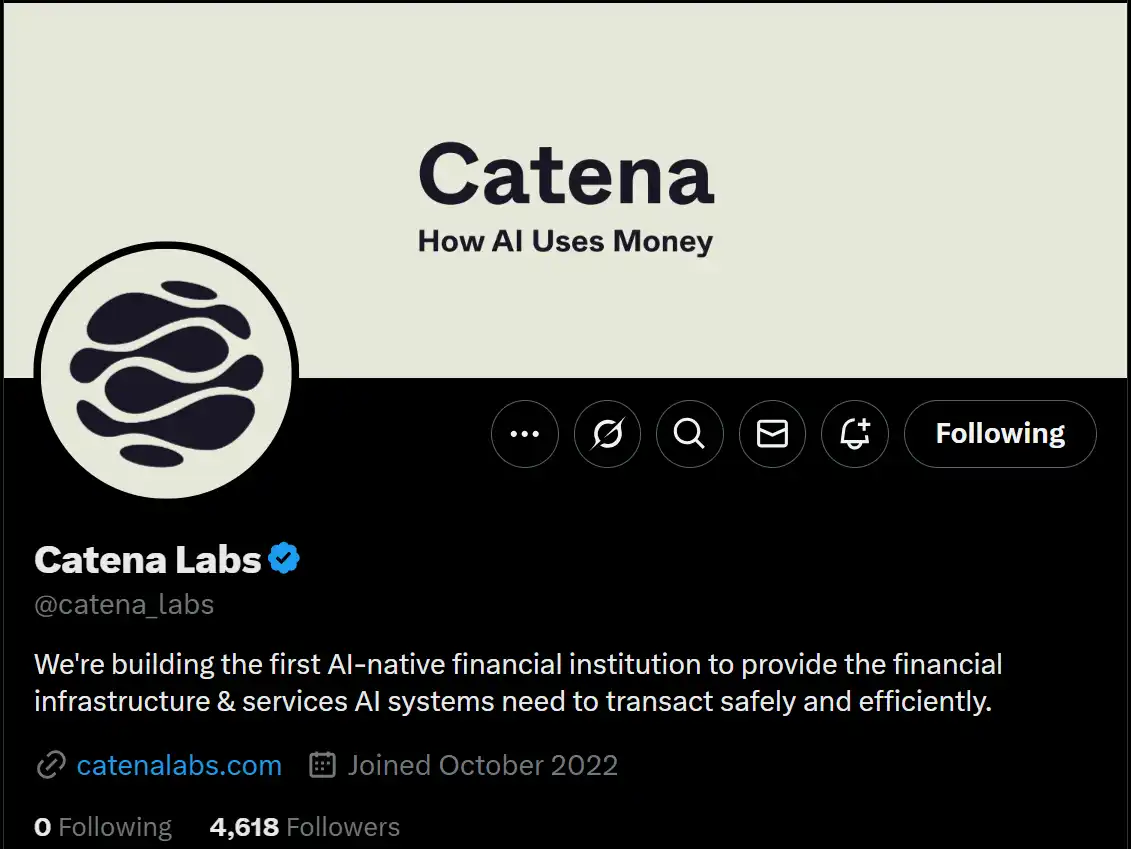
While Catena Labs has not yet launched a coin or product, they have just open-sourced the Agent Commerce Kit (ACK), which is a financial protocol framework designed specifically for AI, with a focus on two key aspects—AI agent identity verification and automatic payments.
What Catena Labs aims to address is the various unfriendliness of traditional finance towards AI—slow payments, high costs, and lack of automation compatibility. ACK represents their first step: using stablecoins for fast settlements, employing standardized protocols for identity verification, and ultimately enabling AI to have its own "bank account" and "financial services" just like a human.
Currently, they have not disclosed specific product plans but have mentioned that in the future, they will open up through APIs and other means to developers and businesses to build an AI-driven financial ecosystem. Although still in development, judging from the direction of the ACK framework, their goal is to rewrite the underlying logic of the entire financial system with AI.
Summary
Catena Labs is a highly promising early-stage project operating in the hot intersection of AI and FinTech. Co-founders Sean Neville and Matt Venables, leveraging their successful experiences at Circle and USDC, lead a lean team of only 9 individuals. They have secured an $18 million seed funding round led by a16z.
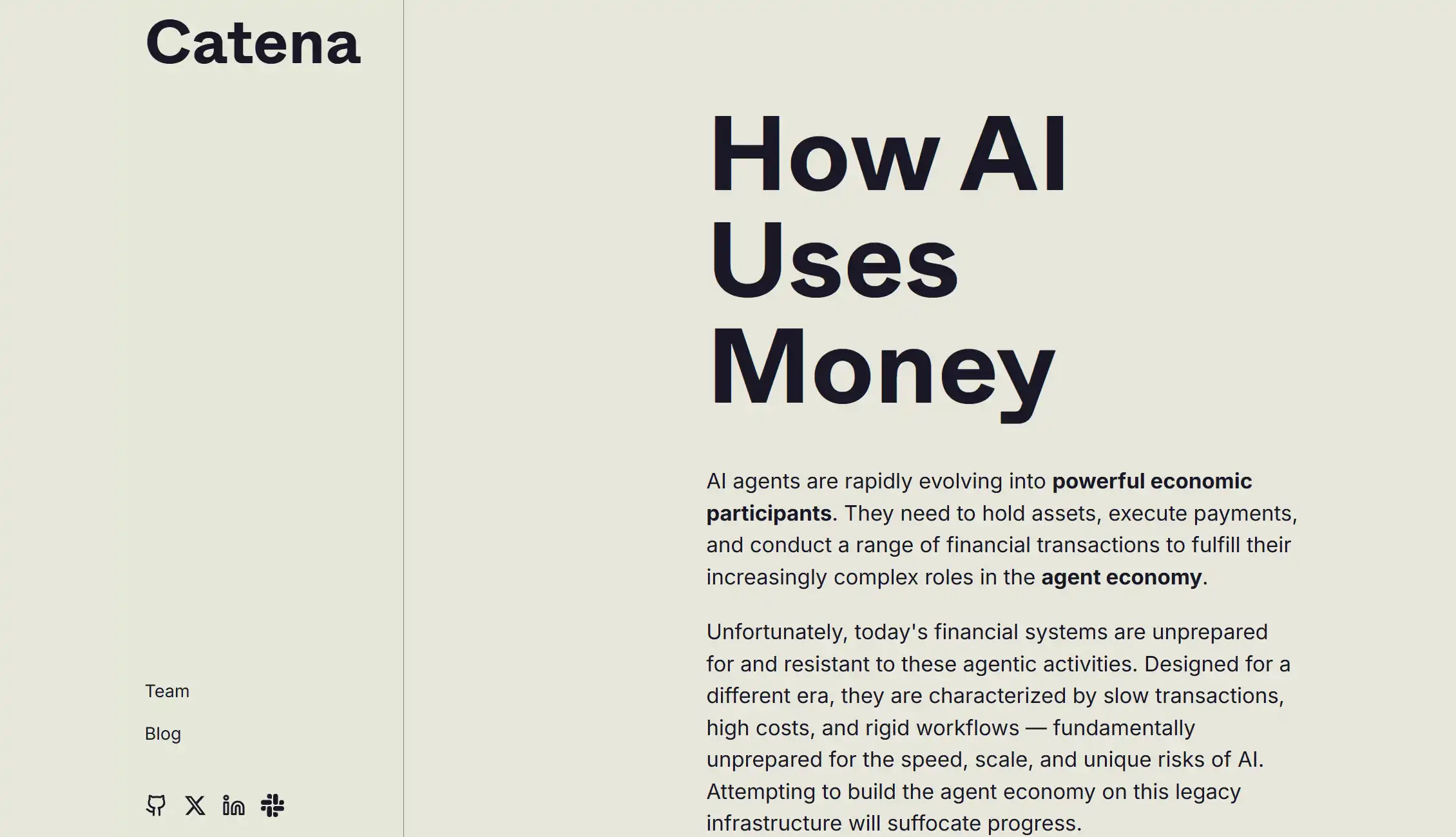
Their AI-native vision, open-source protocol (ACK), and flexible integration with stablecoins showcase their industry foresight. Although specific products have not yet been launched, their strong funding background and industry support give them significant competitiveness in the AI-driven financial sector.
In the future, Catena Labs' development will depend on the speed of product deployment and the effectiveness of ecosystem building.
You may also like

Mining Companies' Great Migration: Some Have Already Secured $12.8 Billion in AI Orders
What Is Vibe Coding? How AI Is Changing Web3 & Crypto Development
What is vibe coding? Learn how AI coding tools are lowering the barrier to Web3 development and enabling anyone to build crypto applications.

The parent company of the New York Stock Exchange strategically invests in OKX: The intentions behind the $25 billion valuation

WEEX P2P update: Country/region restrictions for ad posting
To improve ad security and matching accuracy, WEEX P2P now allows advertisers to restrict who can trade with their ads based on country or region. Advertisers can select preferred counterparty locations for a safer, smoother trading experience.
I. Overview
When publishing P2P ads, advertisers can now set the following:
Allow only counterparties from selected countries or regions to trade with your ads.
With this feature, you can:
Target specific user groups more precisely.Reduce cross-region trading risks.Improve order matching quality.
II. Applicable scenarios
The following are some common scenarios:
Restrict payment methods: Limit orders to users in your country using supported local banks or wallets.Risk control: Avoid trading with users from high-risk regions.Operational strategy: Tailor ads to specific markets.
III. How to get started
On the ad posting page, find "Trading requirements":
Select "Trade with users from selected countries or regions only".Then select the countries or regions to add to the allowlist.Use the search box to quickly find a country or region.Once your settings are complete, submit the ad to apply the restrictions.
When an advertiser enables the "Country/Region Restriction" feature, users who do not meet the criteria will be blocked when placing an order and will see the following prompt:
If you encounter this issue when placing an order as a regular user, try the following solutions.
Choose another ad: Select ads that do not restrict your country/region, or ads that allow users from your location.Show local ads only: Prioritize ads available in the same country as your identity verification.
IV. Benefits
Compared with ads without country/region restrictions, this feature provides the following improvements.
Aspect
Improvement
Trading security
Reduces abnormal orders and fraud risk
Conversion efficiency
Matches ads with more relevant users
Order completion rate
Reduces failures caused by incompatible payment methods
V. FAQ
Q1: Why are some users not able to place orders on my ad?
A1: Their country or region may not be included in your allowlist.
Q2: Can I select multiple countries or regions when setting the restriction?
A2: Yes, multiple selections are supported.
Q3: Can I edit my published ads?
A3: Yes. You can edit your ad in the "My Ads" list. Changes will take effect immediately after saving.

What are the key highlights of this year's Ethereum's most important upgrade, the Glamsterdam upgrade?

March 6 Key Market Update You Can't Miss! | Alpha Morning Report

Sell Nvidia, Buy Power Plant: 27-Year-Old AI Investor Earns $5 Billion in One Year
The $24 Million Heist Behind It: The Most Dangerous Vulnerability in the Crypto World is Actually Human

Justin Sun Lawsuit Dismissed, BlackRock Bullish on Tokenization, What Is the English-Speaking Community Paying Attention To?

Morning News | NYSE parent company invests in OKX; Morgan Stanley provides $500 million loan to Core Scientific; Western Union partners with Crossmint to launch stablecoin USDPT

These former crypto builders have transitioned to the hottest AI projects globally

Ethereum Overhaul 2026 Blueprint, this time to abandon "gradualism"
What Is OpenClaw? How AI Agents Could Change Crypto Exchange Trading
OpenClaw is a rapidly growing open-source AI agent that can autonomously execute tasks and interact with software, including connecting to crypto exchanges through APIs to analyze markets and automate trading strategies. While this creates new opportunities for smarter trading, it also introduces security and operational risks. Through this article, WEEX aims to help users better understand the potential and risks of AI trading agents so they can explore new technologies while trading more safely and responsibly.
Ethereum 2029 Strawmap Guide: Ultra-Fast Consensus, Native Privacy, and the "Acceleration Variables" Brought by AI

Altcoin ETF Surge: SOL and XRP Inflows Total $23 Million as Institutions Diversify
Key Takeaways Institutional interest in altcoin ETFs is expanding, with SOL and XRP showing significant inflows on March…
Vitalik Drops Ethereum Endgame Bombshell: ETH USD to $3,000?
Key Takeaways Vitalik Buterin introduces the “Sanctuary Tech” manifesto to address Ethereum’s non-financial limitations. A current lack of…
Exclusive: Yuliya Barabash Predicts the Most Regulated Could Be the Biggest Crypto Winners
Key Takeaways The aftermath of FTX and Celsius collapses has ushered a new regulatory era, reshaping the crypto…

iPhone Crypto Wallets Under Threat from State-Grade Malware
Key Takeaways: The Coruna exploit kit exploits 23 iOS vulnerabilities, threatening iPhone users’ crypto wallets. Initially state-level surveillance,…
Mining Companies' Great Migration: Some Have Already Secured $12.8 Billion in AI Orders
What Is Vibe Coding? How AI Is Changing Web3 & Crypto Development
What is vibe coding? Learn how AI coding tools are lowering the barrier to Web3 development and enabling anyone to build crypto applications.
The parent company of the New York Stock Exchange strategically invests in OKX: The intentions behind the $25 billion valuation
WEEX P2P update: Country/region restrictions for ad posting
To improve ad security and matching accuracy, WEEX P2P now allows advertisers to restrict who can trade with their ads based on country or region. Advertisers can select preferred counterparty locations for a safer, smoother trading experience.
I. Overview
When publishing P2P ads, advertisers can now set the following:
Allow only counterparties from selected countries or regions to trade with your ads.
With this feature, you can:
Target specific user groups more precisely.Reduce cross-region trading risks.Improve order matching quality.
II. Applicable scenarios
The following are some common scenarios:
Restrict payment methods: Limit orders to users in your country using supported local banks or wallets.Risk control: Avoid trading with users from high-risk regions.Operational strategy: Tailor ads to specific markets.
III. How to get started
On the ad posting page, find "Trading requirements":
Select "Trade with users from selected countries or regions only".Then select the countries or regions to add to the allowlist.Use the search box to quickly find a country or region.Once your settings are complete, submit the ad to apply the restrictions.
When an advertiser enables the "Country/Region Restriction" feature, users who do not meet the criteria will be blocked when placing an order and will see the following prompt:
If you encounter this issue when placing an order as a regular user, try the following solutions.
Choose another ad: Select ads that do not restrict your country/region, or ads that allow users from your location.Show local ads only: Prioritize ads available in the same country as your identity verification.
IV. Benefits
Compared with ads without country/region restrictions, this feature provides the following improvements.
Aspect
Improvement
Trading security
Reduces abnormal orders and fraud risk
Conversion efficiency
Matches ads with more relevant users
Order completion rate
Reduces failures caused by incompatible payment methods
V. FAQ
Q1: Why are some users not able to place orders on my ad?
A1: Their country or region may not be included in your allowlist.
Q2: Can I select multiple countries or regions when setting the restriction?
A2: Yes, multiple selections are supported.
Q3: Can I edit my published ads?
A3: Yes. You can edit your ad in the "My Ads" list. Changes will take effect immediately after saving.


 App
App